Oliver Twist, Part 3 of 3: Nancy's Last Loyalty
Dickens · Part 3 of 3: Nancy's Last Loyalty
Oliver Twist
Charles Dickens (1838) · Chapters 36-53
Nancy risks everything to help Oliver, the gang takes terrible revenge, and Mr Brownlow uncovers the secret of Oliver's birth.
The story so far: Oliver escaped the workhouse and London's thieves, was seized back by Fagin's gang, and was wounded in a failed burglary. The kindly Maylies took him in, while the sinister Monks sought to ruin him.
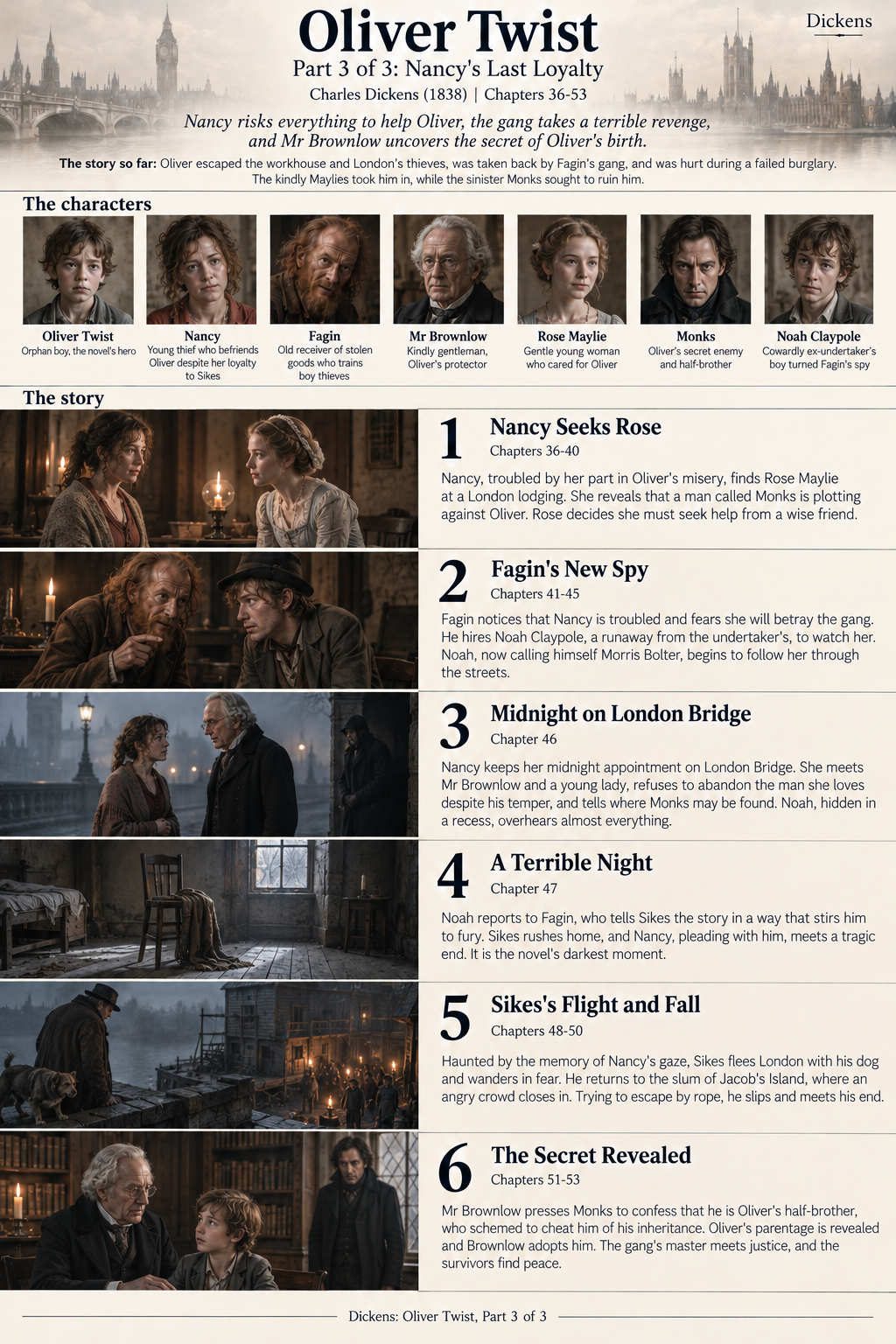
By now Oliver has been dragged back into Fagin's den, wounded in a bungled burglary, and then sheltered at Chertsey by Mrs Maylie and her niece Rose. Meanwhile a sinister stranger, Monks, has been plotting to destroy him. This final part opens with Nancy, the young thief who has pitied Oliver, finding Rose at a London lodging and telling her that Monks is hunting the boy.
Fagin soon senses that Nancy is changing and, fearing betrayal, hires Noah Claypole, the runaway from the undertaker's who once bullied Oliver, to follow her. On Sunday night Nancy keeps her midnight appointment on London Bridge, where she meets Rose and Mr Brownlow. She refuses all offers of a new life, saying she cannot leave Sikes, but she describes Monks and where he can be found. Noah, hiding in a recess, overhears nearly every word and carries it to Fagin.
Fagin twists the tale to rouse Sikes, and Sikes rushes home to beat Nancy to death with a club. Dickens does not spare the reader. Sikes then flees with his dog, but he cannot escape the memory of her eyes. After a feverish journey he returns to London and takes refuge at Jacob's Island, a rotting slum. A crowd surrounds the house. He tries to lower himself by rope, the noose slips round his neck, and he dies.
Meanwhile Brownlow confronts Monks, who is really Edward Leeford. Monks confesses that he is Oliver's half-brother. Their father, Edwin Leeford, loved Agnes Fleming, who died giving birth to Oliver. Monks and his mother destroyed their father's will to cheat the child of his share. Agnes was Rose's elder sister, so Rose is Oliver's aunt. Brownlow adopts Oliver. Fagin is captured and hanged after a last night of terror, and the survivors settle in peace.
The motives are starkly drawn. Nancy acts from conscience and pity, though she stays loyal to a man who despises her. Sikes kills out of rage and a fear of exposure. Fagin, whom critics have also read as an unfortunate stereotype, manipulates others to protect himself. Oliver changes little, but his goodness is finally rewarded.
The part develops the novel's central themes: the corrupting power of poverty and crime, the survival of goodness amid squalor, and the tangled force of coincidence and fate. Many readers find the neat revelations contrived, though others see them as part of the book's moral design.
The lessons are plain. Conscience can survive in the most degraded lives, and loyalty given to the wrong person can destroy us. Guilt cannot be outrun, and kindness, though slow, can undo cruelty.
Further reading
- Charles Dickens (ed. Philip Horne), Oliver Twist (Penguin Classics) (2003)
- Peter Ackroyd, Dickens (1990)
- Claire Tomalin, Charles Dickens: A Life (2011)