A Christmas Carol, Part 3 of 3: The Future and the Morning
Dickens · Part 3 of 3: The Future and the Morning
A Christmas Carol
Charles Dickens (1843) · Staves 4-5
A silent spirit shows Scrooge a possible future, and he wakes determined to live differently.
The story so far: After Marley's warning, Scrooge has revisited his past and seen how others spend Christmas. The Cratchits' love, despite their poverty, has begun to unsettle him.
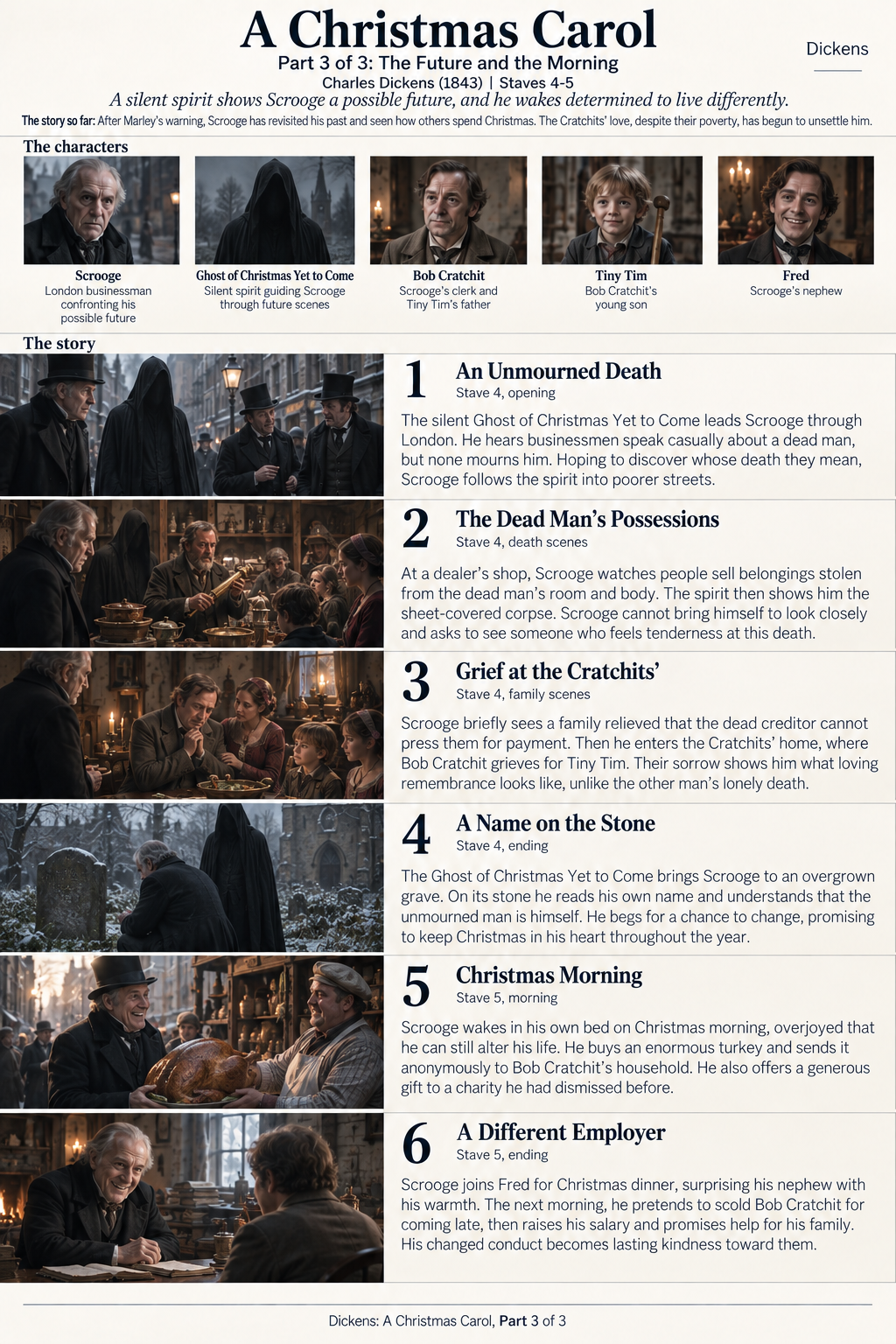
Ebenezer Scrooge began Christmas Eve as a man who valued money above fellowship. Marley's ghost warned him that his way of life had consequences, and two visiting spirits showed him his past and the Christmas being celebrated around him. Now the last spirit arrives. The Ghost of Christmas Yet to Come is silent and concealed in a dark robe. Scrooge fears it, but asks to learn what it has come to teach.
In London, Scrooge hears businessmen discussing someone's death with little concern. Others wonder whether anyone will attend the funeral. The spirit takes him to a dealer's shop, where people sell possessions taken from the dead man's room and even from his body. Scrooge recoils at their conduct, but he does not yet know whose things they are. In a lonely room he sees a corpse beneath a sheet and cannot bring himself to lift it. When he asks the spirit to show him anyone moved by this death, it first shows him a couple who feel relief: the dead man was their creditor, and they hope for more time to pay what they owe.
Scrooge asks instead to see tenderness connected with a death. At the Cratchits' home, the family is mourning Tiny Tim. Bob Cratchit has visited the boy's grave and speaks of him with affection. The household is quieter than when Scrooge last saw it, but its members care for one another. Their grief contrasts with the indifference surrounding the other death. Scrooge then looks for his own future self, whom he has not seen in any of these visions. The spirit leads him to an overgrown grave. There, he reads his name on the stone and understands that he is the man whose death brought no sorrow. He pleads that the future can change and promises to honour Christmas throughout the year.
Scrooge wakes in his own bed on Christmas morning. He is delighted to find that he has not missed the day. He buys a large turkey and has it sent to Bob Cratchit's home without naming himself. He also promises a substantial donation to a charity he had refused to help the day before. Out walking, he greets people warmly. Then he visits his nephew Fred and joins the Christmas dinner he had earlier rejected. The following morning, when Bob arrives late to work, Scrooge begins as though he means to reprimand him. Instead, he raises Bob's salary and promises to help his family. Dickens closes by saying that Tiny Tim does not die and that Scrooge keeps his word.
The spirit's visions do not make Scrooge fear death alone. They show him the difference between being remembered with love and leaving behind only possessions and unpaid debts. Dickens gives him a chance to act on what he has learned: generosity becomes a gift, help for a struggling household and a warmer welcome for his family. The ending asks readers to consider how their ordinary conduct shapes other lives, and to remember that changing it requires more than a moment of regret.
Further reading
- Charles Dickens, A Christmas Carol and Other Christmas Writings (2003)
- Michael Slater, Charles Dickens (2009)
- Peter Ackroyd, Dickens (1990)