Sense and Sensibility, Part 1 of 3: Loss, Love and a Secret
Austen · Part 1 of 3: Loss, Love and a Secret
Sense and Sensibility
Jane Austen (1811) · Volume 1, Chapters 1-22
Cast out of Norland, the Dashwood women settle in Devonshire, where Marianne meets Willoughby and Elinor learns a painful secret about Edward.
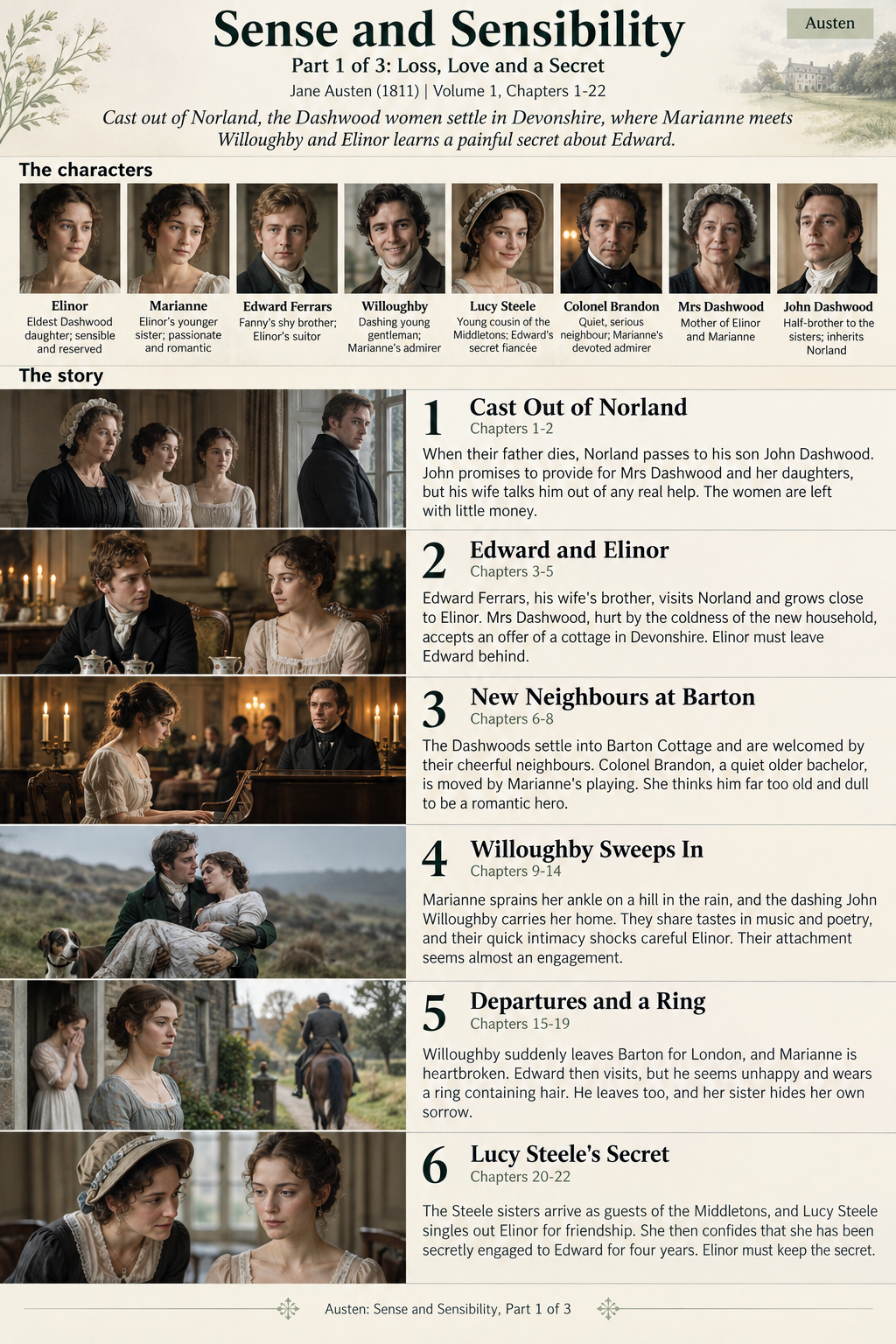
Sense and Sensibility opens with a family losing its footing. The Dashwoods have owned Norland Park in Sussex for generations. When Henry Dashwood dies, the estate passes to his son John by his first marriage, and his second wife and their three daughters, Elinor, Marianne and the young Margaret, are left with a modest income. John Dashwood promises his dying father to look after them. His wife Fanny soon argues him down from generosity to almost nothing.
Fanny's brother, Edward Ferrars, visits Norland and soon becomes attached to the eldest daughter, Elinor. He is modest, awkward and unambitious, and his family expects far more of him. Mrs Dashwood, tired of Fanny's coldness, accepts the offer of a cottage on the Devonshire estate of a kind relative, Sir John Middleton. The women leave Norland, and Elinor leaves Edward without any understanding between them.
At Barton, the neighbours are friendly, if noisy. Colonel Brandon, a reserved man of about thirty-five, admires Marianne at once. She, aged sixteen, thinks him almost too old to love at all. Then she sprains her ankle on a rain-swept hill, and the handsome John Willoughby carries her home. He shares her taste in poetry, music and spontaneous feeling, and the two fall rapidly in love. Elinor, who values caution, is uneasy at how openly they behave. She persuades Marianne to refuse a horse Willoughby offers, since the family cannot afford to keep it. Everyone expects an engagement.
Then Willoughby is suddenly called away to London by his wealthy relative, and Marianne collapses in grief. Soon after, Edward arrives, but seems low-spirited. Elinor notices a ring on his finger with a lock of hair, and she is left to wonder whose it is. He leaves, and Elinor resolves to bear her sorrow quietly. The Steele sisters then come to stay at the Middletons'. Lucy Steele makes a friend of Elinor and finally confides that she has been secretly engaged to Edward for four years. She has the proof to show Elinor, and she demands silence.
The central contrast is between Elinor's self-command and Marianne's open feeling. Austen does not simply praise one over the other. Marianne's honesty is attractive, but it makes her careless of propriety and prudence. Elinor's restraint protects others, but it forces her to suffer alone. Money and inheritance also shape every choice, from who gets Norland to who may marry whom. Readers have long debated whether Austen favours sense over sensibility or sees the need for both.
A reader can take away several lessons. Promises made in grief are easily broken by self-interest, so generosity needs more than good intentions. Appearances and charm are not proof of character, and unspoken understandings can mislead. Finally, discretion has a cost: Elinor keeps a promise at the price of loneliness, and we are left wondering how long she can bear it.
Further reading
- Jane Austen (ed. Ros Ballaster), Sense and Sensibility (Penguin Classics) (2003)
- Claudia L. Johnson, Jane Austen: Women, Politics, and the Novel (1988)
- Claire Tomalin, Jane Austen: A Life (1997)