
The Reflecting Pool Is Now Accepting Competing Explanations
Internal documents, public statements, and a water feature that no longer agrees with either.
There is a certain kind of Washington story that arrives already over-explained.
It begins with a renovation, continues with a press release, and ends—inevitably—with water doing what water has always done while people insist it is behaving unreasonably.
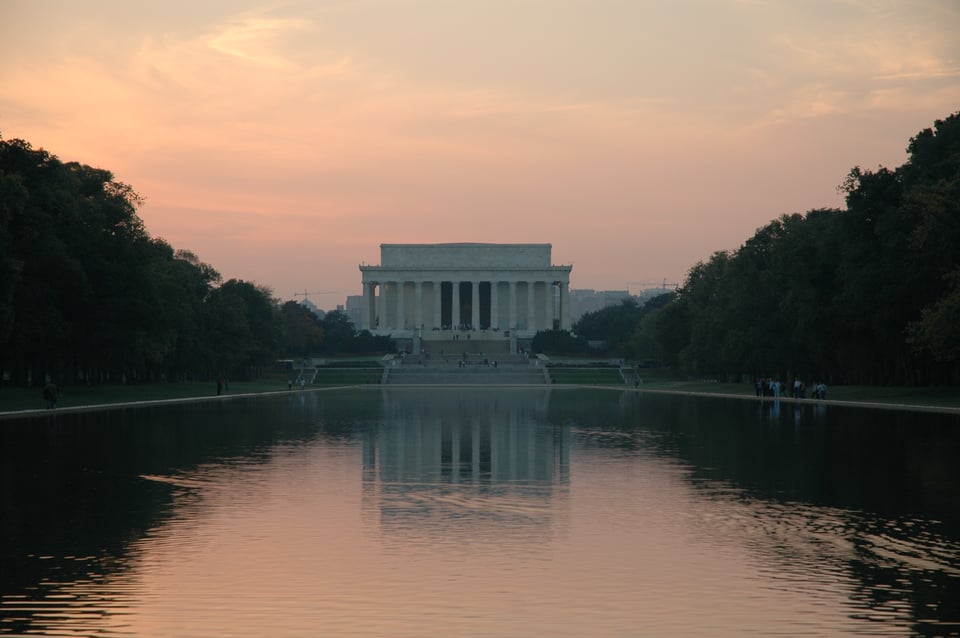
The latest example is the $16.4 million overhaul of the Lincoln Memorial Reflecting Pool, which has now become less a piece of infrastructure and more a debate about whether physical reality qualifies as a stakeholder.
Upgrade nowTrump has attributed the pool’s peeling coating and algae growth to vandalism. Not ordinary vandalism, of course, but a more theatrical version involving knives, darkness, and a level of coordination that would be impressive if it were documented anywhere outside of assertion.
Internal documents reviewed by The New York Times describe something more familiar: coating failure, equipment malfunction, and water conditions that are entirely consistent with being water in a shallow basin during summer.
The National Park Service, tasked with maintaining the site, appears to be doing what federal agencies often do in these situations: documenting the material reality of a project while watching that reality become increasingly optional in public description.
The facts, insofar as they are allowed to exist without interpretation, are fairly straightforward.
The pool was drained, resealed, and refilled. Shortly afterward, workers observed peeling sealant, cracks, and algae growth. Devices intended to control biological buildup were intermittently nonfunctional. The water responded accordingly.
At no point in this sequence does the water appear to have misunderstood its assignment.
By mid-June, sections of the blue coating were visibly detaching and floating. The algae, as if responding to an unspoken cue, expanded its presence across the basin. The overall effect was less reflecting pool than material undergoing simultaneous disagreement with itself.
Still, public explanations have largely emphasized external interference. Reports of “razor blade slashes” and fertilizer introduced into the water have circulated without supporting documentation being made available in any conventional sense. The narrative exists; the verification does not appear to be on the same schedule.
This gap—between assertion and record—is where most of the story now lives.
Anthony Flett, chief executive of U.S. Coating Specialists, reviewed the available documents and offered a comment that, in its restraint, carries its own emphasis.
“I don’t want to totally blame the vandalism,” he said.
It is difficult to overstate how much professional distance is embedded in that sentence. It is not disagreement. It is a controlled stepping-back from a conclusion others have already rushed toward.
He added that insufficient material may have been applied and that experienced polyurea specialists “should have been there to watch over the project,” which is another way of describing the difference between a plan and its execution.
The coating manufacturer, Rhino Linings, characterized the peeling as limited. A description that is technically precise in the way structurally compromised in localized areas is precise.
What makes the Reflecting Pool unusual is not that it is failing. Many public works require ongoing maintenance, especially those exposed to weather, wildlife, and time.
What is unusual is the insistence that each stage of predictable deterioration must be assigned a more complicated cause than the system itself.
Algae is not political. Sealant adhesion is not ideological. Water does not respond to messaging.
It responds to conditions.
And yet the explanation continues to compete with the object it is describing.
By the time the pool was reopened to partial visibility, it had already become something else: not a reflection of monuments, but a reflection of how quickly observable conditions can be reinterpreted when they are inconvenient.
At a certain point, the question is no longer what happened to the pool.
It is how many layers of interpretation it takes before the pool itself becomes the least flexible account of events in the story.
