
How to survive the job hunt
Words for job seekers on how to survive the experience
Note from Tucker
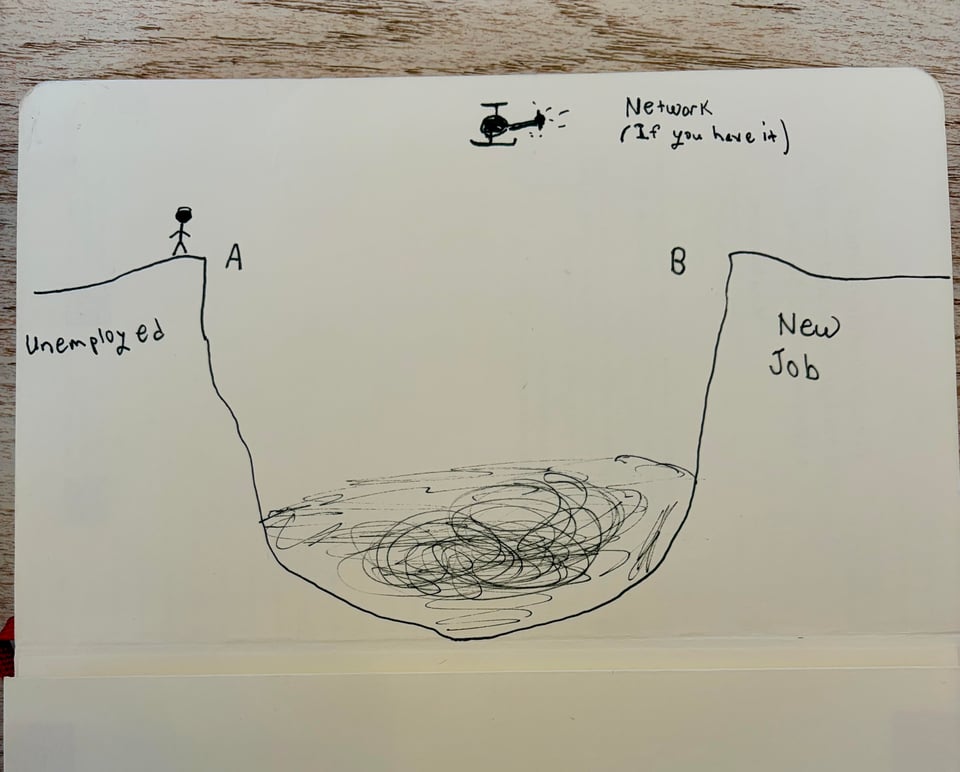
The feeling of getting a job can sometimes feel like finding a way across a canyon. Especially if you’ve been laid off, let go, quit, or if the job has for one reason or another, evaporated.
How do you get from one side to the other? If you have a networked connection, it can be like having a helicopter. Your contact easily alerts hiring managers or employers. You glide to the golden land of interviews. You’re vetted. If you’re the organization, who wouldn’t want this?
We all take recommendations from people we know and trust. From movies, to cars to food to jobs, a human rec has huge value these days. For employers, what bigger investment do you have than your employees? Like so much else, getting a job is who you know.
But if you’re under-networked it can feel like you have just rope and arm strength to get across. You have to get into the belly of the canyon to reach the other side. You can’t just send an application and show off the merits that are printed like decals on your resume.
Even if that is the system that we have all agreed to perform: find job, apply to job, hope your resume and cover letter convince hiring managers to set up an interview.
Increasingly this traditional way of applying for jobs often doesn’t hold true. Especially with the integration of AI tools and systems. People who have been in the belly of the canyon have said it has gotten harder.
And yet, in the job search world, people try. They do everything they can to get to the other side of the canyon.
Editor and writer Rachel Meade Smith has brought the voices of the canyon jumpers together in her collection SEARCH WORK. Contributing editors are Kaye Cain-Nielsen, Dorothy Dubrule, Rayya El Zein, and Rachel Kauder Nalebuff.
SEARCH WORK includes essays, art projects, screenshots of emails, old advertisements, loads of testimonials. If you’ve ever felt alone in the search for work, this is the book for you.
Smith is the curator behind Words of Mouth Newsletter, a weekly newsletter with professional and creative opportunities across design, the arts, civic tech, libraries, archives, and the built environment.
Reading the various voices in SEARCH WORK made me realize how human the experience of job searching is. As Rachel told me on the latest episode of Book Stuff, the social and economic stakes are high. A job can mean everything. It can change your identity — in more ways than one. Contributor Kelsey Yandura called the act of a job search a “liminality.” A hazy zone of in-betweenness where you feel like you’re out at sea. Yandura calls this phase something that will “carry individuals through what can be the most challenging and mysterious part of the transformation.” In that transformation, the job seeker will leap between “possibility and dread.”
For we are after security and a joy of life. José C. Sanchez, another contributor, one of my favorites, puts it succinctly here:
Admittedly, I am infected with bourgeois pretensions. I want an apartment here in Brooklyn’s Commie Corridor, from Greenpoint to Crown Heights. I want a home that no one can evict me from, full of monsteras, Persian carpets, books, and paintings on the walls. I want as many funky vintage sweaters and penny loafers as my closet can fit, international and domestic trips twice a year, films at IFC Center, Saturday nights out dancing, and weekend stays at the Pines every summer.
And to not have to worry about affording the rent, groceries, subway, or my debts — student loan, credit card, medical, you name it. Despite being a commie, I am more than not libidinally invested in the idea of having a white-collar, status-driven, and respectable occupation that does not just pay the bills, but allows me to enjoy the best of what life and New York City has to offer.
Take away commie leanings and New York City, and replace with your most identifiable group and location, I think we’re all after this when we apply to a job: something that pays the bills and allows us to enjoy life. We want status, too, if we can have it.
So often though, to get that, to reach that sacred ground, it takes a mighty amount of luck, resources, and patience. But what SEARCH WORK has opened my mind most to is that the sacredness, the experience that should be considered more fully, isn’t the destination. It’s the search itself.
Her book has documented that feeling and reality of the search in a diverse set of voices that shine like a constellation. Let this sit on your shelf if you’ve ever wondered how you'd make it through the experience of becoming unemployed to employed.
Bookmarked (Behind the scenes and links to other relevant reading)
I found Rachel’s book in a bookstore. It’s cover was facing out and because jobs are constantly the front of mind for me, I was instantly drawn in. It was a happy surprise when I noticed that Rachel was the creator of the newsletter I had been getting into my inbox for several years. To find what you’re looking for, sometimes you just have to browse and wander.
The write up about Rachel’s episode in Chicago Review of Books.
Jordan Harbinger’s 6 minute networking course I found pretty useful. If you have no idea where to start with networking.
80,000 hours advice on networking towards a more fulfilling career.
Easy advice: Hang with people, join communities, get as local as possible. Find ways to make your own experience (e.g. if you want to work in social, make an account about something you like and post often about it, build in reps.)
Study Hall is a resource for freelancers and media workers. Great job board, especially if you’re in NYC.
I don’t think AI has made job hiring or job seeking easier. Not in a true sense. NYT journalist and novelist Jessica Grose had an interesting post on AI making a claim to make motherhood easier that she posted back in May. Totally recommending into her writing to figure out more about AI.
Bookshelf photo
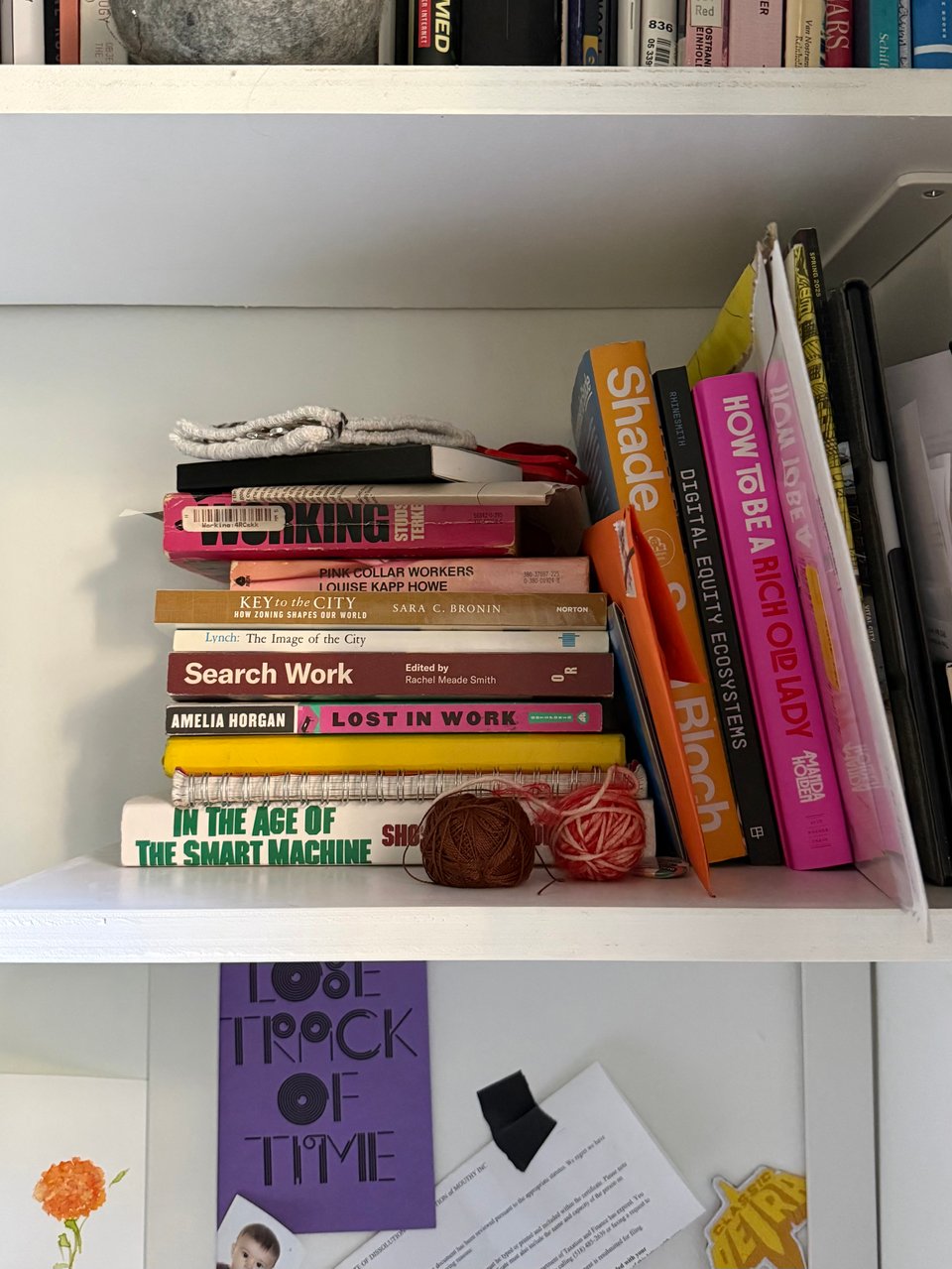
In the podcast, I ask guests to share something from their bookshelves. Rachel shared her needle kit that is for fixing “little holes and things.” It’s made from a carpet sample and is always on her shelf ready to mend small tears, rips, or even children stuff toys.
This has inspired me to get into sewing. A skill “all parents should know,” Rachel let listeners know. Something nice to do between looking for gigs.


Add a comment: