Annie Dillard wrote my Bible
Annie Dillard's writing rocked my idea of what it meant to be a writer and got me out of the Great Indoors
Note from Tucker
I didn’t grow up reading the Bible or going to church. It’s still on my to-read list. I genuinely want to read the Bible because of the ginormous impact on not just literature, but well, everything. Plus, I know lots of life lessons, basic humanity lessons have hopped out of the Bible. But also observational beauty, at least what I’ve been told and heard from others.
In the Bible void, it was Annie Dillard’s PILGRIM AT TINKER CREEK that did that for me. Her recent passing was a sad one; losing a legend.
I encountered Pilgrim for the first time in college. That book taught me something about being alive, and about writing itself. Her writing also blasted a gust of possibility into non-fiction, even if her non-fiction was different from any other kind of non-fiction. It was meditative, spiritual, nature contemplating, no characters — just a set of observations with a soft hitch of synthesis from a historical or literature-inspo anecdote.
Here’s the graph that really sat like a Super Mario glow flower inside of me:
You quit your seat in a darkened movie theater, walk past the empty lobby, out the double glass doors, and step like Orpheus into the street. And the cumulative force of the present you’ve forgotten sets you reeling, staggering, as if you’d been struck broadside by a plank. It all floods back to you. Yes, you say, as if you’d been asleeep a hundred years, this is it, this is the real weather, the lavender light fading, the full moisture in your lungs, the heat from the pavement on your lips and palms — not the dry orange dust from horses’ hooves, the salt sea, the sour Coke — but this solid air, the blood pumping up your thighs again, your fingers alive. And on the way home you drive exhilarated, energized, under scented, silhouetted trees.
This is from Dillard’s “Present” chapter, and I still remember reading and thinking, “I need to stop watching TV.” And I did. In 2010 I didn’t electively watch TV. I quit. I traveled, got outside, hung out with a lot of friends. I read. I tried to write.
It was a happy time, in some ways. I wanted to feel the blood pumping and be energized by the world, and get out of what I thought of as the “Great Indoors.” It was in those Great Indoors where I grew up: playing video games, watching TNT/TBS movies, and watching mega swaths of sports.
Dillard’s writing was part of the great ricochet my life took in the 2010s and shook me to the notion of being alive and out from under the influence of the TV glow. It’s as if I was grabbed by the very oxygen of the earth and wanted to do everything I possibly could with every possible hour I had. I didn’t want to look back on my life and say I had watched TV and was a Bronco fan. I didn’t want that to be my story. Dillard crammed more of that into my spirit:
I have to look at the landscape of the blue-green world again. Just think: in all the clean beautiful reaches of the solar system, our planet alone is a blot; our planet alone has death. I have to acknowledge that the sea is a cup of death and the land is a stained altar stone. We the living are survivors huddled on a flotsam, living on jetsam. We are escapees. We wake in terror, eat in hunger, sleep with a mouthful of blood.
Cheers to Annie Dillard and the gifts she left us to read. May we see just a sliver of what she saw out in the world. May we also strive to use verbs like her, too.
Bookmarked (Links to other stuff to read and stuff to check out)
Annie Dillard’s OBIT in NYT. This was good, too from Sam Anderson (great writer).
Dillard in Atlantic
I wrote a review in Zona Motel on the graphic novel Opioids and Organs. Check it out!
Check out Book Stuff. New episode out next week!
On the note of podcasts, I made a starter pack for science writers on how to get started for your podcast. It’s a living document that I’ll be adding to, but had to start somewhere. Shout out to Ariel Nissenblatt — I took lots of inspiration from a podcast syllabus of hers.
Whoa, Joyce Carol Oates advocates for AI-generated romance novels…yikes!
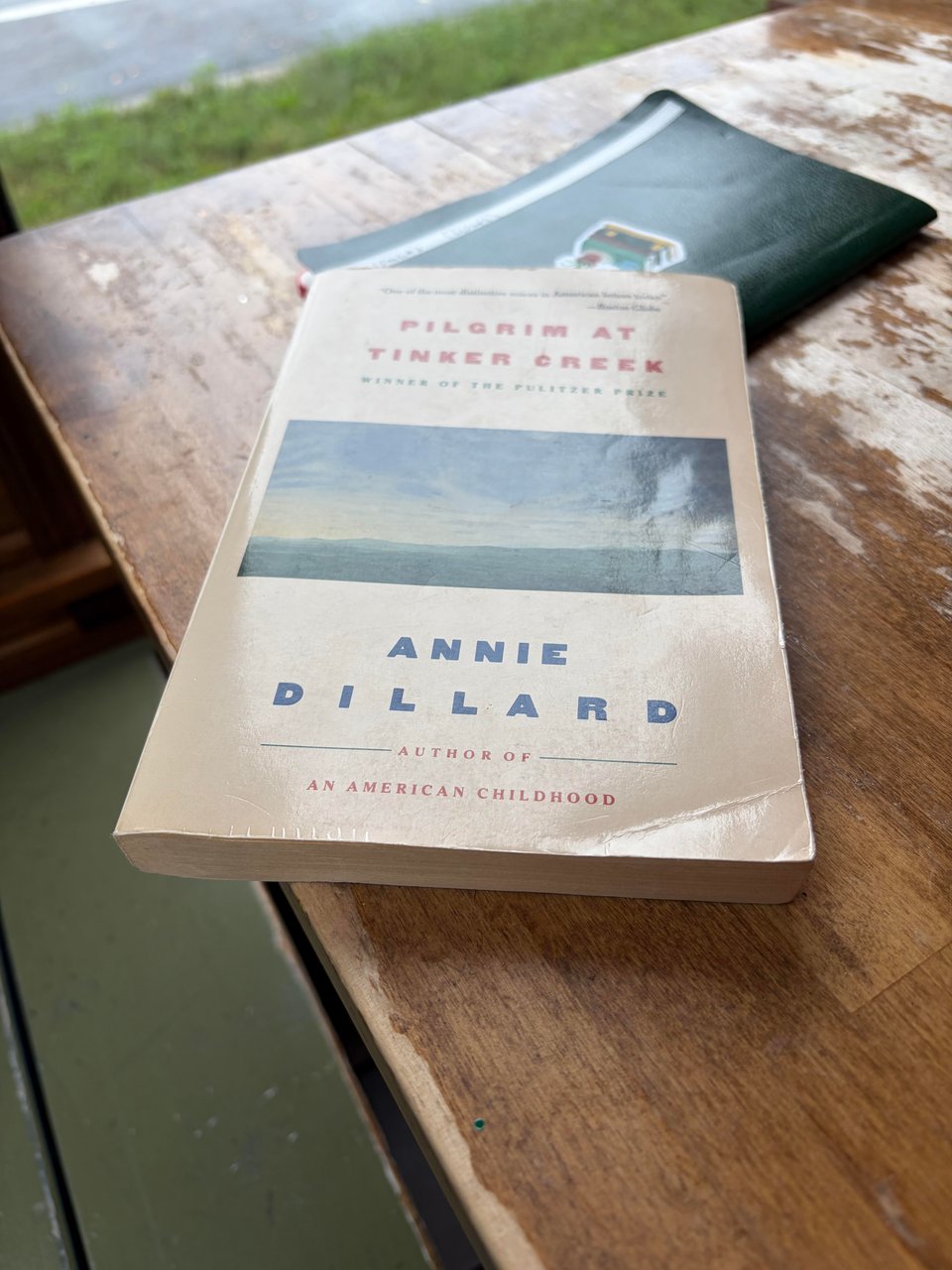
Bookshelf photo:


Add a comment: