
Do we really live in uncertain times?
Natasha Lennard wrote ON UN/CERTAINTY: The Usage of Doubt in Dangerous Times from Verso Books. Published October 2026 — brand new book. Check out on Book Stuff today!
This week’s episode:
Natasha Lennard wrote ON UN/CERTAINTY: The Usage of Doubt in Dangerous Times from Verso Books. Published October 2026 — brand new book. Check out on Book Stuff today! It’s on Spotify and Apple, too. Here’s the article in Chicago Review of Books.
This is a non-fiction, political and philosophical commentary on “sites of struggle” that includes the concept of nation-state borders, on-going violence in Palestine, and transgender human rights, among other globally important topics.
More about Natasha and links:
As her bio states, Natasha is a British-born, Brooklyn based writer. She’s a professor at New School and a columnist for The Intercept. She’s written for a grip of other outlets like Bookforum, New York Times, The Nation, Dissent, among others. She moved to New York to pursue journalism, to avoid “the equivalent of advanced Sudoku” of a PhD program, she told an interviewer. It was Occupy Wall Street that sparked the possibility of journalism for advocacy and leftist ideas. That movement, for whatever legacy it left, sparked the creation of many left-leaning advocates and thinkers. Occupy may have had limits, but it planted some seeds that have stayed alive, even through two Trump administrations.
It’s also important to note that Natasha is someone who has dealt with immense mental health challenges, which she has written about, links are below. It doesn’t come up in her book, but I think it’s helpful to see how Natasha writes about this intensely personal experience alongside everyday political action. In both macro-political and micro-personal, Natasha pulls on ideas from a library of sources to help explain global and personal actions.
For most of her writing, Natasha writes with a left political sensibility and toggles between journalism and political analysis. She’s smart, funny, and earnest, too. What I love about her writing is that she weaves big political — even, say academic — ideas into on-the-ground current events.
She is a master synthesizer. In retrospect, I’d love to know how she organizes her notes. If I interview her again, I’ll put that on top of my list.
Natasha’s writing sparks hope for the politically hopeless, especially if you’d like a different world from centrist Democratic rhetoric, which can feel a bit like boxed air at times. Lennard, by contrast, is part of a group of writers who provide a breeze of fresh air to how we can imagine politics.
Natasha’s ideas aren’t headlined often in mainstream media, but are loud on the far left and left organizations. Among those topics are genocide in Palestine, opening borders, and resisting techno-fascists ruler billionaires. Think Naomi Klein, Astra Taylor, Andreas Malm. If you like those writers, or like listening to Democracy Now!, say, you’d dig Natasha’s writing.
Natasha is trying to bring clarity to the current moment. As she writes, “What this work can do, though, is demystify and help us look seriously at what the hell we’re doing, saying, assuming, and taking for granted. In what claims our beliefs and practices are grounded, and when we are proceeding without further grounds or justifications.”
Her previous books include Violence: Humans in Dark Times (City Lights 2018) and Being Numerous: Essays on Non-Fascist Life (Verso 2019).
Some good links I enjoyed of Natasha’s:
Armed Border Agents Arrest Protesters, Bulldoze 200-Year-Old Tree to Build Border Wall (Intercept, 2026)
Ed Sheeran’s Craven “Neutrality” Is a Watershed Moment for Mainstreaming Palestine Solidarity (Intercept, 2026)
No, AOC: “Woke” Wasn’t “Crazy” the Way You Say It Was (Intercept, 2026)
Aeon piece on Patients and psychiatrists at Saint-Alban in France fought against fascism side by side. Natasha is quoted in this piece. A piece of history I wasn’t aware of and busts old stereotypes of fascism. Love this quote in particular:
Natasha Lennard says ‘we can and should apply a more capacious understanding of fascism than simply, “How much like Mussolini’s Italy or Hitler’s Germany is this?”’ We should use the word, she says, ‘to describe a set of tendencies, desires, habits, and collective practices’ that can thrive even in regimes that seem to be democratic. The antidote to this day-to-day fascism, says Lennard, is not military but intellectual, emotional and communal.
Natasha interviews an author for Book Forum about “right-to-die movement” (2022)
Natasha opening up about her own mental health struggles and her thoughts on capitalism. (Mental Health Substack, 2022)
It Came in Through the Bathroom Mirror. Natasha writes about her ghost (Real Life Mag 2016)
Natasha writes about her mental health struggles. Fair warning, suicide is mentioned in this piece. It’s probably some of the smartest writing about the subject I’ve ever read. Written at a raw moment, just weeks after an overdose attempt (The New Inquiry, 2014).
My favorite quote from the podcast: “This is not about convincing the convinced. We’ve seen all too violently the limits of evidence and persuasion.”
One big takeaway from her book:
Power really starts with language and ideas. It’s how we build our certainties and our beliefs. Once you have your self-belief, your point of certainty, you must not argue with the right-wing power holder. Rather, you should build a new coalition, join a movement, and take that power with new support around a new certainty, if it’s needed. But all power starts with your language and what you believe about the world. Simple as that.
More context:
It would be good to know of early 20th-century philosopher Ludwig Wittgenstein to help understand this book.
Life can be different: 10 years ago, Occupy Wall Street changed the world (The Guardian, 2021)
Massive Own-Goal Scored By Ed Sheeran (Defector, 2026)
Molly Crabapple’s Here Where We Live Is Our Country, a history of Jewish Labor Bund.
Reading experience for me:
Buy this if you’re at least curious what left politics could look like. We don’t live in jailed, stuck or uncertain times. Climate change isn’t inevitable, border politics aren’t inevitable, the destruction of human populations isn’t inevitable. They also aren’t uncertain. We know the solutions.
Plus, you’ll feel like you’re in college again: a big idea thundering across your brain, a need to exchange ideas with friends. I got that urge to be in college and head down to the bar and talk about the stuff in this book. I need to find an well-out college version of this.
My favorite part of the acknowledgements:
“To all my comrades who have thought with me through the doubts and the certainties of recent years; on the page, in the streets and encampments, within struggles, across dinner tables and bars, and at our beloved, imperiled New School for Social Research.”
Bookshelf photo
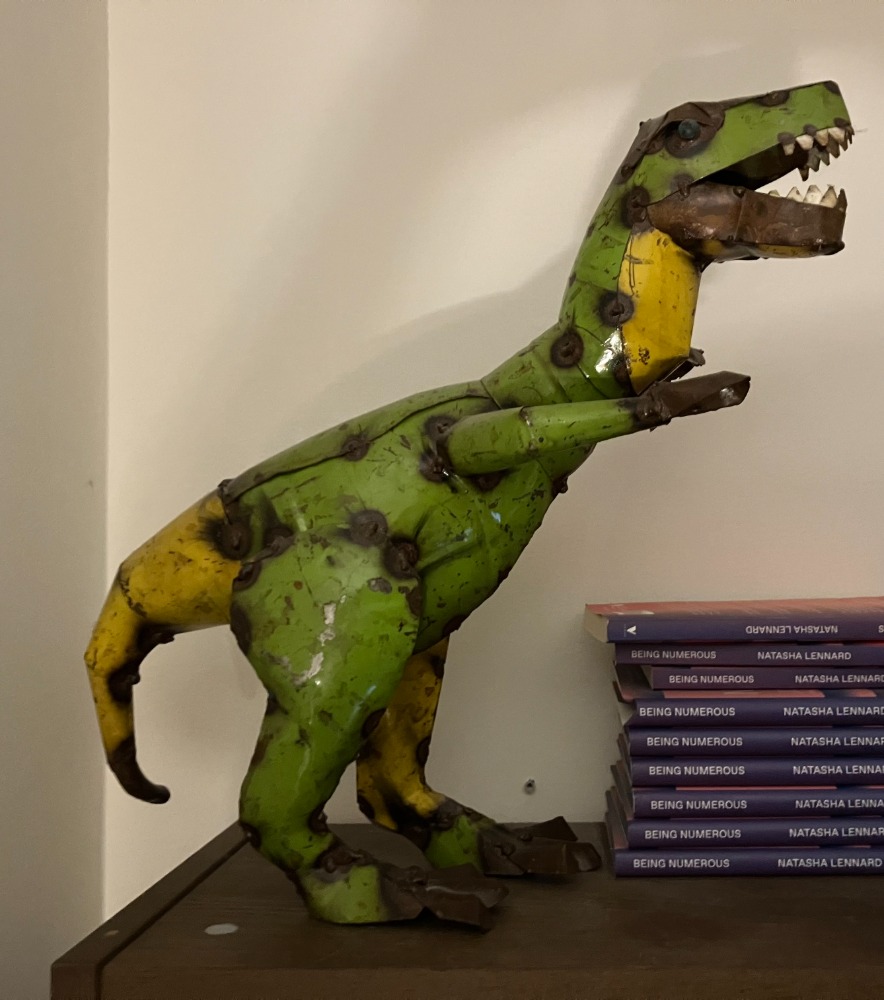
On the episode, Natasha shared that this dino came from her mother after her mother visited a shop that, sadly, no longer exists. It now sits atop Natasha’s bookshelf. He keeps her psychically safe, Natasha told me on the podcast.


Add a comment: