The Nicest Person Ever?
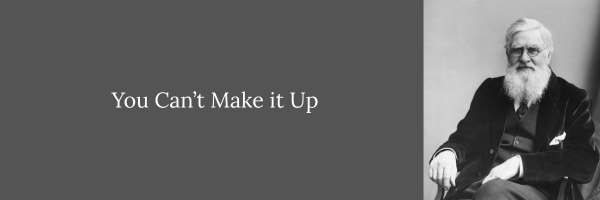
Alfred Russel Wallace may well have been the nicest person ever to have lived. Ok, that’s an exaggeration, but maybe not by much.
Wallace was a great scientist and an excellent naturalist. He made lots of contributions to biology, including collecting more than 100,000 specimens of insects, birds, and mammals for British museums. He was also the founder of the branch of science known as biogeography. But his greatest contribution to science was the theory of evolution.
“What?” you ask. “Wasn’t that Charles Darwin?” Yes, indeed it was. Darwin spent about 20 years working out the details and collecting evidence for what we now know as the theory of evolution by means of natural selection. Long after Darwin had the basics down, he kept gathering data to support his theory. He was also gathering the nerve to publish what was bound to be a startling, even shocking, discovery.
Meanwhile, Wallace almost scooped him. Yep, that’s right. If things had gone a little differently, people might now be challenging the teaching of Wallace-ism rather than Darwinism.
Here’s what happened: One day in June of 1858, Charles Darwin received a letter from Wallace. Enclosed was a scientific paper called, “On the Tendency of Varieties to Depart Indefinitely from the Original Type.” It didn’t take Darwin long to realize that he was looking at his own long-nurtured theory. Wallace was on an island in Indonesia. In those days before email, or even air mail, he would be out of touch for at least a couple of months. So Darwin got busy and wrote up a quick paper that summarized his own findings — findings, it must be said, that were painstakingly worked out long before Wallace put the same idea together in a feverish burst of insight while suffering from a bout of malaria.
The problem, of course, was that even though Darwin had been working on this idea for two decades, he hadn’t published anything yet. That meant he couldn’t prove he got there first. And Wallace had indeed got there on his own—then written up his findings and shared them with Darwin. It was an ethical problem for sure.
Two of Darwin’s friends and fellow scientists, Charles Lyell and Joseph Hooker, worked up a plan. Both papers would be presented at a meeting of the Linnean Society, a London scientific organization. The findings were to be credited to both Darwin and Wallace. Darwin’s paper would be presented first. Of course, Darwin was the most well-known of the two men, so whether or not Darwin (or Hooker and Lyell) meant it this way, Wallace came across as something like a junior partner to Darwin.
The plan was hatched by Darwin’s friends while Wallace was thousands of miles away. Maybe it was a fair solution, maybe not. But either way, Wallace had no say in it at all.
You might expect Wallace to have been seriously ticked off. But he wasn’t. Wallace seemed genuinely happy, delighted even, to give Darwin very nearly all of the credit for the greatest discovery in biology. Wallace even gave his own book on the subject the title: Darwinism.
In today’s hyper-competitive world, it can be hard to understand a man like Alfred Russel Wallace. Wallace was far more interested in having ideas and exploring them than in getting credit for them. He was genuinely happy for Darwin. As far as anyone knows, he never felt a moment’s regret or anger for the way things worked out. That’s just one of the reasons Alfred Russel Wallace is one of my heroes.
In this summer’s issue of Discover magazine, I have an article about the history of the theory of evolution, and the article includes a sidebar about Wallace that shows why I love him so much. Look for the issue on newsstands soon, or in your mailbox if you are a subscriber (which I hope you are!). And if you’re interested in knowing more about this intriguing scientist, let me know, and I’ll feature him in another newsletter soon.
’til next week, don’t get scooped!
Avery