I really don’t know clouds at all
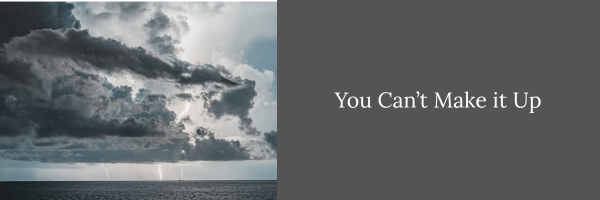
I was rather proud of myself when (at an older age than I’m willing to reveal) I discovered that clouds aren’t actually giant bags of water floating in the sky. (As something of an excuse for picking up on this so late, I’ll just add that children’s books are no help at all with this; nor is the common expression “cloudburst.”) But even after I got that straight, I had a lot more to learn about clouds. And I’m still learning!
This week I learned why dark clouds are more likely to burst — er, I mean, why clouds get darker right before it rains. (Old metaphors die hard.) If you’ve known this for, like, forever, please just close this email now and get on with your well-informed, scientific life. But if you’re like me and still a bit wobbly on nephology,* listen up.
Clouds are basically just aggregations of water vapor. When it’s about to rain, that water vapor becomes denser, thick with water droplets (this is what I once would have thought of as the bag getting overfull and ready to burst). Because the cloud is so dense, less light can get through, so it looks darker. Mystery solved.
Oh, and just in case you were wondering, thunder is not what happens when big cloud bags bump into each other. Of course, I never thought that.
* That’s the technical name for the study of clouds, not to be confused with nephrology, the branch of medicine that deals with the kidneys (which, now that I think about it, also have to do with “water”). However, nephology can also refer to cloud watching, which is apparently what I was doing when I was supposed to be studying atmospheric science in school.
’til next time,
Avery