Wednesday, May 20, 2026. Annette’s Roundup for Democracy.
Trump’s un-American rally that received little coverage.
In a country that has prided itself on the separation of church and state, this past Sunday, the Trump cult stomped on a founding principle.
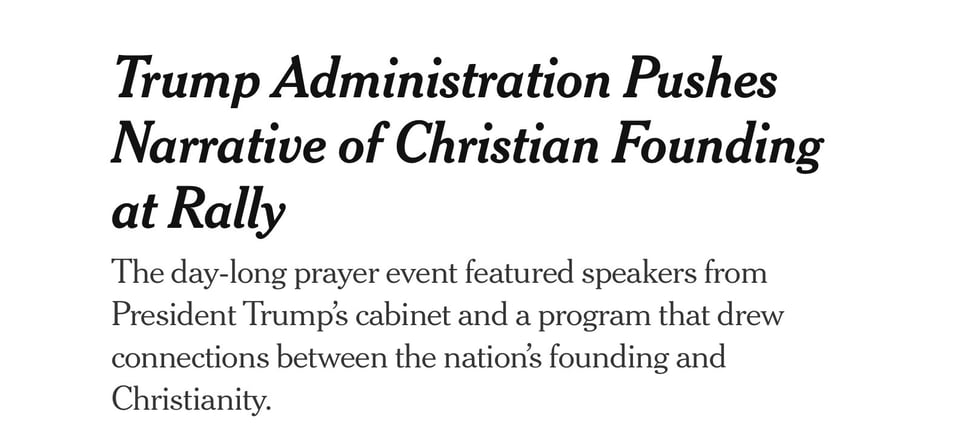
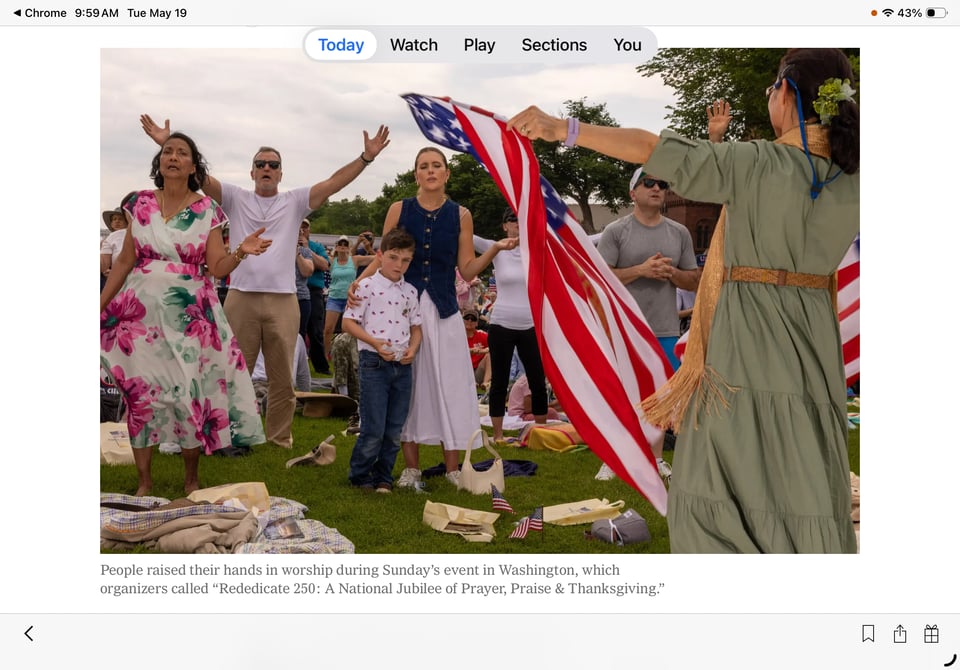
White House organizes a day-long prayer event with private church organizations.
AYESHA RASCOE, HOST:
It's Sunday, of course, and that means lots of Christians are praying. Some of them are at the National Mall in Washington, D.C., today for a daylong prayer event organized by the White House with private church organizations. It's called Rededicate 250. Christian groups holding days of prayer are not uncommon in the U.S., but the fact that the White House is behind today's event has plenty of folks, including the very religious, concerned. Matthew D. Taylor is an author and religious scholar currently at Georgetown University's Center on Faith and Justice. He joins us now. Good morning.
MATTHEW D TAYLOR: Good morning, Ayesha.
RASCOE: So, you know, presidents attend prayer breakfasts, and other administrations have commemorated days of prayer. What's different about today's event?
TAYLOR: Well, part of what makes today's event so different is that it is being sponsored and even organized by the White House and by other federal agencies. So, yeah, there have been a lot of big prayer events on the National Mall, staged often by evangelicals. But those have always been outside organizations. They've sometimes invited government officials in to speak at them or be present for them. But this is different in that now you have a branch of the federal government sponsoring and upholding these narratives that these Christian nationalists have been pushing for a very long time.
RASCOE: Well, looking at this list of 20 or so faith leaders featured, there's only one non-Christian one - a senior rabbi. What does this tell us?
TAYLOR: Well, this is typical of the way that the Trump administration has operated so far. They'll sometimes have a slight veneer of being interreligious or interfaith by including maybe one or two rabbis. But - and often these organized events are centered around evangelicals as well. I think there are two Catholics on the program for today. Both the rabbi and the two Catholic speakers today are both part of Trump's Religious Liberty Commission. So in some ways, there's kind of a tokenization of other forms of Christianity, other religions. But the central narrative today is an evangelical narrative. The vast majority of the speakers are evangelical, and this type of event kind of tries to enshrine certain evangelical tropes and narratives about American history that don't really bear much evidence from actual history.
RASCOE: Well, talk to me about that. Like, what is the overarching ideology of the featured speakers here? And what is their view of America and, quote, you know, the church or Christianity writ large?
TAYLOR: Their view is that the United States is a Christian nation, that it was founded as a Christian nation and that - even the title of the event - right? - Rededicate - there's a built-in assumption that the nation was once dedicated to God. And because they're doing it on the 250th anniversary, I think they're very strongly implying that it was dedicated in 1776. In reality, the era of the Founding Fathers was a very secular era. It was very much influenced by the Enlightenment, and most of the founding fathers were very much shaped by that kind of Enlightenment philosophy. And that's why they talked about ideas like the separation of church and state or the disestablishment of religion.
In fact, the founding of the U.S. was a grand experiment in separating religion out from the functioning and identity of the state. That was - the Founding Fathers had seen what had happened in Europe, as you had these various forms of Protestantism and Catholicism try to become the ideologies of different nations in Europe and then persecute other Christians, not to mention Jews and Muslims and atheists.
RASCOE: Well...
TAYLOR: And they wanted to create a gap between the state and the church so that religion could flourish...
RASCOE: Well, can...
TAYLOR: ...In a country.
RASCOE: Can I ask you - does this view of the U.S. as a Christian nation - does that allow for other religions to thrive in this country? Saying, like, if these faith leaders were to have their way, would you have a religiously diverse country?
TAYLOR: Well, and this is the problem because Donald Trump, while he might not be particularly religious, has surrounded himself by people who are quite extreme in their views on Christian nationalism. And when you listen to things that Pete Hegseth and Paula White and some of these other religious figures that surround Trump are saying, no, I don't think that other religions would be able to flourish in their ideal America. They want the country to be centered around Christianity. And if you look at a lot of the things that the Trump administration has done so far, they are offering special privileges and protections to Christians. They have an Anti-Christian Bias task force. There even are bombing missions going on in Nigeria today that are explicitly saying that they are used to protect Christians in Nigeria.
RASCOE: Can I ask you, just very quickly - I mean, because American evangelicals are such a part of Trump's base, is this more of a campaign rally or is it a religious gathering? How do you draw the distinction?
TAYLOR: I think it's a religious gathering. And I think it's an effort to substantiate some of these pseudo-claims of history that have been put forward by evangelicals and to give it a government flourish of approval and a stamp of officiality that they have not had before.
RASCOE: Well, thank you so much. That's religious scholar Matthew D. Taylor. Thank you so much for speaking with us today.
TAYLOR: Thank you. (NPR)
Updates.
Texas
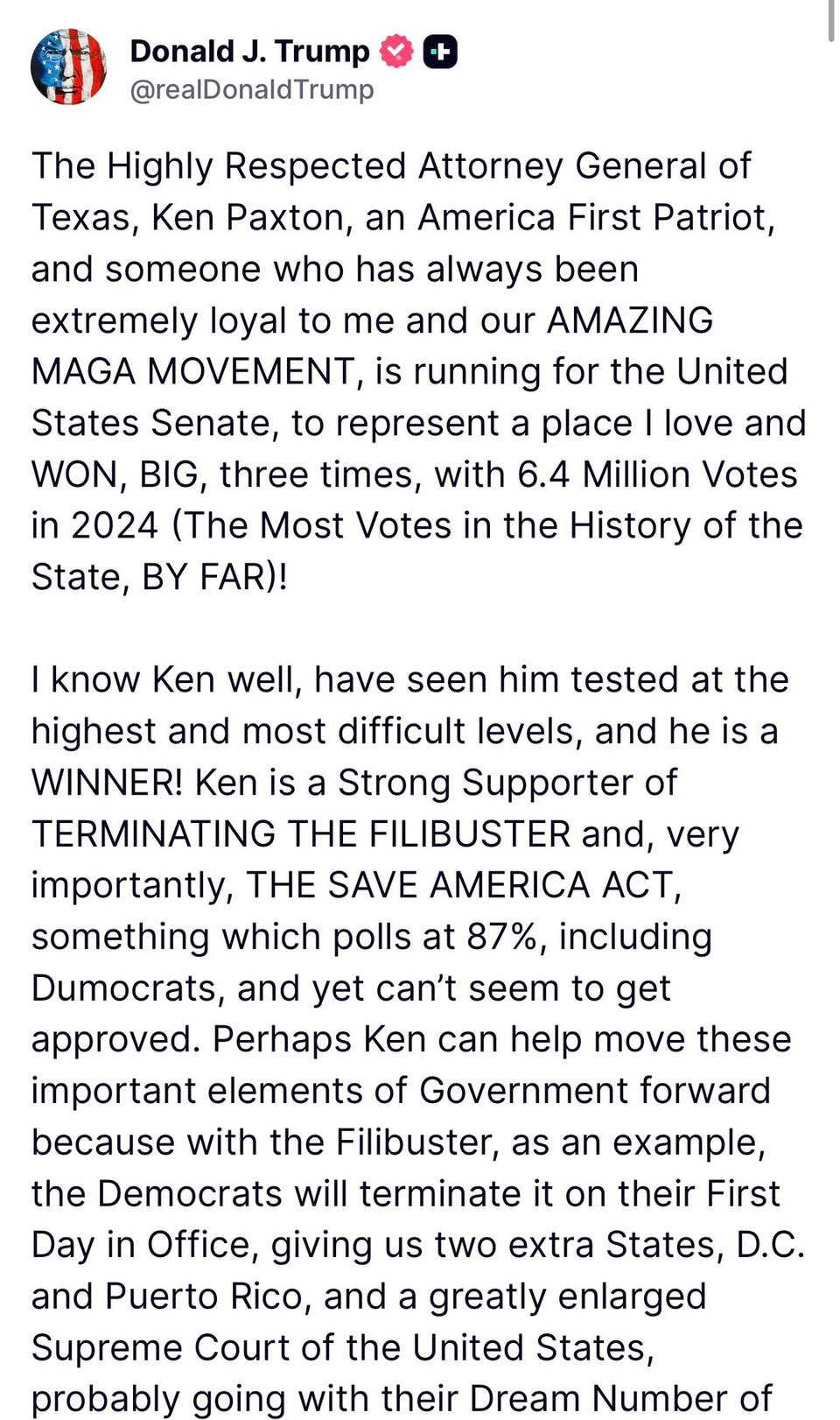
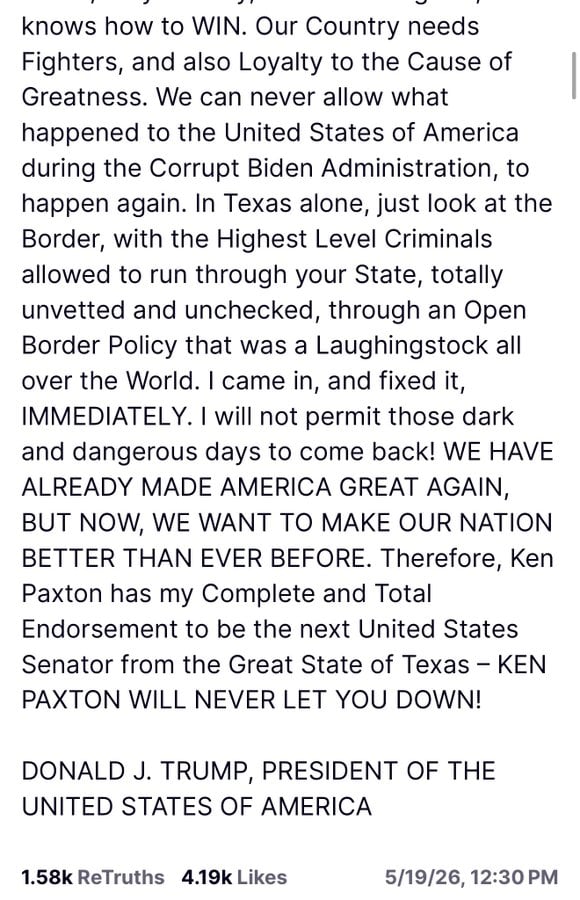
Incumbent Republican Senator Cornyn didn’t get Trump’s nod. Impeached Ken Paxton did.
What is happening with Jobs.
Where the Supreme Court’s Callais verdict leads.
Trump is helping White South Africans.
As to the $1.7B slush fund, the Constitution speaks.
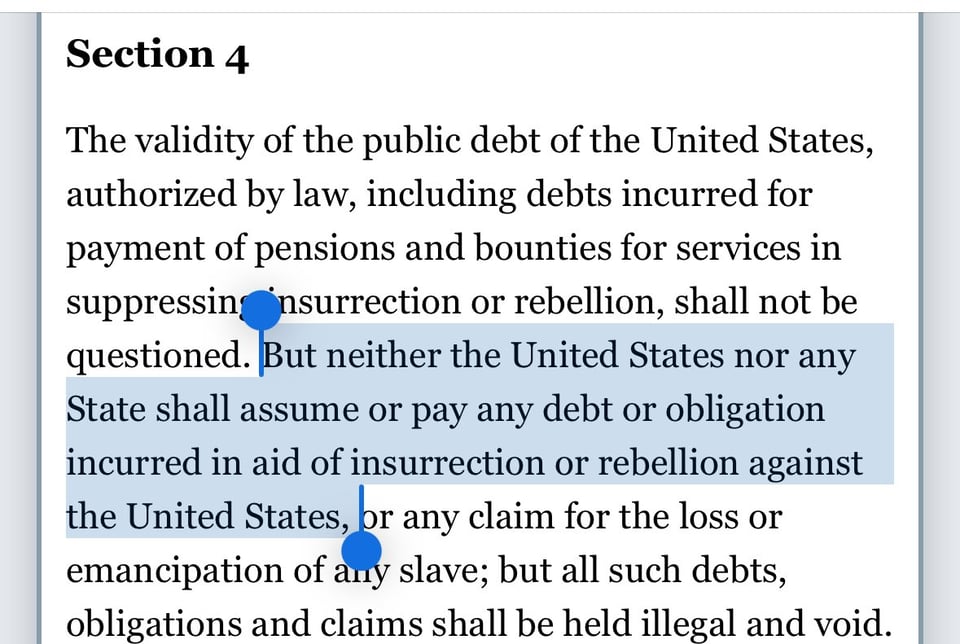
The part of the Slush Fund deal you may have missed.👇
Thune Casts Doubt on Trump Settlement Fund Plan
The top Senate Republican cited “blowback” to the idea, while the chairwoman of the Senate Appropriations Committee questioned its legal basis.
The top Senate Republican cast doubt on Tuesday on President Trump’s plan to use $1.8 billion from a government fund to compensate people who claim to have been the targets of politically motivated prosecutions, saying that Congress would scrutinize the idea.
Senator John Thune, Republican of South Dakota and the majority leader, told reporters that he expected the idea would undergo a “full vetting” by appropriators, who control federal spending.
“My assumption is that based on some of the blowback that’s come since this was announced, that there would be a significant amount of attention paid to it,” Mr. Thune said.
He told Punchbowl News that he was “not a big fan” of the plan and saw no need for it.
It was not immediately clear how widespread resistance would be to the idea, which some Republicans hailed as an appropriate use of federal resources.
Senator Ron Johnson, a Wisconsin Republican who has staked out a position as a fiscal hawk, said he supported the administration’s plan for tapping the Justice Department’s fund.
“A lot of people have been abused by the federal government,” he said, adding that he thought they should have some way to seek recourse.
But in a hearing on Tuesday with Todd Blanche, the acting attorney general, Senator Susan Collins, Republican of Maine and the chairwoman of the Appropriations Committee, raised several questions about the fund, including its legal basis, how eligibility for compensation would be determined and how amounts would be set.
She noted that the Treasury’s long-established Judgment Fund had “traditionally been used for the payment of specific claims against the government or amounts owed for the settlement of those claims, but not for future claims that have yet to be brought.” (New York Times)
ICE is out at New York immigration courts.
Republican voters stick with Trump in Primaries.
Brad Raffensperger loses GOP primary for Georgia governor)
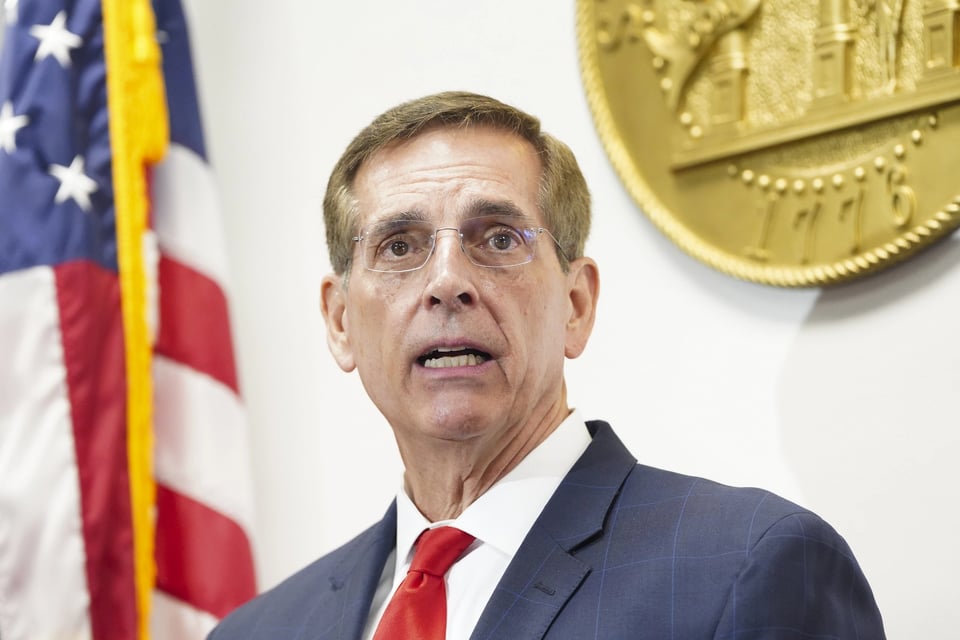
MAGA billionaire Rick Jackson and the Trump-endorsed Lt. Gov. Burt Jones advanced to a runoff in the Republican primary for Georgia governor. (Politico)
—————-
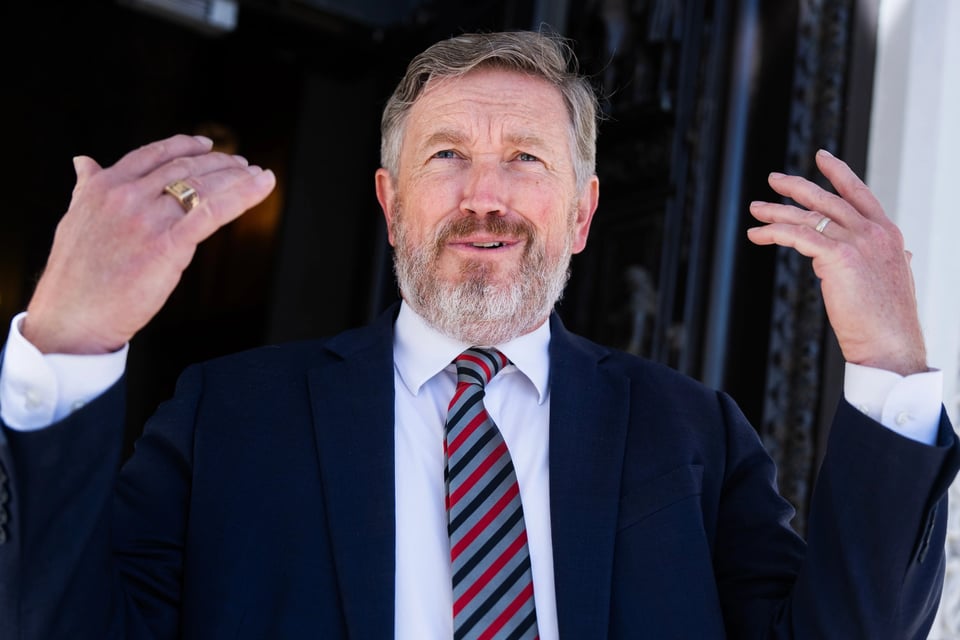
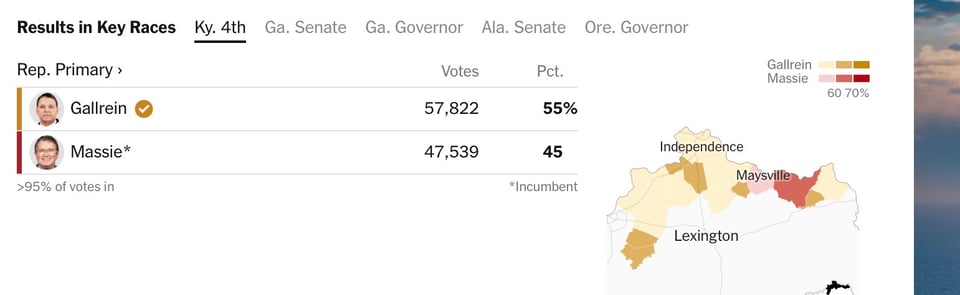
Thomas Massie loses Kentucky House primary in a win for Trump
Remember. As long as Blue voters outnumber Red voters, we will win the Midterms.
This is happening too.

