Tuesday, May 19,2026. Annette’s Roundup for Democracy.
Mr. Unpopular!
A Crack in the Polling Floor Puts Trump in New Territory
A 37 percent approval rating in a new Times/Siena poll suggests the G.O.P. is facing a big midterm problem despite recent redistricting gains.
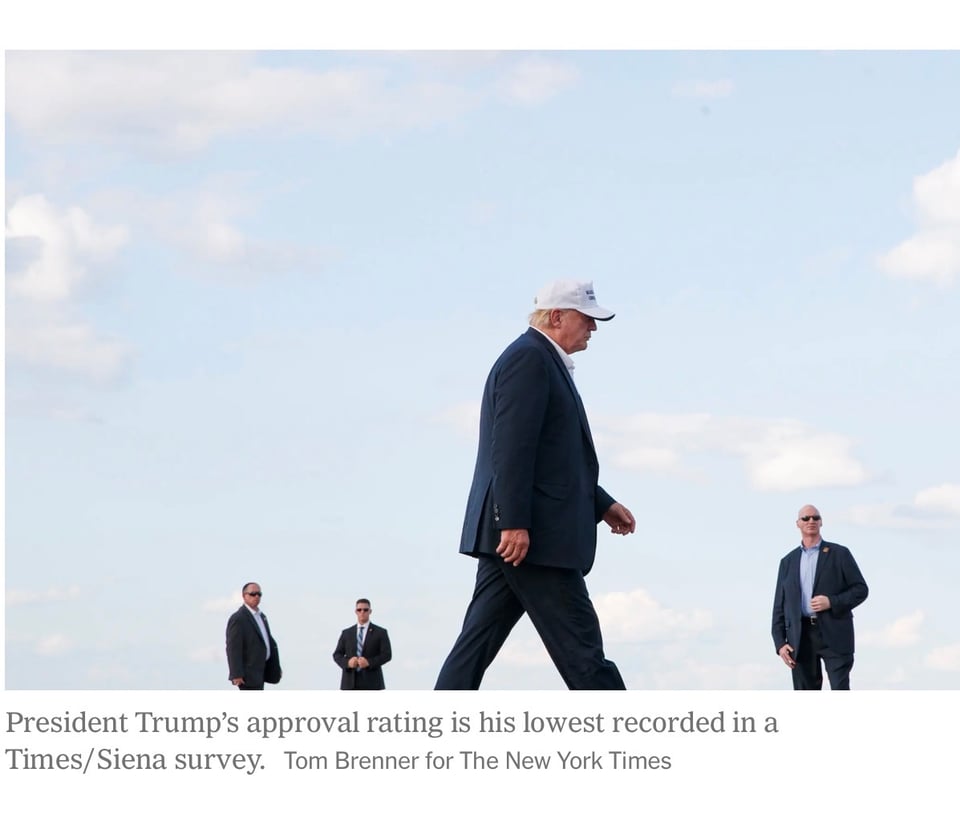
Over the last decade, it’s often been said that President Trump’s support has a low ceiling but a high floor.
In this morning’s latest New York Times/Siena poll, whether Mr. Trump really has a high floor is starting to be put to the test.
Just 37 percent of Americans approve of his performance as president, a drop of four percentage points from the last Times/Siena poll in January and his lowest approval rating in any Times/Siena survey in either term.
A four-point decline isn’t necessarily huge, but it puts Mr. Trump’s ratings in new political territory. While recent presidencies have often been unpopular and polarizing, no president’s approval rating has been under 38 percent for more than a few days in the last 17 years, according to our average. If there has been a floor during this partisan era of politics, Mr. Trump’s ratings today have fallen to it.
While it’s too soon to say whether the war in Iran and high gas prices will ultimately break the floor in Mr. Trump’s support, the poll leaves no doubt that these issues could pull his approval ratings down even lower. Just 28 percent of voters approve of his handling of the cost of living, and only 31 percent approve of his handling of the war. Just 30 percent say he made the “right decision” in choosing to attack Iran.
The most immediate political consequence is that Democrats appear increasingly well positioned for the midterm elections in November. The poll shows Democrats have a double-digit lead, 50 percent to 39 percent, when registered voters are asked which party’s candidate they’ll support for Congress. That’s a notable shift from Times/Siena polls earlier this cycle — which showed Democrats up two to five points.
Anything like it would easily overcome the Republicans’ redistricting advantage in the House and suggest that Democrats could be highly competitive in the Senate. And although there’s still a long time until the election, Democrats held an even larger 14-point lead among those who said they were “almost certain” or “very likely” to vote.
As in other recent Times/Siena polls, the survey found that young and nonwhite voters have snapped back toward the left. Democrats have regained their usual, pre-Biden advantage among both groups in the race for control of Congress as well as in party identification. Mr. Trump’s approval rating among both groups is abysmal: Among voters 18 to 29 years old, only 19 percent approve of his performance; just 20 percent of Hispanic voters say the same.
The possibility that Mr. Trump’s floor is cracking raises the prospect of even more significant, longer-term political consequences. If the war and high prices persist, Mr. Trump’s troubles could start to look less like other recent polarizing presidencies and more like those of George W. Bush, Jimmy Carter, Lyndon Johnson or Harry Truman, in which quagmire abroad and economic challenges at home did significant political damage to their parties.
Of course, Iran is not doomed to be another Iraq, Vietnam or Korea. For now, there’s a cease-fire; there could be a diplomatic solution at any time. If prior wars are any indication, Mr. Trump has time to resolve these challenges before his approval ratings fall into the lower 30s or beyond.
The case of George W. Bush is instructive. At almost the exact same stage of Mr. Bush’s second term, the combination of the war in Iraq and high gas prices dragged his approval rating to about where Mr. Trump’s ratings are today. His ratings ultimately fell into the 20s, but it didn’t happen overnight. On average, Mr. Bush’s approval rating fell by less than one point per month for the rest of his term — which so happens to be the rate that Mr. Trump has been losing support over the last few months. For his approval rating to keep falling, Mr. Bush had to lose the support of longtime fans and Republicans. It can take a while.
If the conflict lasts long enough for Mr. Trump to keep bleeding support, Republicans might face something a lot worse than a bad midterm. A midterm defeat was likely even before the war began — it’s the usual fate of parties in power, after all — but the president’s party usually rebounds relative to that for the next presidential election. If Mr. Trump’s approval rating stays in the 30s, it won’t be so easy to assume Republicans will rebound. In the polling era, there are no examples of the president’s party retaining the White House when the president’s approval rating is under 40 percent. More often, the election is a rout.
You can read the full story on the poll results regarding Mr. Trump, Iran and the midterms here, and an explanation of some methodological changes to the Times/Siena poll here. (New York Times)
Slush, slush - right before our eyes.
Justice Department announces a $1.7B Fund to compensate Trump Allies in a deal to drop IRS suit.
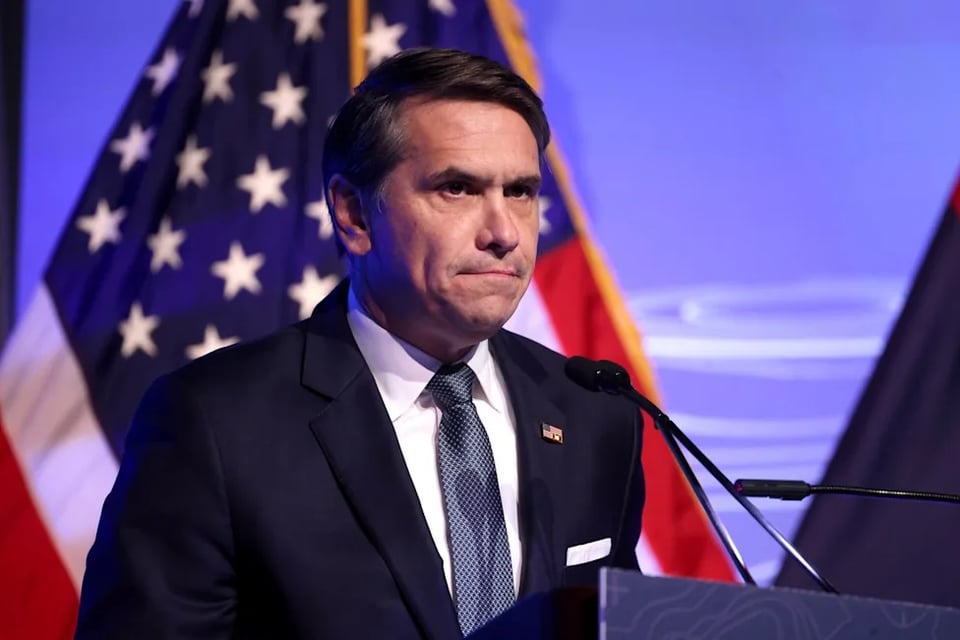
WASHINGTON (AP) — The Trump administration announced Monday the creation of a $1.7 billion fund to compensate allies of the Republican president who believe they were mistreated by the Biden administration Justice Department, an arrangement that Democrats and government watchdogs derided as “corrupt” and unconstitutional.
The “Anti-Weaponization Fund” of $1.776 billion is part of a settlement that resolves President Donald Trump’s lawsuit against the Internal Revenue Service over the leak of his tax returns. It will allow for people who believe they were targeted for prosecution for political purposes to apply for payouts, creating what acting Attorney General Todd Blanche called “a lawful process for victims of lawfare and weaponization to be heard and seek redress.”
"“The machinery of government should never be weaponized against any American, and it is this Department’s intention to make right the wrongs that were previously done while ensuring this never happens again,” Blanche said in a statement that made no mention of how investigations and prosecutions of Trump’s political opponents under his watch have exposed the Justice Department to the same claims of politicized law enforcement that he said he opposed.
Nearly 100 Democrats in the House of Representatives signed onto a legal brief urging a judge to block what they described as an unprecedented resolution that they said would unjustly enrich people close to the president with taxpayer dollars and open the door to meritless claims of political persecution
“This is one of the single most corrupt acts in American history,” Donald Sherman, the president of Citizens for Responsibility and Ethics in Washington, said in a statement.
The fund would represent not only a highly unorthodox resolution but also a further demonstration of the administration’s eagerness to reward allies who before Trump came to power were investigated and in some cases charged and convicted. Most notably, the president on his first day back in office pardoned or commuted the sentences of supporters who rioted at the U.S. Capitol on Jan. 6, 2021. His Justice Department since then has approved payouts to supporters entangled in the Trump-Russia investigation and investigated and prosecuted some of his perceived adversaries.
Trump’s attorneys suggested in their court filing seeking to dismiss the case that the resolution would not be reviewable by a judge. But a group of 93 members of Congress filed a brief teeing up a challenge.
“This case is nothing but a racket designed to take $1.7 billion of taxpayer dollars out of the Treasury and pour it into a huge slush fund for Trump at DOJ to hand out to his private militia of insurrectionists, rioters, and white supremacists, including those who brutally beat police officers on January 6, 2021, and sycophant accomplices to his election stealing schemes,” Rep. Jamie Raskin, the top Democrat on the House Judiciary Committee, said in a statement.
Trump has long raised ‘weaponization’ claims
The Justice Department did not name specific individuals who might stand to benefit from the fund, but said there were no “partisan requirements” for applicants and that anyone who believes they’ve been unfairly persecuted could seek a payout as well as an apology. A five-member commission appointed by Blanche will oversee the fund.
The creation of the fund is in keeping with Trump’s long-running claims that the Justice Department during the Biden administration was weaponized against him.
He has cited as proof the since-dismissed criminal charges he faced between his first and second terms of conspiring to overturn the results of the 2020 presidential election he lost and of retaining classified documents at his Mar-a-Lago estate in Florida. As a condition for resolving the lawsuit, Trump has agreed to resolve administrative claims in which he sought compensation over the Mar-a-Lago investigation and a separate investigation into ties between his 2016 campaign and Russia, an inquiry that unfolded during his first term in office.
A spokesman for Trump’s legal team said in a statement responding to the deal that Trump had been the “victim of illegal harassment and invasions of privacy.”
Merrick Garland, who served as attorney general during the Biden administration, has repeatedly denied allegations of politicization and has said his decisions followed facts, the evidence and the law. His Justice Department also investigated prominent Democrats too, most significantly by appointing a special counsels who scrutinized President Joe Biden for his handling of classified information. Another special counsel brought tax and gun prosecutions against Biden’s son Hunter.
Nonetheless, Trump’s current Justice Department has actively pursued the president’s retribution campaign and grievances, bringing criminal charges against some of his political opponents and initiating a wide-ranging investigation that aims to establish a yearslong conspiracy between law enforcement and intelligence officials to destroy Trump’s political prospects and keep him out of power.
No charges have been brought in that investigation and it is not clear that any ever will be.
In defending the deal, the Justice Department pointed to a $760 million fund established by the Obama administration to compensate Native American farmers who said they had experienced racial discrimination. But that fund was not created with a goal of benefiting allies of the president who’d been previously investigated for potential criminal conduct.
Trump’s lawsuit followed the leak of tax returns
Trump filed a lawsuit earlier this year in a Florida federal court, alleging that a previous leak of his and the Trump Organization’s confidential tax records caused “reputational and financial harm, public embarrassment, unfairly tarnished their business reputations, portrayed them in a false light, and negatively affected President Trump, and the other Plaintiffs’ public standing.”
The president’s sons, Donald Trump Jr. and Eric Trump, also joined in the suit.
In 2024, former IRS contractor Charles Edward Littlejohn, who worked for Booz Allen Hamilton, a defense and national security tech firm, was sentenced to five years in prison after pleading guilty to leaking tax information about Trump and others to two news outlets between 2018 and 2020.
The outlets were not named in the charging documents, but the description and time frame align with stories about Trump’s tax returns in The New York Times and reporting about wealthy Americans’ taxes in the nonprofit investigative journalism organization ProPublica. The 2020 New York Times report found Trump paid $750 in federal income tax the year he first entered the White House, and no income tax at all some years, thanks to reported colossal losses.
In the first sign that a settlement was coming, lawyers for the president asked a federal judge last month to pause the case for 90 days while the two sides work to reach a settlement or resolution.
Kathleen Williams, the judge heading the case, had assigned a group of attorneys to determine whether there was a conflict in the case since, as sitting president, he was suing “entities whose decisions are subject to his direction.”
The lawyers group wrote the court this month expressing concerns about whether the Justice Department was properly insulated from the president’s control of the case.
Additionally, several ethics watchdog groups have filed friend-of-the-court briefs challenging the lawsuit and the resolution. (Associated Press)
One of the King’s Dreadful Men.
A New York Times investigation details growing scrutiny around FBI Director Kash Patel over his use of government resources for leisure travel and personal accommodations involving his girlfriend, Alexis Wilkins. The investigation highlights a controversial Navy SEAL–escorted snorkeling excursion near the sunken USS Arizona memorial at Pearl Harbor, which many service members described as disrespectful to the war grave.

It also describes Patel’s use of FBI jets for personal outings, including attending a high-end concert suite in Philadelphia and providing Wilkins with an extensive FBI security detail reportedly costing around $1 million annually. Current and former FBI officials cited concerns about ethics, morale, and the blending of official duties with personal privileges, while Patel and the FBI defended the arrangements as necessary and within policy. The report further notes internal tensions at the FBI, including staff departures, investigations into leaks, and criticism of Patel’s leadership style and public image management. (Aaron Parnas, The Parnas Perspective)
Trump Stoppers.
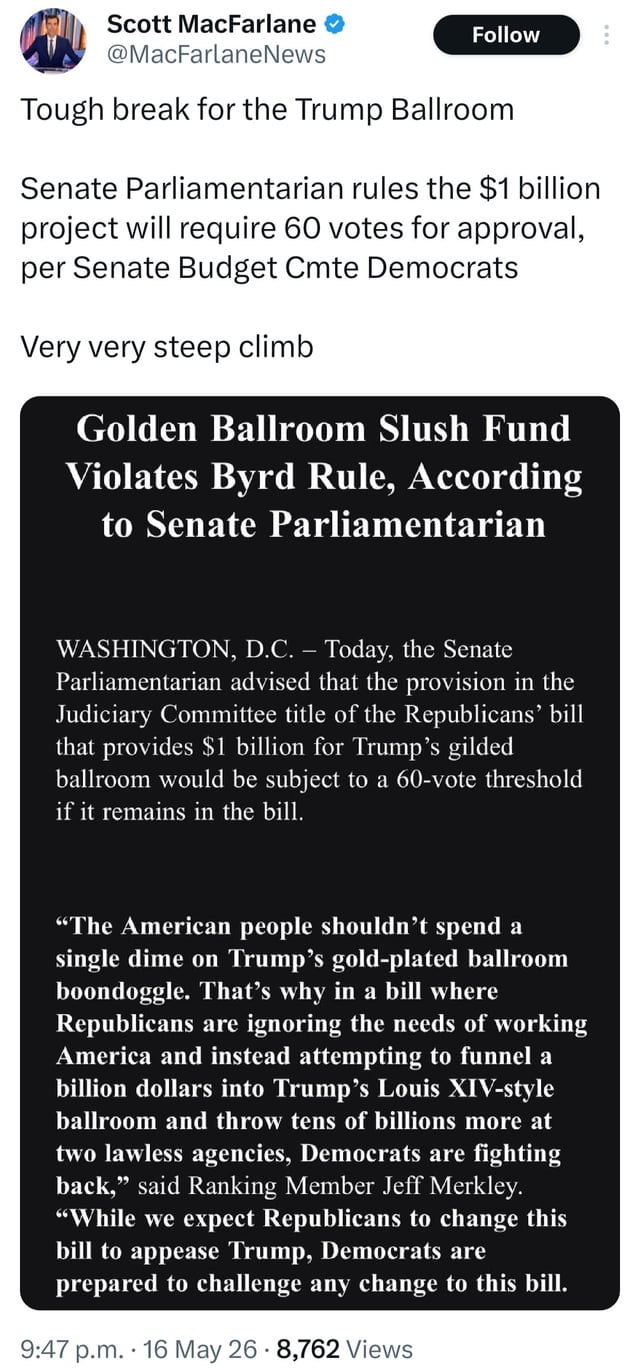
Senate parliamentarian blocks funding for Donald Trump's ballroom in budget bill
The Senate parliamentarian late Saturday ruled against a $1 billion provision intended to fund President Trump’s White House ballroom in the budget reconciliation package.
According to Sen. Jeff Merkley (D-Ore.), who serves as the ranking member of the Senate Budget Committee, the guidance states that “a project as complex and large in scale as Trump’s proposed ballroom necessarily involves the coordination of many government agencies which span the jurisdiction of many Senate committees,” adding that the funding provision is outside the scope of the Judiciary panel.
Earlier this month, the Senate Judiciary Committee — as well as the upper chamber’s Homeland Security Committee — included funding for the new complex in a budget reconciliation bill for federal immigration enforcement.
According to Merkley, Elizabeth MacDonough, the nonpartisan Senate parliamentarian, said the ballroom funds violated the Byrd Rule — a strict Senate provision that prevents nonbudgetary, “extraneous” provisions from being passed through the budget reconciliation process.
“The Parliamentarian’s advice is based on whether a provision is appropriate for reconciliation and conforms to the limitations of the Byrd Rule; it is not a judgement on the relative merits of a particular policy,” the Saturday statement from Merkley’s office reads, adding that any vote on ballroom funding would be subject to a 60-vote threshold.
Amid the setback for the White House, Ryan Wrasse, who serves as the communications director for Senate Majority Leader John Thune (R-S.D.), said the plan is to “Redraft. Refine. Resubmit.”
“None of this is abnormal during a Byrd process,” Wrasse posted to the social platform X on Saturday evening.
The Trump administration has sought to secure the $1 billion to provide security for the new ballroom at the White House, prompting pushback from Democrats and even some Republicans.
Last week, Secret Service Director Sean Curran gave a presentation to the Senate GOP detailing how the funds would be used. The White House ballroom is expected to open in September 2028.
The administration stated that a $220 million investment will focus on installing bulletproof glass, drone detection technologies, chemical and other threat filtration and detection systems, and a host of other national security functions, according to a one-pager obtained by PBS News.
Funding would also be used to counter drones, airspace incursions, unmanned systems, biological threats and other emerging threats through investments in state-of-the-art technologies, the White House one-pager says. The administration’s aim is to also use $180 million for a White House visitor screening facility.
Trump has already secured private donors for the project, but the White House said funds from Congress would be used to improve security. (The Hill)
The ‘Rabid Partisan’ Republican Who Defied Donald Trump
A Republican You’ve Never Heard of Points the Way
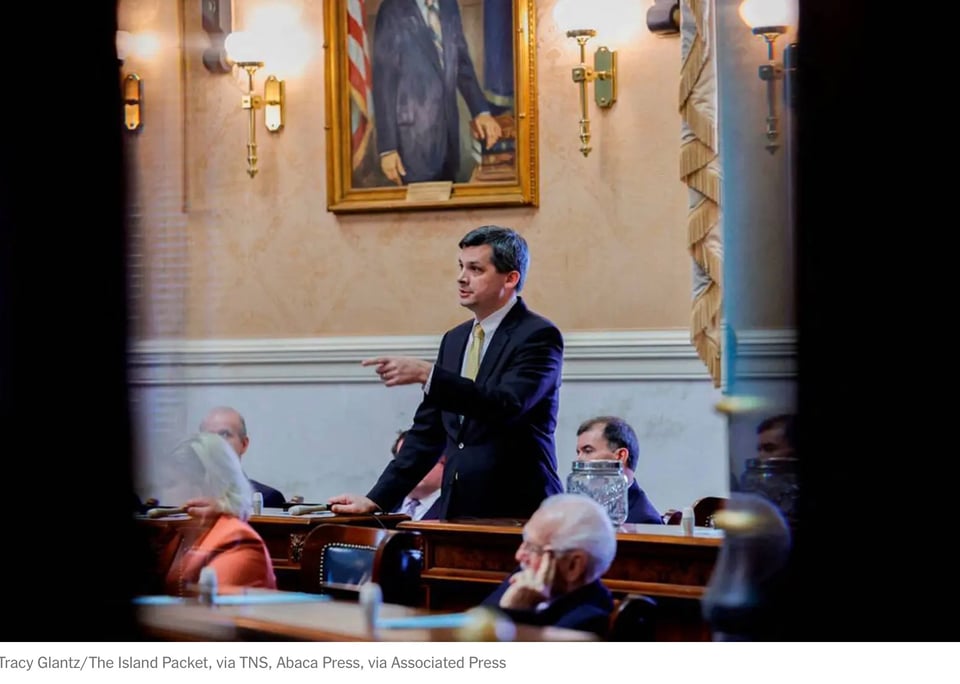
Last Tuesday, the Republican majority leader of the South Carolina Senate, Shane Massey, stood before his colleagues and gave a speech that exemplified two virtues that can seem almost extinct in the Trump Republican Party: wisdom and courage.
Days before, he had received a call from President Trump asking for his support for a midterm gerrymander in South Carolina. Trump wants South Carolina to follow the lead of Texas, Tennessee and other Republican-led states to try to wipe out as many Democratic districts as possible.
But Senator Massey said no. He would not agree to gerrymander Democrats out of existence in South Carolina.
Specifically, he vowed — and voted — to protect James Clyburn’s district. Clyburn is the only Black member of the House from South Carolina.
And when Massey said no, he didn’t just defy a president; he defied many of his Republican colleagues and he undoubtedly defied many of his own constituents. He made his speech one week after Indiana primary voters defeated at least five Republican state senators who’d refused to gerrymander their state further.
South Carolina is already heavily gerrymandered. Democrats usually get roughly 40 percent of the statewide vote in presidential elections, but the state has six Republican districts and one Democratic district.
Massey’s speech is notable not just for its defiance, but for its depth. Using the plain, populist language of a Southern politician (there are lots of y’alls in there), he made both a principled and a pragmatic case for American pluralism.
Before we get rolling on the speech itself, I should mention that Massey is no Republican squish. In the speech, he calls himself a “rabid partisan.” He agreed that Washington Democrats are “crazy.” He said some Democratic ideas are “wacky.” He included a flattering reference to one of South Carolina’s favorite sons, John C. Calhoun.
For those who aren’t familiar with Calhoun, he was one of America’s most reprehensible politicians. He almost split the Union before the Civil War, and he referred to slavery as a “positive good.” Massey also said: “I’ve got too much Southern in my blood. I’ve got too much resistance in my heritage” to capitulate to pressure. This is not a man who’s about to switch parties.
At the same time, however, Massey recognizes that there are issues that transcend partisan politics and that legislators don’t just exist to exercise power. They should also, well, safeguard the Republic, including by upholding the letter and spirit of the Constitution. If any American faction tries to crush its opponents through the use of raw power rather than debating and defeating its opponents in the marketplace of ideas, then it places the American system under intolerable strain.
It’s worth watching the entire speech, but you can also boil it down to a few simple points.
First, our system was designed to divide power not only between the different branches of the federal government, but also between the federal government and the sovereign states. Trump should not dominate the federal government, and he should not dominate the state of South Carolina.
“The separation of powers may actually be the most important governmental doctrine that has been created in the history of man,” Massey said. “It is that important. And what the Congress has done to relinquish their authority to the executive is terrible. And we all see the results of that.”
As for South Carolina, there is “another brilliant creation, and that is of federalism and the sovereignty of the states. I don’t want to be a participant in further eroding federalism and further diminishing the essential role of states.”
Second, Republicans in South Carolina should not try to destroy the Democratic Party in their home state. In fact, Massey made an argument that we rarely hear any politician make. “I will tell my Republican friends: Republicans are stronger when the Democrat Party is vibrant and viable,” Massey said. “We are. Competition makes you better, y’all.”
People often say that America needs two healthy parties. This is a matter of common sense. In a two-party system, power will change hands regularly, and if power is lurching between the competent and the incompetent, between the honest and the corrupt, then the system will not just tip out of balance sometimes, but will be inherently unstable.
We don’t often think, however, that healthy political parties can make each other better. Yet this also makes sense. To defeat a viable opponent, a party has to rise to the challenge. It has to fix its failures. It has to innovate. Defeating a sclerotic rump of a party is no achievement. Instead, one-party rule enables corruption. It fosters stagnation.
This is human nature. If you take a test that you know you’re going to pass, how hard do you study? If you run a race that you’re guaranteed to win, how hard do you push yourself?
Third, Massey dealt directly with one of the most pernicious arguments in politics: You should try to crush your opponents because if the roles were reversed, then they would surely try to crush you. You should, in other words, engage in pre-emptive retaliation for an imagined offense.
What was Massey’s response to the claim that the Democrats in South Carolina would do the same thing to Republicans if they had the chance? “I would hope that wouldn’t be the case, but I’m not naïve. My larger question, though: Is that the way it should happen? ‘They do it to you, so you should do it to them?’ Do unto others as you believe they would do unto you? Is that it?”
“I don’t remember that being the context in the Gospel of Matthew,” he said, “and I don’t think the Messiah meant it only as something to apply to children, but how we interact with each other.”
Fourth, he made a point that every American leader should remember. This nation — the most powerful in the world — cannot be conquered by an outside foe, but it can destroy itself. And it will destroy itself if it abandons its founding principles and its founding values. “Maybe we become convinced that the only way to preserve the Republic is to implement policies that are contrary to the founding ideas of the Republic,” he worried. “Maybe we turn on ourselves. Maybe 250 years in,” we will no longer be able to keep our Republic.
I know that I disagree with Senator Massey on many things, not least on his regard for Calhoun, much less on being a rabid partisan, but if we’re going to get through this terrible national moment, we cannot rely only on our own political allies or a single political party. Our Republic will have to be rescued by people who voted for Trump three times, alongside people who resisted him from Day 1.
I also know that Massey is engaged in an almost certainly doomed struggle. His vote — along with those of four of his Republican colleagues — denied Republicans the two-thirds majority they needed to continue the legislative session and move forward with redistricting.
On Thursday, however, the Republican governor, Henry McMaster, called a special session, and a new congressional map can pass with a simple majority vote.
When I speak in public, I’m often asked what gives me hope. My answer comes from unexpected people in unexpected places who demonstrate uncommon virtue.
At the grand scale, I think of the Ukrainian comedian who has defied the Russian bear. I think of the vice president who found his voice when an angry mob came for his head. I think of a Canadian prime minister who stood up to a president and articulated a compelling vision for preserving the free world.
But the smaller battles matter as well. And now I think of a Republican state senator who knew he would probably lose (and might lose his seat as well), but made his stand nonetheless.
And he made a statement that I’ve longed to hear in the age of Trump: “If we’re going to lose this radical idea of a nation conceived in liberty and dedicated to the proposition that all men are created equal, a nation that in its Constitution guarantees to each state a republican form of government to ensure the debate of ideas — if that’s going to happen, Mr. President, by God, it’s not going to be because I surrendered it.”
“I’m voting no.” (David French, Columnist, New York Times)
One more thing.
Though State Senator Shane Massey refused to gerrymander South Carolina ☝️, Trump found another lackey, and this is now happening.
South Carolina governor calls for a special session on redistricting.
.
Republicans hope to eliminate a majority-minority seat held by longtime Democratic Rep. James Clyburn before the midterms.
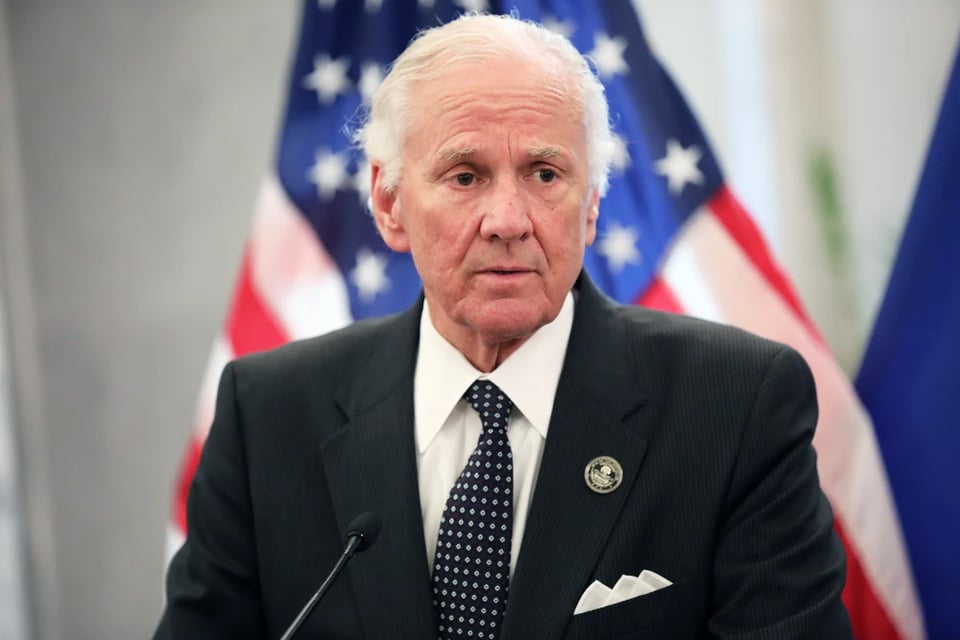
Republican South Carolina Gov. Henry McMaster had initially decided not to call a special session.
South Carolina Gov. Henry McMaster called a special session Thursday for state lawmakers to tackle redistricting ahead of the midterm elections.
new map is expected to eliminate the state’s only majority-minority district, which is held by Rep. James Clyburn, a key Democratic power broker.
“I have issued an Executive Order calling the General Assembly back for an extra legislative session to address the state budget and congressional districts,” McMaster said Thursday evening on X. He said the special session would begin Friday morning.
McMaster initially chose not to set a special session, but he changed course after the Republican-led state Senate rejected a measure this week to extend its current session to take up a redrawn map, despite pressure from President Donald Trump.
South Carolina is one of a spate of Southern states rushing to redraw their maps to create more Republican-leaning seats after the U.S. Supreme Court gutted Voting Rights Act protections against racial gerrymandering in a major ruling last month.
Since then, Tennessee has enacted a new map that carves up the state’s lone majority-Black district, represented by Rep. Steve Cohen. The Supreme Court cleared the way for Alabama to implement a map with one less majority-minority district than it has now. And Thursday, the Louisiana Senate passed a map that targets one of the state’s two Democratic-held seats.
Trump urged South Carolina Republicans on Truth Social on Monday to join the mid-decade redistricting fight.
“I’m watching closely, along with all Republicans across the Country,” Trump posted. “South Carolina Republicans: BE BOLD AND COURAGEOUS, just like the Republicans of the Great State of Tennessee were last week! Move the U.S. House Primaries to August, leave the rest on the same schedule. Everything will be fine. GET IT DONE!”
But there has been some reluctance among South Carolina Republicans to rush to change their map. Five Republican senators denied their party the two-thirds support needed to pass the measure this week that would have allowed them to consider new district lines during their active session.
That group included Senate Majority Leader Shane Massey.
“I believe that our state is stronger with vibrant parties. I think we, as a whole, are stronger when we have a clash of ideas. I think that’s true at the national level. I think it’s true at the state level,” Massey said in a floor speech. “Republicans are stronger when the Democrat Party is vibrant and viable.”
In the special session, simple majority support will be needed in both chambers to pass a new map. (NBC News)
Jack Schlossberg’s world will ‘never be the same’ after sister Tatiana’s death
Jack Schlossberg may be busy running for Congress in New York — but he hasn’t stopped thinking about his late sister, Tatiana.
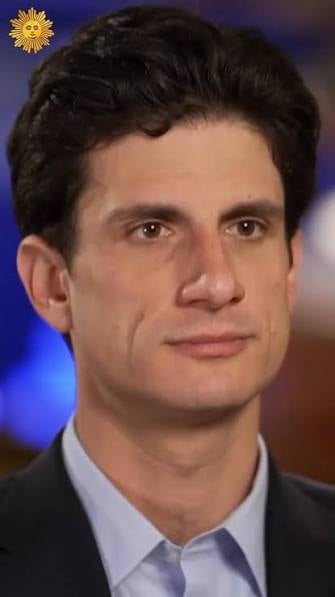
“I don’t think I’ll ever process it ,” he told Vanity Fair in an interview published Friday. “The world will never be the same for me, not only since she passed away, but since she was diagnosed with cancer about two years ago.”
Tatiana, the granddaughter of the late President John F. Kennedy and Jacqueline Kennedy Onassis, died this past December, after being diagnosed with acute myeloid leukemia, an aggressive form of blood cancer, with a mutation called Inversion 3. She was 35 years old.
“She was my best friend. We could finish each other’s sentences,” Schlossberg
said. “I miss her all the time. Every day I think about her.” (Daily News)
A new pleasure in NYC.
25 Pianos Are Waiting to Be Played Outside

Want to play the “Moonlight” Sonata in moonlight? “Here Comes the Sun” as the sun actually comes up?
In late spring or early summer in New York City, you have been able to do so since 2010, if you knew the music. Now Sing for Hope, the nonprofit that puts pianos in parks and public spaces for what it calls “residencies,” is at it again. It has 25 pianos that will be available for anyone to play beginning Monday.
All 25 will be together in an “interactive, open-air gallery” at 28 Liberty Street in Lower Manhattan from 9 a.m. to 3 p.m. At noon, there will be a program with the Broadway star Laura Linney and Ray Angry of the Roots, among others. Then, the pianos will be packed up for delivery to the places around the city where they will spend three weeks in the open.
The pianos aren’t basic black: They have been painted, some by visual artists, two by cast members from Broadway shows like “Aladdin” and “The Lion King.”
They are old uprights that have been reconditioned. They may not be concert hall-ready after a few days: Heat and humidity can make a piano sticky. Rain can be ruinous, though Sing for Hope has “rain jackets,” and people to stretch them over the pianos when the weather turns hostile.
The pianos will be on the streets until June 7. Then — after being tuned again and repaired, if necessary — they will be placed in schools, hospitals and community centers.
A 9/11 origin story
Sing for Hope began informally after the Sept. 11 attacks in 2001, when the two women who founded it, Monica Yunus and Camille Zamora, were students at the Juilliard School. They found themselves “trying to figure out what on earth is the point of being a musician when the world feels like it’s ending,” Zamora recalled this week. They heard that all 11 firefighters from Engine 40/Ladder 35 had died after going to the World Trade Center that morning. Another, diagnosed with kidney cancer years later, died in 2017.
Yunus and Zamora started performing on the street after the 9/11 attacks and went on to build their careers. They organized Sing for Hope in 2006 and, in 2010, they had the pianos-in-the-streets idea. For the first couple of years, they worked with Luke Jerram, a British artist, but later parted ways with him.
Piano lessons
Putting pianos on streets and in the parks, they learned to be ready for anything. In 2010 someone dismantled a piano, piece by piece, putting the keys in one pile, the hammers in another and the strings in another. In 2011, a piano in the Bronx went missing. Someone apparently wheeled it off in the middle of the night.
During the pandemic, Sing for Hope changed from a mostly volunteer operation to what Zamora called “an all-paid model” that sent performers to the Javits Center for two hours a day while vaccines were being dispensed.
Yunus said the change had involved Sing for Hope in “finding new ways to employ artists when, for example, there may not be as many recital series that pay as there used to be 20 years ago.” The group now pays freelance musicians for appearances at city-run hospitals and at the Moynihan Train Hall (as well as Union Station in Washington and in other cities).
But, for the next three weeks, the focus will be on the pianos in parks and public spaces.
“One of the things that we’re very proud to have figured out is how to keep the pianos basically healthy,” Zamora said. Another, she said, is that “everybody is a musician, and we’ve always held to that. Everybody has that creative spark.” (New York Times)

