
What we carry, and what carries us
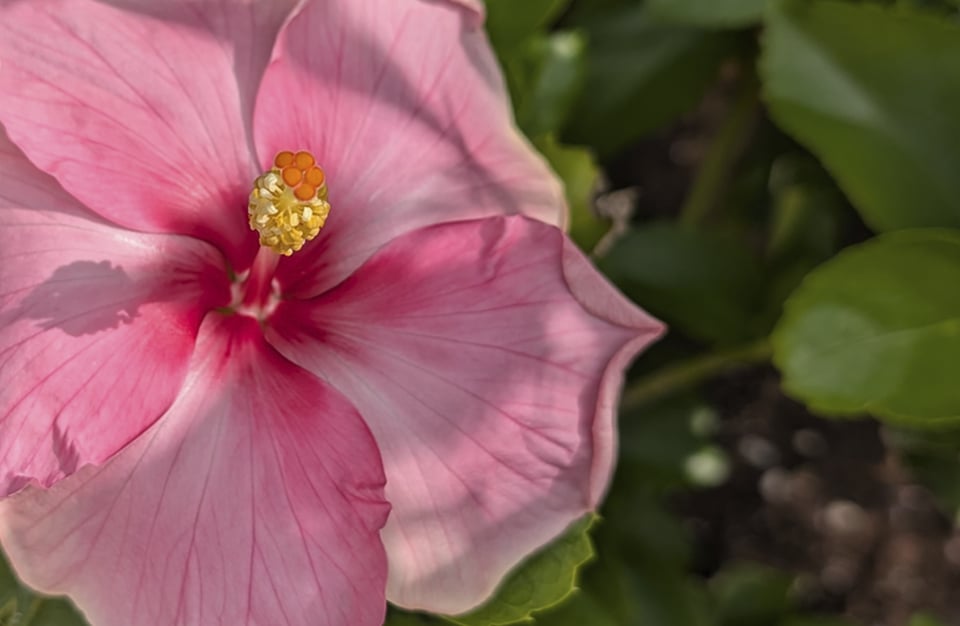
September is here already, a month of seasonal change, serious art, and the start of the fast track to the end of the year.
In this edition, I continue to mix things up, shaping the newsletter as it feels right for the feelings and people featured.
This month came about organically, in conversation, sharing with loved ones, getting excited about the possibilities of a subject.
What originally made sense for me during "Hispanic Heritage Month," a feature on Mexican American artist Paloma Mayorga and my beloved flower jamaica (hibiscus, for my US friends), turned out to be something completely different.
Thanks to Paloma and my research, I learned that jamaica, the flower I grew up drinking in agua fresca, which I thought was Mexican, was indeed not Mexican at all.
It came from Africa and spread through the Americas via the slave trade.
This has changed my perception of a drink I keep in my house at all times, that accompanies a big chunk of my meals. I'm eager to share some of what I've discovered about the flower, about how we transmit knowledge, history, and whole worlds within us and our interactions.
¡Vámonos!
In this issue:
Where have you been? (4 min read)
Flower Taco by Shea Little (4 min read)
Grounding and returning: A conversation with Paloma Mayorga (20 min with paid subscription, 13 min. free version)
Where have you been?
I guess I'll start with the oldest records I found: The Hibiscus sabdariffa (roselle) shows evidence of existence in Sudan since roughly 4000 BCE. One of Africa's oldest cultivated plants: for its edible seeds, its leaves, and the red calyces used in drinks.
From there, it traveled. Three separate routes out of Africa:
North to Egypt as karkadeh, sometimes called the "tea of the Pharaohs," drunk by royalty, still central to Egyptian and Sudanese wedding toasts and hospitality rituals today.
West across the Atlantic via the transatlantic slave trade (a forced crossing, unlike the others); enslaved West Africans carried the seeds and the know-how. In Jamaica, it became sorrel, a signature Christmas drink.
East to Asia: India, Malaysia, Indonesia, Thailand, through trade networks, easily adopted it into their cuisines.
As for Mexico? A few theories. Maybe from the Philippines via Spanish rulers circa 1565, when the Manila galleon route first opened. Maybe from a colony in Jamaica, which would explain how it got its Spanish name: jamaica, even when it has no specific roots on the island. However, once it arrived, it became unmistakably Mexican.
Over 250 species of Hibiscus, but only a few carry the cultural weight for food and drink. There's sabdariffa, the red drink: bissap, karkadeh, sorrel, jamaica. Rosa-sinensis, the ornamental: China rose, Hawaiian hibiscus, Bunga Raya. And syriacus, Korea's Rose of Sharon, mugunghwa, with its association with the nation dating back over 1,400 years. The Silla Kingdom was called the "Country of Mugunghwa." Never codified into law. Treated as the national flower anyway, by long custom, named in the anthem and stamped across government symbols to this day. The never-withering flower was built into national identity as a symbol of resilience.
Two other variations were instrumental in practical and civilizational advancements: cannabinus (kenaf), a major industrial fiber crop with roughly 4,000 years of cultivation history. And tiliaceus (sea hibiscus, Hawaiian hau), one of the Polynesian "canoe plants," used for cordage, clothing, and tapa cloth. Huge in Pacific seafaring technology that predates European contact.
There's a LOT of interesting information. If you're curious, please reach out; I have good links on health benefits, science, and history.
I'll focus on what stood out to me most.
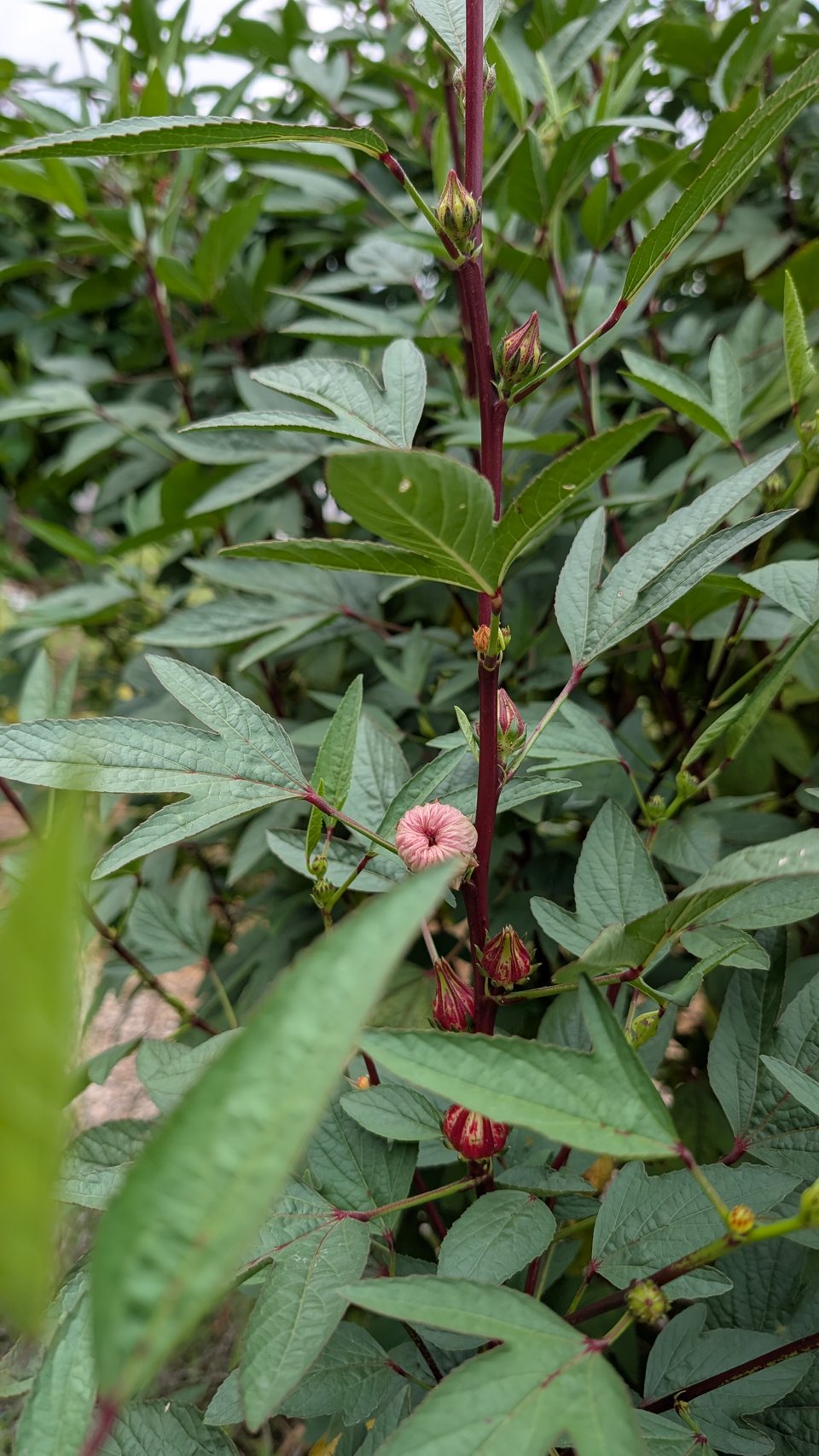
The next big discovery while writing this piece was the hibiscus tie to Texas and Juneteenth. I've been learning a lot about this celebration lately. If you haven't, go back to the archives and read the first edition of Yes, Please and Thank You, where Hakeem Adewumi shared his views and hopes for Juneteenth and Texas, along with a beautiful exhibition on view at the George Washington Carver Museum in Austin through October 10, 2026.
Here's the thing: there's a red-food custom at Juneteenth, with hibiscus specifically tracing back to Yoruba and Kongo peoples of West and Central Africa, brought to Texas in the final decades of the Atlantic slave trade. In West African hospitality culture, hosts welcomed guests with red-hued drinks from two plants: hibiscus (stewed into a reddish-purple tea) and kola nut (chewed or steeped). The red color itself carried spiritual weight in Yoruba and Asante traditions: sacrifice, transformation, ritual offerings to ancestors.
That plant and knowledge crossed the Atlantic with enslaved people as one of the few pieces of home they could carry. In the American context, red drink evolved into red lemonade, then red carbonated sodas by the late 1800s, and brand names like Big Red and Kool-Aid over the decades that followed. I get it, expansion, but isn't it heartbreaking that we take sacred things, dilute them, add stuff they don't need, and sell them back to ourselves? Regardless, the plant remained, and luckily, hibiscus itself has re-emerged more recently as celebrations have reached back toward the plant's actual origin rather than its commercial substitutes. Finally.
Isn't this all surprising? The power of the plant, its uses, the stories, its journey across the whole world. How unassuming it can be. How we've sometimes removed its sanctity and connection to nature while trying to commercialize it. And how we've always been pulled to come back to ourselves.
I love my agüita de jamaica so much more knowing how much it has traveled. Africa continues to amaze us and fill our lives with incredible things. The fact that history is never truly lost, even with excruciating efforts to hide some of it.
That drink that has real benefits for our health, that cools our bodies naturally, that has the same color as wine, it connects us, carries love, wisdom, care.
We are all better for knowing it.
I say, lifting my glass: no sugar, just the tangy goodness and water my body loves.
Salucita to you, my friends.
Flower Taco
by Shea Little
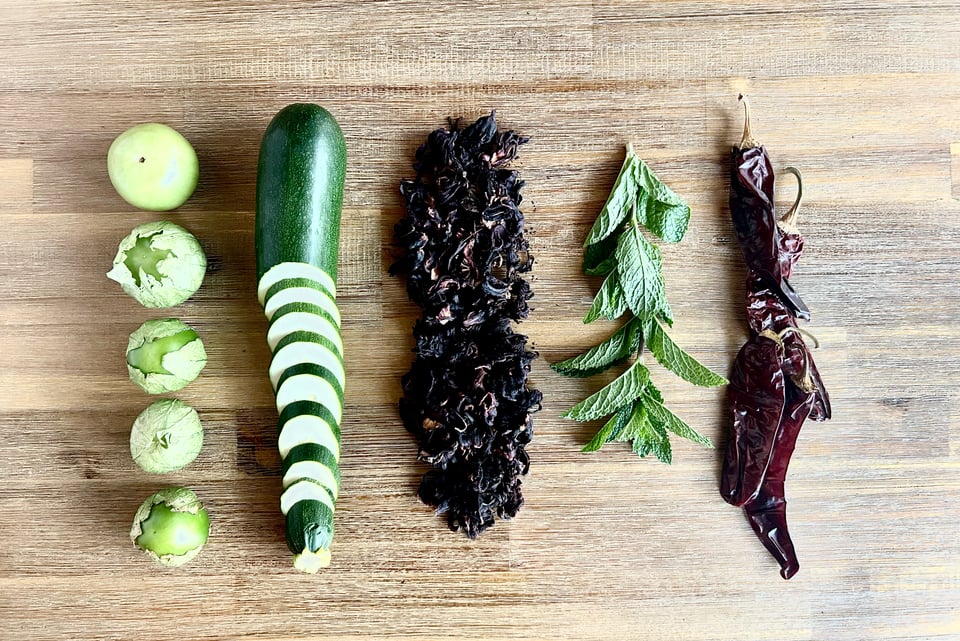
I learned about eating flor de jamaica (hibiscus flowers) from someone on instagram and instantly wanted to try making it for myself. I love agua de jamaica (hibiscus tea) and I love the idea of using the flowers for another purpose instead of tossing them in the compost. I have tried a few different recipes and methods of cooking the flower. It has taken me a fair amount of experimenting to get to this recipe. And I think I have a lot more to explore when it comes to cooking this flower. The tangy qualities of agua de jamaica seem to get stronger and deeper when you cook the flowers. I hope this opens a new door for you to explore in the kitchen, and I hope you enjoy these flower tacos!
These tacos are a great stand-alone dish, but could easily be served with sides. I think this recipe makes around 6 tacos, and it takes whatever time it takes to make.
Agua de Jamaica
Flor de Jamaica - 2 cups
Water - 10 cups
Salsa
Tomatillos - 5
Jalapeños - 2
Garlic - 1 clove
Cilantro - 1 bunch
Mint - 2 sprigs
Olive oil - 1 tablespoon
Salt
Tacos
Leftover Flor de Jamaica - ~2 cups
Zucchini - 2
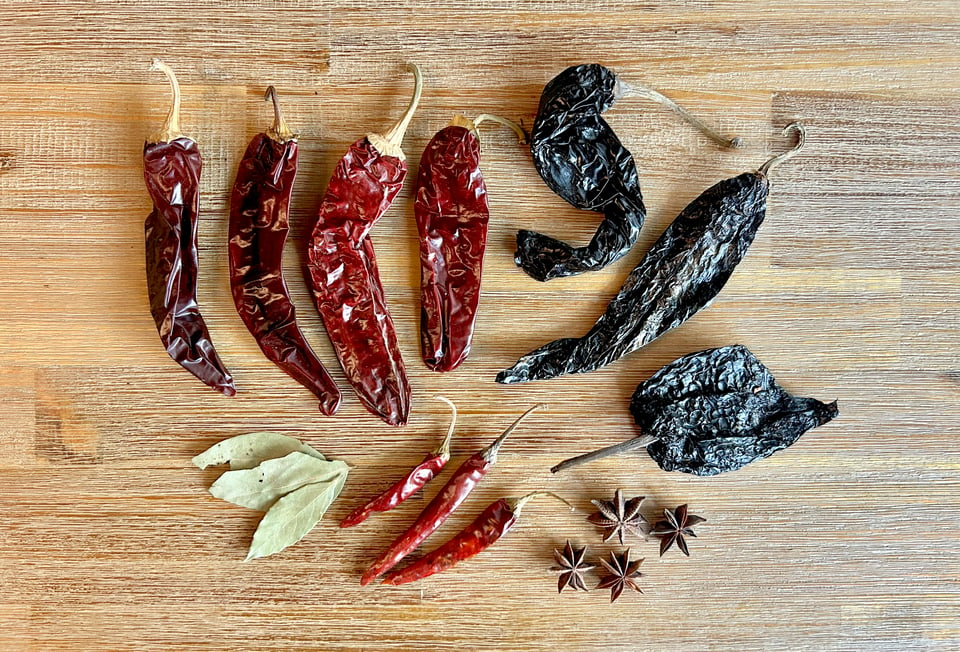
Chile Guajillo - 4
Chile Pasilla - 2
Chile Ancho - 1
Chiles de Árbol - 3
Star Anise - 4
Bay Leaves - 3
Corn Tortillas
Queso Oaxaca
Water
Salt
Directions
1. Make the agua de jamaica. Bring a large pot of water to a boil and add the jamaica. Reduce the heat to a simmer and cook for about 15 minutes. Using a pitcher or other vessel that can hold around 10 cups of water, pass the tea through a strainer and set aside the flor de jamaica. Add water or ice as needed to dilute the tea and fill your pitcher. Now you have a delicious tea. It will be very tart, so add honey, agave nectar, or your preferred sweetener if you like.
2. Make the salsa. This step can happen whenever it makes sense. Peel the tomatillos and wash them (save the husks; if you are making your own corn tortillas, the tomatillo husks are very useful). Deseed and devein the jalapeños. Combine all ingredients in a blender and make a semi-chunky puree. Add a bit more olive oil if the salsa is a little too thick and chunky. Salt to taste.
3. Slice the zucchini into medallions and then into quarters. Sauté and add salt to the desired amount. Once fully cooked, semi-translucent and slightly browned, remove from heat and set aside.
4. Deseed and devein the Guajillo, Pasilla, Ancho, and Árbol chiles. I like to cut a slit down one side and open them up to do this. Soak them in hot water for about 15 minutes. Then blend the rehydrated chiles to a smooth consistency. Strain the chile sauce through a fine mesh sieve to remove the tough chile skin. Then put the sauce into a hot pan with a little oil. The sauce should bubble at first, almost as if it was frying. Reduce the heat to a simmer.
5. Add the leftover flor de jamaica, star anise, and bay leaves to the chile sauce and cook for a while. You want the jamaica to be soft and chewable. It will stay a little chewy when it's ready to eat, but it does need to cook for a while to soften it up. Salt to desired taste. Add water as needed to keep the sauce going; you don’t want all the liquids to cook off. I think I added around 3 cups of water over around an hour of cooking. It kinda reminded me of cooking risotto. When the jamaica is soft, you’ll have to sample it all along the way, and from this you can adjust the sauce as needed; let the liquids all reduce off so you're left with delicious, moist but not wet, flowery goodness.
6. Time to make the tacos! The zucchini will probably need to be reheated at this point, or you can make it as the jamaica stew is coming close to completion. Heat your corn tortillas on a comal and add a good amount of shredded queso oaxaca to the tortillas, covering one side fully. Once the cheese begins to melt a little, flip the cheese side face down to grill the cheese to a perfect crispy brown. Add the zucchini and jamaica stew to your cheesy tortillas, top it all off with the sauce, and enjoy!
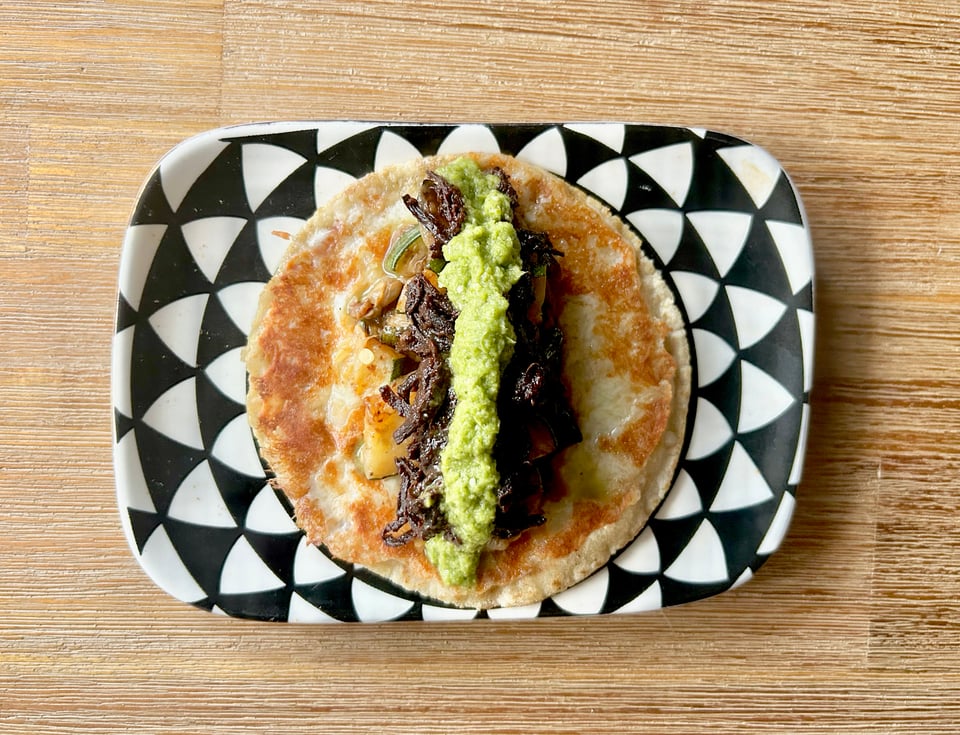
When I tell you you MUST make this recipe, I'm not joking. Every ingredient is delicious, barely any waste, and the flavors are so natural and nutritious you'll feel like a five-star chef in your own kitchen. If you have any questions or want extra directions, reach out!
Grounding and returning:
A conversation with Paloma Mayorga

I talk about Paloma Mayorga and her work all the time. I’ve known her for many years; we’ve gone through a lot together, both personally and professionally. She’s had a deep impact on my life, and I’m constantly grateful for it.
Paloma is first and foremost an artist. Her work spans contemporary, multimedia art, but you can also see her artistry in the way she cooks, the way she builds community, how she presents herself, everything.
She has a very unique sensitivity that is embedded in everything she does.
Luckily for the Austin community and me, she is very active, so we can experience her projects often, and it is always a treat.
Aside from being an artist, she is someone I like to have around; she makes me more thoughtful, to dig deeper; she’s made me look for the beauty and softness I wouldn’t have the patience to notice otherwise.
Since I started the newsletter, she’s been on my list of people I wanted to feature, and this month seemed perfect.
Before meeting with Paloma for this interview, she told me she had a surprise for me. She had sculpted three flowers honoring this project. I was in awe and started with the interrogation…
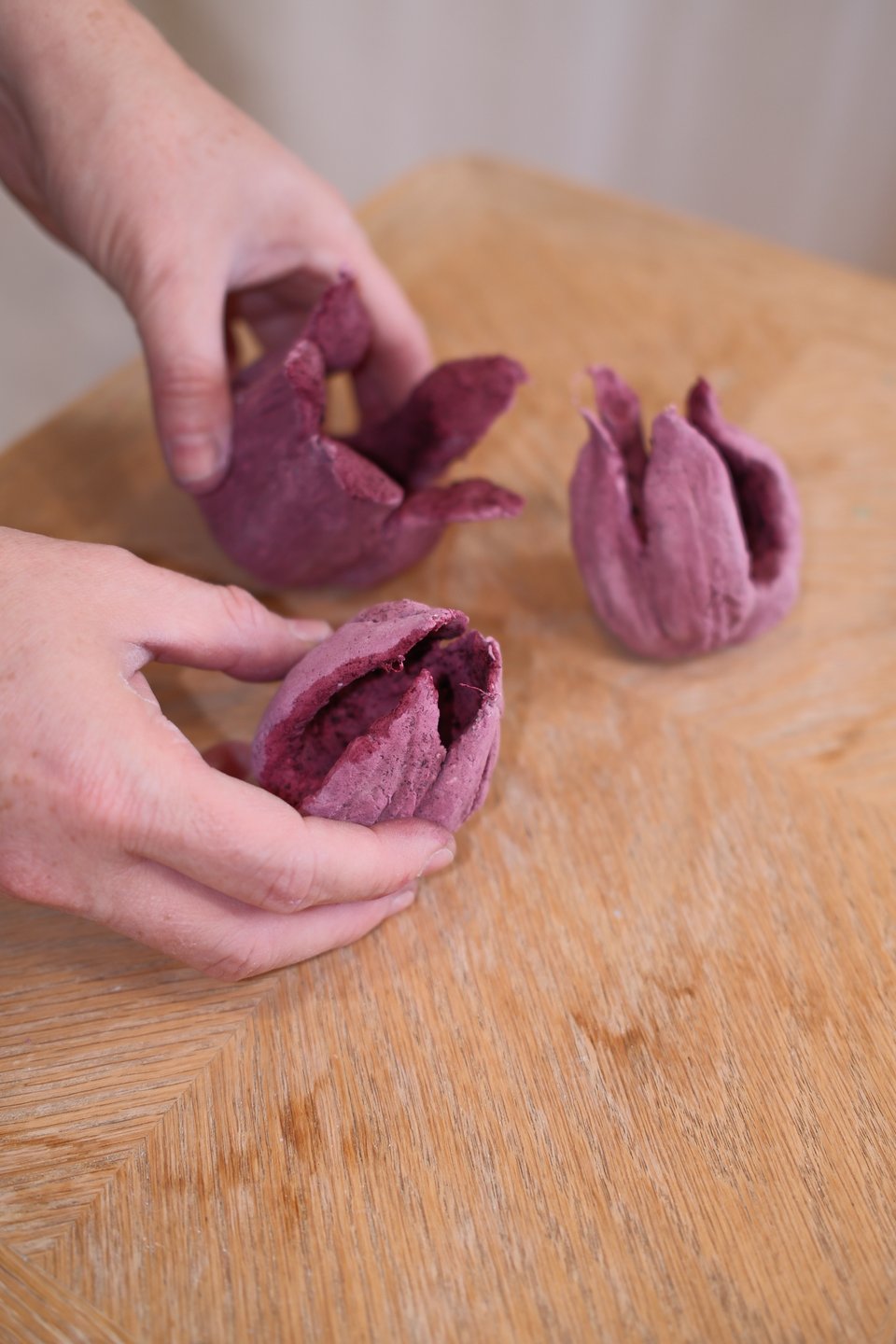
Georgina: Can you start by telling me about the beautiful sculptures that you made?
Paloma: These are paper clay sculptures that are modeled after the roselle hibiscus. They're in the shapes of roselle flowers at different stages of opening. I made them with paper clay mixed in with ground-up hibiscus, some from previous installations that I saved. If you hold them close to you, you can actually smell the hibiscus.
I've been playing around with the color. Even though the color is so intense in the tea, the natural pigment oxidizes really fast and turns blue. You can see it in some parts of the sculpture where I had bigger pieces mixed in. These are experiments. The hibiscus powder didn't oxidize quite the same way, but it was interesting trying to extract the dye.
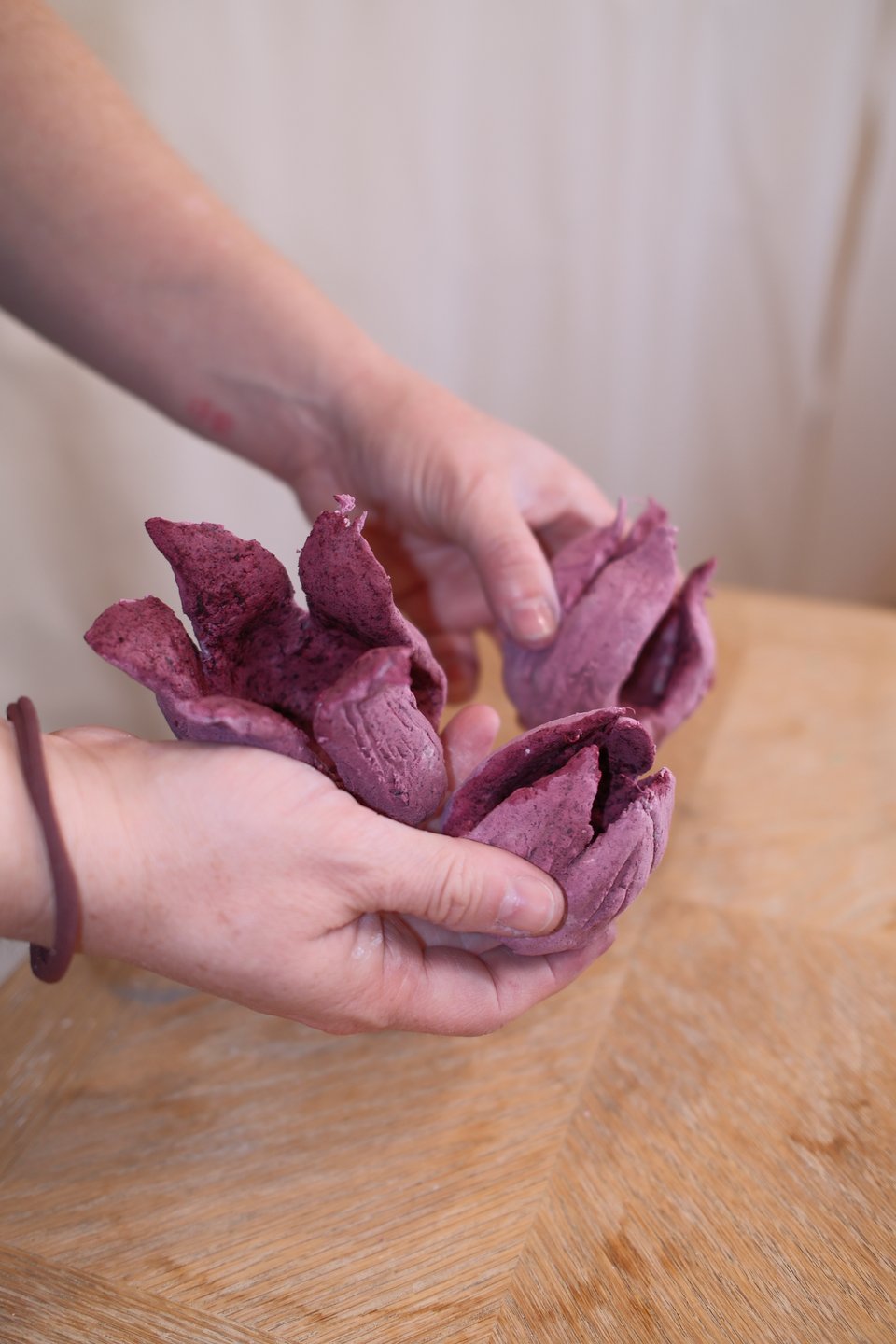
I'm interested in making light fixtures eventually, or ornamental functional pieces for the home. I've been thinking about how colors and smells that we're familiar with, having them constantly in our homes, help us feel more grounded, more nostalgic. It's about remembering things, for the health of our brains. I want to make things that make your home feel more like home.
That is actually true. There's a growing body of research on olfactory memory: how smells are processed in the brain's limbic system (emotion and memory centers). Hibiscus's distinct tangy smell is one of its most powerful characteristics.
Georgina: I know a little about your process, so I know you've worked with jamaica before. Can you tell me what's special about it for you?
Paloma: Jamaica is super prevalent in Mexico and in a lot of culinary practices. It's one plant I associate with my childhood, making agua de jamaica, and more recently learning that you can eat them. I've been thinking about how different plants trigger memories, and this whole area of botanical wisdom, how the smells, the colors, the taste of plants hold space culturally, emotionally, and familiarly in our lives.
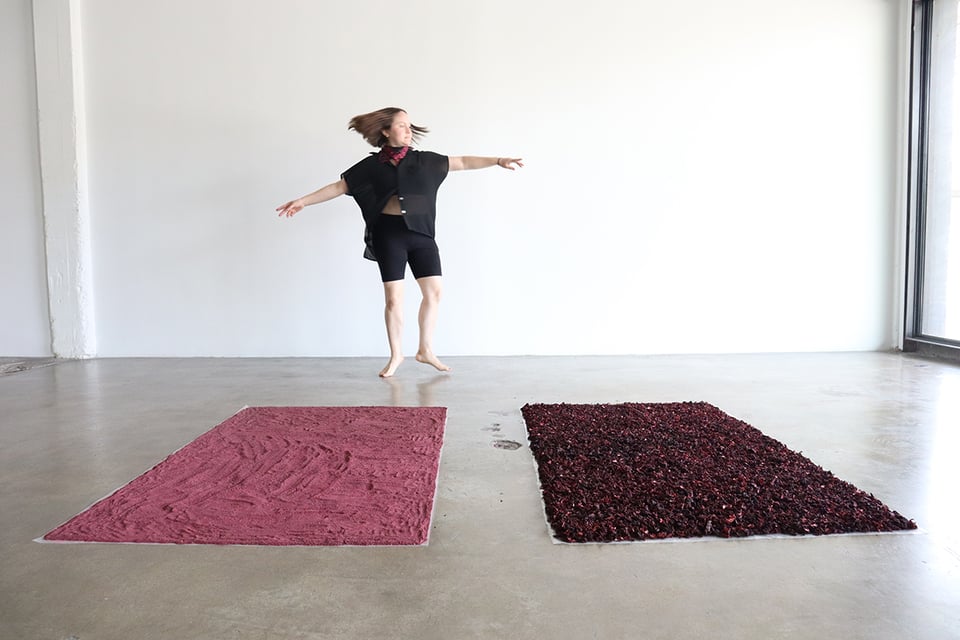
I first worked with jamaica for my installation for Yo Trabajo Con La Tierra that I curated at Big Medium in 2022. I preserved some of the flowers, sun-dried them, ground them up, and created this powdery pink, soft rose color. I made two rectangular shapes side by side to symbolize the graves of both my grandmothers to honor their connection to nature.
Georgina: So would you say it's about memory and inheritance?
Paloma: Yes. My parents migrated to this country, so there was less time spent with my grandmothers. After they passed, I started learning more about them through stories living relatives shared. My dad's mom was really into plants; she knew all their names, but that's not something I ever shared with her. Working with these plants from my childhood is a way of learning more about them, learning how to cultivate them, and how to use them. It's part of the cultural practices of diaspora to heal broken intergenerational relationships.
Georgina: I’ve been working a lot on connecting with my inner child lately, and this felt like something that could be tied to it. Would you say the work is connected to your inner child?
Paloma: I think within my art practice there's work being done to connect to my inner child. Connecting to things that were prevalent in my childhood is a way of grounding myself. I started my own garden; I'd tried before but was disconnected, and everything dried up, which was demoralizing. Now I'm more intentional about learning how to treat the earth and the plants so they provide what you're asking from them. It's about developing that symbiotic relationship we all have with plants.
I don’t know what has been happening in the last year and a half that plants are suddenly more resistant, or maybe we’re more attentive. I’ve shared with y’all my journey with nature, and the amazement that both the datura and dipladenia flowered constantly last year and this year (the dipladenia is still going, mind you!).
My theory is that the state of the world is so hard to process that nature is the only thing that makes sense, and being closer to it has such invaluable healing powers that if we let it, it’ll keep calling us back. I am so grateful for this “discovery”. Anyway, it is interesting how I would have assumed that Paloma was like Snow White and had all plants and animals singing to her, yet she is also going through some transformation, and she is doing a lot with it.
Georgina: How does that translate into art?
Paloma: I'm trying to extend the way I incorporate these plants into my life; through eating, drinking tea, digging my hands in the dirt. It's a very physical thing. I'm trying to translate that into the artwork. With these sculptures, I bring familiar scents and colors inside the house. With other work, I'm exploring that relationship, trying to understand it better, to separate from the everyday ritual and have more intentional time to think about these practices. The everyday can get so automatic. I'm trying to actively think about these practices.
Georgina: Hibiscus wasn't a thing when I first moved to the States, and now it's very trendy. Does that feel any particular way for you?
Paloma: I think there are so many people trying to reconnect to their roots, especially as generations get further disconnected from their ancestors' places. I think it's just that people are trying to understand their roots to see how we can make things better. So many systems now are broken; they don't prioritize people, they don't prioritize nature. The more we see these systems aren't working, the more we're like, "Let me understand where I come from. What was my ancestors' connection to land, to nature?"
I think that's why it became trendy. First of all, it's a beautiful color. But it's an acquired taste; it's so tart. It's not immediately enjoyable. But I think people are at a point where they want what's authentic, not just what's palatable. What's true to yourself and your family's history.
Georgina: To me, it sort of pisses me off. I love it because I’ve loved jamaica forever; in Mexico, that's what you drink instead of sodas. It's ever-present. But I feel like everything is so disposable nowadays. I'm sort of expecting people to use it and then leave it.
Paloma: I understand that; you become protective of something that was just an everyday thing. But other people's exploitation of something meaningful to me doesn't change my relationship to it. I still hold my own relationship first. I recently learned about the history of jamaica coming from Africa and being something that was brought over and passed down through the slave trade. I think it talks more about the shared experience of one particular plant. For me, it does more connecting than disconnecting.
And as a visual artist trying to make a living, I understand the need to monetize something you feel passionate about. I think a lot of the trendiness, at least within the Latino creatives community, is coming from a good place.
Point taken.
Georgina: It blew my mind learning that it came from Africa! To me, it's as Mexican as the color rosa mexicano.
Paloma: I believe within the West African community it was used in "red drink" with ginger and spices, brought to the US after Emancipation. In the States, it was used by people in the South and people working the fields to cool down because, scientifically, it's good for circulation and lowering body temperature.
And then in Mexico, people prepare jamaica y canela; it's never really just jamaica. I realized this recently when I'd go to my dad's, and he'd make it. I asked, "Did you put something else in it?" He replied, "Canela, como la preparaba mi mamá." It's not powdered cinnamon; you steep the cinnamon stick in jamaica. I went to a friend's mom's recently, and it was the same thing. She said, "Of course. That's how you prepare it."
Georgina: Oh wow, I had no clue. I think I grew up with the flavor packet!
Upgrade nowThis is where the conversation gets deeper.
To stay in it with us, Milpa Press, the work she won't compromise on, and where all of this is headed,
By the way, aside from all the work you're doing, what do you do for fun or joy? How do you deal with it all?
Paloma: I do a lot of things at home now. One of the nice things about the heat in the summer is that you can just stay home and wait for the heat to pass. So I've been getting into just really weird hobbies; weird for me. In my early 20s, I was so focused on making art that whenever people would ask me about hobbies, I'd say, "I'm an artist, I don't have hobbies." I was very proud of that. But now I haven't been creating as much, and because our time is limited, there are all these different hobbies I've been wanting to try.
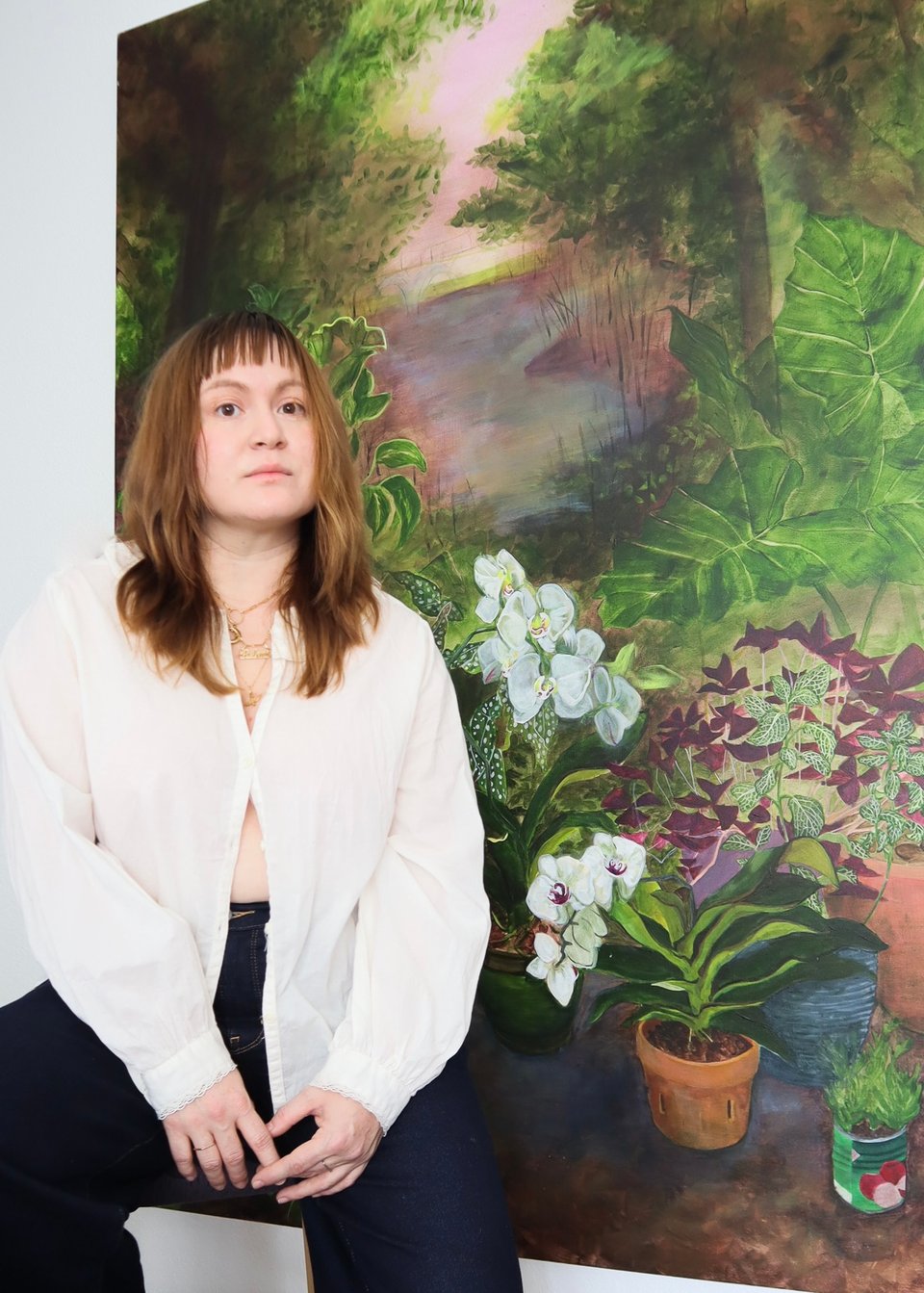
I've been learning how to knit and crochet; that's already worked its way into my art. I'm working on my garden. I started fossil hunting, spending more time in nature, going on more hikes, and spending quality time with people I really care about (if you can call that a hobby). I feel like I can do that too. It's just about finding time to build and rebuild human relationships that mean something; remembering that things are good despite all the shitty things happening politically. Spending time rebuilding good relationships with good people.
I think that's something I really appreciate about you and what you're doing with the newsletter. We just need more; we need to be reminded that there is goodness in the world, and that it's going to be stronger than everything else.
Following, you’ll get to witness my corniness and the love fest for a second too 🫠
Georgina: I hope you know that you have such a big influence on me and on the newsletter in particular, like me reading your artist newsletter and crying steadily. You've injected so much tenderness and kindness into my life. I don't think I would have reached this without you in my life. You are a big part of this.
I'm so glad you're liking it and that it's not causing eye-rolls!
Paloma: Oh my gosh, no.
Georgina: It is so important to have you be part of this.
🖤
Georgina: Back to hibiscus. Maybe we should mention that the recipe going in this newsletter is something we enjoyed together.
Paloma: Yes. I think that was a really special moment. One, because we hadn't had a meal together in a very long time (not counting our hangout). And also really special that Shea prepared it. And then, to add the cultural element, eating hibiscus is something that's becoming more common, but it was a newer thing for me in the past five years. I was so used to having it as just agua. It's evolved to be consumed in different ways. Eating hibiscus is not new, but it is new for me. Having that meal with you and Shea was a reminder that culinary experiments can be really fun and can be something we share. I think about how many meals in my family happened around the kitchen table. Having hibiscus be the thing that brought us together, that's really something special.
Georgina: I agree. And adding that we thought about this together while eating at Nixta and other local places. It talks about who you choose to surround yourself with, who you're supporting, where you're spending your time. There are such good people around town doing necessary things.
It's really a privilege to be here.
Thank you for reading, friends!
I keep coming back to that image: a seed carried across an ocean in a pocket or a memory. Something so small, so unassuming, that held an entire world inside it. That's what we do, isn't it? We carry what we love. We pass it on. We trust that it'll find ground somewhere.
This issue made me ask: what am I carrying that I thought was mine, but actually came from somewhere else? Who transferred the things I love most about myself, and how do they keep moving me?
I'd love to know what you're carrying and what's carrying you.
🖤
If your practice, brand, or institution is looking to carry different values forward, I'd love to talk. You can find me at georginatrevino.com for an intro call.
For speaking and programming inquiries: [email protected]
