
Solidarity and Care
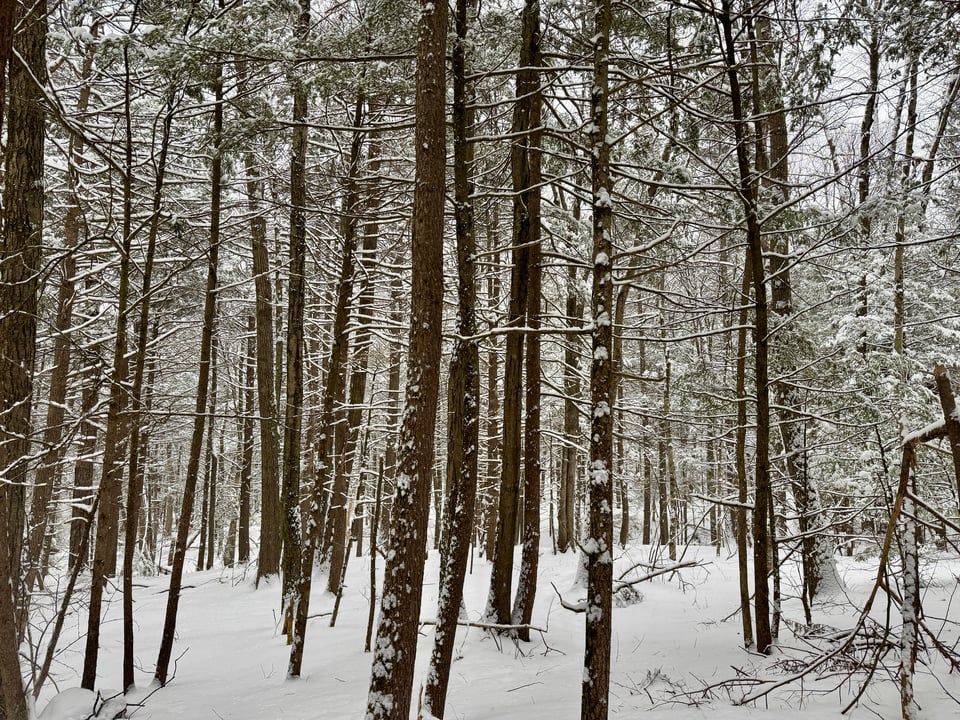
The early February woods are cold. Not much moves; even the water in the little brook flows invisibly beneath a concealing shell of ice and snow. A couple of warm days last week invited some of the wildlife out of their dens, leaving tracks of varying sizes criss-crossing the snow. But the cold has returned, and the woods are quiet again.
Not me, though! I’m here talking (well, writing) about it—though not outside, or all you’d hear would be my teeth chattering. No, like the rest of my woodland community of creatures, I’m hunkered down for what I hope will be the last deep freeze of the season. And so I’m in here thinking. As I do.
The severe cold and deep snows that many areas of the U.S have experienced this winter have, of course, brought out some of the usual dismissals of global warming and climate disruption, even though it’s the warming of the Arctic that appears to be driving the extreme cold further south. While I think climate denial has deeper ideological roots than people usually admit, the way people talk about it often seems rooted in local conditions: global warming can’t be real if winter in New York is still cold! Sea level rise can’t be leading to worse and worse flooding if it’s still nice to go to the beach! It’s as if a disruption in global systems couldn’t possibly be happening if it’s not simultaneously catastrophic everywhere. So if it’s not obvious where you are, deniers will tell you, maybe it’s easier not to think about.
This goes not only for climate change, of course, but other disasters like war, displacement, genocide, exploitation, disease, destruction and abandonment. For starters, that’s a lot to keep up with, and of course anyone’s ability to survive and resist these things is going to be focused very much on the immediate situation. When you’re in the middle of a crisis, it may feel more like chaos than clarity, but there’s an obvious need to focus on those circumstances. When you’re not at the center of a crisis, on the other hand, it can be harder to decide where to focus. Especially if you encounter an attitude I sometimes see toward those of us who care about non-local conditions and catastrophes, the one that goes, “Why are you getting so upset about things that don’t affect you?” And I end up wanting to ask, “Are there things that don’t affect you?”
Now, I do think it’s sometimes useful to distinguish between things that are literally happening to you right now and need to be addressed—those crisis situations I just mentioned—versus things you are learning about happening elsewhere…but they are all affecting you. They are affecting all of us.
In my first issue, I talked about the fact that we—for any definition of “we” that you like—are literally all interconnected in numerous ways. We share the breath, water, and substance of this planet to sustain ourselves, for example. What happens elsewhere in this world, no matter how far, affects all of these things we are connected to. People in my area thought wildfires hundreds of miles away didn’t affect us…until the air got smoky and people had to mask up or stay indoors.
But I’m not just talking about the physical impacts that distant events can have on our bodies. I’m also talking about emotional and spiritual impacts. It hurts to know other people are hurt. (Human and non-human “people” alike.) I like to think, deep down, we all feel this. We know this. But I also think that’s why some people are so invested in not caring, in not learning—because of the pain that would result if they did.
Also in that first issue, I mentioned how I didn’t care for the sentiment that human concerns don’t matter in the grand scheme of things, arguing that we can’t detach the “human” from the “natural” world. That it’s all interconnected and interdependent; everything affects everything else. Here, I’m deepening that to say that we also can’t reduce our level of care for “everything else” simply to how it will affect us (either personally or at the species level). I think doing so only reinforces the separation that feeds oppression. When people argue that we should care about a species going extinct because we’ll lose something it could give us, or that we should help a stranger because we would want someone to do the same for us, they leave the actual well-being of others completely out of the equation, and reduce caring to selfishness.
Maybe the problem begins with needing to find a reason to care.
When I first read Peter Kropotkin’s book, Mutual Aid: A Factor in Evolution, it was a breath of fresh air to read words like the following:
“Love, sympathy and self-sacrifice certainly play an immense part in the progressive development of our moral feelings. But it is not love and not even sympathy upon which Society is based in mankind. It is the conscience — be it only at the stage of an instinct — of human solidarity. It is the unconscious recognition of the force that is borrowed by each man from the practice of mutual aid; of the close dependency of every one's happiness upon the happiness of all; and of the sense of justice, or equity, which brings the individual to consider the rights of every other individual as equal to his own.” (p 10)
Despite the antiquated “man” and “mankind” language, this idea that it’s not just love or sympathy for individuals at play, but a larger sense of unity really resonated with me. And though this passage was focused on human solidarity, a good chunk of Kropotkin’s book is spent delineating the importance of solidarity and cooperation among non-human animals as well. So I don’t think it’s too far a leap to apply this thinking to cross-species and ecological solidarity, too.
So why care? Why help someone in pain? Because I can. Because they’re hurting. Because.
And I think it's when people forget this sense of solidarity, or never learned it, that they feel entitled to oppress others. Unfortunately, this compounds and cycles, because not only do people come to believe they are not connected to others (and therefore not affected by the cruelty they inflict), and not only do they directly harm those on whom they inflict that cruelty, but the fact remains that we are still all connected to one another. So this storm of violence has the potential to pull more and more beings into it, as people (quite rightly) feel alienated and abandoned, and lose even that unconscious instinct toward solidarity that Kropotkin wrote about.
This is why I think that, in addition to letting ourselves feel the pain of what is going on in the world, even if we are not in the middle of it, we also need to remember to feel joy and find beauty in the world. Just as our bodies need sleep in order to function, especially if we want to stay engaged with the struggles we are in, we need to deepen our connections to keep that sense of solidarity strong. That means connections with other humans, to be sure; for me, spending time in friendly and supportive settings reminds me what is possible in human relationships. But it also helps me to step away from the single-species focus and feel myself as part of the living ecology of this planet, not as a visitor but a member of the family.
If we can manage to keep and strengthen that instinct toward solidarity, and extend it across species and living systems, I believe we can also begin to change the systems that instead drive us toward oppression and exploitation. Even if it starts with just a quiet pause and a deep breath, or appreciation of a sunset or a tree, that is still a start.
I hope you have a chance to find connection and beauty in your life! But for now, that’s going to do it for this essay. Before I go, I’d like to invite you to visit my YouTube channel where I share videos of the wildlife in my local woods, if you’d like to enjoy some connection at a distance with this lovely ecosystem! In any case, I wish you well, and I’ll talk to you again soon.