
Observation and Awareness
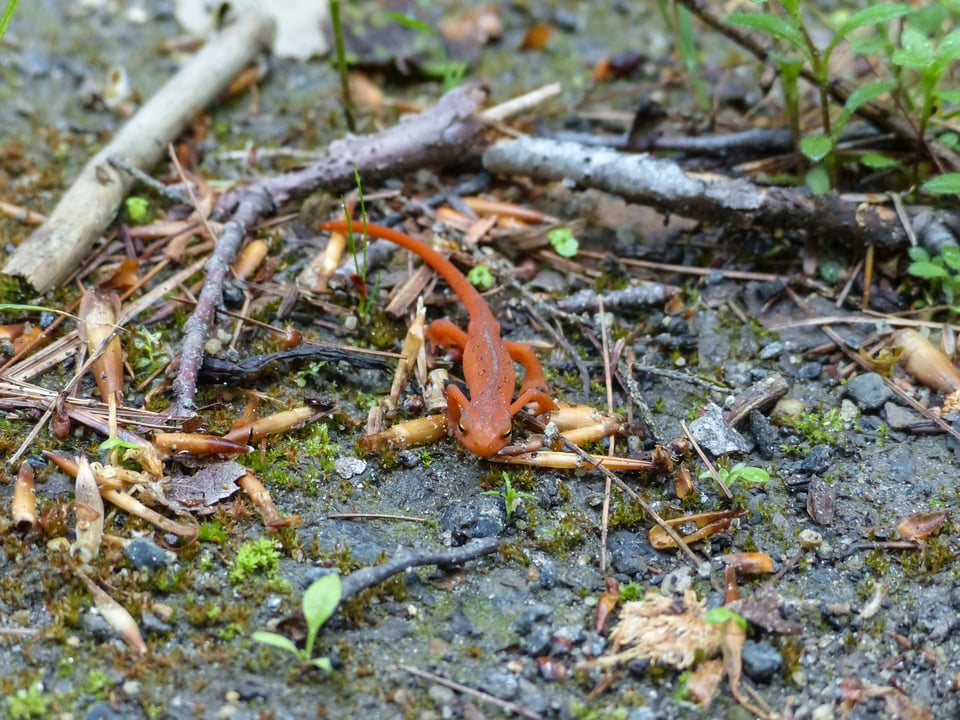
Quiet observation is foundational to many forms of meditation, whether you’re observing objects or events outside of yourself—such as a candle flame—or within yourself—such as the flow of your breath, or the movement of your thoughts. Sometimes this can be a narrowly-focused observation of one thing (that candle flame comes to mind again), while other times observation can broaden our attention and expand our awareness. This is definitely of value in human-dominated environments—people watching or looking at architecture can be fascinating—but I find I mostly end up doing this in natural versus built environments.
In pretty much all cases I can think of, though, meditative observation like this involves slowing down. Taking a meditative observation walk through the woods is going to move a lot more slowly than if I am walking to get somewhere. I’ll also typically pause, too, when something catches my eye. In the woods where I live, especially in the spring and summer, stopping completely to look closely at the base of a tree or the edge of a pond can yield enough observation of life to keep me busy for quite a while!
It’s actually one reason I enjoy photography, especially of subjects that are close up and detailed. Not necessarily full-on macro photography, where I’m trying to capture very small details, but just anything that isn’t a long-range landscape photo. The more I start to focus in (with my camera and my own eyes) on one thing—or what I think is one thing—I end up seeing its connections to many other forms of life. I also find that being in photography mode prompts me to let my attention wander, following it from detail to detail. I notice so many things I didn’t see at first glance, which also often sparks my curiosity to look deeper.
And that leads me to the notion that perception is participation: we don’t just passively perceive what is “out there.” Instead, perception is shaped by our expectations and prior knowledge; this has been studied in both psychology and neuroscience, and it’s something you can notice in yourself if you look for it. (Because, haha, you won’t perceive it until you know to look for it. Which is the whole point.)
As one example, I’ve heard multiple people who teach wilderness skills talk about overcoming the “wall of green” when learning plant identification. This is when you look at a garden, or a forest, or a meadow with lots of plants growing everywhere, and just get an overall sense of “green,” or a general identification of “plants.” For a more specific example, say you’re looking at a yard or a vacant lot that’s mostly filled with grass but isn’t overly controlled or manicured. The “wall of green” impression is that it’s all “grass”—or maybe “weeds,” if the growth is particularly tall. But with more knowledge, your eyes might start to pick out clover, wild strawberry, and young dandelion leaves amongst the grass. Now you notice differences in height and texture, even if there’s nothing as obvious as yellow blooming dandelion flowers that break up the color. The perception of a “wall of green” (or I guess, a “floor of green” in this case) has changed because your understanding of it has changed. These details catch your eye now, because they’re familiar. Observation requires interpretation. We learn what to perceive.
Another aspect of observation involves questioning and evaluating what you're looking at. Sometimes it’s not immediately obvious what you’re perceiving, even when it’s clear you’re perceiving something. Here, I’m thinking of the couple of times I’ve been out on a walk and a black bear has stepped out of the woods ahead of me, onto the road. At first, my brain wants to tell me it’s a large black dog…but something isn’t right. The size, the way it moves, the shape of its feet—and again the SIZE. Then once I realize that I’m looking at a bear and not a dog, it’s like its outline snaps into place and it’s obvious. And then I make sure we go in different directions!
All of these, well, observations about observation also apply to observing ourselves. And here I’m not specifically thinking of the kind of self-observation in some forms of meditation, where you observe the flow of thought without following it—although this is a good exercise to do, and helps with other types of self-observation as well. No, right now I’m referring to slowing down and observing our habitual behaviors and responses, the kinds of things we might do or think on autopilot, and especially the kinds of things we might have been trained to do and never really looked at all that closely.
Now, I realize that speaking in terms of “we” and “us” gets into dangerous territory in terms of assumptions and who I think I’m talking to. I don’t actually assume that everyone reading this has had the same experiences or socialization that I have—but I also do want to talk about social processes that go beyond (or underlie) individual beliefs and actions. So speaking in plural pronouns is a way of getting at these group- or society-level things, even though there are certainly variations. If an experience I’m talking about doesn’t resonate with you, I invite you to see if you can find something similar from your own experience. The main thing I’m talking about here is how people learn from others what kinds of thoughts and behaviors are “normal” and expected, and how those become internalized to the point where we might not even notice them.
Basically, there are a lot of social pressures to think, feel, and behave in certain ways. Those pressures are going to vary depending on who you are, what social groups or identities you belong to (or are assigned to by others). Many of those pressures start acting on us as soon as we’re born, as soon as our sex, or our skin color, or our disabilities (for just some examples) become evident to others. We are also each born into a particular culture, with norms and expectations we are expected to follow, and that culture is nested within other, larger cultures that sometimes align with, and sometimes contradict, the things our family’s culture believes.
So, just as with the “wall of green,” or the dog that is really a bear, our expectations shape perception in the human world as well. In this case, the social expectations that we are raised to see as “normal” might hinder perception. Things we take for granted might not even register as something we are actively participating in—they’re just “natural” or “ordinary.” It’s just “how things are.”
Breaking with some aspect of “how things are” often requires changing deeply ingrained habits that can easily go unnoticed without a lot of unlearning. If you’ve ever moved away from a belief system you were raised in—whether that was religious, political, or otherwise—you may have caught yourself reflexively falling back into old habits of thought and action. It can be frustrating, right? But seeing through the illusion of normality and inevitability of the systems you were raised in is not a one-time thing; instead, shifting our expectations and envisioning something better takes repeated attention, including attention to our own habits.
And since observation involves perception, and perception relies on expectation and knowledge, the more you learn about the environment you’re in, the more you will notice and be able to observe. Just as with the wall of green becoming a landscape of known species, the human world can also become more intelligible the more you learn about it through fields like psychology, sociology, history and anthropology. And just as you would learn more about your local ecosystem by learning about different facets of it—like the trees, birds, insects and other beings that call it home—you can learn more about your social ecosystem by learning from different groups of people about their experiences with it. We are all connected, but just like any ecosystem, the conditions we experience are not all identical, and sometimes you have to change your perspective to see the bigger picture. Even—or even especially—when those perspectives challenge what you thought you were seeing. If you keep trying to see the bear as if it were a dog, you might end up in a whole lot of trouble.
And that leads me into a whole long train of thought about being embedded in larger systems, and how those systems create a lot of pressure to just go along with “the way things are,” even when we disagree. But that will have to be a topic for another time! I’m also thinking of publishing an observation exercise or two as separate newsletters, and I’m not sure which is going to come first. Times are busy, but I’ll be back soon! For now, keep learning and observing.