
In this issue:
ongoing efforts to conserve soils knowledge
my new typewriter
research updates from our team
a recommendation for a quick but impactful read

FROM THE AUTHOR
Hi there! I have been busy collecting ideas, memories, and things that keep me inspired. More often than not these days, I find myself collecting photographs and written notes, rather than tactile items (but see typewriter below…). This issue comes from this irresistible pull to collect and share. I hope you find some inspiration here. Send me a note if you do!
Take care and stay curious,
Yamina
PROFILES
Wandering along the playa on my recent trip to Death Valley, I was again drawn to the cracks in the silt and clay that have accumulated on the valley bottom. I could look at these repeating (but not repetitive) patterns all day. This one caught my eye because it looks like a flower drawn into the cracks. What do you see?

Share your recent soil profile sightings with us! Email your photo to wonderofsoil@outlook.com with a caption that includes a general location and I might feature it in a future issue.
FEATURE
This summer, a student and I were trouble-shooting a laboratory protocol that required coating clumps of soil in a waterproof material before dipping it in water so that we could obtain a more accurate volume. We normally use a liquid plastic, of sorts, but it is pretty nasty to work with and our supplier had recently stopped stocking it. Our long-time lab manager suggested we try wax and then wondered aloud whether he had some in the storage room. A few minutes later, we were looking at a large jar full of paraffin wax on the lab bench. He said he had been holding on to it since he started the job decades prior and was happy to see it put to use. I, too, was delighted.
This kind of thing happens all the time. My enthusiasm for the "old things" has given me a bit of a reputation among our staff. They find something while cleaning out a cabinet or reorganizing our supplies, and think "I bet Yamina would like this". I always do. I like being known as someone who appreciates the items that make our collective history apparent in the present.
Our department has a warehouse on the outskirts of campus where we store all sorts of equipment and supplies for our research and teaching activities. My students and I affectionately refer to it as "the shed", because for some reason that sounds more quaint and full of possibilities than "warehouse".
The shed is as utilitarian as it sounds, but full of surprises. There are long rows of shelving units full of containers of different sizes, shapes, and vintages. When faculty need a place to store things, our staff find a way to clear off a shelf and make space. This has been happening for decades, and the shed has become somewhat of a treasure of soil science history.
Like many soil science professors who have come before me, I have accumulated soils from our research and need a place to store and archive them. We are in a period of transition between projects where we have made the measurements we set out to make on the samples we collected. We save the extra soil for future (unknown) work, because science is iterative and you always want to leave the possibility of being able to go back to a sample and take a closer (or different) look at it.
The longer you care for the soils in your archive, the more valuable they become. As the environment changes, having a geolocated time-stamped record of prior soil conditions is irreplaceable. If I am to hold on to these soils for my career, as I intend to do, I need to store and archive them with care and intention. That's why I found myself in the shed this summer.
We went to the shed to make measurements of the shelving units so we could figure out what kind of storage boxes to invest in and how to keep our samples tidy. While we were there, our lab manager pointed out another pile of "old things" we have been storing that he had been meaning to ask me about. Hours later, we left with a truck bed full of cardboard boxes because I uttered the words "how about we organize them now?" Summertime gives me the space to think that's a good idea. Thus began several days of sorting through old soil maps, surveys, and books, and deciding which to keep and which to give away.
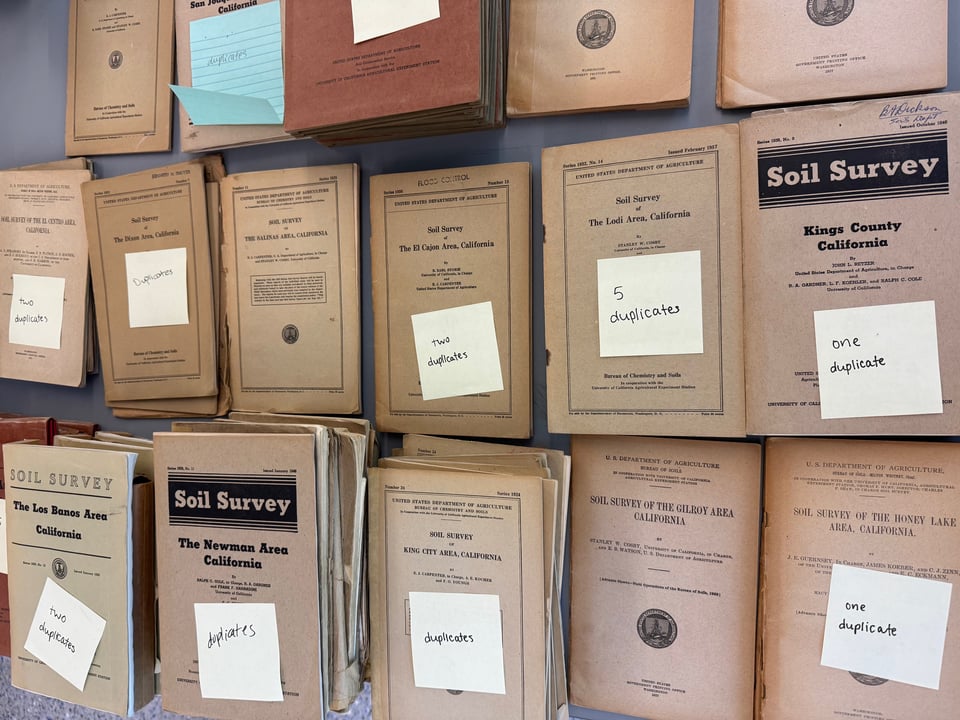
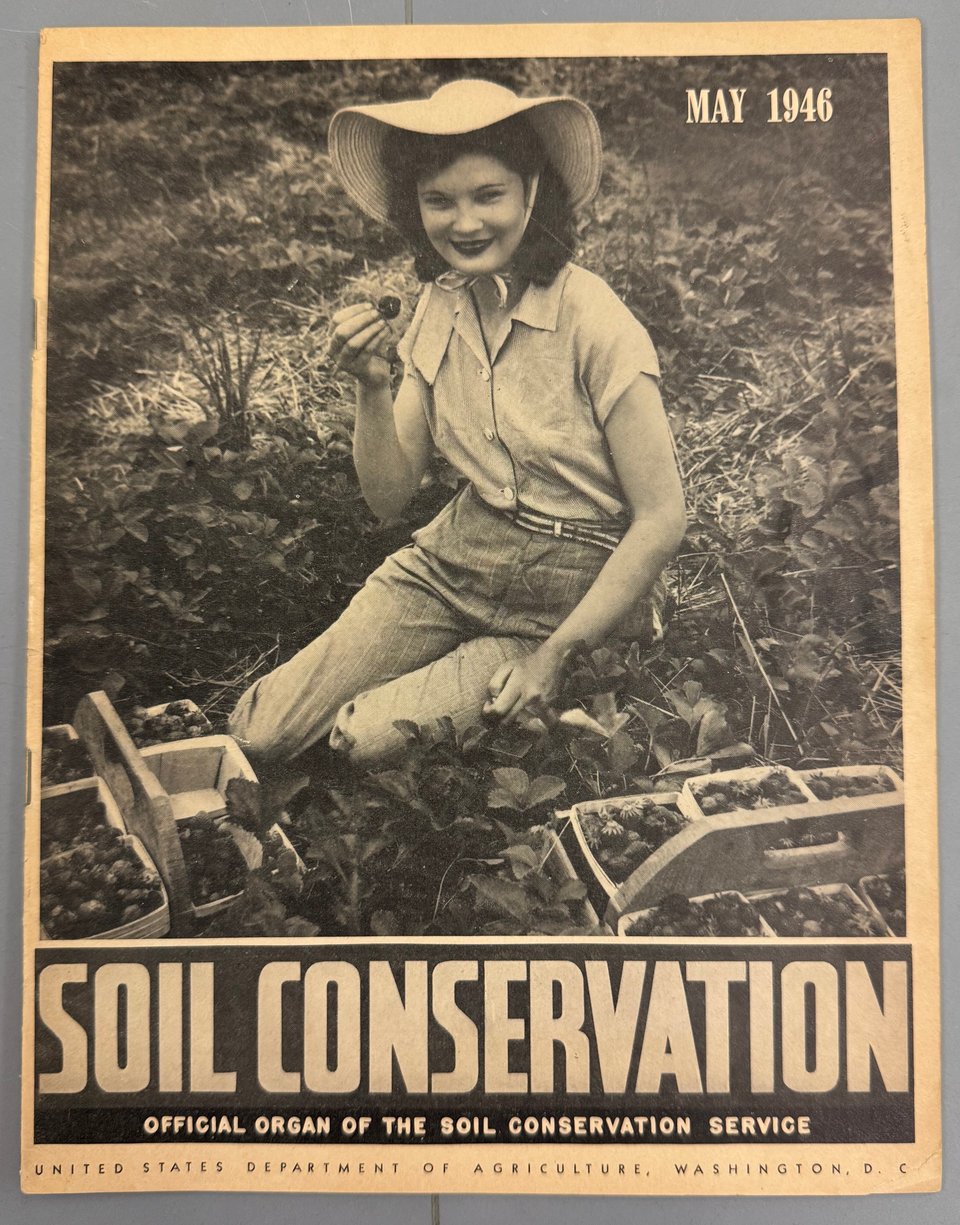
I could not be more delighted by what we found. We inventoried over 300 different types of materials, including soil maps from as early as 1905. We found colorful maps from all over California, type-written field guides, and a collection of Soil Conservation magazines from the 1940s. One student remarked that opening a box to find a book from 1886 was the highlight of her day. Every box contained a new surprise. We took care to count and catalog every single one.
We saved the two copies in best condition of every item. The remaining extras are tucked away in boxes waiting to be given away to faculty and students who may want them for their personal collection.
I am grateful to be one of the keepers of this collection of soils knowledge. I am still day-dreaming about creating a little museum where visitors could peruse the maps, flip through old magazines, and observe little jars of soils on shelves. Sure, many of these old maps are digitized and could be found online. But the algorithmic internet does not create a space for untethered perusal into the unknown. That's what libraries are for.
Now that I know what is in our collection, I plan to do more exploring of the historic maps and records for areas that are meaningful to me and my work. I feel like I am walking into a local soils library, not really knowing what I am looking for, but trusting that I will find something worthwhile.
FROM THE STUDIO
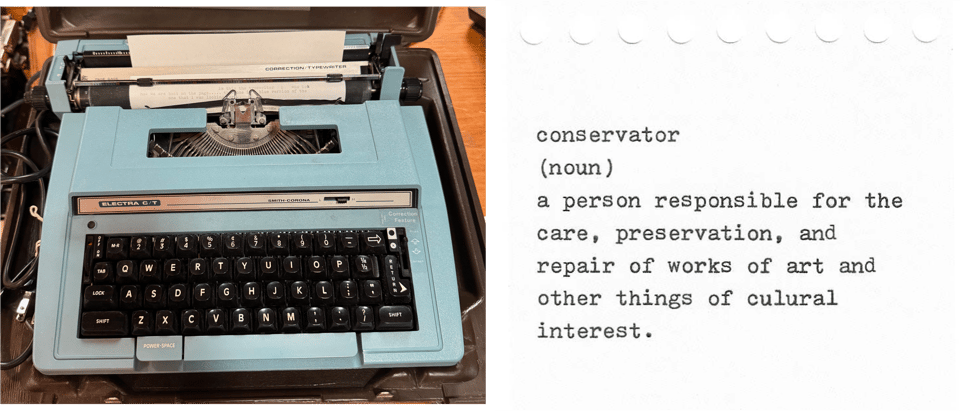
I found a new typewriter on my travels this summer. I have been looking for an electric typewriter to add to my collection since I first typed on one in 2014. I own two manual typewriters: an orange one my mother would type on as a child, and a black one that I found at a thrift store somewhere in Kansas on a road trip to a soil judging contest almost 10 years ago.
Sometimes, the best things come into your life when you aren't looking for them. Thank you Type Townsend Studio for bringing this source of joy into my life.
NEWS AND UPDATES
Former undergraduate student, Abby Evans, has a paper out in Grasslands, the journal from the California Native Grasslands Association. We compared methods for assessing aggregate stability (how well soil particles stick together) to inform grassland restoration. We are so happy to see this work in print! Congratulations, Abby & team! Read the article in the summer issue.
I am serving as the guest editor for Ecesis, the news journal for the California Society for Ecological Restoration (SERCAL). I am excited about the winter issue we are putting together. It has been a fun way to learn about restoration and conservation efforts that are happening around the state. It will be available in January and I will send more info then.
Our study of the impact of cover cropping and mycorrhizal inoculation on soil health in a lemon orchard was published in Plant and Soil earlier this month. We found that location on the orchard floor better explained patterns of microbial communities than any of the cover cropping and inoculation treatments. You can read the original research paper, and a summary in Progressive Crop Consultant magazine. Congratulations, Anna!
RECOMMENDATIONS
I loved Robin Wall Kimmerer's latest book The Serviceberry: Abundance and Reciprocity in the Natural World. It is an impactful, slim volume that argues for the value of seeing the world through the lens of the gift economy. I highly recommend you pick up a copy and share with others!
I was happy to read soil scientist Cassius Spears Jr.'s profile in AGU Eos summer Career Issue. It is great to see soil scientists (and soil life) highlighted in broader discussions of Earth science.
You just read issue #13 of wonder of soil. You can also browse the full archives of this newsletter.