

From OrbStack to AKS: Installing Dapr on a Managed Cluster
Transferring a Dapr-enabled application from local Kubernetes to AKS should be straightforward. The annotations, app ID, application port, sidecar API, and workload manifest stay familiar. The key difference is ownership: a temporary local setup transforms into a shared runtime that requires a version policy, availability plan, network access, identity strategy, and support structure. This post moves the sample from Installing Dapr on Kubernetes Locally with OrbStack to an existing AKS cluster.

Installing Dapr on Kubernetes Locally with OrbStack
To quickly grasp Dapr on Kubernetes, it’s best to start locally rather than with an AKS cluster. Local setup allows for rapid pod creation in seconds, minimizes the consequences of mistakes, and keeps all control-plane components easily accessible for inspection. In this post, we’ll demonstrate setting up OrbStack’s single-node Kubernetes cluster on macOS, installing Dapr in development mode, examining the creation process, deploying a simple web app with a sidecar, and accessing it via Dapr’s H

What Is Dapr, and Why Run It on Kubernetes?
Every distributed application gathers various plumbing components. One service requires retries and timeouts, another needs a message broker client, and a third must store some state, retrieve secrets, or discover other services. Over time, each team ends up with a unique set of client libraries, connection handling methods, telemetry, and failure behaviors. Dapr, the Distributed Application Runtime, provides a uniform API for the underlying infrastructure. Your application communicates with a l
Secrets Management Showdown
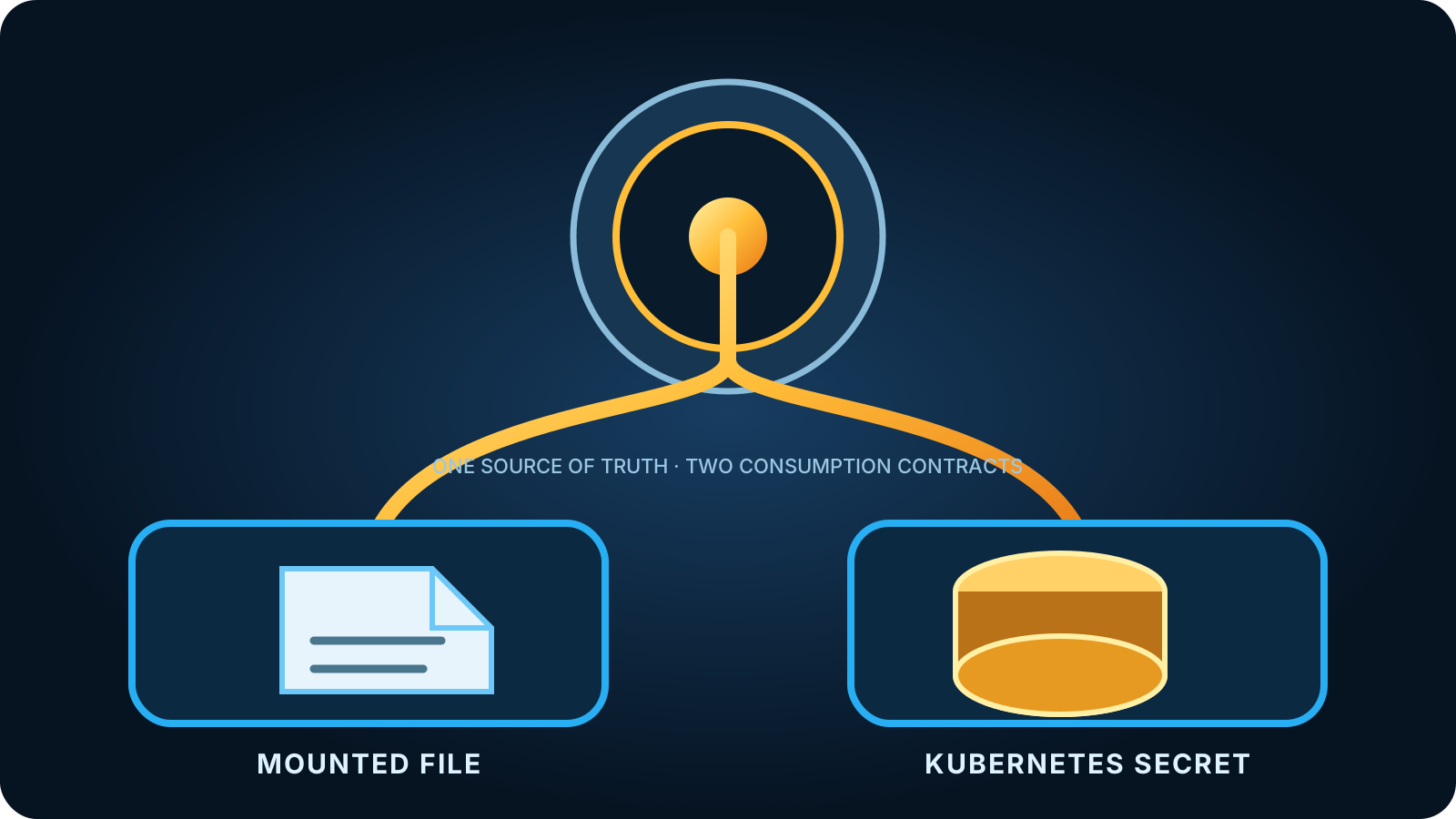
The real question is not whether to use the Azure Key Vault provider for the Secrets Store CSI Driver or the External Secrets Operator (ESO). Instead, it’s whether your workload should access secret data as mounted files or via native Kubernetes Secret objects . That choice influences application design, rotation, incident handling, RBAC, observability, Helm compatibility, and GitOps. In short: CSI offers a more secure default for applications that consume files; ESO provides a more practical pl
Test123
This is test post

