
Gardnerville
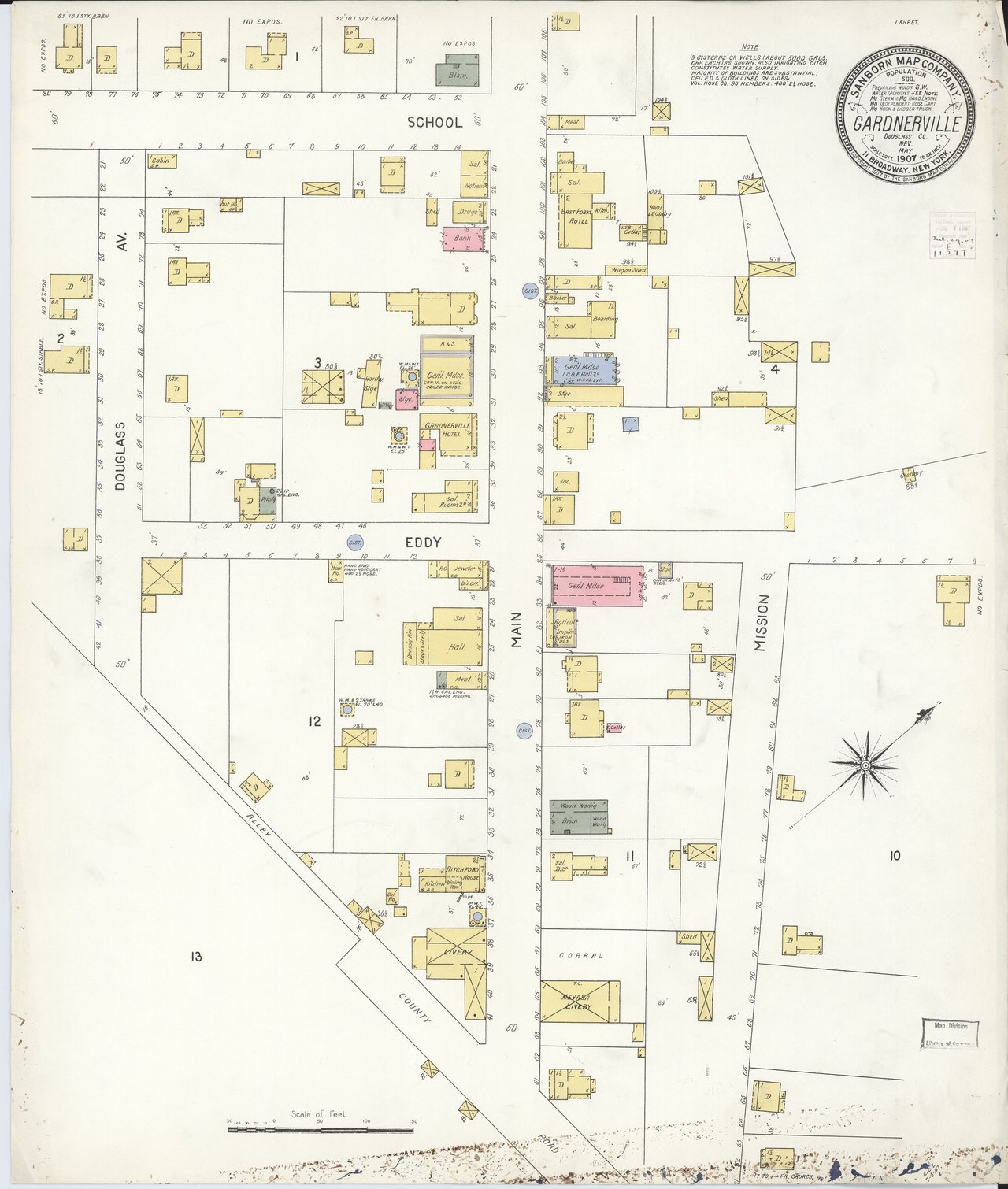
The State of Nevada keeps a cast marker at 1426 US 395 in Gardnerville, numbered 129. The town’s first buildings, it says, were a blacksmith shop, a saloon, and a hotel. The hotel came on skids. Lawrence Gilman kept a hotel in Genoa and had watched the wagon traffic through that town fall off in the late 1870s. He bought a vacant hotel on the emigrant trail between Genoa and Walley’s Hot Springs, the Kent House, and in 1879 moved it to the homestead of John M. Gardner. His wife sued for divorce the same year. Senator Harry Reid of Nevada, marking the town’s 125th birthday in the Congressional Record on March 24, 2004, put a price on the ground. Seven acres on the East Fork of the Carson River, $1,250, and the town named for the seller in gratitude.
Which Gardner is another matter. The marker says John M. Gardner. The Carson Valley Visitors Authority’s 2013 guide says John and Mary Gardner, an English-born couple in the valley since 1864, “and not for Matthew C. Gardner as is commonly thought.” The Nevada Expeditions website makes the parcel seven and a half acres. None of them prints the deed.
The early town, on the marker, was a farming community and a stop for teamsters hauling produce to Bodie, the California camp over the Sierra to the south. In Reid’s telling they were 24-horse teams between Carson City and Bodie, and Gardnerville was where they fed, “the 19th century equivalent of a filling station.” The freight was still being fought over in 1905. WILL FIGHT FOR BODIE FREIGHT, the Record-Courier headed a column on November 10 of that year. “The business men of this section took up a subscription this week and sent a representative to Reno,” to confer with the railroad people about hauling the Bodie freight by way of Wabuska. Wabuska was some 25 miles nearer Bodie than Carson.
Valhalla Hall went up early in 1885, in time for a Washington’s Birthday party. The Danes who built it had been coming since the year of the hotel, and they founded the Valhalla Society the year of the hall, which stood a block south of where the marker is now. It burned with much of the town, and the Danes put it up again. On September 8, 1905 the Record-Courier, under PEOPLE YOU KNOW, printed “There will be a social dance in Valhalla hall tomorrow night,” and two lines later, “Don’t forget the social dance in the Valhalla hall tomorrow night.”
The Lutherans were older than the hall. Nevada: A Guide to the Silver State, the Federal Writers’ Project book of 1940, puts it on page 91: “Lutherans appeared in Gardnerville in 1877 but no church was built until 1895.” The congregation spoke German and it spoke English, and the services alternated between the two.
George Lamy taught the violin. He also put out the first number of the Gardnerville Record, on July 12, 1898, a story Kurt Hildebrand told in the Record-Courier’s own anniversary piece. The Courier of Genoa moved up the valley the next year and the town had two papers. The fire that took Valhalla Hall took the Record’s plant, and the two titles merged as the Record-Courier, which the 1940 guide, on page 88, has following “much of the population of Genoa” to Gardnerville. It “still appears weekly,” the guide says.
The railroad did not come. State marker 130, a mile up the road, has the H. F. Dangberg Land and Livestock Company establishing Minden in 1905 “to provide terminal facilities for the Virginia and Truckee Railway, which was then extending a branch line southward from Carson City.” The promoter was H. F. Dangberg Jr., the company’s secretary and the founder’s son; the name is the Westphalian town where the elder Dangberg was born in 1829. The Town of Minden’s walking guide has the first train arrive on June 12, 1906. The Nevada Expeditions page has the tracks reach the new town on August 1, 1906.
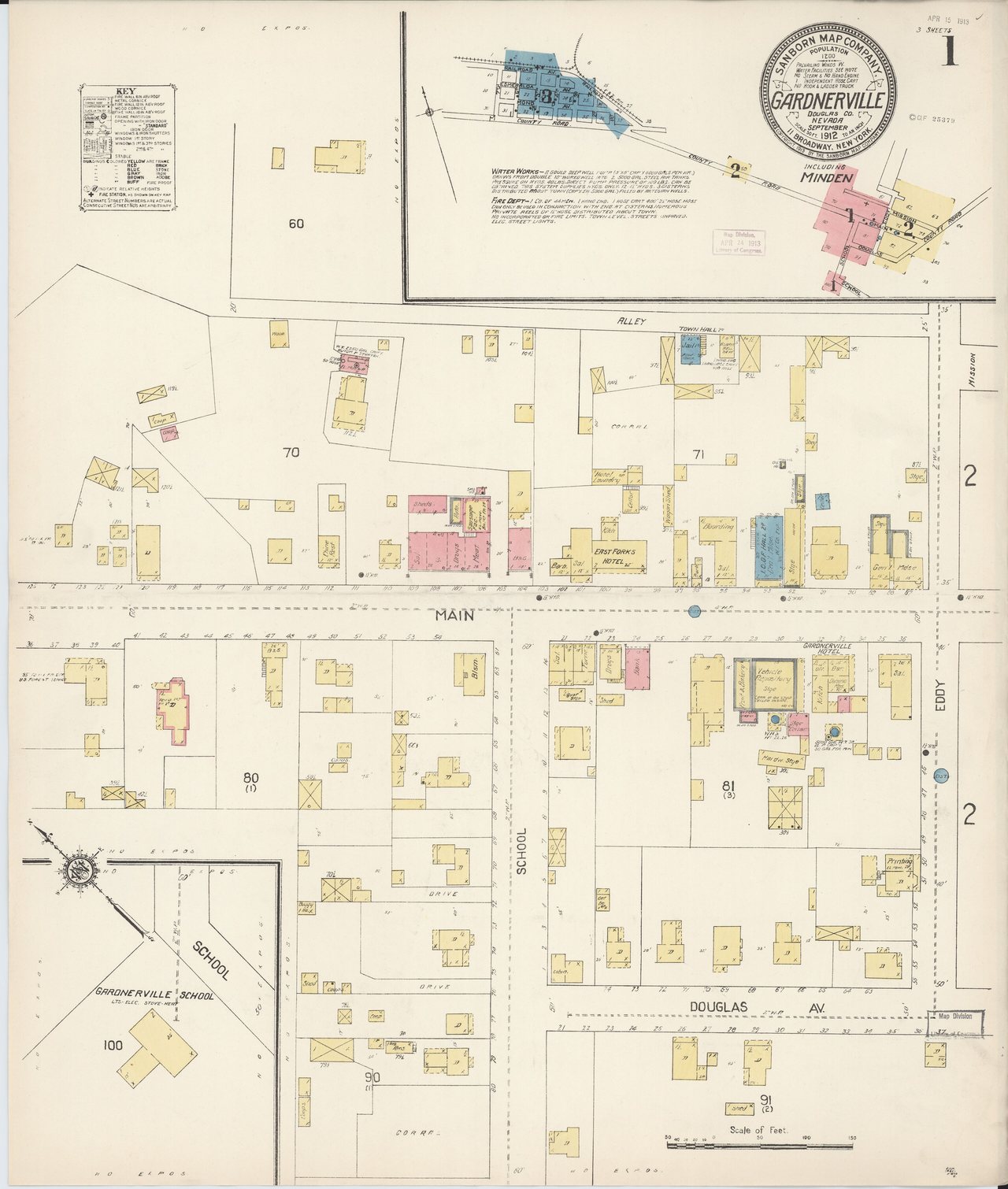
The 1940 guide’s Tour 4 puts Gardnerville at mile 62.7 on US 395, altitude 4,710 feet, population 400, “a trade town of Carson Valley,” with “solid buildings and shaded streets.” Minden, a paragraph earlier, has “the neat trim look associated with the old-fashioned German villages.” One family moved the mile. Meta Kathryn Dangberg, born in Hohenaverbergen, Germany, married Fritz Dangberg in 1897 and lived in Gardnerville. After his death, the Record-Courier wrote on August 26, 1949, she sold the family home there and moved to Minden.
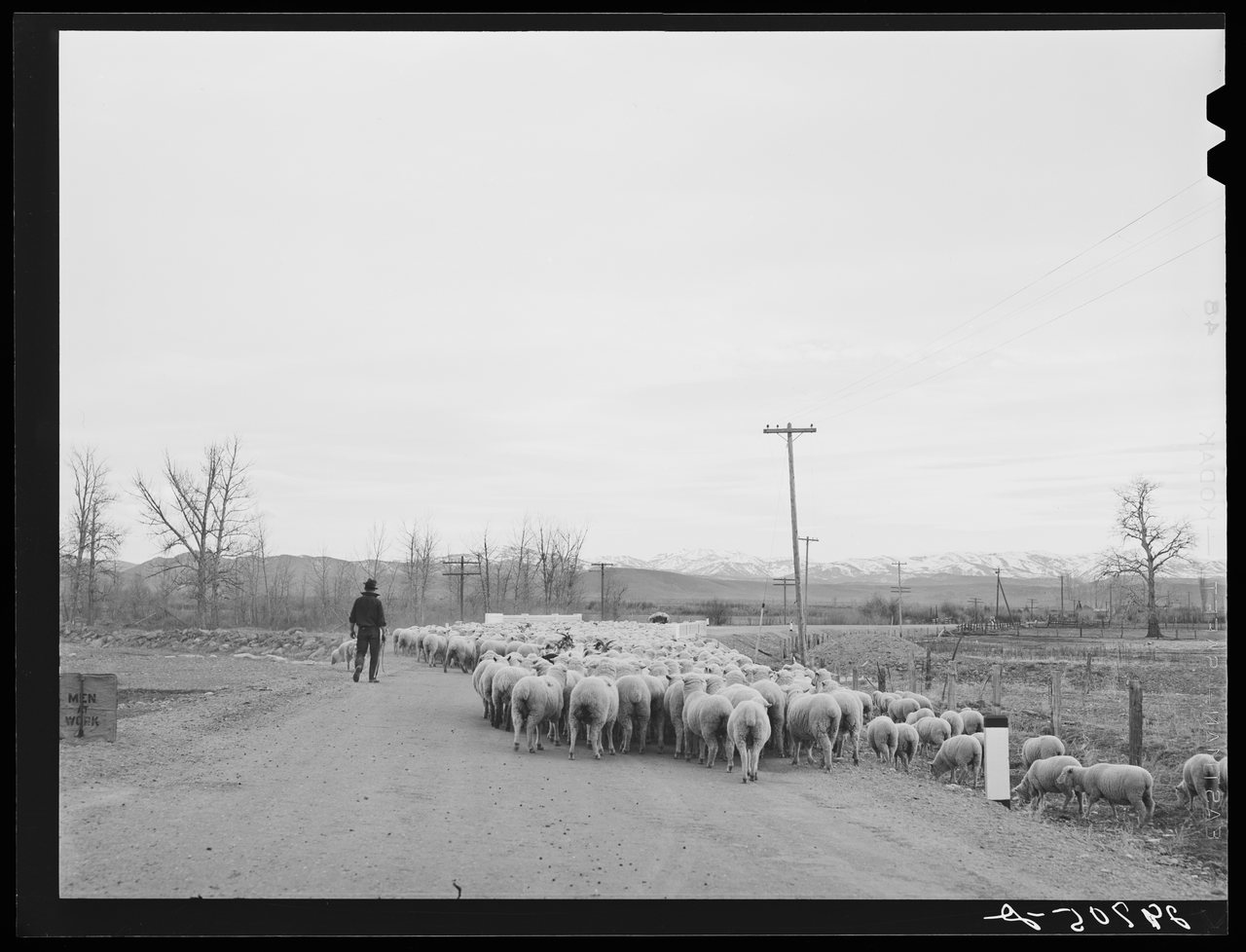
The Basques are the third people on the marker. “Starting in 1898, Spanish and French Basque shepherds tended some 13,000 sheep in Carson Valley.” Twenty-five thousand by 1925, when they began buying sheep and land of their own. “After 1918, several Basques in Gardnerville opened inns which flourished during the Prohibition years.” The Overland Hotel was built early in the century by Sam Imelli, a Swiss who ran a meat market in the building. That was “at a time when the county seat was still in Genoa, and Gardnerville comprised only a few buildings on Main Street,” the Record-Courier wrote on October 12, 1967, when the Overland changed hands. The building, Imelli’s daughter told the paper, was still essentially as built. It had always been Basque operated, leased first to Bob Yam and then to John Etchemendy, “who remained proprietor until 1953.” The same paper’s 2012 roll of valley names has the Etchemendys buying the Overland in 1921 and running it until 1967.
FIRE DOES DAMAGE AT THE FRENCH HOTEL, the paper headed its front page on August 8, 1924. Smoke was seen pouring from the roof shortly after seven on the Wednesday morning. Seven hundred feet of hose were run to a new cistern above the Ritchford Hotel, “completed but a few days ago”; the Minden chemical engine worked beside Gardnerville’s; the fire was under control in thirty minutes. Loss, $1,500 to $2,000, fully insured. The two irrigating ditches that ran through town were dry, “owing to the shortage of water in the Carson river.”
In January 1955 the county’s first-quarter liquor licenses ran on the front page, and the Gardnerville hotels came in a row: the Overland Hotel; Borda Sheep Co., East Fork Hotel; Raymond Borda, French Hotel; Joe Micheo, Pyrenees Hotel; Valentine Aja, Ritchford Hotel. Mary Micheo Abbott, interviewed for the University of Nevada’s Basque oral history project in Gardnerville in 1987, told it from inside the French Hotel. Her parents leased it in 1937, when she was seven. In 1947 her father bought the Seth Hotel nearby and renamed it the Pyrenees. Gilman’s hotel, the Kent House become the Gardnerville Hotel, burned in the 1920s; the years printed since do not agree. Its bar and dining building stood, and on February 18, 1955 the Record-Courier reported it open that week as the J. & T. Bar, grand opening Saturday the 26th.
Marker 131 stands south of town. “In 1917 State Senator Wm. F. Dressler gave this 40 acre tract to Washo Indians,” it reads, “then living on ranches in Carson Valley.” Dressler ranched in the valley. A school opened in 1924 and the tract became a nucleus of settlement. The marker spells the name Washo. The tribe spells it Washoe, and the Washoe Tribe of Nevada and California keeps its offices at 919 US Highway 395, Gardnerville.
The East Fork of the Carson runs past the east side of town, along the seven acres. The Record-Courier of September 8, 1905, under PEOPLE YOU KNOW: “There isn’t enough water in the Carson river to keep a polliwog alive.”