
It's Not Either/Or. It's Both/And. On Blink YA & Undermining Literary Choice
Young people need access to *all kinds* of books, not just those that pass some kind of purity test.
Blink YA launched in 2013. Initially under Harper’s Christian Publishing banner, Blink moved under HarperCollins Focus as their books took a broader approach than being explicitly Christian. It’s based in Nashville, Tennessee. The imprint publishes both fiction and nonfiction.
Blink YA is not new, but over the last few months, how the imprint is positioning itself in the market has certainly caught some attention.
The imprint’s description is pretty useful to share in full, as it explains the intent and goals behind its seasonal titles:
What is Blink’s overall mission as a YA publisher?
Blink YA is dedicated to publishing great stories for teen readers ages 12 and up. We believe every teen deserves access to stories that take them seriously —books that tackle real emotions, real challenges, and real stakes—while remaining something readers in the 12- to 15-year-old YA age range can pick up without hesitation or need to worry they’ll come across a scene they aren’t yet ready to encounter. This means you will find bold, beautifully crafted stories that entertain, inspire, and occasionally break your heart in the best possible way, just without detailed descriptions of things like violent acts or sex showing up on the page itself.
In short, they offer an option to anyone who is not ready for—or who simply prefers not to read—books that contain explicitly described scenes but still want the engaging material YA is known for.
What can readers expect from Blink books? Blink books are known for delivering all the emotional depth, page-turning plots, and compelling characters that teen readers crave. Like other books in the YA market, the plots in our fiction realistically depict the challenges, experiences, and questions today’s teens face—respecting the fact teens encounter many things while they make their way toward adulthood but aren’t always ready for “adult” material and descriptions in what they read.
Whether a teen is a lifelong bookworm or a reluctant reader, Blink titles are crafted to be genuinely engaging, with material that doesn’t shy away from reality but often offers a sense of hope in a world that can be challenging to maneuver.
What is the ultimate goal of Blink’s books? To provide books anyone can pick up and enjoy, with high-quality content you’ll want to read and share with others.
Books published by Blink fill a hole in the market. They reach a teen readership that both self-select books that don’t include violence or sex, as well as the adults who select books for their teen readers with those things in mind. As a librarian, I sometimes found it challenging to discover these kinds of books for my patrons. That was especially true for voracious readers who would come looking for the next great book but would soon find they’d read most of the books that met their needs and interests.^
I had both young readers and their adults asking for books that “won’t make you blush,” or that were “clean,” or that didn’t have violence.* When you work in a library, your aim is access. That includes curating a collection that meets a wide range of needs and interests. Blink launched the year I left libraries, but these are the kinds of books that would have been eagerly purchased for several of the libraries where I worked.
For most of its existence, Blink’s place in the publishing and reading world has been just that. One exception might be that, at launch, Blink noted they “won’t go dark”; they’d approach tough topics teens deal with, but hope would be the big through-line of those stories. It’s hard not to look at this now–something that’s in their description pasted above–both as a reference to the 2011 article by Megan Cox Gurdon about YA being “too dark”** and an ungenerous read of YA books. Most YA literature conveys hope. There are very, very few YA books that are only bleak, and those have a place in the literary ecosystem, too.
But since March of this year, Blink’s marketing has taken on a different tone that feels both odious and desperate. Amidst unprecedented numbers of book bans across the United States, including legislation at the state level that has banned wide swaths of themes and people from inclusion in public school and public library collections; rampant mis- and dis- information about the materials available for teen readers; and the harm being perpetrated on poorly-paid, highly trained and educated library workers, the imprint has specifically and purposefully angled itself as the refreshing alternative to the books being targeted right now. In doing so, Blink not only undermines their key consumers. They also perpetuate the very lies being spread by book banners about the content in today’s YA books. Blink muddies the understanding of what teen literature is, aiding attacks on YA books like those in states like South Carolina, where entire YA collections are being dismantled. Not only that, but the imprint stands in direct opposition to their parent company’s efforts to curtail these blatant attacks on Americans’ First and Fourteenth Amendment rights.
Blink appears to do this under the belief that book banners will back them. What Blink fails to understand is that libraries are political–they utilize taxpayer money to support their services, including their collections–and they can and should make choices with full awareness of who has had their backs and who hasn’t. Blink also fails to understand that book banners talk a good game and will certainly try to get their books into libraries–see Texas’s laws that allow significant input from parents and “parents” on what books can be in a school library. But they ultimately don’t care about the books.
They care about power.
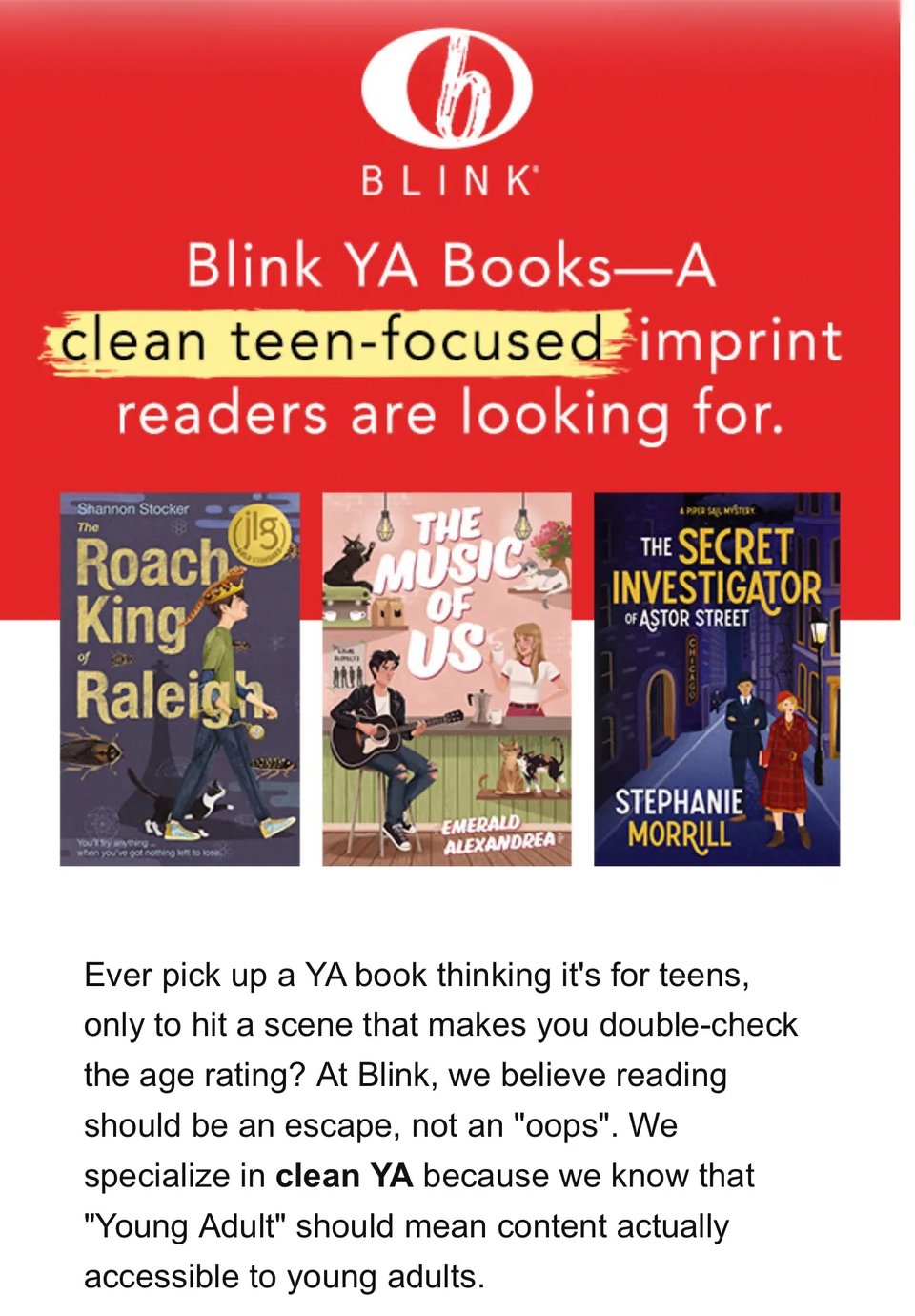
The above image is but one example of the imprint’s dedication to positioning itself outside the YA world while also seeking to capitalize on it. They highlight being “clean,” and most disturbingly, suggest that their books are “actually accessible” to young adults. This raises the question of who they have in mind when they think of young adults.
The answer is, of course, cishet, white Christians privileged enough never to have gone through hardship, had skin that marginalized them, didn’t struggle with economic challenges, never questioned their gender or sexuality, and so on, and who have never wanted to open up their worldview to people whose lives don’t mirror their own imagined reality. Books serve as windows, mirrors, and sliding glass doors, per Dr. Rudine Sims Bishop. Blink’s books? A never-ending hall of mirrors.
The books Blink centers are the kinds of books many teens would enjoy. The problem is that the marketing doesn’t invite readers or gatekeepers in. It tells them to stay away. It also tells teens who care about access to literature and to libraries and to schools and educators–including the scores of young people advocating for these very things–they’re not whatever “young adults” are.
Marketing on Blink’s social media has become even more hostile over the last eight weeks.
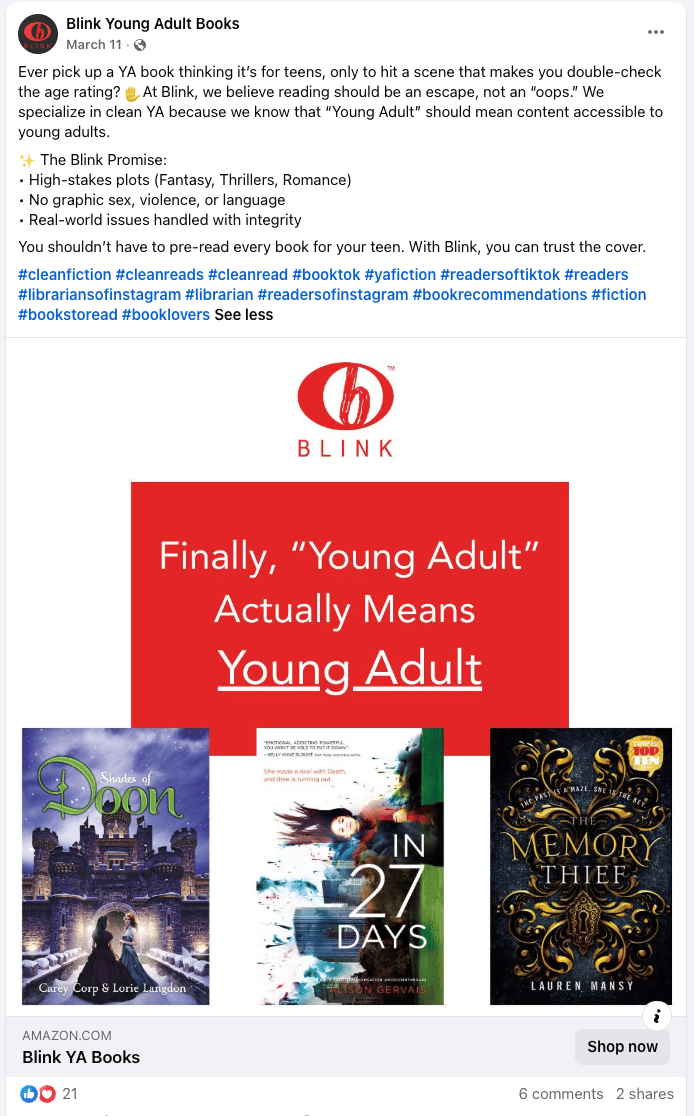
Young adult has always meant young adult. The shift in perception about what young adult literature means has come directly from the book banners. It has not come from the industry nor from the gatekeepers who are highly educated, highly trained, and highly experienced in connecting books with readers. What defines young adult has been at the center of mass book banning and erasure of young adult spaces in public and school libraries nationwide, but especially in South Carolina. Banners have infiltrated boards with disinformation about what these books are, suggesting that anything “young adult” is meant for readers 18-23, not for those 12 and up. Individuals who’ve pushed back because they’re actually professionals have been removed from their positions for daring to use factual information to justify why YA books are for teenagers. Rather than supporting experts, Blink chooses to add more targets to their backs.
Despite the claims book banners and their favored politicians make, librarians are not peddling pornography. No such thing exists in libraries. Librarians and educators are also not willy-nilly throwing books at teens, telling them what to read. Librarians are experienced in making recommendations for readers based on themes or topics, as well as recommending books to individual readers based on what they’re looking for. The times that parents have claimed that librarians have pushed “inappropriate” material on their children have come at the behest of those very parents who’ve directed their children to ask for those books in their libraries.
Blink’s advertisement suggests that books published elsewhere in the industry that tackle real-world issues don’t do so with “integrity.” Is that because many of those books explore race and racism with an understanding of how our politics and culture create situations that make marginalized people targets more often than their cishet white counterparts? Is it because realistic fiction has to grapple with the real world, which is full of challenges, flaws, and uncomfortable moments?
It is a curious word choice presented with no elaboration.
Much like book banners cherry-pick passages to fit their agenda, Blink’s advertising suggests that a young person reading one challenging scene or scenario means the book as a whole is an “oops.” That’s not only inaccurate, but it’s also belittling to young readers who are far more likely than their adult counterparts to set aside a book that they’re reading when it makes them uncomfortable. We also know from the research that the vast majority of young readers have never picked up a book that made them uncomfortable from the library, just as we know from that same research that most parents have never experienced their child picking up a book that made them, the parent, uncomfortable.
Stumbling across a queer character or a character of color isn’t an oops. It’s called life.
And yet, it feels as though no matter how much effort goes into explaining these facts, it moves the needle little, if at all. Blink has taken the very language and ideas used by banners to market their wares. Leaning into the lies, rather than joining forces to push back against them and invite them into the larger fold of YA in all of its facets, is a mind-boggling choice. Especially for an imprint whose parent company is and continues to be a plaintiff in several high-profile lawsuits filed against state legislation that bans books from libraries (against Idaho’s HB 710, against Florida’s HB 1069, and against Iowa’s SF 496–Harper also signed on to an Amicus Brief in Little v. Llano County).
You can scroll Blink YA’s social posts to get a sense of how they’re all in on standing apart, rather than with, others during this critical moment of censorship and attacks on public institutions of democracy. But there’s one more worth addressing specifically because it highlights how little regard there is for the state of the American book ecosystem and how little regard there is for the very people whose lives are being upended right now–both the professionals and those whose voices are being actively erased from the public.
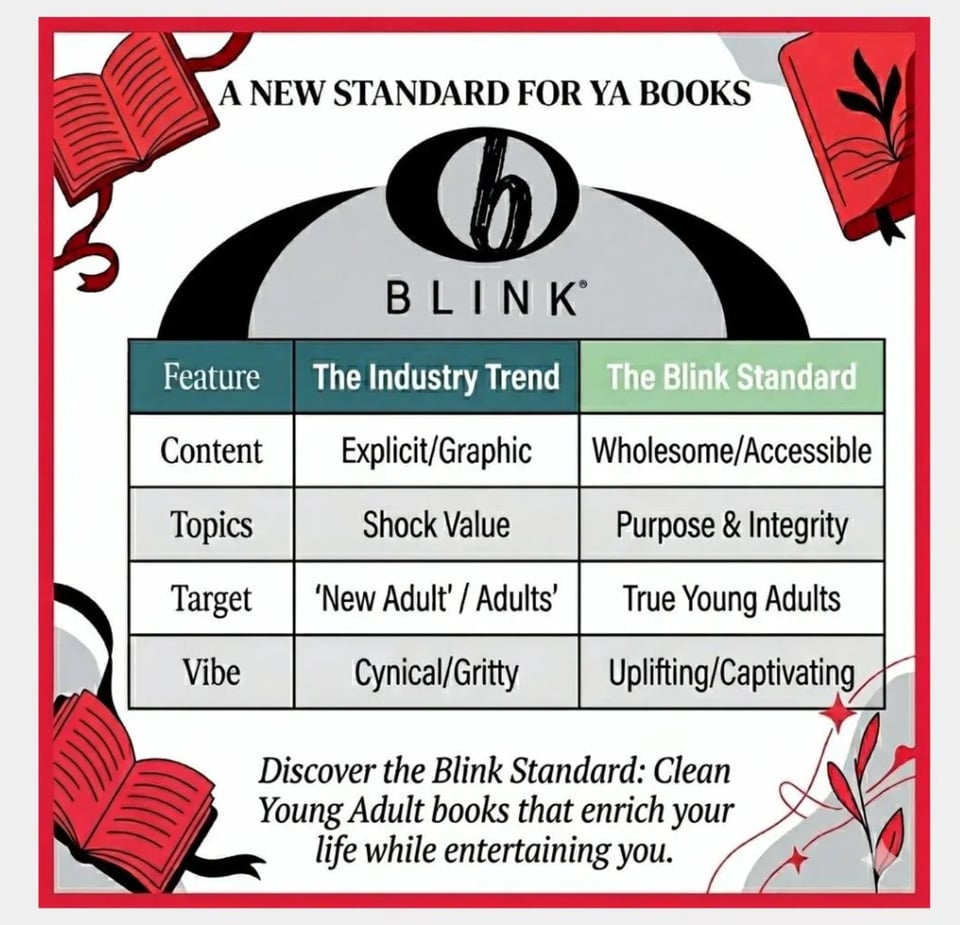
Who gets to decide what makes the content of a YA book “explicit/graphic” or “wholesome/accessible?” The same question goes for who gets to decide what topics are meant to be there for “shock value” vs “purpose and integrity.” “Cynical/gritty” vs “uplifting/captivating?” There’s certainly a lot of binary thinking at the heart of this, and there’s little to no question of what this coded language actually means.
That’s not to touch on the tired discussions of “new adult” books, which aren’t being packaged or sold as young adult books.*** Adult books are not being sold as young adult books.
This advertising is blatant disinformation. It once again elevates and centers a specific brand of white cishet Christianity as the standard by which all other things are to be judged.
To quote editor Andrew Karre, if anything is “cynical” or tailored for “shock value,” it’s Blink’s marketing. It’s not only loathsome, but it’s also intended to garner support from the book banners. From the optics perspective, it’s been successful. But those same social media champions of erasure and suppression aren’t going to support Blink or its titles financially.
They did the same thing with other now-failed ventures in right-wing attempts to take down the current systems: SkyTree Book Fairs is gone, Moms For Liberty’s push to infiltrate school boards is no longer a priority because leadership got their coveted positions within the Trump administration’s architecture (until they were let go and now their sycophants are waking up to how used they were), Brave Books’s annual library story time shilling their books doesn’t appear to have plans for 2026, and more.
Advocates are tired of being trounced upon, and they’re tired of being at the center of ceaseless lies. As much as Blink YA does meet the interests of middle grade and teen readers, library workers, educators, and parents don’t have to listen to or spend their limited budgets on books from an imprint that not only doesn’t care about them but is actively engaged in amplifying harming. At least one grassroots group has stepped up to push back against Blink, encouraging people not to purchase titles from that imprint. That’s Freedom to Read South Carolina, and their messaging is what others should hear and consider sharing, too.
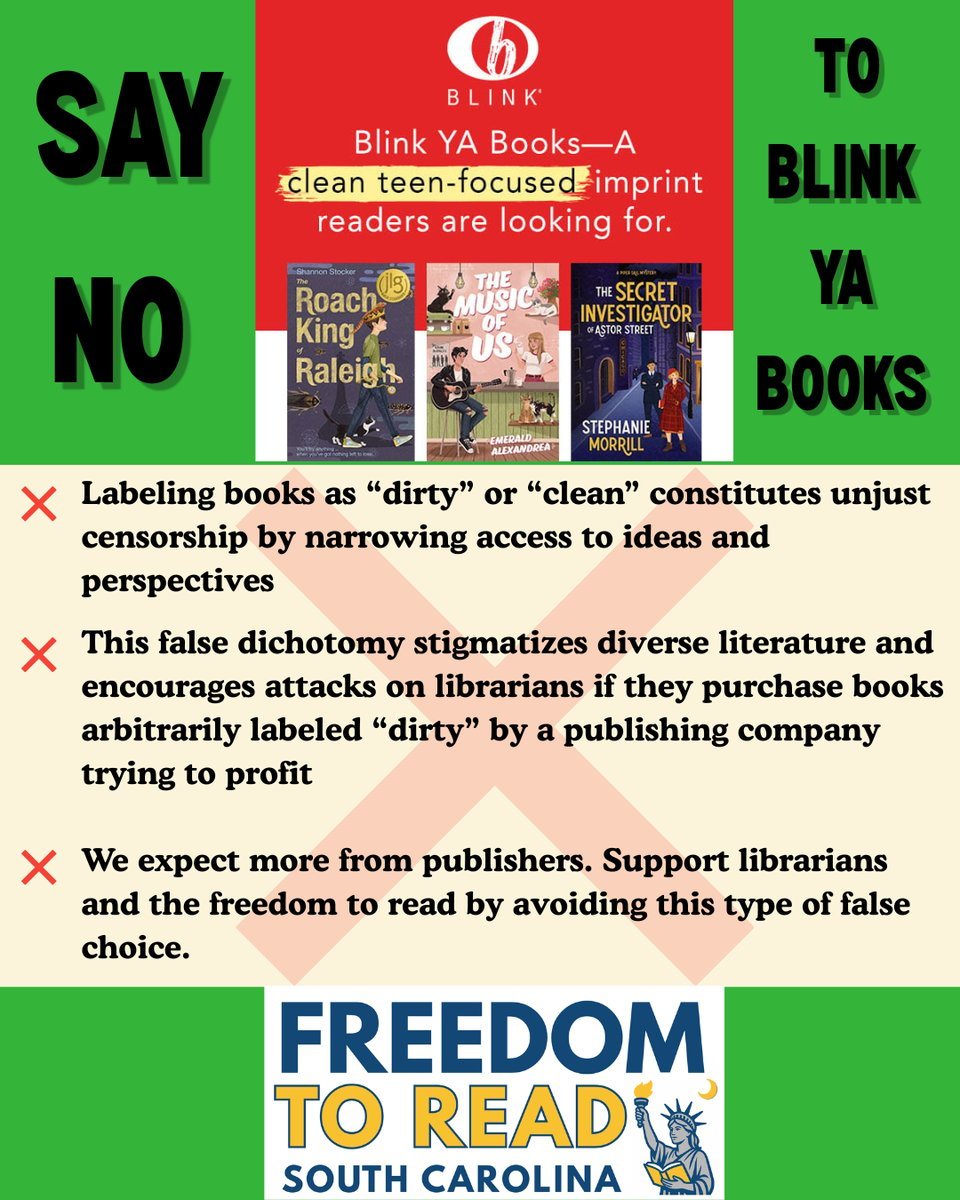
This messaging from this organization in this state is especially potent. As noted above, South Carolina has been at the heart of bans and erasure of young people from public and school libraries, through the dismantling of teen sections and the YA books within them, and through their state-sanctioned school book bans. South Carolina is an ideal consumer for Blink YA, at least as far as both the imprint and the book banners are concerned.
Freedom to read advocates stepping up and saying that this messaging is harmful and calling on colleagues statewide to resist purchasing from an imprint that doesn’t care whether they live or die is not only powerful–it’s necessary. It’s also not censorship. This is selection: choosing to procure materials from companies that aren’t actively harming the institution from which they’re getting their money. Blink shouldn’t get taxpayer dollars–money which supports the library or school–when they are part of the cycle of harm to those organizations.
Blink’s positioning is antithetical to what the pro-literacy movement is all about. What young people have access to in schools, libraries, and bookstores isn’t about some people’s choices over other people’s choices. It’s not about some parents’ rights over other parents’ rights. It’s about serving the largest possible swath of readers and community members.
And yet, Blink wants to stand apart as something different, “better,” and more “moral.” To do so, they’ve taken the very language and philosophies underpinning the censorship that public institutions have and continue to endure right now. It’s white supremacy packaged as an alternative to the diverse world we actually live in.
Meanwhile, advocates want books like these which reach young teen readers and those who want low-romance, low-violence stories (and to have them be inclusive to boot–none of our imaginations are too tiny to know this is possible!). There are entire movements and discussions of the need for “younger” YA titles, for the kinds of stories that can be handed to any middle school reader without wondering if it’s the kind of title they or their parents might not yet be ready for them to read. But in an era where librarians’ and educators’ lives and careers are at stake, they’re paying attention. They don’t need to purchase Blink books. Why would they? Blink doesn’t care about them, their work, their institutions of democracy, or the young people they serve?
It’ll be a harsh reality to discover the book banners aren’t going to sustain the business, either. It’ll be even harsher to see that some of the biggest book purchasers in the country, schools and libraries–the very industries that can make-or-break publishing–don’t want to support something that prides itself on aligning with those damaging those very institutions.
The First Amendment works because all five of the rights established within it are intertwined. You don’t have freedom of the press without freedom of religion. You don’t have the right to free speech without the right to assemble. Blink’s marketing tactics assume that they’ve got to fight against the literary world as it exists to publish the stories that matter to them and their readers. But the fact of the matter is that they’re able to do that because of the hard-fought battles to shape this landscape.
It’s a shame that instead of inviting readers in, they’re loudly slamming the door in their faces.
Notes:
^ I had this same issue with Amish fiction for teens, which is something for which one of my library communities had an especially voracious reading interest. No, this wasn’t an Amish community, though there were some within 50-60 miles. Amish fiction is often compared to Christian fiction in terms of it being “clean” and “appropriate” in certain circles.
*Calling any book or other form of media “clean” is inherently problematic. If a book isn’t “clean,” then it’s “dirty,” even if the so-called “dirty” books are just realistic depictions of young people’s experiences. “Clean” is code for white, cishet, upper-class, and Christian. The term is used throughout this piece because it’s both understood as problematic and because there’s no better term that doesn’t raise additional questions or concerns. I tried to play with the idea of “green light reads” back in the day, but that, too, suggests some books are “red lights,” and who gets to determine what that is? Certainly not me and certainly not a publishing imprint.
**Gurdon is back in children’s literature circles again right now for a piece about how white men like Mac Burnett are the ones being “canceled” by literary advocates for expressing opinions (under the Wall Street Journal’s “Free Expression” tag–we know who gets to express freely here). It’s some timing, given that Burnett’s comments about 94% of children’s literature being “crud” and wider discussions of the role of books for young readers–didacticism vs. entertaining vs. accepting there’s more than a binary of possibilities here–tie into this, too. Blink’s books are about “enrich[ing] your life while also entertaining you.” What they aren’t about is storytelling, at least according to the new marketing. They’re about message creation and message sending, with a potential side benefit of being entertaining. It feels like living in a bizarre and unsatisfying version of Groundhog Day, youth literary criticism edition.
***Ceaseless “rediscovering” of “new adult” is also getting tiring. The “new adult” books from the first round of these discussions (2012, 2013–same era as “the YA is too dark!,” because these things are intertwined) have expanded from contemporary romance with college-age protagonists. However, it’s still almost entirely romance books. Perhaps we need to address the stigma of romance and the ways that women reading romance is perceived culturally, and some of the so-called “problems” of adults reading YA books/”new adult” books can start to be addressed, too. These manufactured concerns and controversies are about hating girls and women and their interests. No amount of remaking categories will address that. Don’t get me started on the rise of illustrated covers in romance and where that’s been a convenient way to also ban books.