
Theft Is All These People Have
The actions of the censors (and their idols) continue pointing to how small and unfulfilled their lives truly are.
It’s not been a great National Library Week for the libraries across the United States. There hasn’t been a great one in a long time, between rampant book censorship, targeting defunding, and the withering of robust staff paired with the proliferation of new “essential” tasks the library has to take on as other social services disappear. Not great National Library Weeks will continue until libraries are robustly supported in every sense of the word.
Three things stood out to me this week. None of these things are meaty enough for a full newsletter, so instead, I’m pulling them together here. They’re meant to be food for thought, as well as an opportunity to highlight some news and updates that are worthy of more than a passing link.
The Top 11 Most Challenged Books in the US in 2025
Every National Library Week, the American Library Association’s Office of Intellectual Freedom releases their list of the most challenged books in the country from the previous year. Challenged as the framing is important here. These are books that had some kind of formal complaint lodged against them, which may or may not result in some kind of book censorship.
The ALA’s list is especially interesting to compare to PEN America’s. They track different things and use slightly different definitions to get at the same thing: books being relocated, redacted, restricted, or all together removed from libraries. ALA looks at all libraries, while PEN homes in on school libraries. Because censorship in school libraries is happening more quickly and has been since the rise of this movement in 2021, books on PEN’s list change more frequently than those on ALA’s. It’s not because the titles aren’t being banned still. It’s because once a title’s been at the top of that list, that’s indication that it’s gone. A book atop that list is also prime opportunity for quiet censorship–libraries and administrators fearful of what people might think if they know the book is on their shelves comply in advance (and in some cases, just agree with the manufactured panic around the “appropriateness” of those books).
There is some overlap this year, and perhaps the most noteworthy overlap is the title which sits atop ALA’s Most Challenged List and at number two on PEN America’s Most Banned list: Sold by Patricia McCormick. The book, published 20 years ago, has frequented these lists throughout that time. But in an era where protecting powerful sex abusers of children is an open secret, the targeting of a book that is explicitly about a (Brown) girl sold into sex slavery is sure as hell prescient.
Although transparency around the Epstein files has been anything but, over the last year, Americans have gotten far more knowledge of the sex trafficking of young girls going on by powerful rich men in this country. These girls were used as toys, sold promises that were lies, then discarded as if their lives were worth nothing. The image of former US Attorney General Pam Bondi testifying with no expression on her face against the pained and aching ones from victims behind her is one for history books.
It’s eerily reminiscent of the lies and dangers that Lakshmi and fellow girls trafficked into sexual slavery in Sold experience. And that’s the thing of it: the books being banned–and being banned by the stack–are those which reflect our contemporary moment and the things that got us here. Banning Sold is not only banning that powerful book; it’s further silencing of young people, especially girls and especially girls of color, whose lives are seen as throwaway. Whose voices are seen as obscene and inappropriate, even when they are the ones falling victim to disgusting, perverted adults–usually white men–exploiting their power. Their domination fantasies matter more than the young girls whose bodies, hearts, and minds are seen as expendable.
Banning books like Sold is removing one of the few tools young people have to understand the world and contextualize today’s reality. Sex trafficking isn’t just happening in other places. It’s happening here, right now. Books like Sold help teach young people about safe adults and about how they are empowered to speak up against injustices and cruelty that impacts them.
Advocating for the removal of Sold further protects the bastards sexually abusing children. It’s all connected.
With Open and Accessible Book Ban Data, Why Pay for a Vendor to Lie to You?
In addition to sharing the Most Challenged Books of 2025, the ALA Office of Intellectual Freedom also dropped a new tool: the Censorship Search Portal. The portal allows users to learn what books have been challenged or banned, as well as where and how those decisions have come about. The Office of Intellectual Freedom has been collecting and tracking this data for decades, and it comes from their research, from published reports, and from those who reach out to them to share an incident. It isn’t and can’t be complete the same way other tracking isn’t and can’t be complete–the biggest purveyor of book censorship, the quiet kind, is quiet because most of the time it’s never recorded.
This might be the biggest trove of information about modern book censorship, though, especially when used in conjunction with PEN America’s databases and Tasslyn Magnusson’s compilation EveryLibrary.
I put my name in, and though I thought I kept decent track of where and how my books have been targeted, I discovered that at least for Body Talk, the number is higher than I knew.
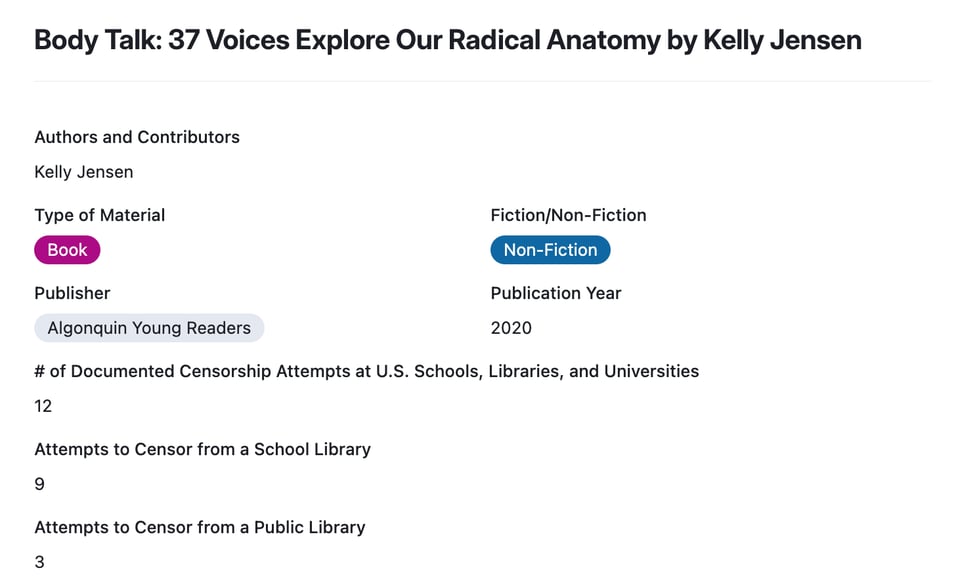
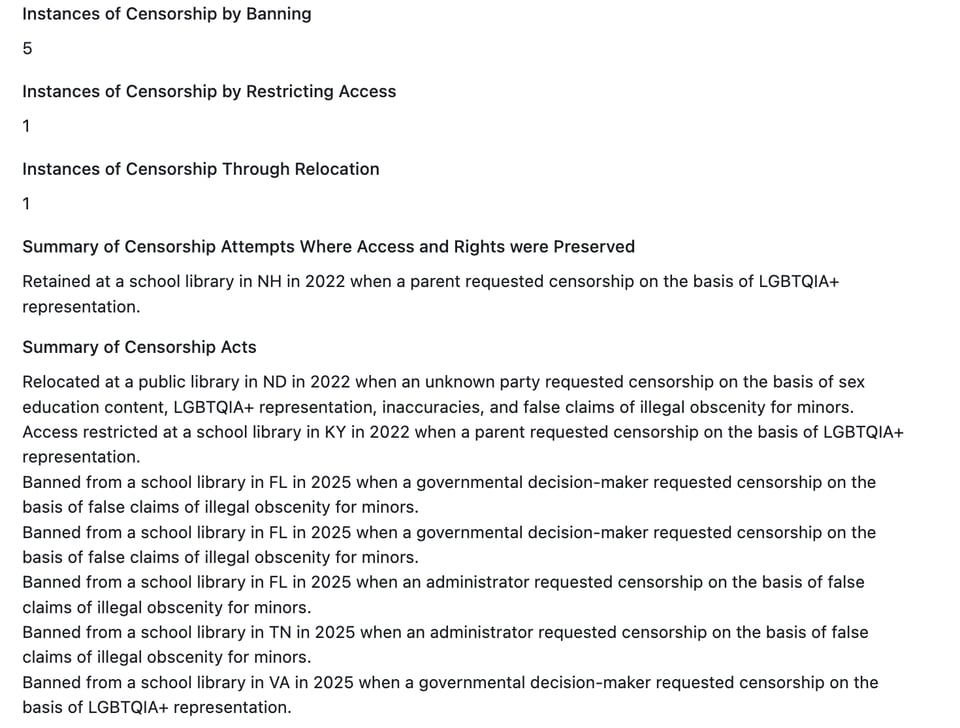
The breakdown of censorship attempts is enlightening, and when you scroll down the entry, it’ll share where those challenges happened, how they happened, and where possible, the outcomes of each.
You may recall then that one of the biggest selling points for OnShelf by BookmarkED, an educational technology company in Texas, is that the software could search through all of the book bans across the country and notify librarians of those titles. OnShelf requires librarians scan books students want to check out through their software, and the software lets them know about bans and whether or not little Johnny or Susie are allowed to borrow the book. The company refuses to share where they got their data, though from the beginning, it was pretty clear their “AI” for it was simply scraping Tasslyn Magnusson’s tireless work.
Since my reporting on BookmarkED in 2023 and 2024, several other outlets have gone deeper into this company. The founder, a white man, was among those showing up to Texas legislative sessions, advocating for bills that would ban books and thus, require the use of software like his to solve the manufactured problem. It took two years, but Senate Bill 13–which the founder advocated for in 2023–finally did pass in 2025.
So now here’s the question: with ALA opening up their data, and it’s robust data that’s based in research and fact, why would anyone need a program like BookmarkED to ban books for them? It seems like it’s easy enough to simply search the database. The solution in search of a problem doesn’t need to do anything anymore, since the actual solution illuminates the problem.
Do we want to advocate for using a database like this to ban books? Absolutely not and that’s not the point of such a database. It does, however, beg a lot more questions of educational technology companies swooping in to “help” librarians in the era of book bans. Why do they need to exist when this information is already freely available and library workers are smart enough to use them? Why would school districts that are already wildly underfunded spend precious taxpayer dollars on the book banning technology? Or on the book banning technology that stole its information and never verified it?
ALA’s database offers context for bans. It provides insights that help library workers navigate the reality they’re in, especially if they’re in states with oppressive legislation they need to navigate.
OnShelf just further restricts books from young readers and profits off the curtailing of their constitutional rights while they’re at it.
The ALA database is also not a student privacy nightmare.
PragerU Is Launching a Book Fair
Remember when SkyTree Book Fairs launched in fall 2023 as an alternative to Scholastic? Scholastic, they believed, was “too woke,” and SkyTree would step in to provide the kinds of wholesome, right-wing literature children in schools would be eager to spend their parents’ money on. The company promoted their initiative through lies, including one from the company’s Head of Finance, where she performed being forever hurt by being exposed to Raina Telgmeier’s Drama while in school.
SkyTree books is no longer.
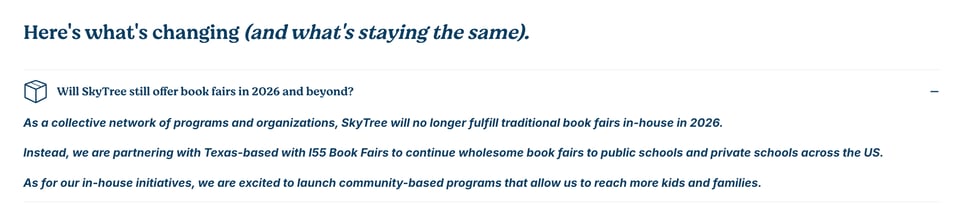
The company has rebranded as “SkyTree Collective,” and per their messy FAQs about the transition, they’ve elected to work in partnership with other organizations to shill their materials.
Enter PragerU.
You may recall PragerU as a far-right “educational” group that’s had its whitewashed history shoved into several state education curricula. They’re also the creators of the materials aboard the Institute of Museum and Library Services (IMLS) Freedom Trucks, pushing a whitewashed, propaganda-laden story about the history of America in honor of the 250th birthday. Those Trucks were paid for with over $14 million in stolen taxpayer dollars and despite being a project “from the IMLS,” the staff of the IMLS had no actual involvement. PragerU did.
Now, PragerU is launching its own book fair to compete with Scholastic. A lot of the language used on the website mirrors what we saw with SkyTree when they launched. The company brags that they’ll be bringing “a non-woke, patriotic education” to the kids. They’re also marketing through blatant lies.
Here’s a peek at the initial titles offered by the company for their book fairs. It’s certainly a series of choices:
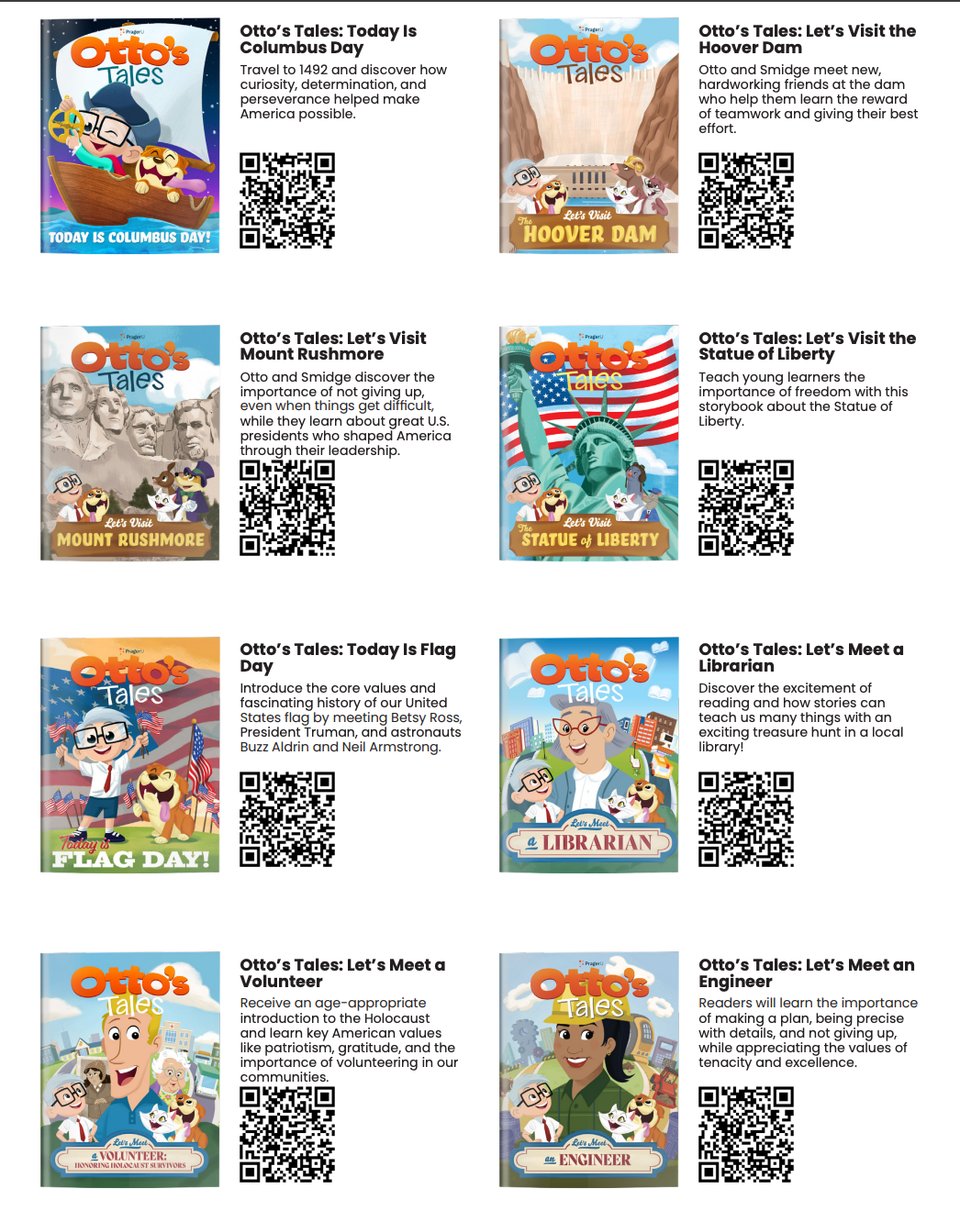
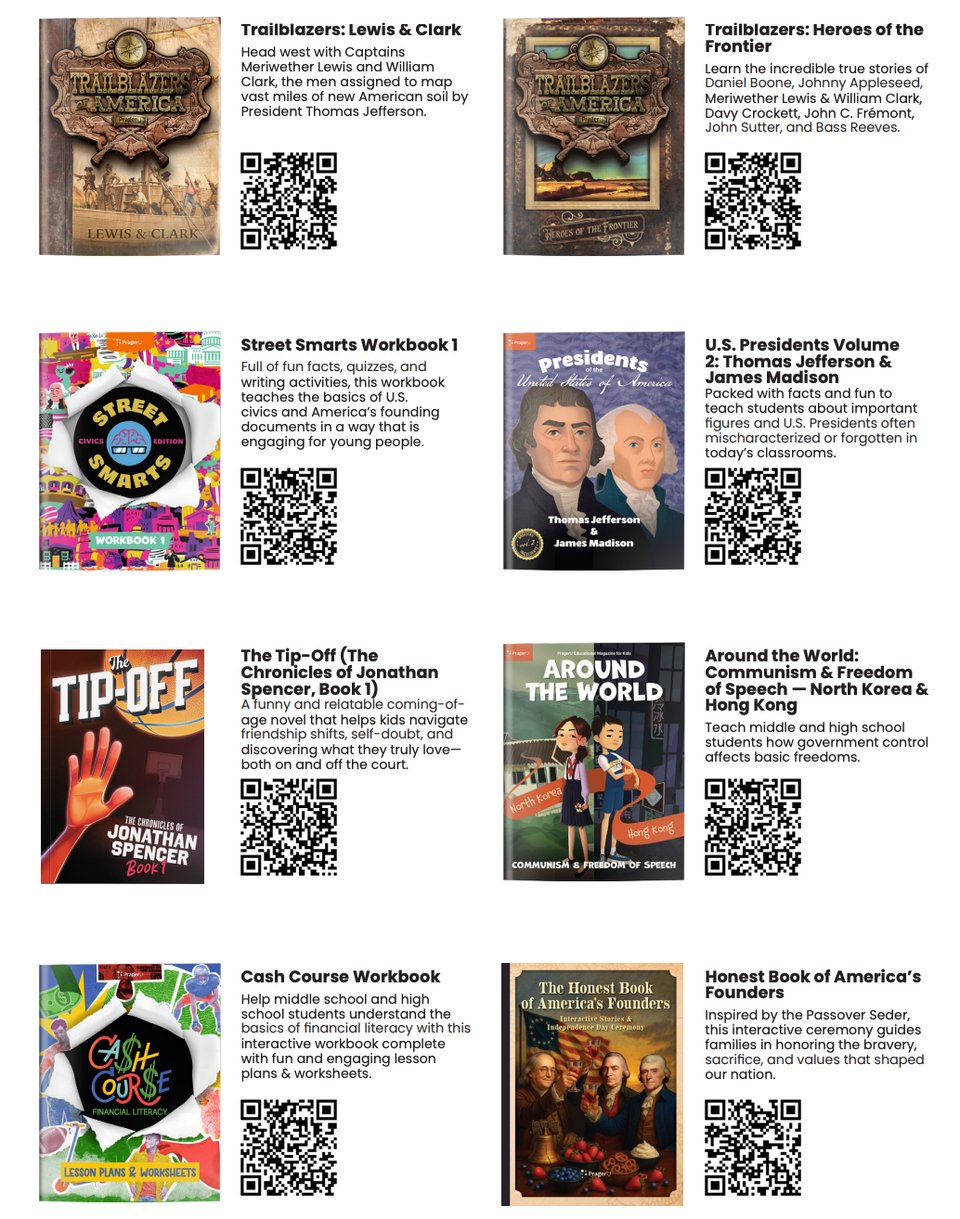
Beyond the propaganda and the historical lies these books perpetrate, there’s something to really be said about how the far right has no appreciation or understanding of art, culture, or entertainment. These books are sad looking, and the stories being shared appeal to few, if any, young readers. These are morality tales and stories where the message isn’t just heavy handed. The message is the whole thing, start to finish. There’s no room for inquiry, no room for joy, and no room for imagination. They’re report books without offering much in the way of facts that would help write the report.
The books–and book fairs peddling them–are indoctrination as much as they are a reflection of how deeply uninteresting these people are. How little they have to offer in terms of developing relationships or holding meaningful conversations. Their goal is but to continue shilling something that doesn’t exist nor has ever existed.
They want obedience, whether that’s from the women they subjugate, from the children they see as mere property, or the schools and libraries which are packed with materials that they’re unable to look at with awe, wonder, or appreciation. These are the hobbyless, whose anger boils because they lack the capacity to empathize or connect with people who do have and cultivate full, rich, and meaningful lives. It is easy to fester in anger when you have nothing of substance to occupy your non-working hours (or, frankly, your working hours).
Perhaps the takeaway here is this: everything is connected, even when they don’t feel that way. Where it is necessary to find library joy this week and every week, that joy is an object of envy and distain from grown adults whose lives are so tiny and constrained that they couldn’t imagine anything better. They have no imagination from which they can pull. They not only fail to engage with the cultural and literary arts made by humans who wish to make thoughtful and meaningful connections with one another. They also simply fail to be human or forge relationships that aren’t based entirely on exploitation.
Theft–of young people’s lives, of library and educational material, of our time to be joyous and engaged with the things we love and care about–is all they have.
Just to put a finer point on it: here’s the deeply unserious book series that Moms for Liberty was shilling for National Library Week.