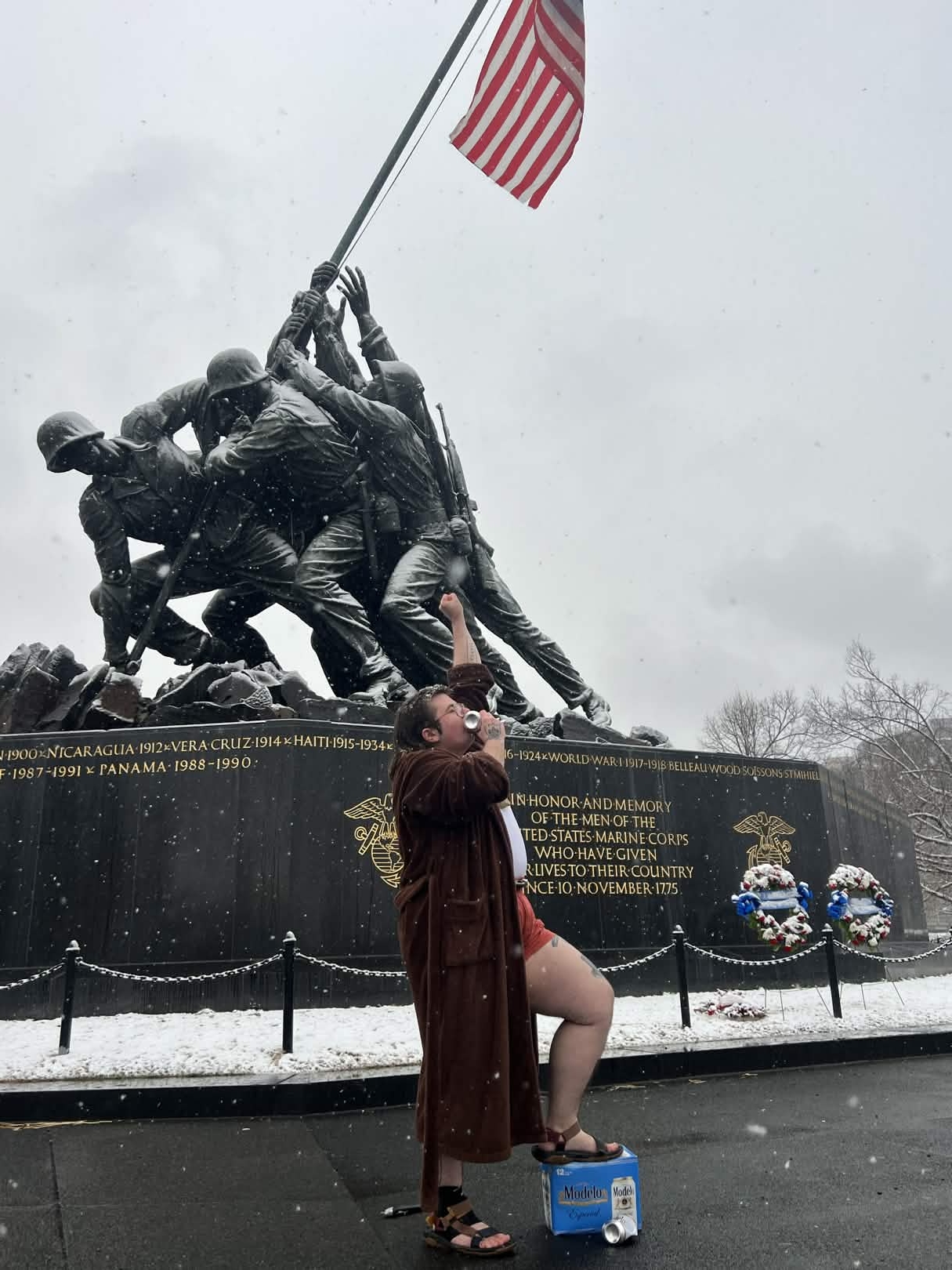
The War within The War (2026)
Last night I finished packing in time to attend a book talk by Wil Haygood, for his new book The War within the War: the Black Strugggle in Vietnam and at Home. Haygood is probably most famous for his book The Butler: Witness to History and his work with Forest Whitaker and Oprah to make an accurate adaptation to film.
I never read the Butler, but that movie, which came out the same year as 12 Years a Slave, really marked a moment in my childhood where I could feel a particular consciousness of slavery’s long shadow coalescing among my peers. I was 16 that year. My very white mother was listening to the Django Unchained soundtrack on repeat. Obama still had three years left in office, and we all knew Lupita Nyong'o was going to win an Oscar.
I didn’t see the movie either. I think, even then, I was skeptical of the biopic industrial complex’s portrayal of the relationships between white people in power and the black people close to them—slaves or servants or somewhere in between, never really equals in the eye of the camera. I didn’t need movies to illustrate the condescending way DC insiders treated black people an also wanted to be saved by them—I saw it every day.
After seeing Wil Haygood talk, I wonder if I was wrong to assume that’s what his movie must be. I went because I care about Vietnam as a disappearing moment in American memory, and because I thought I could learn something worth knowing. I left deeply moved by his words, more than moved.
I’ve been wanting an opportunity to share the notes I take, because they are pieces of art in and of themselves. J. Has been encouraging me to share them here, says the energize him as much as me. I took a lot of notes last night because they are my way of being present with the work, and there was a lot in his talk to be present for.
The Notes
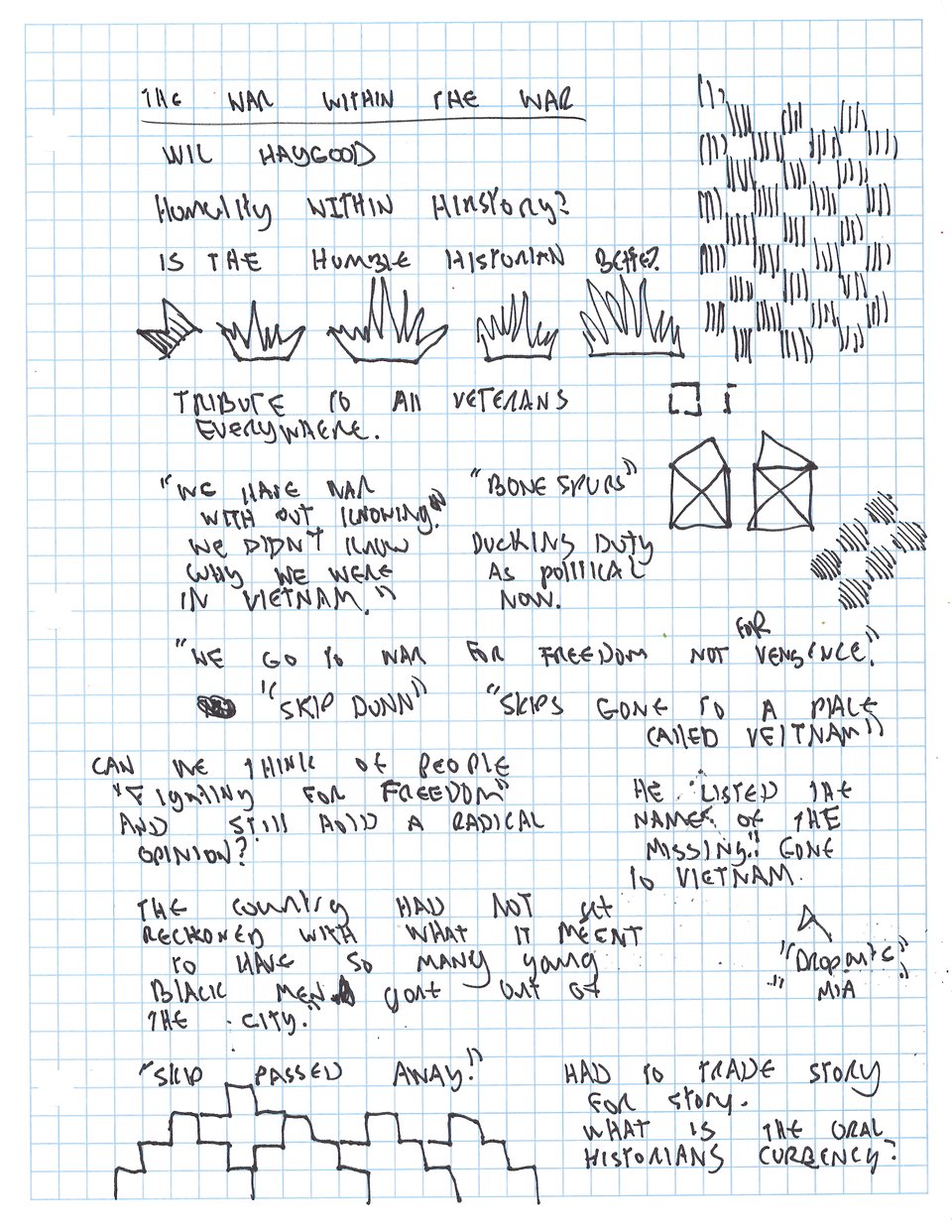
He started with contextualizing what the Vietnam era felt like to him as a child too young to be drafted but too old to be ignorant. Many of the words on this page are me trying to capture his language, the ripples and eddies of his phraseology.
I haven’t talked about it here, but I am writing a book about Vietnam. Well, it’s actually a story about Climate change and the war in the Middle East, but it’s also about Vietnam. It’s a fairy tale, and historical accuracy isn’t my main worry, but I think it will be the language that sells it.
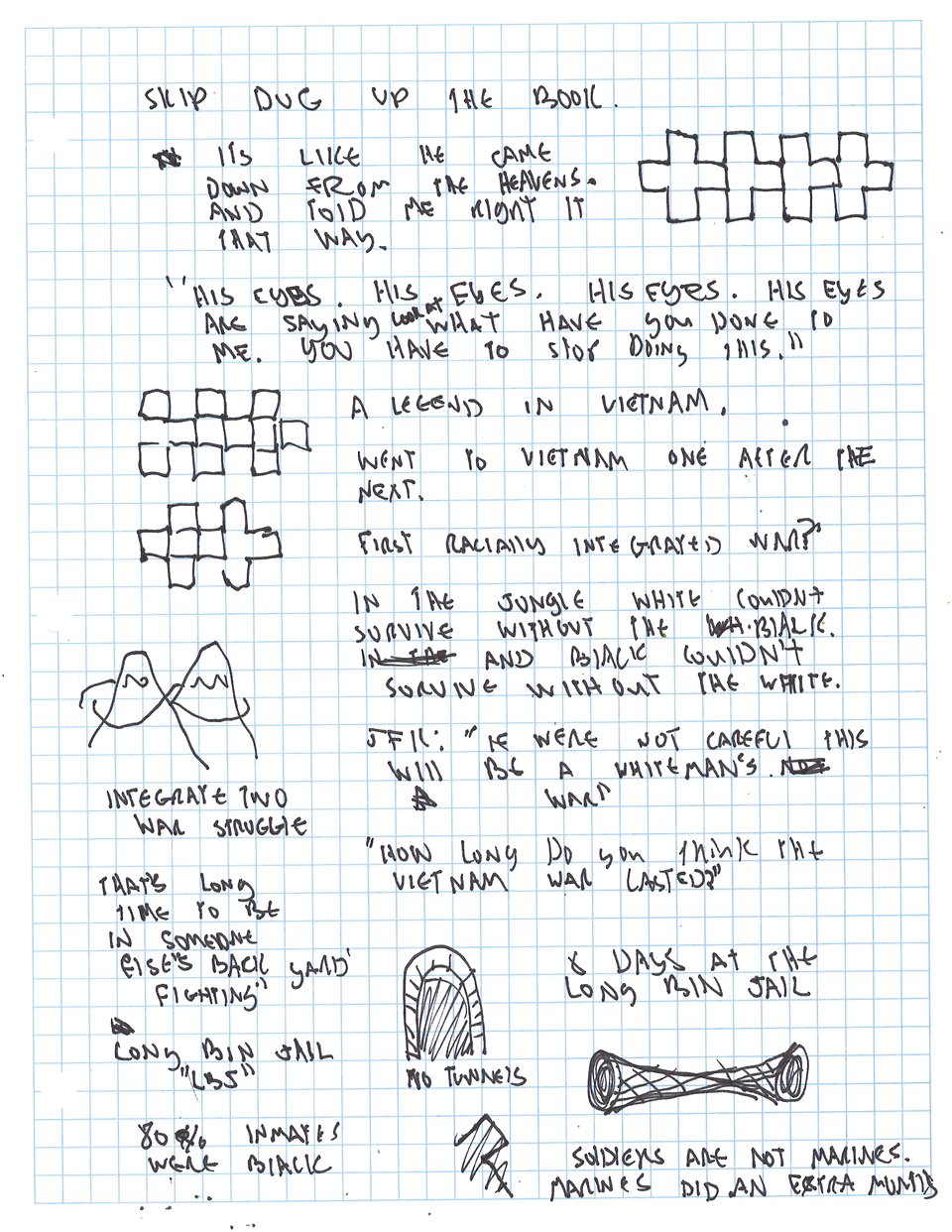
When I wrote his eyes that man times, I wasn’t exaggerating. There were several moments when Haygood seemed trapped in a memory and repeated a single phrase over and over again. It made me think, I need to let my self repeat more in my work.
Another interesting piece from this part of the talk was him talking about research tunnels. He said that in historical research there are basically people who have put themselves in the tunnel of civil rights and people who have put themselves in the tunnel of military history. “You have to have both mountains,” he said. I don’t know where he got mountains from tunnels but I couldn’t agree more.
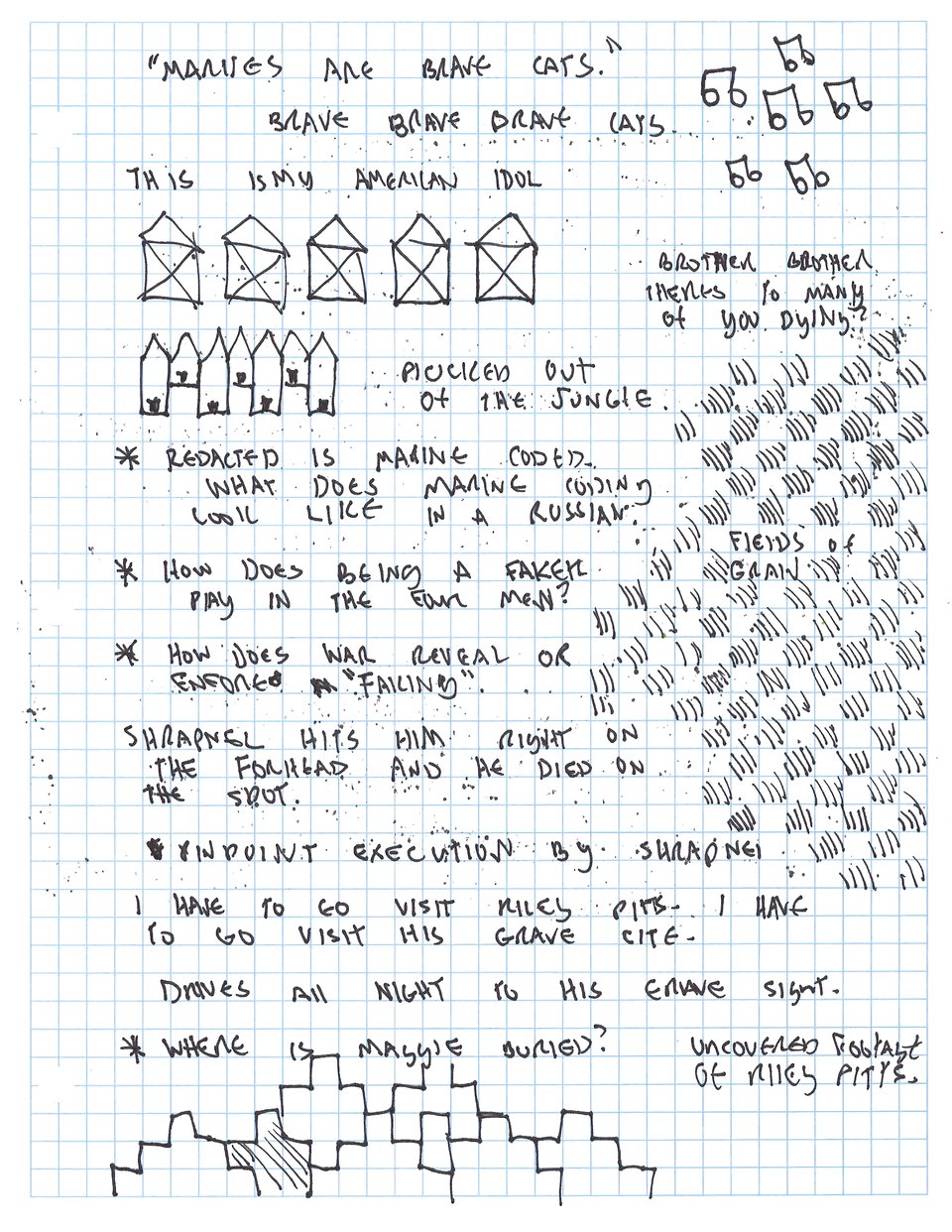
Stuff marked with stars are things I want to pull on directly for my book, which is called 3 Bullets. I’m mostly in a gathering phase now. I have walked a long road with it already, honing it down to a messy but understandable thematic core, now I need to start weaving it into the tapestry.
I realized during this that the character closest to the Marine mindset is going to be the Russian Spy who is as yet unnamed. What does that mean? I do not yet know.
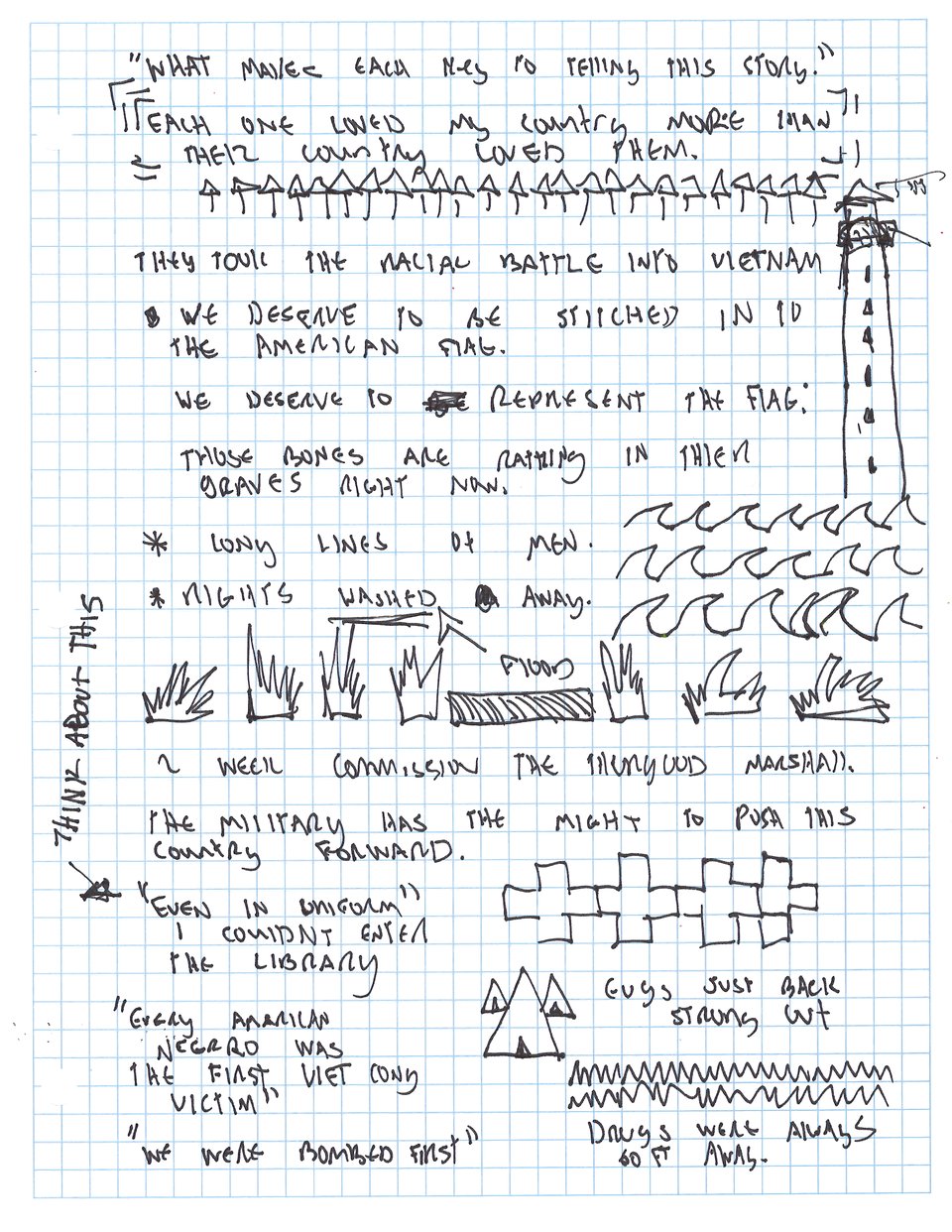
By this page we were nearing the end of the talk, but we were also getting to the heart of it. He spoke here about patriotism. He spoke bluntly about his anger at the disrespect black service members are facing now. His exact words were “When we [black men] sign up to serve, we are saying we deserved to be stitched into the fabric of the American flag.”
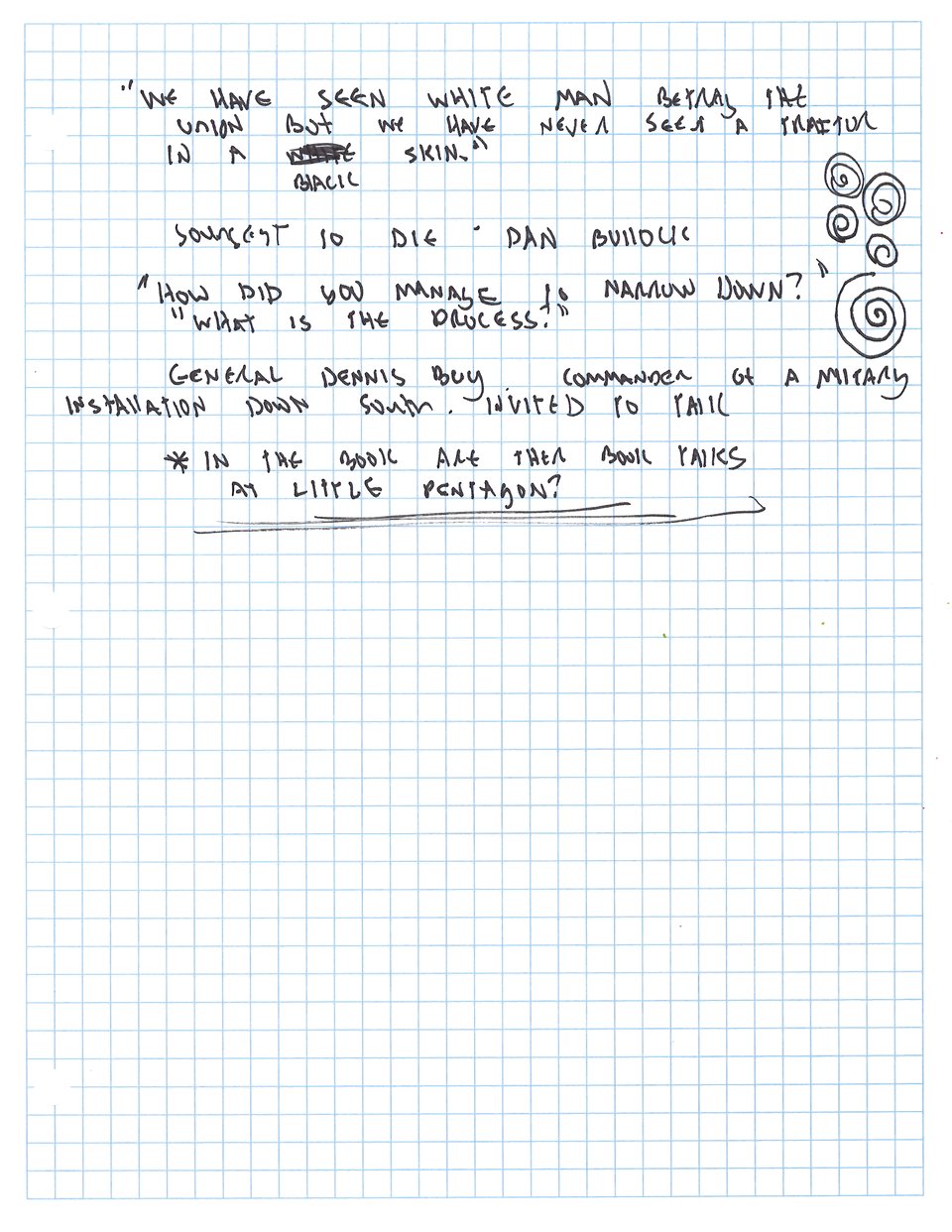
His book is not a linear history but a series of portraits and he said that each was chosen because they love their country more than it loved them. I heard my own voice in those words. I have always come at the problems of America as a patriot, which is a funny thing to say because I think most people would never see me as such. It’s not that I want America to continue as is. It’s that I want it to change not from disgust but from love.
As bell hooks said, we cannot change something if we do not love it. And I love my land enough to fight for it to honor its promises and pay recompense for the wrongs committed in the name of these United States. When I listened to Haygood talk, I heard him say the same.
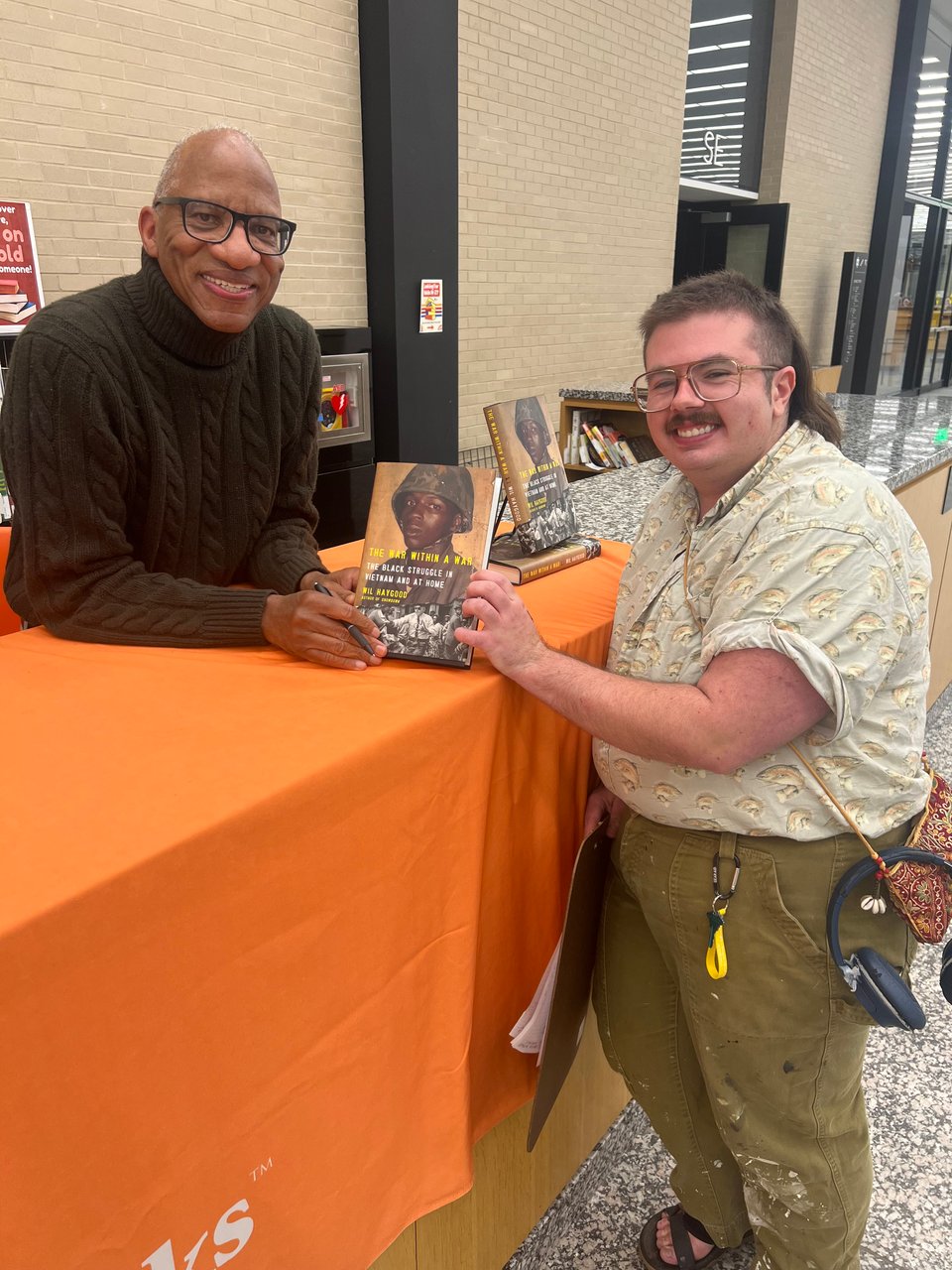
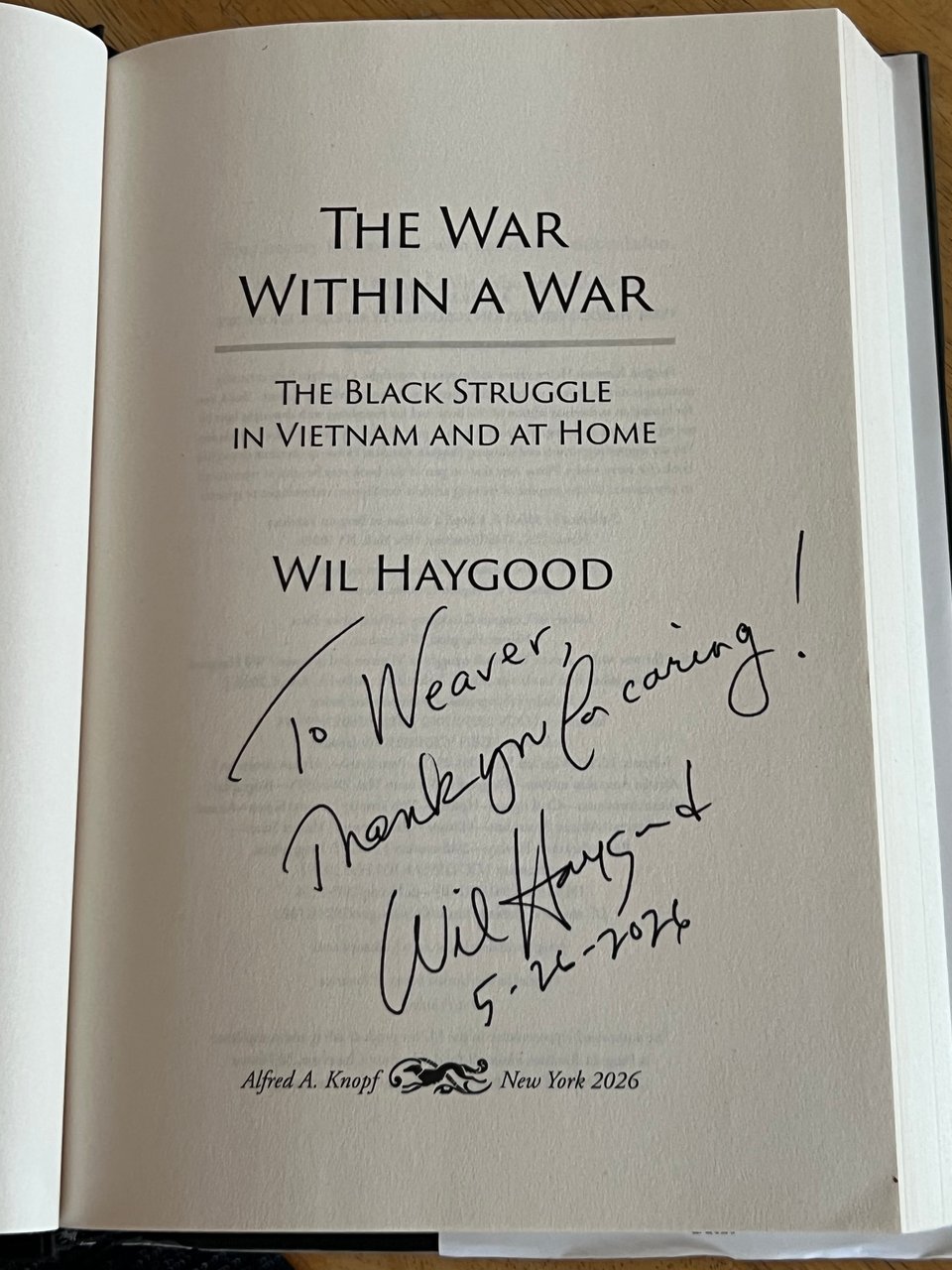
Other Notes
No emails from me for a few days. I’ll be far from civilization learning to build sustainable houses from mud.
Next email will be Sunday or Monday of next week.
I think, being away from my workshop, a lot of these emails are going to be about 3 Bullets. The book seems to be in the air. I think, hearing Wil Haygood talk, that it’s time to buckle down and do the research.
See you soon,
Weaver
-
Happy to take a peek at your notes for what sounds like a really good talk. To risk life and limb and to kill for the dignity of inclusion in America side by side with descendants scant generations from the Confederacy... hell of a thing.
Being a filmmaker's son means manning film sets at short notice, and a feature on Admiral Larry Chambers seemed like one of many such cases. Between making sure the camera was in focus and recording, I got to listen to him talk to a classroom of Black students about being the first African American to command an aircraft carrier in the US Navy. I suspect his experience of the war was very different to Army and Marine soldiers inland; I also suspect he left some things out for the sake of his audience. If you're curious, the feature is on vimeo (though lacking my footage, it looks like, and no wonder--I'm not built for the work): https://vimeo.com/608538418
I hope you have a blast and learn lots! We'll be here. :)
-
Glad you made the talk and were inspired with it, and connected with the author! Now you can reflect while you are waist deep in the big muddy.
-
Really interested in your question of where he got mountains from while talking about tunnels. It makes me think of mines - the idea that these parallel (or intersecting) tunnels of history were bored through mountains of the same stuff, we extracted something from them, and the holes remain.
Add a comment: