
First Harvest Part 2.
I’ve been done with the work of harvest for a week now but its only now that I am sitting down to write about it.
Processing the Mugwort was a long task, made longer by other things demanding time and by my own inexperience. It was a long job but it was not a bad job. Nor do I think I did a bad job.
But what I thought would take two evenings or so, ended up taking a week. And as I worked, rhythmically picking stems from the pile and pulling the dead and sunburnt leaves from them, I thought of a hundred different ways I could improve the quality and the yield.
It was a humbling task. One which reminded me how much about a task you have to reinvent when you are teaching your self, how far I still have to go in my herbal practices, and most of all how much work it is to provide even a fraction of the wealth needed for ceremony and prayer—in any practice not just the ones of my teachers.
I use the word wealth here because it was during this harvest on call with a friend (S/T) that I first described my house—full of animal bones and feathers, full of antiques, full of dried plants and art supplies—as displaying wealth. Like many people who grew up on the edge of the white world, with wealth but not capital, my idea of what wealth looks like was surfaces empty and clean, the “tasteful minimalism” preferred by the rich but not uncouth.
But processing the mugwort I realized that my house is designed to display wealth in the old way. I have the wealth of the forest. The wealth of being a trading post where materials and objects can flow in and out of my house. I have the wealth of time needed to provide Mugwort Vulgaris to a community and the wealth of love needed to prepare it for them.
Bluntly, I think the mugwort I prepared this time is only of middling quality. I am not sure I would treat someone internally with it, though that may be my own hesitance to step fulling into the world of herbalism with out more practice. But it should be good for smoke work, and for mixing with other herbs as needed.
It is the most fragrant I have picked, and I put love into it with every step, but I know there are heights to which I can take it yet.
The Pile
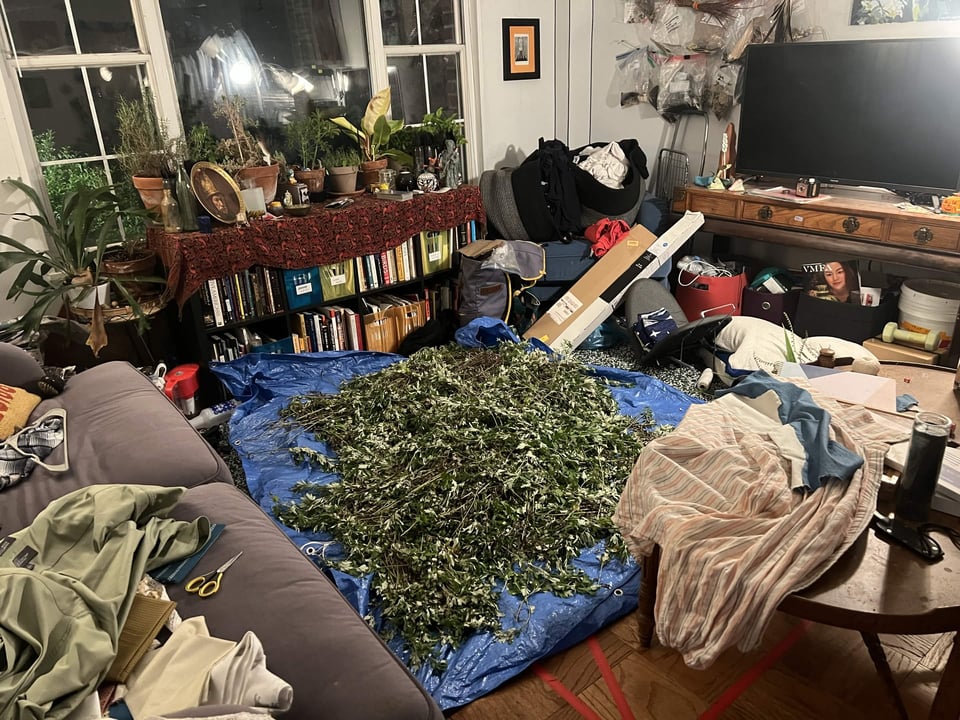
J. came home from the harvest tired and we dumped the tarp full of Mugwort in the middle of my living room and then both needed to go to sleep. What had looked on the massive back porch of my families house in the country seemed to have grown three or four times.
I noticed that the center of the pile was still warm—hot actually. I figured this was from a combination of sitting in the hot sun and then being places over the drive train in the car and picking up some of its heat, but I was worried about composting and mold. So I set up a fan next to it and over the next day or two regularly turned it over so that none of the mugwort was on the bottom for long.
I think under the circumstances this was the right call. I simply didn’t have the man power to process it quick enough. But turning over the pile means that the pieces that had been placed in the pile more or less straight got turned and dried curved.
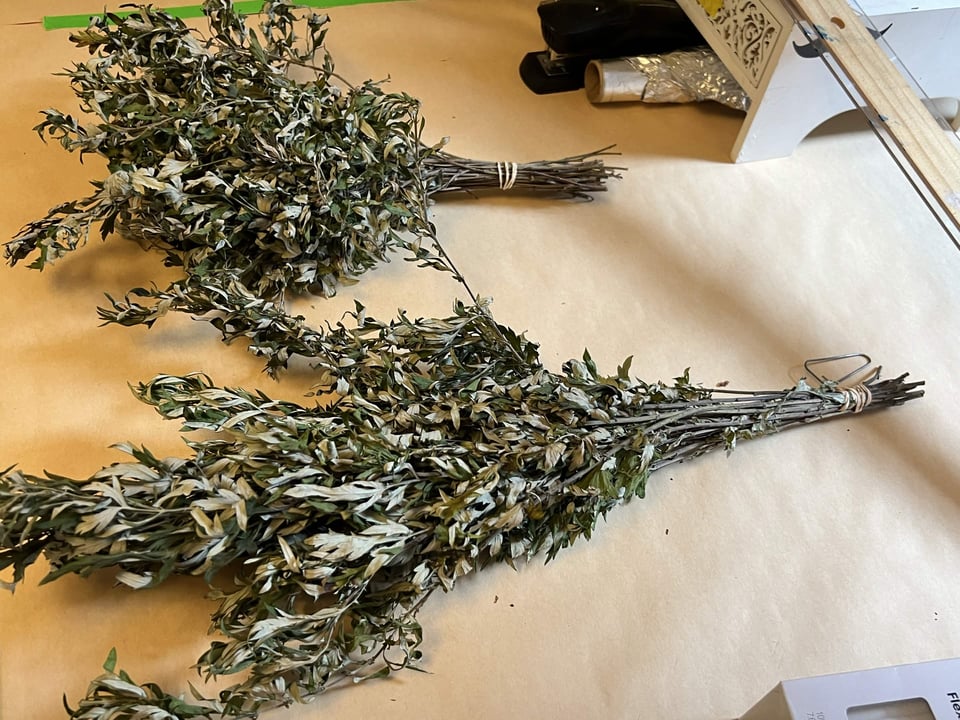
In the next picture you can see how the bundles that got hung up first (on the left) take up less physical space than those which partially dried in the pile, because their main stem dried while hung. Gravity did the work of keeping them straight. The stems will be removed in further processing, but when you’re preparing a huge selection of plants for a community, space is a real concern.
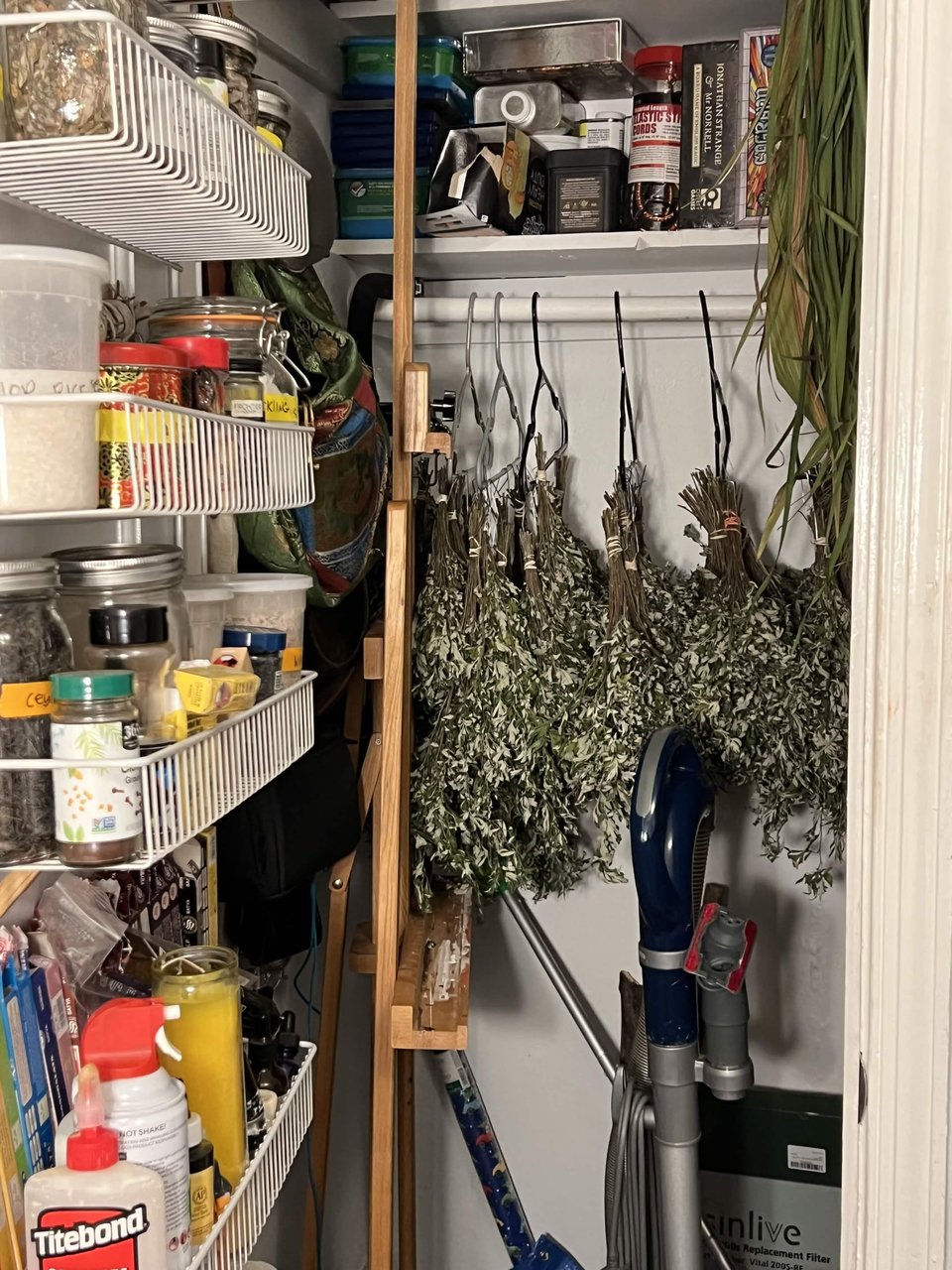
I am also concerned with them drying under the influence of gravity because I suspect those hung upside down while the sap can still flow will be of high quality because the essential oils will be pulled downwards towards their tips.
What the Plants Taught Me About themselves
I spent a lot of time with the plants as I processed them. This much should be obvious. But as I paid attention to them I learned a lot.
I learned that the leaves I thought looked the best and would be best were not Necessarily the most fragrant. I learned their smell changed as it dried.
I learned that there were basically 2 types of Mugwort sprigs. There were long ones with thick stems which probably emerged from close to the tap root and which a lot of energy was being sent to. And there were smaller ones, who’s stems had seemed larger before drying out but which shriveled much more than the stems on the longer plants. Proportionally there were many more of the big than the small, but I do not think that’s a bad thing. I had assumed that the small ones would be of lower quality, but many of them were the most fragrant.
I also learned that offering mugwort to the earth had a deep effect. All of the excess dried leaves and bits of stem I removed from my bounty as I worked got offered to the compost pile I illegally keep in the woods. I call this place my altar to rot and renewal, to grandmother mushroom, to the forest itself. Mugwort is known to strengthen psychic connection. And I found as I offered 3 full buckets of mugwort to the pile that I too felt our pathways of non physical communication open wider. It brought me closer to her.
It would be important to offer mugwort back to the compost, or to A compost, even if I had not been doing so as psychic offering. Mu++++++gwort is a carbon and nitrogen fixer. It carries large amounts of both proportionate to its size. returning it to the compost ensures that the carbon and nitrogen return to the soil rather than becoming part of our air. In deliberately returning it to the earth I can move forward in my gardening as an interconnected practice to that of caring for our air, our dirt, our lungs.
Some Thoughts on Next Year and the Years to Come
Mugwort is hard to remove completely if you are not willing to indiscriminately use herbicide. It is likely I will have patches of it popping up on my property for decades to come. Eventually I would like it to be confined to a few pots, so that I may keep it without harboring and invasive species, but I think I should plan for at least 5 or 6 more years of big harvests.
I want those harvests to produce higher quality and more useful medicine for those to whom I am becoming a supplier. The absolute key is more people. There was nothing to be done about it this year. It needed to be something J. and I did alone, but we can get more hung up quicker with 4 or 5 people. That will make all the difference.
I also want to get the harvest date closer to the date of bloom on the plants—which for those who do not know is when the energy and oils in the plant rise to the top to flower and seed. Being separated from my land and having to rely on others to drive me out there meant I just kind of had to guess. But in the future It might be worth it to do two days of harvest offset by 2 weeks so we can catch both waves of plants just before bloom. (It was clear this harvest that not all were on the same schedule.)
I also noticed a lot of sun bleaching on leaves which had grown in the middle of the garden. I think in the future the patches I will allow to grow and will invest the most time on are those sheltered by the shade of the house and the dogwood at the end of the garden because those plants were the least damaged.
But most of all, I think the best change I can make is just pouring more time and attention into the land. The more I give to it, in energy and song, in time and prayer, in attention and laughter, the better it will produce for me. This is not science but it is fact.
I might be in a moment where I am looking back critically at all I can do better, all I want to improve on. But that is a reflection of the pride I take in learning quick and my determination to provide for my community the best I can. It looks like reflection but truly it is excitement.
I cannot wait to learn what my land will grow when I have invested years into it.
Love,
Weaver
-
It's nice to read more about what the mugwort will do, not just in medicine practice, but for your compost - for the greater ecosystem you tend!
In the context of my own work, I'm also working right now on reinventing tasks while teaching myself - in my case, its the task of speaking in an engaging way into a camera while re-teaching myself how to do the live aspect of my video work. Our work always finds new ways to humble us about what we've accomplished within it.
Reply: