bone boke
There’s a community on Reddit for people who have never broken a bone. Like many such communities, it’s developed its own little language. It mostly exists as a place for BBBs, or “brittle-boned bitches”, to share their bone-related misfortunes. They are summarily derided by “strong boners”, whose bones remain intact, before being banned from the community. (I am told that if your bone is broken during the course of a surgery, it is a form of dark magic that does not speak to a bone’s intrinsic brittleness.)
I was not in the community when I broke my kneecap falling off my bike; I discovered it after the fact, on a quest for bone lore as I adjusted to my new straight-legged lifestyle. It’s the same principle that drove me to learn all I could about wound healing during the post-top-surgery gorefest of 2024. When your body has to do what it’s going to do, and you have limited scope for intervention, the closest you can get to a feeling of control is in trying to understand the why.
“I boke my bone,” I said to Isaac, forlornly, when he brought me lunch one day during the first week. “Isaac. I boke it.” And then we both lost our shit.
Here is what happened: I was riding a bike for the second time in my adult life, and probably the third time in my whole life, having proven to be a nervous and unteachable child. It was all going marvellously, until I wobbled and overbalanced and caught all my weight on my kneecap. My kneecap then landed right on the edge of the sidewalk (“pavement” for the Britishes in the room) and broke cleanly albeit painfully in two.
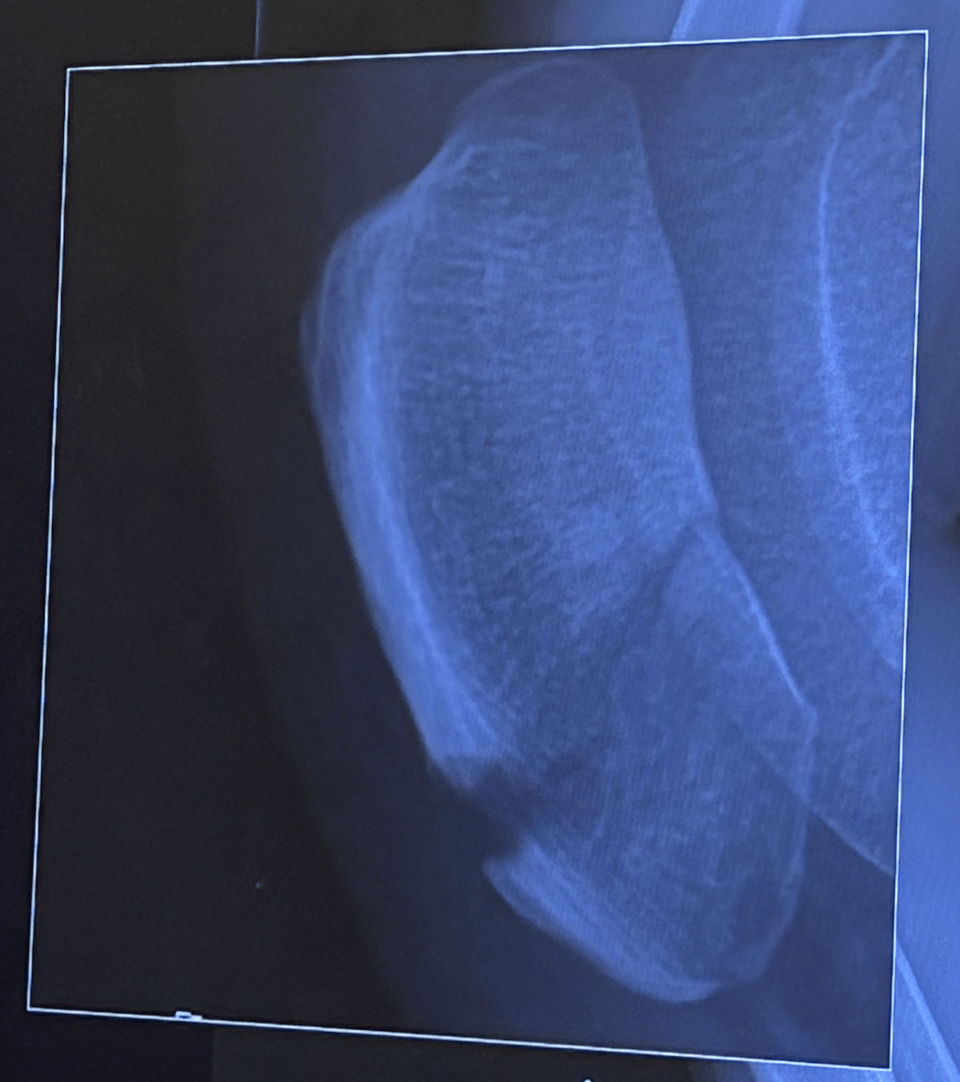
With hindsight, I am very proud of myself for not screaming. I spent a lot of time during my English degree thinking about Elaine Scarry’s take on pain; to her it is an isolating experience because it’s inexpressible. The language we use to describe it is imprecise and figurative, or it’s an attempt to quantify the sensation based on response and on relative hurts. The broken-knee pain was total and consuming; I had to close my eyes, because I couldn’t support both the pain and the experience of the world. It pressed everything else to the margins of experience for a long and awful moment before I could put words together. It made me think of a nuclear blast. The saving grace was that, for as long as I didn’t try to move my leg, it receded.
Isaac called us a car to get us home from the park, and I somehow managed to hobble to the road and get in. At this stage, I didn’t believe it was broken – as intense as the pain had been, I had no frame of reference for how a broken bone was meant to feel, and I think I wanted to believe it was only sprained. I got home, iced it, compressed it, elevated it, and hoped it would be better in the morning.
When it wasn’t, we called the doctor, who booked me in for an X-ray. The X-ray tech took the pictures and then told me to go to Urgent Care, which is how I knew it was broken. Urgent Care proceeded to sneak me in for an appointment they were telling other patients didn’t exist, because they looked at my X-rays and realised they couldn’t send me home without help. I left with crutches and a knee immobiliser, and I spent the next six weeks unable to bend my leg.
For the first few weeks, I only left the apartment for hospital visits. I learned how to crutch around the apartment, how to sit and stand without bending or resting on my injured leg, and how to tolerate doing nothing while Isaac (a hero, and the best husband) picked up all the slack. I literally couldn’t bring myself food; both my hands were occupied using the crutches. Roxy was confused, then perturbed, then ultimately accepting and forgiving. When she started headbutting the crutches, I started to feel like she might someday forgive my weird way of moving.
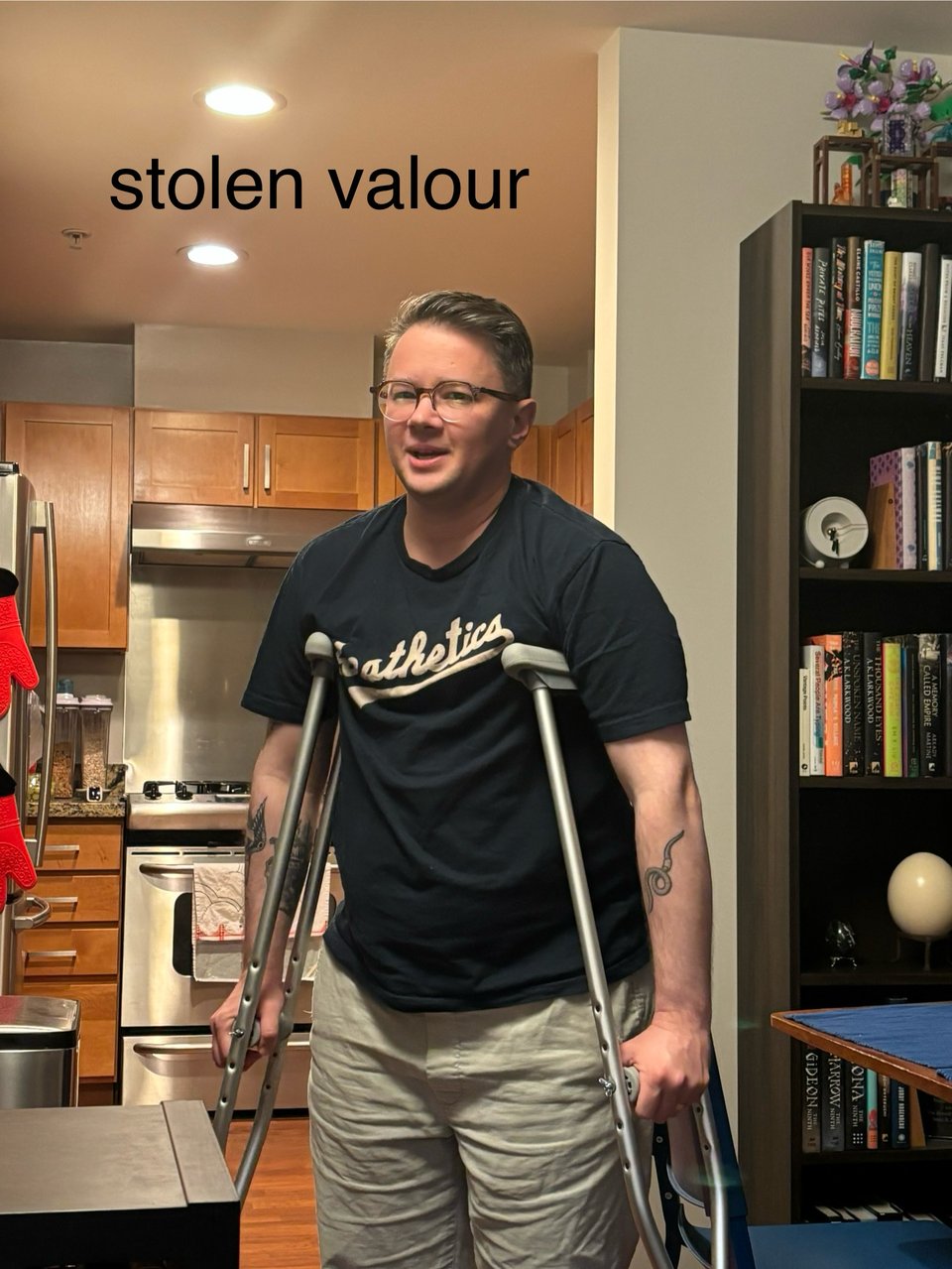
Sometime in the initial straight-leg phase, we went to see St Vincent at the symphony. We upgraded me to an ADA seat, but it still wasn’t far enough back to accommodate my leg comfortably; plus, crutching through crowds or up steps was still incredibly scary. I remember sitting with my broken leg resting on my good foot, trying to think through the motions and momentum involved in walking up a step. How could I replicate that with crutches? Navigating the world became an endless logic puzzle. The show was incredible – I don’t regret going – but I was exhausted and sore the next morning.
The silver lining was that, while my leg stayed in one position and didn’t try to bear any weight, I wasn’t really in much pain. I took gabapentin to help me sleep in the immobiliser, and I learned very quickly to take some ibuprofen before seeing the orthopedist. My bone research led me to believe that it could’ve been significantly worse.
Bones are one of the only parts of the human body that can regrow with time. If you lose a limb, that limb is done; a serious meniscus tear is not going to repair itself without surgical help; but the main reason for surgical bone intervention is to get the pieces positioned correctly before they start to mend. Think of using canes or cages to guide the shape of a plant. The growth happens no matter what, but you can control the result.
I was very lucky. Because I landed on the edge of the sidewalk, the bone cracked neatly in two; because it cracked neatly in two, the pieces stayed well aligned. If I’d landed with my kneecap on the flat ground, per the orthopedist, it likely would have shattered – and at that point, I would have been looking at another surgery, with all the attendant worries about suture rejection and wound separation (plus, I am sure, all the attendant pain).
After six straight-legged weeks, new bone showed up on my X-rays. There’s still a surface-level canyon across the middle of my patella, but it has a floor; the two pieces are joined up again.
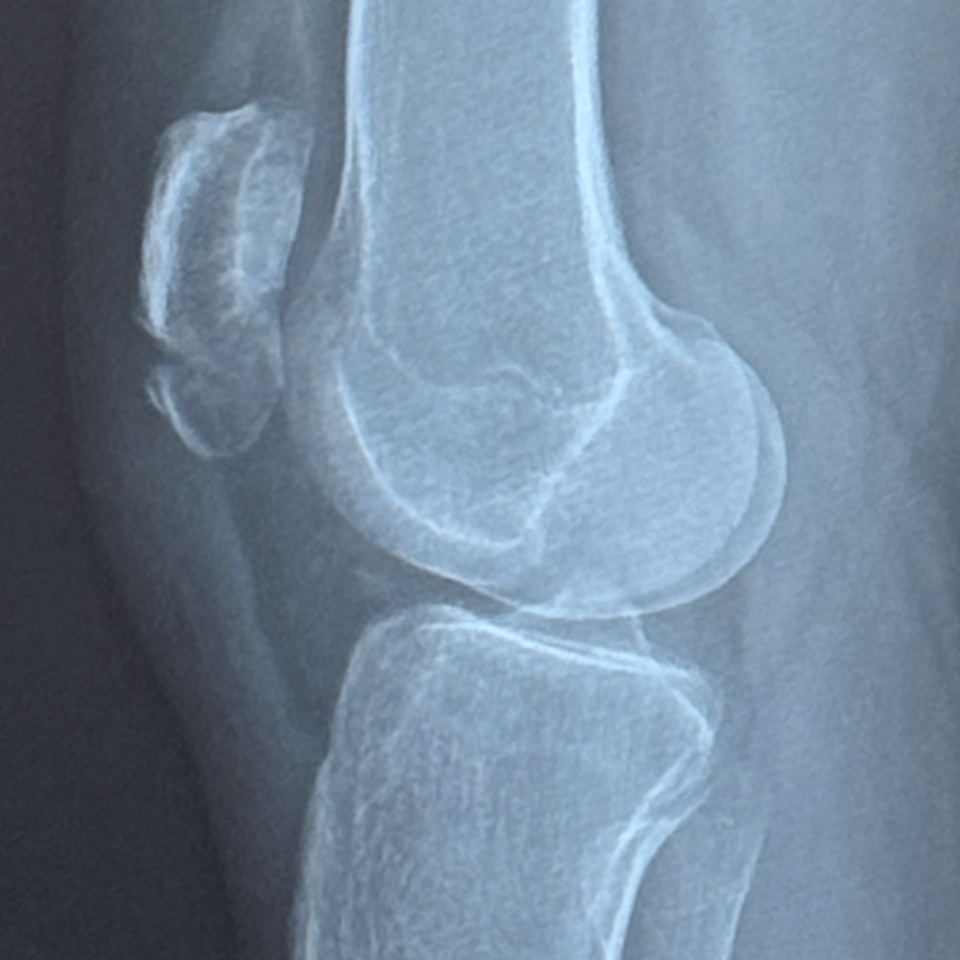
As I write this, I’ve been able to bend my knee (with the help of a hinged brace) for about a month, and I’ve been doing physical therapy for about two weeks. An underrated consequence of the break is that my leg muscles, woefully underutilised, started wasting away. All the clamshells and leg extensions and hip bridges are meant to rebuild those muscles, with a view to getting me out of the brace in the early days of next month.
Coming back to the office this morning felt like re-entering the world after a strikingly long time on parole. I got on and off the bus with the grace and stability of a baby horse. I am trying to remember how to talk to my colleagues without resorting to the private language of my marriage (or my cat). I am tired and overstimulated and my knee is vexed because there’s nowhere to prop my leg up at my desk. Most crucially, I miss hanging out with Roxy. Getting so much time to bond with her, and to help her get acclimated to our new place, has been one of the best things about a very stupid experience.
But also: the city this morning was grey and foggy and austere, and my body still remembered when to snap back into focus on the bus ride to work, ready to change lines. And everyone seems happy to see me. I’ll take it, I guess.
Oh – and I’m hoping to be back on the bike as soon as possible. I’m already a BBB, after all. Nothing left to lose!!
xoxo
W
-
Brilliantly written if somewhat harrowing to read and more so to experience apparently. I do hope it all comes right in the end for you. All the best
-
That first picture of the clean break looks like the open maw of an alien. I'm glad the maw has closed and you are on your way to heeling. (That was a mistype, but I'm going to leave the pun in.)
-
This is so great. (Not the experience, obviously. Insane that you didn't scream.)
Reply: