
National Park Trips: Seeing Through the Fog
In which our humbled hero gets a taste of his own medicine—and loves to learn the open waters of Kenai Fjords National Park
National Park Trips: Seeing Through the Fog
Note: I’m in Alaska this summer, so I decided to share something I wrote about a national park trip I took last month. Regular programming may or may not return in August!
June 2026:
When my buddy Ray moved to Anchorage, Alaska, in the summer of 2018, he extended an invite to Steven and I: Come up to visit, and we’ll have a good time.
I don’t know if he thought we’d ever take him up on it, never mind that we’d book flights just four short months after his move. But in the cold winter months leading up to our trip the following August, the three of us game-planned some of the fun we’d have—like visiting Kenai Fjords National Park outside of Seward.
When it came time to plan the adventure, Ray suggested—of all things—a day-long boat tour into the park.
I knew nothing about Kenai Fjords but was nevertheless offended at the thought.
“A day cruise?! With all the old fogeys?! But why?! Don’t they have signs on the dock that say, ‘You must be this hunched over to ride this ride’? Will they give us bifocals while boarding and serve saucers of warm milk with lunch? We’re strapping young men, not pampered tourists, so why aren’t we hiking onto glaciers and breaking off chunks of ice for the glasses of Jameson we brought along? Why aren’t we wading deep into the backcountry, climbing the highest peaks before daybreak, and looking down on forested fjords from atop the grizzlies we just wrestled into submission?!”
Okay: My skeptical reaction was probably closer to an arched eyebrow and a tossed-off, “A boat tour? Really?” But the outrage was there.
Surprise, surprise: The guy who lives in Alaska, and who’d visited the park just a few months before suggesting the day cruise, knew better than me. He smirked and said simply, “It’s not that kind of park.”
Kenai Fjords was created to protect the glacially carved fjords jutting into the Gulf of Alaska, the glaciers that remain at the end of those fjords, and the Harding Icefield at the heart of it all.
There are a couple hiking trails that cover a few miles of the park’s more than 600,000 acres—an area three times the size of New York City—but they’d be closed due to bear activity on our visit. Unlike Yellowstone, Mount Rainier, and other (more accessible) national parks, Kenai Fjords mostly resides off the road system. If we wanted to see the park, we’d have to don our bifocals and book a boat tour. So that’s what we did.
On an impossibly sunny day August 2019, I got a taste of my own medicine—and it tasted suspiciously like warm milk.
Humpback whales breached before us. A pod of orcas surfaced close enough to touch. A school of porpoises sped by like they were late for work. The occasional sea otter glided by, curious about our cruise but otherwise unmoved by our presence. We stopped at islands and rock formations that jutted straight from the sea—and which housed thousands of common murres, cormorants, bald eagles, and puffins.
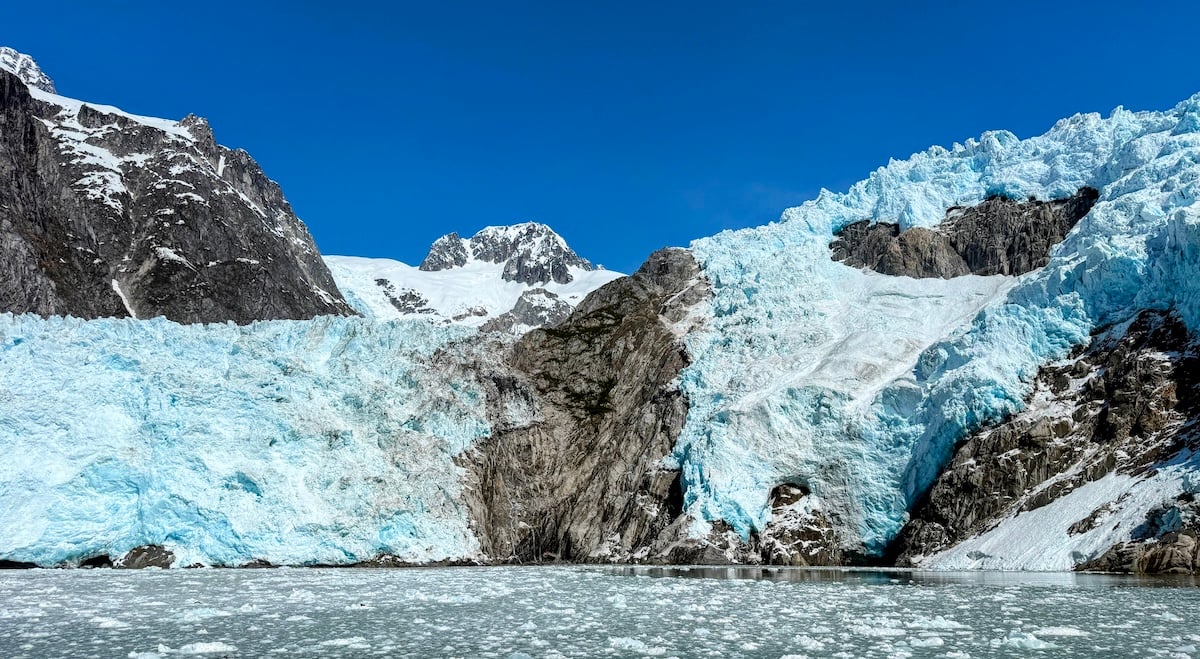
Eventually, we left the open waters of the Gulf and headed through one of the fjords before arriving at the foot of the Northwestern Glacier—where a cool breeze wafted off the wall of ice as chunks cracked like thunder and fell into the turquoise waters below. An impossibly cool blue hue peeked out from behind (and below) centuries of accumulated ice and packed snow.
When we debriefed over dinner that night, I remember running out of words and wondering to no one in particular, “This is Alaska?” I didn’t even mind that we never wrestled a grizzly.
Seven years later, memories of that epic August day cruise bounce around my brain as I return to Kenai Fjords for—yes—another boat tour. Believe it or not, I’m even excited this time around.
There is nothing impossibly sunny about the skies on this ominous morning. By the time our ship leaves the harbor in Seward and enters Resurrection Bay, fog has slithered in and is too thick for us to, you know, see the harbor (or, for that matter, much of Resurrection Bay). The clouds, a dull shade of gunmetal, bleed into the mostly calm waters below; the horizon, I can only presume, was left back on the dock.
Our friendly captain says that, in more than 20 years, he’s never piloted a cruise that’s been fully fogged in—and that he’s in communication with other boats to see what conditions are like further from shore. Notably, he declines to share what those conditions are. He blows a soul-shaking foghorn every few minutes and doesn’t even bother with cursory narration about the nearby peaks and rock formations we can’t see. As the minutes tick by, we trudge quietly toward Northwestern Glacier with only the occasional foghorn blast jolting us awake.
After a few hours, we turn into a fjord for the home stretch to Northwestern Glacier. Almost immediately, the fog threatens to lift. The sun tries to break through. Clouds scatter. The faintest outline of a granite peak pierces the wall of gray. On shore, a moody forest briefly breaks through the fog before retreating behind a misty curtain. The elements are duking it out in a battle royal refereed by Mother Nature, and we’re all rooting for sun as we inch past rounded hillsides and towering cliffs.
The sun outlasts its competition, and our boat enjoys almost unimpeded blue skies as we slow down in jewel-colored waters and work our way through floating icebergs, many of which offer resting spots for harbor seals and their newborns. After what feels like 20 minutes since first seeing Northwestern Glacier, our captain kills the engine.
My sense of scale is comically unequipped to hazard a guess at how large the face of the glacier is—or how tall it rises from the chilly waters below; the closest I figure is “hundreds of feet” tall and wide, which is definitely helpful. Parts of it resemble cotton candy frozen in time. Parts are textured like a tub of ice cream at Baskin-Robbins. Jagged spikes jut toward the sky from the glacier’s peak.
We all crowd to the right side of the boat for the best views and take photos like the fog might return at any moment. Two Indian parents wrangle their young children and jostle to take the perfect group photo. A pair of sisters from Tennessee, both of whom have spent the entire trip on the deck, take selfies from every possible angle. Old-timers pull out high-powered cameras with funnel-shaped telephoto lenses; I’m positive they could tell me how many whiskers are on the face of a harbor seal a half-mile away. One brand-new deckhand whips out her camera phone alongside the rest of us; it’s her first time seeing this glacier, and she’s just as transfixed. We’re all hoping for shots that might outlive the glacier itself.
After about 45 minutes of mostly perfect views, we return to the inky stillness. At least one of us onboard remembers the captain’s earlier promises about never getting fogged in and starts to wonder if there really is a first time for everything.
The sun tries to mount a comeback—and is successful enough for the fog to lift and our captain’s streak to remain intact. Merely overcast skies and occasional sun breaks have rendered our ship positively jubilant. We scan the surface for a pod of orcas known as the Kodiak Killers, wait patiently for the return of a humpback whale that our captain saw dive a few minutes earlier, stop by a waterfall that plunges into the sea from heights we can’t see in the mist, and learn more about birds than ever thought possible. (Did you know the common murre is considered the penguin of the North—and that it can dive more than 600 feet?)
As we return to Resurrection Bay, the sun has emerged victorious—and our captain is, as the kids might say, feeling himself. He’s heard reports of humpbacks near the harbor back in Seward and declares that we’ll be late getting back to the dock today. He gets on the intercom and throws out a half-hearted, “Let one of our crew members know if you have a train to catch …”, but none of us dare mess with the mojo. We’ve waited all day for sunshine, and we’re going to make the most of every minute—even if our time with blue skies can only be measured in minutes.
Sure enough: A misty spray erupts nearby. Then another. And another. We see the whale’s exaggerated hump briefly arch above the water, the surest sign this humpback is ready to dive, and it’s followed immediately by a postcard-worthy whale tail briefly pointing skyward. When the whale dives, it may remain underwater anywhere from eight to 45 minutes, and we can’t be that late. Our captain fires up the engines, and it’s not long before the harbor comes into view.
Buoyed by this briefest of sightings, our cabin is as chatty as it’s been all day. Sapphire waters surround us, and gulls squawk like we’ve offended them. A sea lion swims by. Only a few clouds hover apologetically beyond the snow-capped peak of Mount Marathon overhead. Resurrection Bay has never felt more alive.
We’ve been out here for nearly nine hours, and none of us are ready to call it a day. It’s been hours since we’ve heard a foghorn. The only thing I’m missing is a cup of warm milk.
Thanks for reading! If you’re not already a subscriber, learn more about “Forever on Our Mind: 1,859 Love Letters to Oregon” and click the button below to subscribe to this weekly email:
Subscribe now