
Forever on Our Mind: Oregon Wine Tasting or: How I Learned to Stop Worrying and Love Pinot Noir
In which a life-long craft beer fan ventures into the exotic world of Oregon wine—and learns to love what he sips.
225. Oregon Wine Tasting or: How I Learned to Stop Worrying and Love Pinot Noir
October 2020:
Kellen and I walk out of the drizzle and into Cathedral Ridge Winery near Hood River, where barrels line the wall and lights twinkle overhead. We take off our jackets, sit down at a high-top across from the bar, and look at the tasting menu—at which point I wonder whether I’ve forgotten how to read.
Having grown up so close to the Willamette Valley, one of the top wine regions on Earth, I know pinot noir. Rather, I know of pinot noir. I know it exists; I even think it’s red. Merlot rings a bell, but only because Paul Giamatti’s character famously hated the varietal in the 2004 film “Sideways.” I figure rosé’s soft pink hue is achieved by mixing red and white wines. A chardonnay on the Cathedral Ridge menu is described as “buttery”—and why is it a good thing this wine has been likened to a baked potato topping? Will its Syrah taste like bacon and chives?
As you might have guessed, this is my first time really drinking wine and visiting a real, live winery. I’m researching and writing a guidebook on the Columbia River Gorge and Mount Hood, so I asked my best friend Kellen—who’s forgotten more about wine than I’ll ever know—to act as my Chardonnay sherpa on this wine-tasting weekend. Deep down, I know the Columbia River Gorge is beloved for its wine and that I’d miss out by not sampling at least a few pours. But I’ve always been much more of a craft beer fan and have incuriously regarded the state’s wine scene as the refuge of well-to-do yuppies with too much time on their hands, too many zeroes in their paychecks, and (by extension) too many linen shirts in their closets.
My mistake. While researching the guide, I found that Oregon is home to roughly 1,000 wineries—and is the third-largest grape-producing state in the nation. If a region in Oregon supports the cultivation of wine grapes, a world-renowned vintner has probably tended to their crops for decades—and has a cabinet full of awards to show for it.
Oregon’s first vineyards predate statehood, having been planted around 1850, but its modern-day wine industry dates back to 1961—when HillCrest Vineyard took root in the Umpqua Valley near Roseburg. By the mid ‘60s, vintners realized that pinot noir seemed to grow better in Oregon’s Willamette Valley than in the Burgundy region of France—and planted grapes accordingly.
It wasn’t until 1979 that Oregon officially arrived as a force on the global winemaking stage. That year, The Eyrie Vineyards’ 1975 South Block Reserve Pinot Noir was named one of the world’s top 10 wines at the Wine Olympiad in Paris—a competition among more than 300 wines from nearly three-dozen countries around the globe. Finally, this rural backwater with no wine scene to speak of could credibly compete with heavyweights from France and Italy; to say it sent shockwaves through the winemaking world would minimize the breadth and effect of shockwaves.
Roughly 50 years later, Oregon’s wine scene is celebrated and adored the world over. The fertile Willamette Valley, home to more than 700 wineries and tasting rooms, is synonymous with pinot noir. The Rogue Valley supports warm-weather grapes you won’t find anywhere else in Oregon. A few wineries have put down roots in the Central Oregon high desert, using the region’s short growing season to churn out one quality pour after another. And dozens of vineyards dot the Columbia River Gorge, where windy conditions cool off the vines after long, hot afternoons in the sun.
Of course, I know almost none of this when the friendly server stops by to see what sounds good.
I stutter through the occasional “uhhh”, stammer through the stray “ummm”, lower my head, and let out an aggravated sigh like I’ve just stubbed my toe on a coffee table but don’t want to wake anyone up. Mercifully, she offers to come back later.
It’s no exaggeration to say I don’t understand 90% of the words on the menu. I don’t know how a wine can be dry when the server is clearly pouring a glass two tables over. White wines are white and red wines are red, that much I’ve figured out, but anything beyond that might as well be astrophysics. I’m worried the server will smell the poverty on me the second I try to pronounce sauvignon blanc. (Is the “g” silent? Did they misspell “blank”? I’m too nervous to ask.)
Feeling small enough to fit in Kellen’s shirt pocket—given his wine expertise, I assume it’s linen—I briefly consider abandoning our reservation and retreating to the comfort of pFriem Family Brewers nearby. At least I’ll know what I’m getting when I order an IPA there.
Kellen, to his credit, offers to help. It’s not that complicated, he explains. Most wineries have pre-selected flights that mix the best of their reds and whites. I don’t have to know what tannins are, but he’ll explain them if I’d like. When I don’t love a particular pour, there’s no shame in using the spittoon. He promises that no one will laugh at me, least of all the server, and clarifies the pronunciation of sauvignon blanc—which, incidentally, is not misspelled. Besides: The only way to really get a feel for wine is to, you know, taste the wine.
Ted Lasso would be proud of Kellen’s pep talk.
Something about his easy-going, open-hearted frankness nudges my runaway train of thought onto a far more productive track: Maybe I can use this ignorance to my advantage. What is this wine-tasting experience, after all, but an opportunity to learn? Am I not here to research wine for a guidebook that will be read by dozens? I am—so why should I pretend otherwise? Everyone has to start somewhere, right? And what if the rest of these wine snobs, clad in their finest linen shirts, are as open and friendly as Kellen? Would it kill me to envision the best-case scenario for once?
When the server returns, I don’t tell her which flight I’d like; instead, I perk up like the first shot of espresso just kicked in. I explain that I’ve never had wine before, I don’t know what I’m doing, I’d appreciate her advice, and I’m excited to learn.
Rather than sniff out the poverty on me—she for sure knows I don’t own any linen shirts—our server’s smile widens at the chance to share some of her knowledge. She hand-picks a flight of four and patiently walks me through the tasting process—observing the wine to gauge its age, swirling the glass to unlock its aromas, sniffing to better understand those aromas, and (eventually), you know, tasting the wine.
Kellen and I ease our way through each pour. From across the bar, the server asks how we like it. I lack the vocabulary to communicate my feelings and instead come across like a three-year-old trying vegetables for the first time: “I liked this one. That was okay. I like this wine better than that wine.” At no point do I embarrass myself by declaring a particular wine “icky.” The server uses my insightful feedback, incisive commentary, and thoughtful, well-reasoned opinions to pour a few more that we might enjoy. I ask what a vintage is and get confident enough to use the word in a sentence later this weekend.
As we put our coats on, I tell the server how intimidated I’d been just an hour ago and how much I appreciate her generosity. She smiles and remarks that she’s happy to help. “We’re like Sonoma in blue jeans,” she says of the Columbia River’s Gorges unpretentious wine scene.
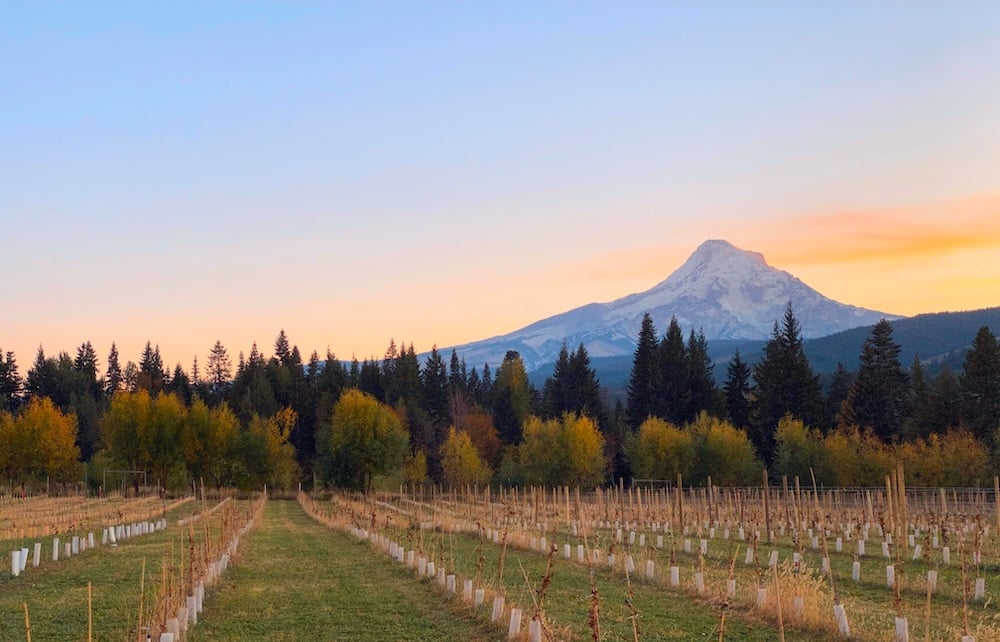
Sure enough, that laid-back ethos reverberates across the weekend. Our next stop is the funky Sunshine Mill Winery, where wines are poured into plastic cups inside a converted Cheez-it factory. Tomorrow, we’ll spend two relaxing hours at Mt. Hood Winery, where a father will braid his daughter’s hair while his wife navigates her own flight. We’ll end the weekend with a sunset visit to Grateful Vineyard in the magical Hood River Valley; there, we’ll pair our pinots with pear-topped pizzas in the shadow of Oregon’s tallest peak.
I still won’t know whether my pinot has tannins, never mind what tannins are or whether they’re good. But I’ll know this: It will be a damn fine vintage.
Thanks for reading! If you’re not already a subscriber, learn more about “Forever on Our Mind: 1,859 Love Letters to Oregon” and click the button below to subscribe to this weekly email:
Subscribe now