
what is conflict?
a relational concept in a political context
hey y’all,
i have been drinking coffee at home a lot lately, so no new beverage reviews at the moment. but! i have gotten into pen drawings and watercolor lately. of course, one of them had to be a cold glass of sweet tea with kalamansi. i’m thinking about digitizing these into stickers for my shop. this is not really my medium, but it felt good to tangibly actualize a vision in my mind and have it mostly turn out how i pictured it.
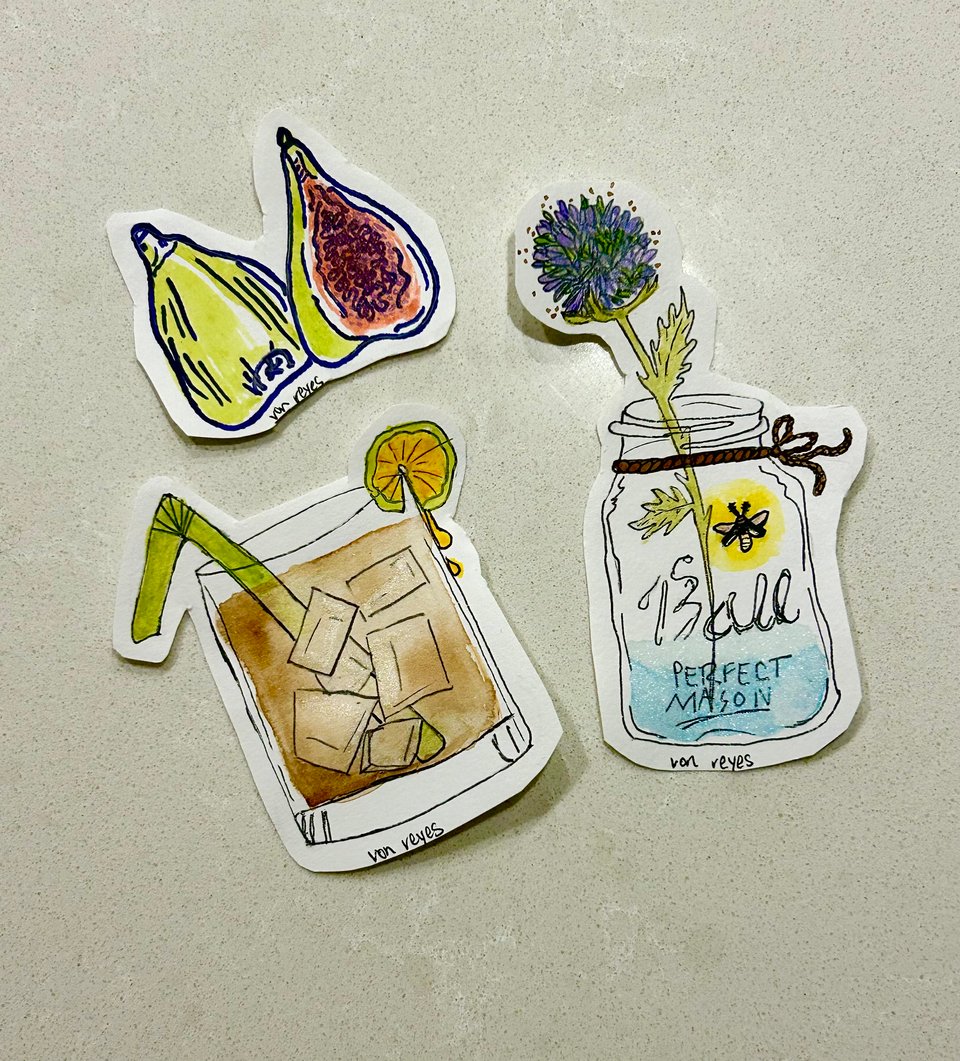
i have room in my down time for watercolor, in-part because i have largely removed myself from digital spaces. i deleted all the social media off my phone in november of 2025 and i (mostly) haven’t looked back. i’m still working on my detox, so every now and then i’ll get caught in a scroll.
i had a weird interaction this week as a result of one of those scroll traps. i had long since given up on interacting in good faith with people on the internet. i wrote a piece years ago on medium (which i’ve now deleted for AI scraping reasons…) about our inability to have generative conflict on these poisonous social platforms. nowadays, i only check my instagram on my ipad and only for 10 minutes at a time. a few weeks ago, i came across this video:
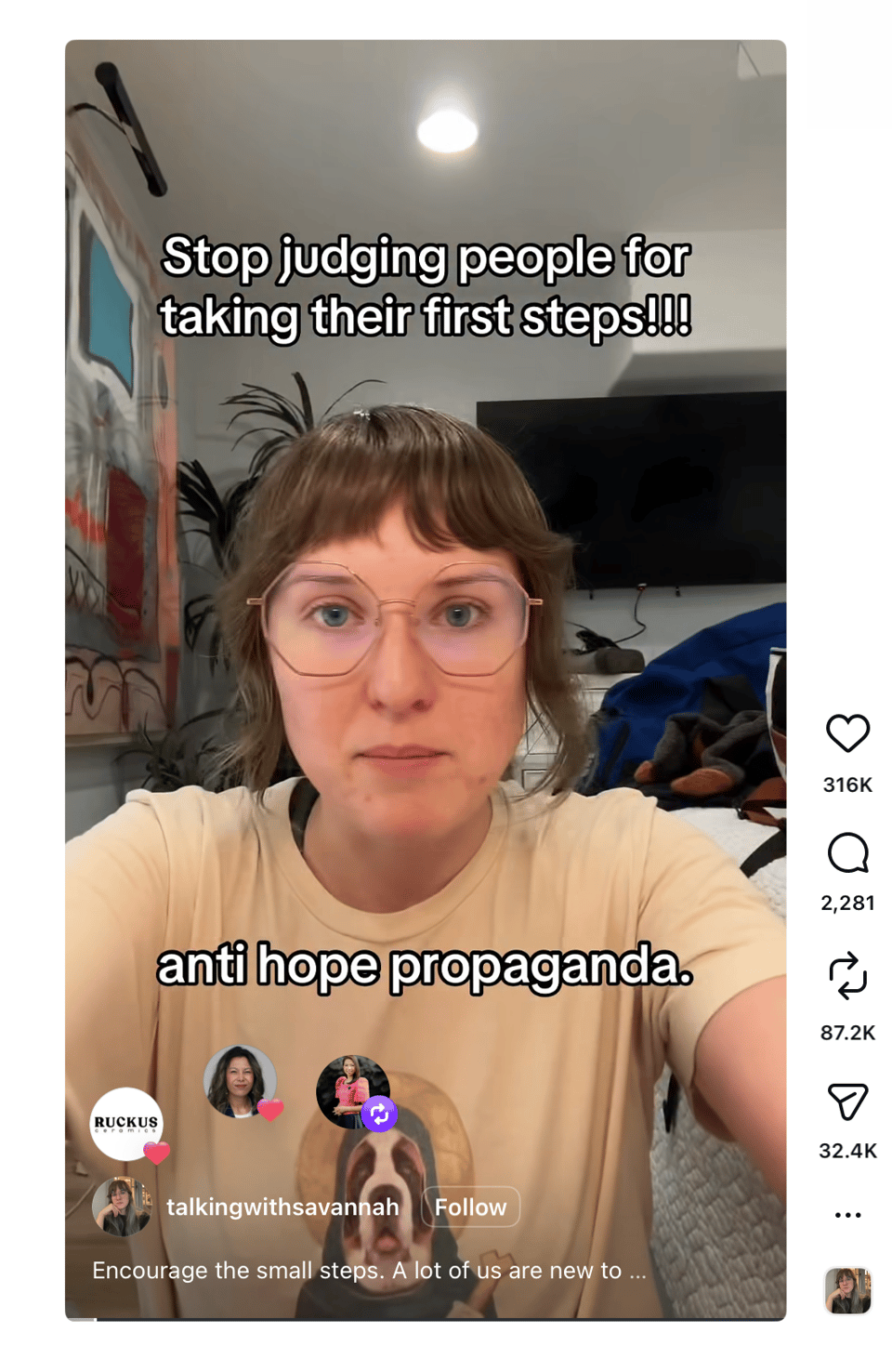
i’ll let you watch it at your leisure, but the central point was we have to stop discouraging people who have just joined up with us. i 100% agree with this frame, which i believe is apparent from the backlog of sweet tea & kalamansi. we need everyone! we have to stop punishing people for not knowing what they don’t know. that said, i didn’t think this video achieved that.
the original poster makes a point to say that people who are frustrated with baby activists are “deeply unlikable.” they double down in the comments, saying that the people who are disillusioned about baby steps aren’t doing anything themselves to fight fascism. the irony here is that i believe OP is also a nascent organizer, so they are advocating for themselves by positioning themselves as an expert who is only trying to stick up for others (classic dunning-kruger effect at work).
what could have been a call for hope and solidarity actually came off, to me, as an indictment of legacy and/or career activists who are frustrated with the lack of respect and solidarity for what has already been done. in a strange and completely out-of-character decision, i decided to share my thoughts.
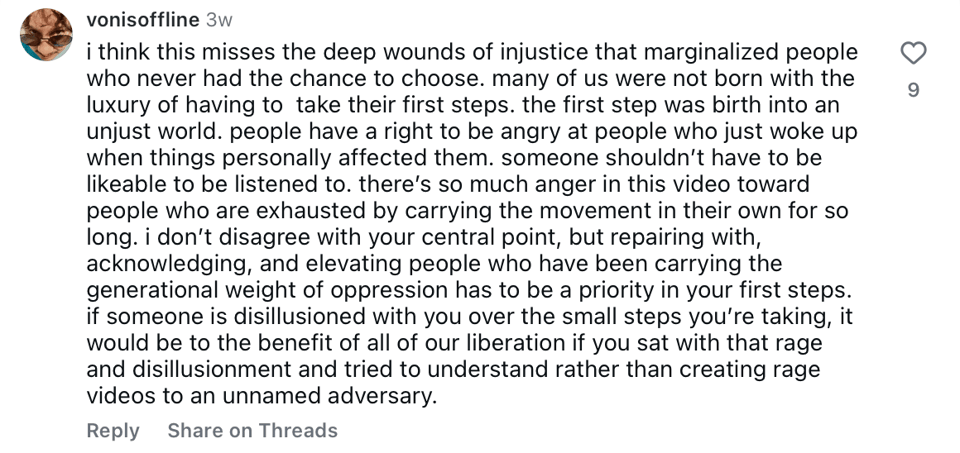
i know that tone can get lost in text communication. my intention here was to engage authentically with OP and offer another perspective. nonsensically, i thought that OP was well-intentioned and i wanted to genuinely engage with them on their point-of-view by offering how it might not land the way they intended on a more marginalized audience. further, i believed that they truly wanted to do the best they could to aid in the fight for all of our collective freedom.
i scrolled the comments for awhile and saw that the OP only replied to the white people agreeing with them, and none of the BIPOC people calling them in, no matter how gentle the call-in was. that tells me a lot about the intent of the central message. this person is not actually interested in advancing our movement. those of us who have been in this work for decades can clock that pretty quickly. it was also telling to me how many white people in the comments were thanking OP for absolving them of their guilt. “i can’t protest because of XYZ reason, i don’t care that calling my rep doesn’t matter, i have to do something.”
this is why our movements stagnate. if you are new at something, you must have humility. videos like this allow people who are already not invested in doing the hard work to wash their hands of the discomfort they feel about their efforts. activists, political scholars, and movement leaders all know that we must have a coordinated, tactical, and laser-focused action plan to achieve our goals. that is the only way we have been successful. when we ask for new people to come on the path with us and trust us to show them the way, they often double down or ignore us.
we do, absolutely, have a messaging and culture problem on the left. we do isolate and alienate newbies in a way that damages our movement. i don’t believe that videos like this bridge that gap. they only serve to allow people on all sides of an issue to dig their heels in. the only way i know how to bridge this gap is holding multiple truths and trusting people to engage critically. it is true that we are too hard on new activists. it is also true that white fragility and neoliberalism knee-cap us when we try to take steps forward. i am of the mind that we have to heal the wounds of oppression within our movements in order to heal them at the systemic level. i believe that healing can happen simultaneously and imperfectly.
that is what i was attempting to address with my comment. several weeks have gone by since i left it and i’d forgotten about it as my instagram app stayed closed. i happened to check it this week, and a few people liked it, but OP still hadn’t engaged. i had gotten a notification today that someone else replied to me. i was (naively) excited that someone was engaging with my point of view. i never seem to learn the lesson that these platforms bring out the worst in us all.
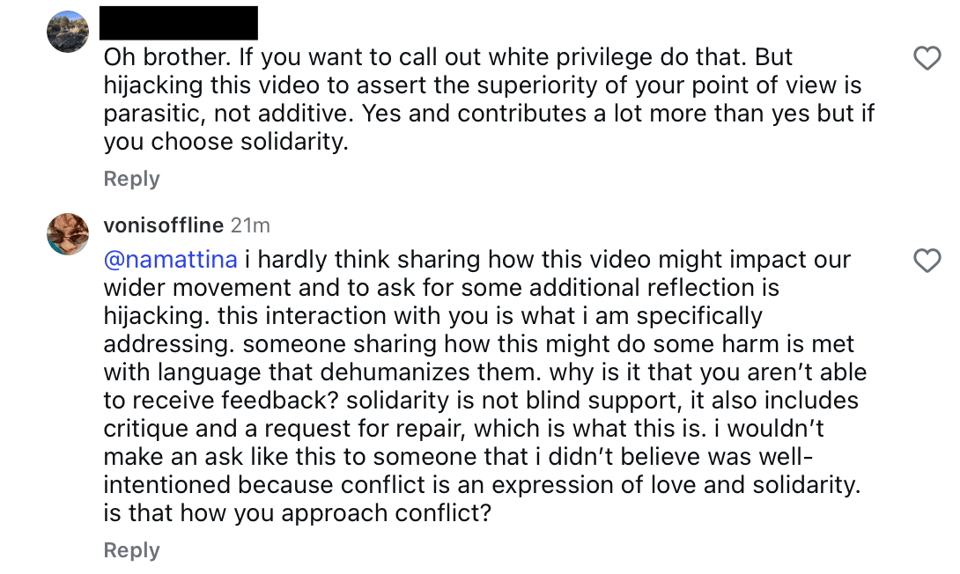
in coaching recently, i have been processing the many violent experiences i have had with people, in my life but also in the movement, choosing to misunderstand me. i know that i’m a good communicator. i am compassionate and articulate. it has taken me most of my life to recognize when someone is choosing not to hear what i have to say. i was not talking specifically about white privilege in this context. i was naming an overarching dynamic that, for any number of reasons, someone might not have ever experienced the weight of oppression before now and that matters. whiteness may be one of those reasons, but it is not the only one.
i know that people filter everything through their own lens, and i can understand my comment making someone defensive when read in an accusatory tone. i also know that white people experiencing guilt about how they are showing up have a tendency to displace that guilt onto non-white people attempting to engage with them. that is what i believe happened here. it never ceases to amaze me how combative people are on social media to someone they don’t even know. i’m a person. i deserve to be treated like a person, not a parasite. i was floored by how dehumanizing this reply to me was.
this commenter dismissed me entirely. my voice, my personhood, and my expertise. it triggered me deeply, and reminded me why i deleted all my social media. i took a deep grounding breath and journaled a few possible responses, just as a practice in catharsis. i had planned to let it go. then, i did something insane a second time and responded.
i’m practicing not silencing myself if i feel i have something meaningful to say. i know that i won’t reach this person. i responded because i still have hope for the OP despite all evidence to the contrary. i also responded for all the other organizers and BIPOC community members who might be scrolling the comments with the same ancestral heartbreak that i have. for all of us reading one justification after another and feeling completely abandoned and hopeless for the future. if my dissent to OP makes one person feel seen, heard, and hopeful for the future, it was worth it. i am here to bring all of us along, but i’m here for us first and foremost.
we have to be able to give and receive constructive feedback, with clarity and compassion. we have to be able to hear when we’ve missed the mark. we have to engage critically with ourselves and the world around us, especially when we might have gotten it wrong. making a mistake or unintentionally causing harm is not a moral failing. it means you are trying! that is a good thing. when someone lets you know that in your trying you’ve gone off course, it is not an indictment of your character. actually the opposite. it is an invitation into a healing circle. it is a reflection of the self to one another (kapwa). it is an acknowledgement of trust and understanding. when we have the hard conversations, and work through them collaboratively toward a mutual goal of repair, we learn to trust each other. we deepen our intimacy.
i am choosing to say the hard things to you because i love you and trust you to receive them.
that is what conflict means to me.
xoxo,
kuya von

i showed you my gooey center, please respond 👉👈
(you can reply directly to this email)
if you liked this, you’ll love vonreyes.com
eat local, buy small press, support your local library, and don’t call the police <3