
32. organizing can alienate you from yourself
but it doesn’t have to!
hey y’all,
today, i’m sippin on some classic southern sweet tea and whew, i’ve had a breakthrough.
i’m currently doing some intensive coaching and trauma therapy to work through my self worth issues, mother wound, and shame. TMI, i know, but i think it’s important for all of us to be able to be a little imperfect in public sometimes. last week, i connected some dots that had been previously untethered and unwieldy.
i had a tough interaction in a writing class last week that made me spiral. while unpacking this experience with my therapist, i shared that it made me feel small, weak, pathetic, worthless. we mutually discovered that my autopilot function is to de-escalate, listen with compassion, take accountability, and redirect the conversation - even when i’m not the aggressor. it is so deeply ingrained that i didn’t even realize that i’d done it.
in the aftermath, i felt what i always feel, which is the ripples of self-abandonment. i prioritized the comfort and safety of everyone in the room over mine. i made myself appear non-threatening, trustworthy, able to take tough feedback. i used body language that conveyed “domesticated, will not bite.” i kept my voice calm and i didn’t defend myself.
i have been doing this all my life. when you are told from infancy that you are too much, you will either grow too large to be stopped or shrink yourself endlessly, hoping to become an acceptable amount for people. in my adolescence i was the former, and it came with a lot of rejection. in my adulthood, i’ve grown more sensitive and at some point i’ve opted for the latter. it is proving hard to de-program this habitual shrinking because it’s one of the things that has made me a good organizer.
we’ve talked about the core principles of organizing before, in case you need a quick refresh. the main thing i want to focus on here, is the power of perception. in order to convince someone that the problem you want to solve is not only urgent, but directly affects them, you have to prioritize their needs. one of the ways good organizers do this is with a concept called power mapping.
power-mapping is not unique to organizing. every industry on earth uses power mapping, it is how you influence change. we’ve talked about power before too. when you are attempting to mass mobilize people around a common cause, you have to look for the levers of influence. who among your target audience has authority? this could be formal authority (elected leaders, managers, business owners, law enforcement, etc.), or informal authority.
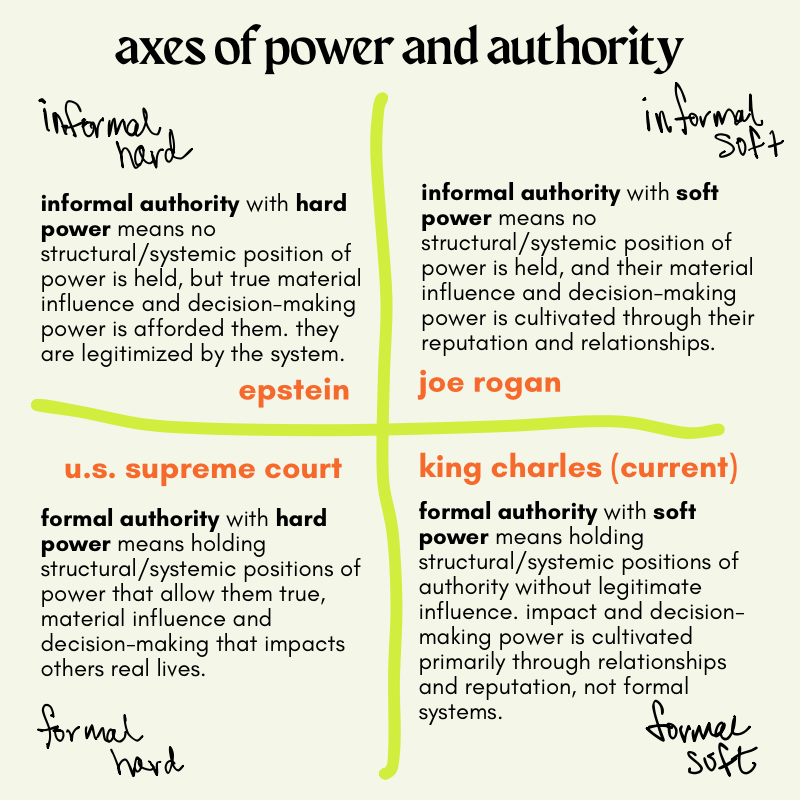
informal authority and soft power are harder to specify, and it requires a high degree of emotional and social intelligence to power map them. i’ll give you an example that i think is more relatable than being a male podcaster or sitting monarch.
you’re an entry level employee at your first job out of school. you notice a number of data entry errors in your CRM, and they’ve all been entered by the same user. you bring this to your manager’s attention. your manager says: “oh yeah, that’s chris. he’s never really figured out the CRM. dana just goes into the back end on fridays and cleans them all up.”
dana is lateral to chris. they have the same job title, and neither of them is clerical or administrative. why is dana having to do extra work to correct chris’s mistake, instead of chris being retrained on the CRM and his performance measured?
it turns out that chris is the highest earning salesman at the company, and he plays golf with the VP of Sales on the weekends. he’s not an executive, partial owner, or even a middle manager. just a salesman, like you and like dana. his ability to generate revenue with the company has given him informal authority. his charisma and charm has afforded him proximal, soft power. if dana were to complain, it would likely result in negative consequences.
so, if you wanted to unionize this work environment, you might think to try organizing chris first. he has the most power without the title, and he likely has insider managerial information that he shouldn’t have because of his proximity to formal authority. this is the route a lot of organizers take. get the most powerful person onto your side by any means necessary.
but what happens when you focus your attention to chris, and not the other workers who might be experiencing workplace dissatisfaction due to the preferential treatment your managers give him?
chris might feel entitled to a leadership role within the bargaining unit in exchange for his support, which might lead to attrition. or, he might have anti-union sentiments and tip off the VP prematurely. or, he might not want to risk his current position by doing something that would piss off the VP.
worse, you run the risk of losing your target population. the other workers might associate the union with more of the same unjust levers of power that have benefited chris, and they will lose trust in the union’s ability to represent their interests.
what would happen if you focused your energy on getting critical mass to vote “yes” on unionization, so that you don’t need chris? my AHUY for this might sound like:
A is for anger: “we deserve equal treatment, unbiased performance evaluations, hands-on training, and a fair distribution of labor. we cannot allow our managers to force unpaid labor onto us to make up for their failure to train and manage.”
H is for hope: “with these demands, we will all have more work/life balance and transparent escalation/accountability processes that benefit all of us. this will strengthen all of our relationships, and help us all progress in our careers without burning out.”
U is for urgency: “annual reviews are in less than 3 months, and they will determine our bonus structure for the end of the year. we have to come together now and ensure that un-biased, anonymized peer-to-peer feedback is included in the review process. everyone deserves a fair chance at a bonus.”
Y is for you: “we need 90% of staff to vote yes to unionize and sign off on our demands. we have 87% so far, and counting. we can’t do this without you. can i count on you to vote yes to unionization this friday?”
now that we have our goal and our script, it’s time to do power mapping and risk assessment. what will you lose by attempting to organize, and is it still worth it? if it’s not worth it to you, it won’t be worth it to anyone else. who amidst the bargaining unit eligible staff are loyal to chris and don’t see a problem? is it more than those who are disgruntled? if that’s the case, what do you do next?
i’ll end the example here, but you can see how much social math organizers do every single day to try to build a better world. if you aren’t careful, this becomes your standard mode of operation. there will never be a moment where your guard is down, and you’re fully being yourself. i’ve been an organizer since i was 15. that’s 17 years of training and execution on these principles. i’m really good at it, but it comes at a cost.
the cost is often genuine connection, sometimes without you even realizing it.
you have to be able to turn it off. these are skills, not a way of life. they are also not the building blocks for authentic relationships with your inner circle. they are tools to achieve a goal, and tools are not inherently good or evil. corporations and social media oligarchs use these tools every single day. they deploy personalities onto their platforms to get you to see the world their way. when you are up against a machine with that much power, you have to convince people that what they are selling isn’t worth the cost.
if you are spending 24/7 trying to convince people of your position, it is easy to lose yourself entirely. it’s easy to mold yourself into whatever the person across from you needs you to be, so that they’ll trust you. organizers worship at the alter of the future we want to build, often by any means necessary. there is a school of thought that morality is a privileged, western concept that has no place in the life or death situations we find ourselves in every day at the hands of our oppressors.
i think that the unintended consequence of this school of thought, is that we begin to lose sight of why we are pursuing a liberated future. you have to start there, and stay there. what do you want your relationships to look and feel like in the new world we’re co-creating? how do you want people to treat each other? how do you want to feel? what are the underlying motivations for the systems you are building?
who do you want to be when the dust settles?
i want to be someone whose presence helps every person feel brave enough to be fully themselves in every room they’re in. unfortunately, i’m finding that “every person” includes me.
xoxo,
kuya von

i showed you my gooey center, please respond 👉👈
(you can reply directly to this email)
if you liked this, you’ll love vonreyes.com
eat local, buy small press, support your local library, and don’t call the police <3