Losing Our Marbles
In which I review Molly Tanzer's novella And Side by Side They Wander, with a brief detour to ramble about art.


Slight delay in this month’s edition due to finishing up a short story submission that was doing it’s best to kill me. I survived. The story has been submitted. Now I can stop suffering, and go back to my novel WIP (different flavor of suffering). I also, unrelated, got a new short story acceptance, which I will post more about later.
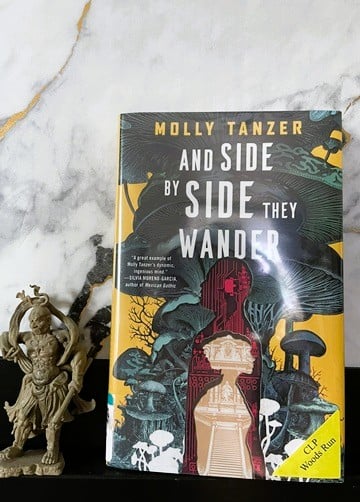
Today I’m reviewing Molly Tanzer’s new novella, And Side by Side They Wander, in which a group of humans set out on a heist to reclaim several works of art that were taken by aliens in exchange for fixing climate change and various other human-inflicted problems on Earth. Though they agreed to return the art when humanity proved responsible enough to care for it, the aliens have reneged on their promise, and humans lack the technological power to fight them over it.
I went into this novella thinking it was going to be about art repatriation, but it’s really more about copies: the differences between the real, the fake, and duplicates that lie somewhere in between (or beyond). The novella incorporates not just artistic copies but clones, robot duplicates of real people, and strange mushroom-derived mimicry. I was actually pretty relieved that the issues of art repatriation were more plot scaffolding than thematic core, because in all honesty the way people discuss this topic online drives me nuts. Sometimes the issue isn’t that complicated (The Parthenon Marbles. Just give them back). Sometimes different groups might have valid claims to an object. Sometimes you need to not hand objects over to scammers who are going to sell them on the black market. Etc.1
On the other hand, I love thinking about copies in art.2 It was something I kept coming across in grad school, even though it was only really tangential to what I was working on. I was unsurprised to see Tanzer reference Walter Benjamin’s “The Work of Art in the Age of Mechanical Reproduction,” which is pretty much the foundational text on the subject. What has always interested me more though, is artistic reproductions before the age of mechanical reproduction, as such.3
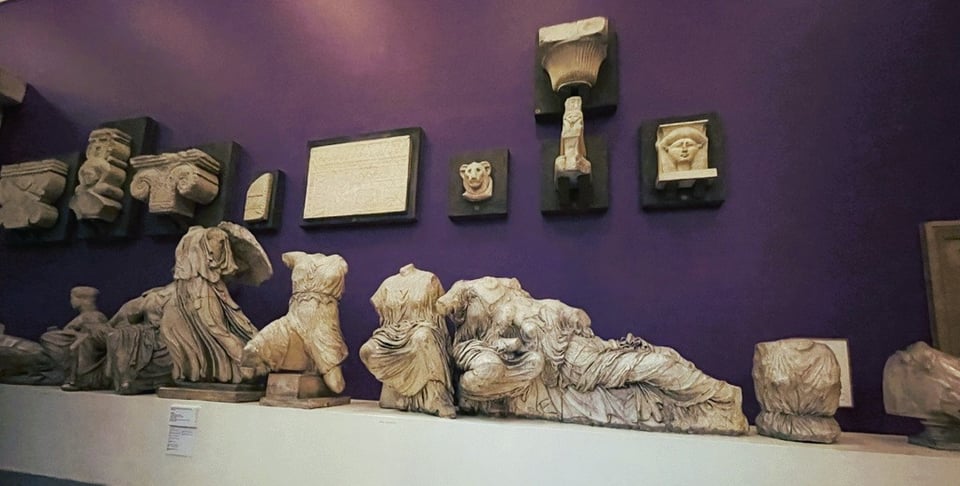
This gives me an excuse to talk about one of my favorite things at the Carnegie Museum of Art in Pittsburgh: their extant plaster cast collection, originally used for study by students of art. They include, among other things, copies of the Parthenon Marbles. They also include a plaster cast of the Choiseul-Gouffier Apollo, itself a Roman marble copy of a lost Greek bronze original (many such cases).
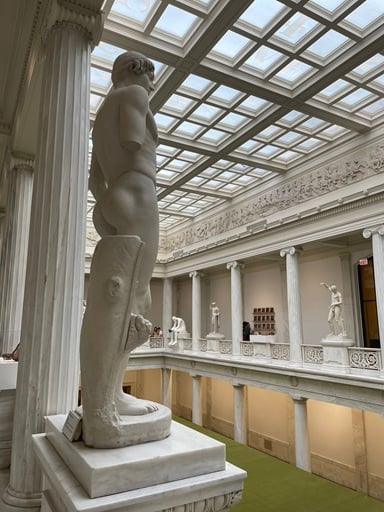
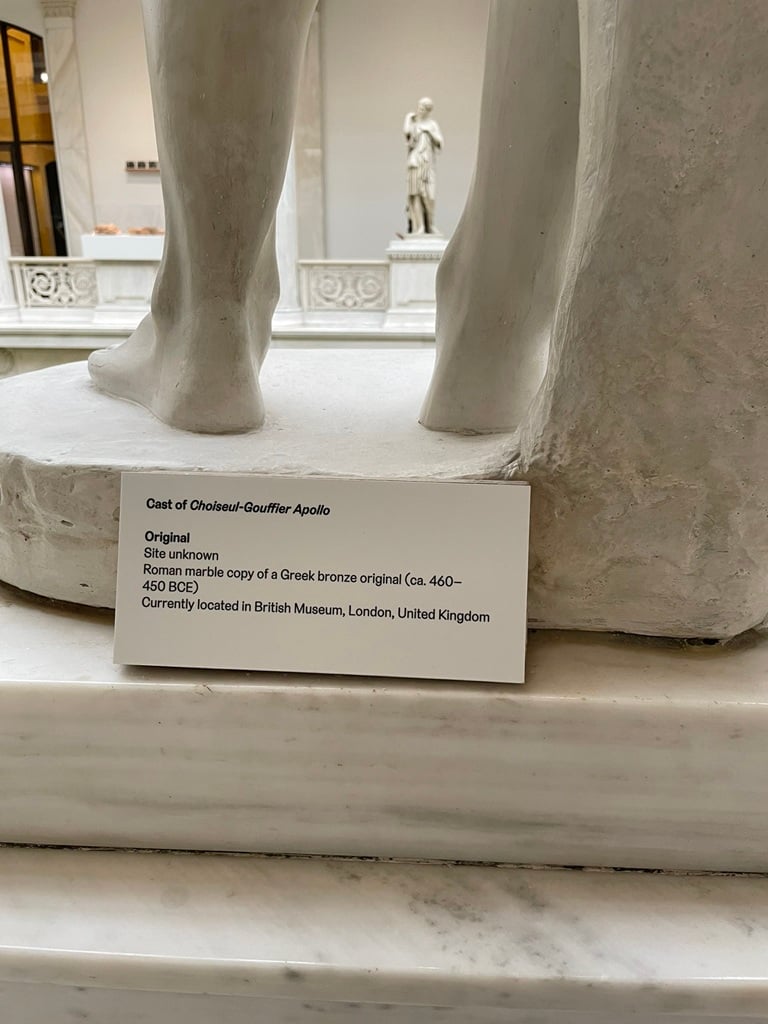
The first time I saw the collection I experienced a range of emotions. At first, I did not realize they were copies. Then I saw either the Parthenon Marbles or Winged Victory and went: hold on a second. Then I was mad and disappointed that they were copies. Then I actually read the plaques.
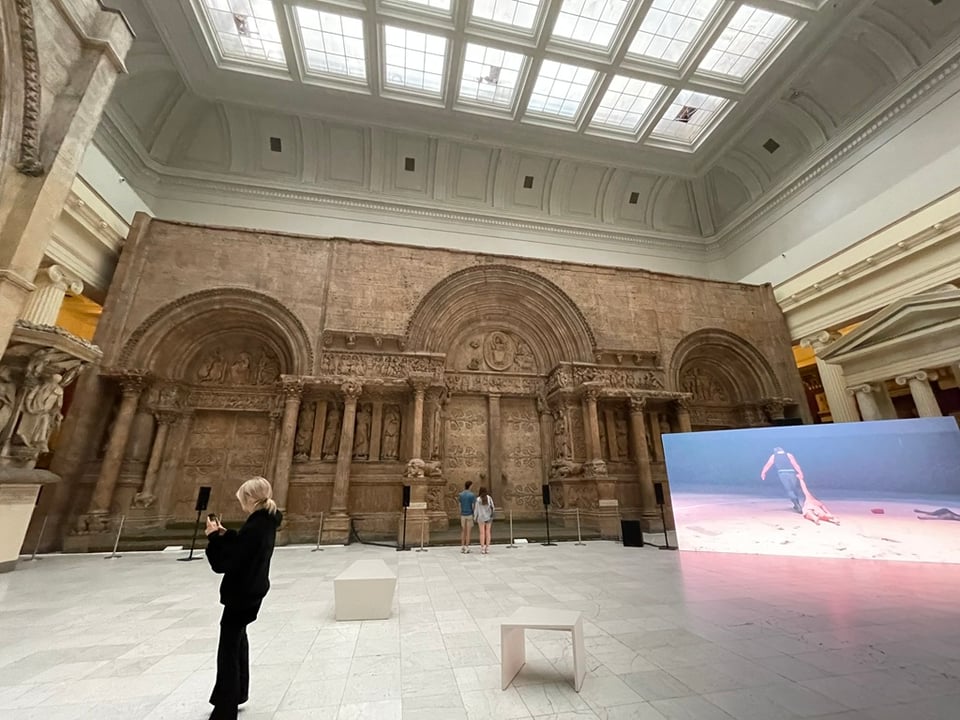
Plaster cast collections were useful for students and art aficionados who were unable to see the originals. None of the plaques say when the casts were made, but based on the time of Carnegie’s collection, pre-1907.4 Most collections were broken down and destroyed when they were no longer considered relevant, I presume due to things like the invention of air travel and the internet. The fact that the Carnegie kept theirs intact is incredibly cool.

But it brings up a question: how old must a replica be before it acquires its own aura, to return to Benjamin—that sense of uniqueness that belongs to a work of art alone? Or, what nature of replica could generate its own aura? Which is a question Tanzer comes to over the course of the novella, though in the context of copies of living beings (clones, androids, mushroom-based lifeforms).
When is a reproduction meant to be treated as the original? The novella mentions in passing that one of the artworks taken by the aliens to “preserve” in their museum is Kinkaku-ji, itself a replica of the 14th-century original, constructed in the 1950s after it was destroyed in an act of arson. One of the originals is already a duplicate, and a questionable one at that, as there is a high chance that the reproduction from the 1950s added significantly more gold than the original (pre-modern paintings of Kinkaku-ji only depict the highest, smallest, floor with gold leaf). This is not a criticism; I just love forcing anyone who stands still long enough to listen to me talk about Japanese art. I have dragged at least two people to go look at Kinkaku-ji in person, one of whom was a man I met on the bus, both of whom were underwhelmed by it.5
Like the Choiseul-Gouffier Apollo, the true original is gone. While the Roman marble was probably made less for preservation or reconstruction than for decorative purposes, it is now the only “original” we have. All that remains is the copy, having acquired via the passage of time some strange transferal of the original’s aura. In And Side By Side They Wander, this has already begun to happen for some humans, as the replica artworks given to Earth by the aliens are several hundred years old. But for the protagonist and her compatriots, this is not enough. At the same time, the novella does raise questions about the separate lives of replicas, in the context of replications of living people, and how they may be more than what they mimic.
Assorted remaining thoughts: I liked that the narrator (Fennel Tycho) is a woman in love with a terrible boyfriend. I feel like this type of woman MC used to show up more in fiction, though possibly I’m imagining it. There’s an interesting balance between the type of guy who considers his own self-absorption more important than whatever is going on with the woman he’s dating, but also Fennel’s obsession with him feels reductive in its own way. Maybe everyone sucks here. Either way, I liked reading about them. The ending opens up new possibilities, but still feels disquieting, which I like in an ending.
Novellas can be a weird beast; half the time they feel like a short story stretched out too long, and the other half feel like they should have been expanded into a full novel. Not as many as I would like feel like they are the right length. I think this one does, though the setting feels like it has a lot of opportunities for expansion and I would happily read more about whatever is going on with the mushrooms.
Tangentially, I happened to listen to the Weird Studies episode Artworks are People Too not long ago, which considers interactions with art as interacting with a living being. Not directly related, but some interesting parallel thoughts.
That’s all for August. Read a book, visit a museum, let me know if you develop any strange relationships with replica works of art.
August Roundup
Reading: Piranesi, Susanna Clarke / Merynthia’s Master, Luana Saitta / New Edge Sword & Sorcery vol 6
Watching: Revolutionary Girl Utena. Very weird. I keep wondering if I had watched this during high school what effect it would have had on my life, but I think watching it north of 30 means I am much more aware of how bizarre it is as a show.
Listening: Days, The Mountain Goats / The Dark, Chelsea Wolfe
The internet is where nuance goes to die but I also don’t love people treating museums as a monolith when the museums are getting defunded and education levels in general seem poor lol. ↩
I guess AI is relevant here but I am bored of talking about AI so I’m going to ignore it. ↩
You can read a copy here: https://viscomi.sites.oasis.unc.edu/viscomi/coursepack/criticism_etc/Benjamin-Mechanical.pdf ↩
- https://carnegieart.org/art/art-around-you/hall-of-architecture/
And I’ll do it again!!! ↩
You just read issue #4 of Vespertine Dispatch. You can also browse the full archives of this newsletter.
