clutching my herb garden for dear life
projecting onto the ancestors
When I moved into a home that came with ample but poorly landscaped outdoor space, my first order of business was to plant an herb garden. The herbs would have to be a fragrant variety else they’d get nibbled to nubs: garden sage, thyme, lavender, and rosemary. I raked away the godawful red mulch, then began to prise four boxwoods out of the patio perimeter to clear the space. My hands dug through the earth for the end of their root systems, twisting and pulling until they yielded their grip. I felt like a midwife from the movies, twisting a breeched baby.
I planted the herbs in spring, and by fall they were spilling over the stone perimeter. The image recalled an abundance I seem to encounter every time I travel to Europe–brushing my fingers through shoulder-high hedges of trimmed rosemary, swishing through fields of wild fennel, spotting a random stalk of asparagus jutting up from the side of a footpath, a finger to the past. Like some of you sensitive souls, when nature surprises me, I feel like I am dialed into the cosmic time continuum, drawn into the earth’s magic through the eyes of our infinite ancestors.
Isn’t that what you feel, when you see the first snowdrop?
want this delivered? subscribe here!Five years from its planting, my herbs have gone above and beyond in their function, assisting with everything from a Thanksgiving turkey to a theater set. But none of these uses compare to how it helped me through a roller coaster of emotional turbulence this year. And it is a primitive use: a sage leaf, crushed between my fingers, and held to my nose.
Like the first drag of a cigarette, one hit of a fragrant herb and I am calm, at least for the moment. It makes me wonder: did my ancestors also self-soothe as I did, on a whim, when all hope seemed lost? I can see her, the woman in the kerchief and embroidered apron, blinking back tears from whatever cause as she walks out of her cabin to gather some rosemary. She needs it, to season the potatoes. And potatoes are all she has! To feed a family of ten! Sure, she’s also pregnant. She breaks off the rosemary twig, rubs the stiff leaves and breathes them in until her tears stop, and she can see the kitchen knife properly.
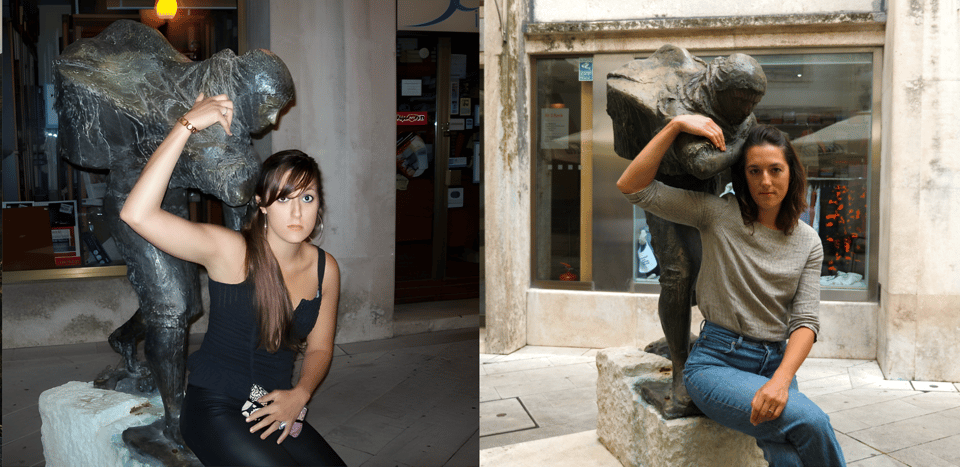
In the city of Rijeka, Croatia, there is a place called Mljekarica Trg, or “Milkmaid Square.” Flanked by a bank and a cafe, a bronze statue of the regionally famous milkmaid Antonija Reljac reminds passersby of this bygone vocation. The mljekarica’s job was to carry milk and cream from the mountains of Grobnik, down to the city by the sea. She would trek the miles for decades, even after the work crippled her spine.
I fucking love the mljekarica! I was drunk when I first met her in 2009 (see below), and she has called to me since. She even negotiated a role in my film. Maybe it is that she is often depicted alone, trudging up and down a hill like a crone Sisyphus, and pursuing a career in the arts feels this way. Or maybe it is that I am a sapphic, and her work kept her mostly removed from the domestic sphere and in the company of other women—a more relatable life than that of my homemaking grandmothers. But my existential challenges pale in comparison to what the mljekarica and her contemporaries lived through. Take Aunt Ruža, and the story of her husband, my Uncle Stipan, splashing cold water on her after she gave birth to get her out of bed. Or my grandmother enduring my grandfather’s mood swings. Those women witnessed wars in their homes, survived hungry winters, and gave birth not knowing they would survive. Would a smelling a puny sage leaf have done shit for their disposition?
I like to think so.
Picture the perimenopausal milkmaid snapping a sprig of lavender and crushing it in her palm, mixing it with beeswax until it is a balm. She rubs it on the chapped lips of her companion. Their pails of milk clink on their backs like shackles as the first rays of sun crest the Adriatic Sea. The two women breathe deeply the lavender’s sugary perfume, and for a moment, forget about the ache in their bones.