
Evicting Māori: Grey’s 9 July 1863 Proclamation
On 9 July 1863 a proclamation was issued by the government addressed to 'the natives of Mangere, Pukaki, Ihumatao, Te Kirikiri, Patumahoe, Pokeno, and Tuakau', warning that:
All persons of the native race living in the Manukau district and the Waikato frontier are hereby required immediately to take the oath of allegiance to Her Majesty the Queen, and to give up their arms to an officer appointed by Government for that purpose. Natives who comply with this order will be protected.
Natives refusing to do so are hereby warned forthwith to leave the district aforesaid, and retire to Waikato beyond Mangatawhiri.
In case of their not complying with this order they will be ejected.
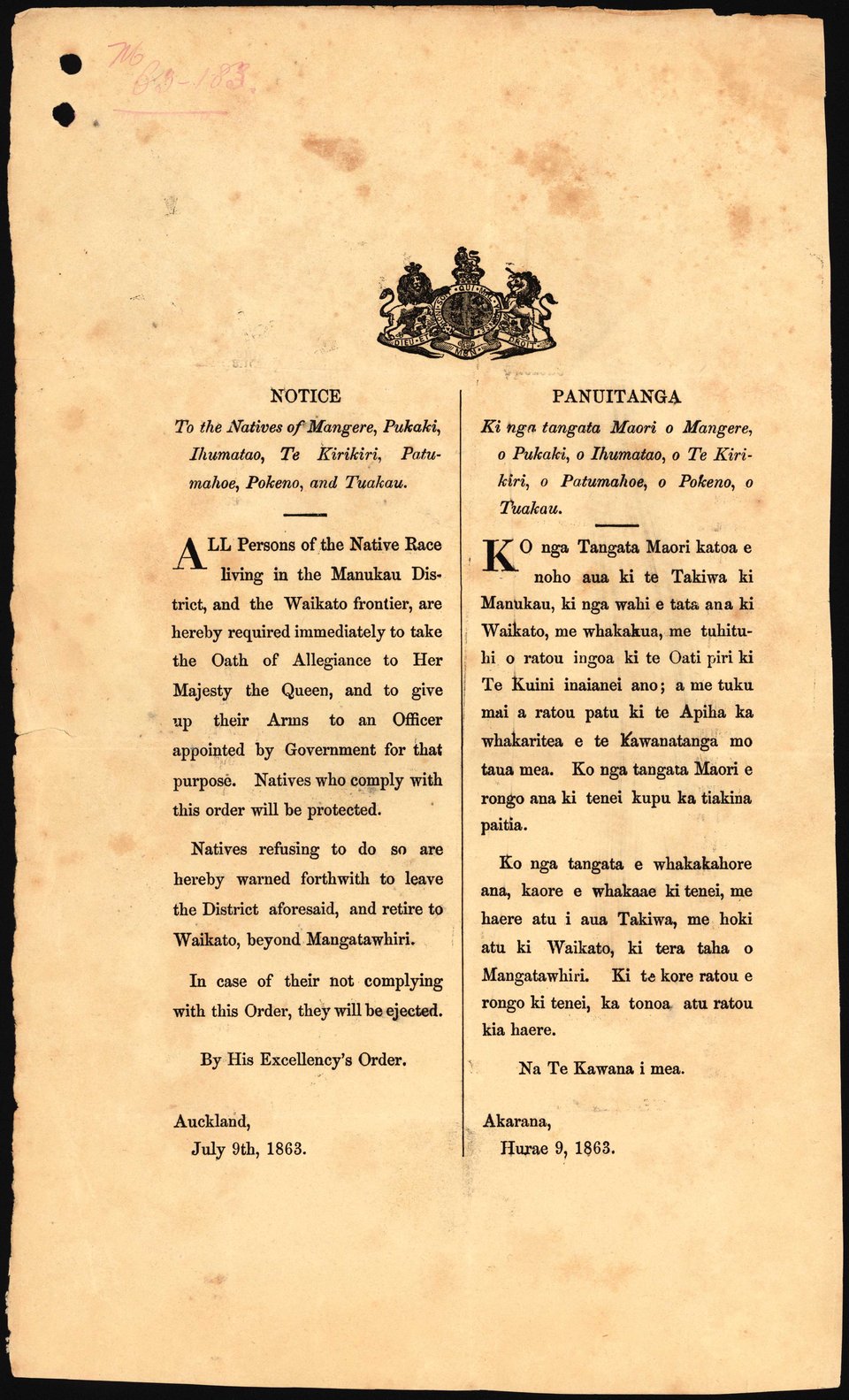
On the same date magistrates were despatched to the various settlements to deliver the notice and demand that Māori take an oath of allegiance to Queen Victoria or leave. As discussed in The Great War for New Zealand, few took the oath. Many of those to whom it was read feared they might be forced to fight against their own kin in the Waikato if they did so. Others read it ‘a positive order to leave’. The overwhelming response was one of bewilderment.
Leading Tainui rangatira Tāmati Ngāpora asked whether the ‘day of harvest’ had arrived and was told it had. His request for an inquiry into the conduct of the Tainui tribes was rejected outright. As John Gorst described the scene in his 1864 book The Maori King:
They were Maories and relatives of Potatau. Underlings of the Native Office were despatched in haste to call upon them to give up their weapons and take the oath of allegiance to the Queen, or, in default, to retire beyond Mangatawhiri under pain of ejection. The first native to whom this cruel decree was made known was Tamati Ngapora, the uncle of the Maori King, who lived at Mangere, in European fashion, receiving a large income from letting his lands as grazing grounds to the neighbouring farmers. After a short silence, Tamati asked — “Is the day of reaping, then, at hand?” Being told that it was, he observed — “Why has not the Governor put Waikato on her trial, before stretching forth the strong hand?” Tamati and the other Mangere natives quite understood the alternatives. They must submit to what they regarded as an ignominious test, or lose the whole of their property. And yet, to their honour be it said, they did not hesitate for a moment.
They all thanked the Pakeha for this last act of kindness in giving them timely warning of the evil that was to come upon Waikato, and an opportunity of themselves escaping; but they could not forget that they were part of Waikato, and they must go and die with their fathers and friends...All the old people showed the most intense grief at leaving a place where they had so long lived in peace and happiness, but they resolutely tore themselves away.
At Mauku, James Speedy found just one man willing to take the oath of allegiance. Henry Halse reported from Mangere that ‘the answer of all the people, when I read the notice was, why does not the Governor “whakawa” (investigate) the “he” (misconduct) of Waikato before he puts forth the “ringa kaha” (strong hand). In a more detailed report drafted a few days later, Halse explained that immediately upon receipt of the ultimatum on 9 July he had departed for Māngere, Ihumātao and Pūkaki for the purpose of administering the oath of allegiance to those Māori resident there. On his way he came across the Rev. Purchas in the company of Tāmati Ngāpora, and it was agreed that the object of his mission should first be explained to the chief before seeing his people. Halse reported that:
after tea the notice was read to Tamati Ngapora. He listened attentively, and requested that it might be read a second time. His request was complied with. After the customary Maori silence, Tamati put the following question to Mr. Purchas — “Kua tata ranei te ra o te kotinga witi?” (“Is the day of harvest close at hand?”) “Yes;” Mr. Purchas replied. Tamati then asked why the Governor had not caused an investigation to be made into the wrongs of Waikato before moving the troops? I said it was not my business to discuss that question; ample time had been given, and now that the troops had been moved forward to prevent Waikato Natives making an attack on Auckland, I heard of the desired investigation for the first time. Tamati then asked why the natives could not have their king as well as the pakehas? I replied that I had come to read the notice, and not to talk about the Maori king. Tamati, in a thoughtful mood, said that, if he had influence, there should be no fighting. He had dear friends living in the midst of the English, and dear friends living with the Maoris, and would like to know why they were to be killed. He would not cease to urge for the investigation.
Halse gave Tāmati Ngāpora a copy of the ultimatum, the chief departing for Māngere soon after. When Halse reached the settlement the next day about 20 men were assembled in Ngāpora’s whare. Halse read the notice to them, and asked if they wished to read it again. He reported that:
Two men said there was no occasion, because they all understood it. In the course of a few minutes a native, whose name I did not obtain for the reason that his friends objected to give it, jumped up and said “I belong to Waikato; I am going to Waikato[.]” He then sat down.
Rihari then s[a]id, “Hearken. My fathers and my friends are in Waikato; I am going to them.” An elderly native then rose, and looking at several natives who had not spoken, asked me whether I understood the meaning of their silence. I asked him to explain. He said their thoughts were the same as the previous speakers’, and all would go to Waikato. Tamati Ngapora, who had been reclining, sat up and said, “When I arrived here last night I gave the ‘Panuitanga to the people for their consideration, without attempting to influence them either one way or the other. You have now heard their decision. I have nothing to say in addition to what took place between us last night. We are one tribe, and cannot be separated.
A small group of women and men, some of whom were visitors from Ngāpuhi, did agree to take the oath of allegiance, though when called upon to surrender up their arms and ammunition they denied that they had any. At the same time the group asked for some distinguishing mark so that Pākehā might recognise them, and Halse added that ‘The women expressed great fear of the sailors belonging to the vessels of war, and hoped the Governor would protect them.’
When Halse reached Ihumātao a short while later, he discovered that many of the residents had gone to Onehunga to sell poultry, having previously disposed of some of their cattle. Clearly they had decided to lighten their load, since those who were at the settlement told Halse that they had also resolved to return to Waikato. One speaker told Halse that there were some infirm people amongst their number who would not be able to travel, and that the governor would be expected to look after them. But before Halse had a chance to reply, others said that they would take the ‘turoro’ (sick people) with them.
At Pūkaki people were also making hasty arrangements in anticipation of the impending war. Halse discovered that Mohi, the chief of the settlement, had gone off with Bishop Selwyn to point out a burial ground which (together with a village church) was to be handed over to the care of the Anglican Church during their absence. The people of the settlement had all packed up their possessions, ready to make a start, and when Mohi returned he also told Halse that all of the people were going to Waikato.
While those communities visited by Halse appear to have been resigned to their fate at the hands of the Crown, James Armitage encountered a more defiant response to the ultimatum on the part of the Tūākau community. Armitage reached the settlement on 10 July 1863 and later reported that ‘I communicated to them the purport of my mission, and was informed by Te Atua, for himself and others — except Hira Kerei and te Atua, who dissented from same — that they would not take the Oath of Allegiance, nor give up their arms, &c., nor leave their lands, unless driven away by force, which they would resist.’
Yet hundreds of Māori living at Māngere and elsewhere gathered up what belongings they could carry and trudged south to join their relatives in the Waikato. The invasion began three days after the 9 July proclamation. The Tainui communities of South Auckland saw their lands confiscated, their property looted or destroyed and their once flourishing economy destroyed almost literally overnight.
In 1927 the Royal Commission into Confiscated Lands (known as the Sim Commission) concluded with respect to the Tainui communities of South Auckland that ‘a grave injustice was done to the Natives in question by forcing them into the position of rebels, and afterwards confiscating their lands’. Nearly sixty years later the Waitangi Tribunal reached a similar conclusion in its 1985 Manukau Report, finding that ‘all sources agree that the Tainui people...never rebelled but were attacked by British troops in direct violation of Article II of the Treaty of Waitangi’. It added that ‘not only were the inhabitants attacked, their homes and property destroyed and their cattle and horses stolen, but then they were punished by confiscation of their lands for a rebellion that never took place’. In 1995 the Crown apologised to Tainui for ‘the loss of lives because of the hostilities arising from its invasion’ and ‘the devastation of property and life’ which resulted.
Add a comment: