William Shatner Wants to Die
Captain Kirk on death, Shakespeare, and trees.
Dear William Shatner,
It’s taken me more than a year to write you this letter. Typical neurodivergent procrastination, to be sure, but there is also a finality about this letter which prevented me from completing it earlier. You see, I know you want to die. But I am not ready for that. Because, if all the people who want to die, die, then people who don’t want to die will have to start dying. And if you, with your hard-won wealth and fame, world weary and rest earned, someday die, so too will my grandmother.
My grandmother does not want to die, and, as long as I never wrote this letter, she wouldn’t. But now her sooner-than-later-arriving death is guaranteed, and it is my fault, and a little yours, Mr. Shatner.
It is the end of October 2025 as I write this, just over a year since you visited Lexington KY for the premiere of your documentary, You Can Call Me Bill. It was a sold out experience, which, in Lexington, means about 800 people, and we were excited to see you.
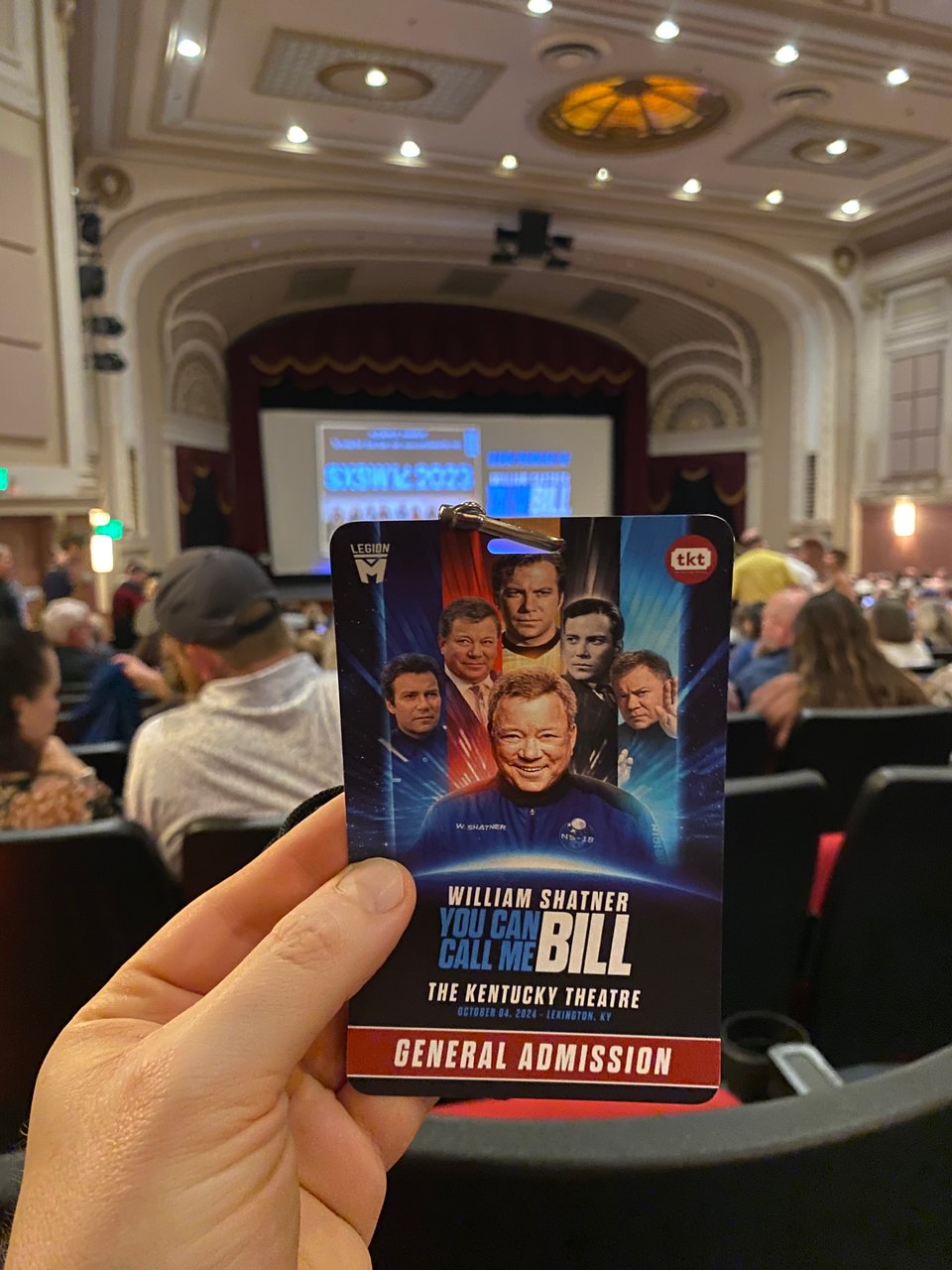
(Not to be a jerk this early in an otherwise earnest letter, but this line from the Wikipedia page of your movie cracks me up: “You Can Call Me Bill qualified to be considered for a 2025 Academy Award in the Best Documentary Feature category.” Translation: The Academy was legally allowed to nominate YCCMB, but it didn’t get enough [any?] votes.)
I was lucky. Thanks to my seat on the extreme edge of the auditorium, I was one of the first to see you walk through the theatre’s rear doors, sneaking up behind your audience. I counted to ten as you walked down the aisle, before I said, loud enough for my neighbors, “There he is.”
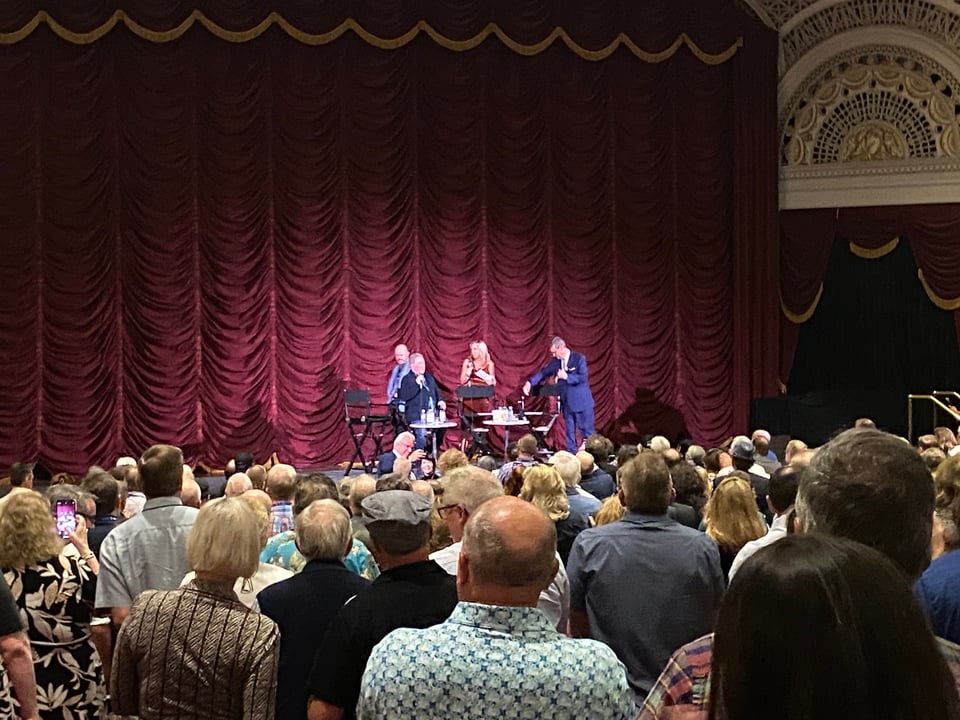
A ripple of recognition waved across the crowd, until we were all standing and applauding your simple presence. You looked shorter than I imagined, and a little thicker IRL than you appeared in the documentary, shot a year earlier. I came because I wanted to honor you, a living legend, and say “I was in the room with him” to people who might find that to be impressive. I wanted to see you in person, just once, before either of us (probably you) died. I wanted to be part of something bigger than myself, and to be reminded I am not alone.
What is the connection between you and my grandmother? There is none. It never occurred to me before, but I just realized she probably didn’t even own a TV until after she gave birth to my mother in the early 60s, and equally probably wouldn’t recognize your face or name. Don’t take it personally. She’s not like me (which is to say, autistic) and doesn’t have much time for pop culture figures who aren’t Elvis Presley.
Actually, now that I mention it, the thing that unites you, my grandmother, and me, is our fixation on death. Forgive me if that is too strong an adjective, but it is plain from your movie that you are preoccupied with how little time you, a robust 94, have left. You mentioned your father’s sudden death while you were starring in Star Trek, and your decision to stay on set and work through the pain. You tell an odd story about the death of a childhood pet, who you refer to only as “The Dog”, which you found upsetting. But more than any one deathly experience, your focus on death stems from the certainty that every single living being is going to die, and that right soon. In the film you go so far as to act out your death scene, eyes bulging and death rattle ringing. You say that death is the next great adventure after a life more than well lived. I agree.
I don’t remember not knowing about death, I don’t remember not knowing about suicide, and I don’t remember not wanting to commit suicide. I do remember being seven, on the playground, trying to understand how Toaster + Bathtub = Death, as Saturday morning cartoons suggested. Was electrocution going to do the deed, or just make sparks fly from my ears? I decided not to find out.
I think about suicide most days, in a “I’d rather kill myself” sort of way, not in an “I’m going to kill myself” sort of way. I’m actually quite proud that I’ve made it this far without killing myself, despite years of daily attempts at drinking myself to death. So far, the two great antagonists I’ve faced and defeated in my life are My Father and Suicide. I am so self-satisfied with my success at failing at suicide, that I worry someday I’ll be sick like my grandmother, and won’t make use of euthanasia because of my stubbornness to not kill myself. Or, worse, in the final moments before the grace and peace afforded by euthanasia, I’ll regret it.
My grandmother does not want to die, but she knows she is dying. She says “I’m sorry to die and leave you with these two,” indicating my grandfather and my mother, in a joking way that means “I’m going to miss you so much.”
Anyway. I liked your movie. You and I have a lot in common, as classically trained Shakespearean actors who never could quite manage to be taken seriously. In the film, you recount the first half of one of my favorite of your stories, which I’d read several years ago in your first biography, Up Till Now.
You were understudying Christopher Plummer in the title role of a production of Henry V at the Stratford Shakespeare Festival. One night, suffering from a kidney stone, Plummer was unable to perform, and you were called on to fill the role. After completing 98% of a perfectly acceptable performance, you suffered the actor’s nightmare and forgot your lines in front of an audience of 2,500. You abandoned the rehearsed movement and walked over to another actor, who claimed to have a photographic memory. You whispered to him, asking for the line. He stared back at you blankly, his photographic memory temporarily overexposed.
In You Can Call Me Bill, the story ends here. The punchline, included in your memoir but missing here, is that your under rehearsed performance was praised as “instinctive” and “original”, your “halting interpretation” earning acclaim from critics and fellow actors alike. I like that you don’t tell that part of the story anymore. By leaving the ending untold, you allow the nightmare to linger in the listener’s mind, forcing them to wonder what they’d do in similar situations. Highlighting the potential for public humiliation is a very effective method for convincing non-actors that acting is hard.
My grandmother was a kindergarten teacher, who also had difficulty convincing others that her work was hard. She tells a story about a woman who wandered into the principal’s office one day, hoping to “sign up” to be a kindergarten teacher. When she was told she needed a degree and state certification, she spun 180-degrees and left, aghast that early education could possibly require more than a willingness to pour paint and apple juice (into separate cups, of course).
My grandmother worked hard, and when she retired she sat down, and now she has trouble moving on her own. You frequently claim that you, William Shatner, cannot die so long as you’re booked somewhere. This calculus makes sense to me, as my grandfather, with his undiagnosed AuDHD, cannot sit still and therefore will live forever. Like you, he looks younger than men 10, maybe 20 years his junior. Like you, he is ready and willing to die, as he is completely unprepared and unwilling to remain on this side of the grass once his wife of 60+ years passes.
I can’t imagine it was fun getting divorced at the age of 89 from your fourth wife, although Google tells me that the two of you have since reconciled and reunited, so that’s good. If I had to guess I’d say that your relationships with your children and their children are discussed in other autobiographical works, or at least public interviews. But You Can Call Me Bill made me think you are existing far from family. During your pre-movie introduction, you told a story with a tone that suggested it was funny, but it made me sad. The story was, essentially, “I can’t reach the remote anymore when it falls under the bed, so my assistant has to do it.”
I worry about you, Mr. Shatner. My grandparents have each other, and their daughter, and three adult grandchildren who are all less than an hour away should an emergency or holiday unexpectedly arise. We see each other more frequently than most families, I imagine, and there is a casualness to our togetherness which reflects this. Stakes are low, even at Christmas, because we have plenty and we love each other, and this isn’t the only time we’ll be together this year, maybe even this month. After a lifetime of work, it seems you have plenty, but I wonder if it is enough. You do not seem overly invested in the pursuit of wealth, but you don’t seem overly satisfied by your quantity of love, either.
We love you, and I guess that’s the point of this letter. When you are gone you will not be replaced. Captain Kirk will join Henry V as a towering character in the western canon, passed down through the ages from actor to actor, none of them quite ever matching the legend of the original.
I’m almost done, and thank you so much for your kind indulgence. But before I let you go, I’d like to mention my two favorite moments from your movie.
The first occurred in space. You were a guest of Jeff Bezo’s penis, I mean rocket. Recordings from the ship’s closed-circuit television show the rest of your party giddily spinning and flipping in the zero G environment. You are separate from the action, in the background of the shot, rooted to your spot despite the lack of gravity. You are looking out the window, at the Earth. Your experience, more spiritual than spatial, was profound, bringing you tears of wonder and fits of anger. Wonder at the delicacy of life, anger at the disrespect the Earth receives at the hands of polluters and warmongers. If I am ever in space, I will look at the window. Thank you for this lesson.
My second favorite part of your Goodbye Note-shaped documentary was your explicit directions for what should happen to your body after your death. You want to become a tree, planted in the ground to grow and spread and tower and provide shelter to wildlife and shade to visitors. You will be free of formaldehyde, earth to earth, seed to sapling, never dust, never dying, really, but joining life, as long as your limbs shall grow. This is what I want as well, and my brother, and many of the people my age who, because we are almost 40, are as preoccupied with death as you. A casket does not sound fun for me, not forever, and I’d rather be earth, ashes, and dust.
I do not know if my grandmother “disagrees” necessarily, but she will be embalmed and entombed and buried in a hole that is already bought and paid for, like her brother and parents and others before her, in sure and certain hope of the resurrection (I assume). I am not looking forward to seeing her in a box, or watching that box be closed. I know that the part of her I love most won’t be in there, it’s in the breeze and the warm sun, but I still don’t want to see that love boxed up, and would rather she be a tree. I’ve just decided, she will be a tree to me.
There was a Q+A after the movie, and I didn’t stick around for much of it. You looked tired, even asking the hosts if your “obligations were satisfied.” They were not. After an hour of Q+A you were expected to attend a VIP happy hour with more of the same questions you’ve been answering for 60 years. This did not seem to appeal to you, so I left, rather than be disappointed by whatever happened next.
Anyway. I hope this letter doesn’t kill you, and that it doesn’t kill my grandmother. You both have earned enviable legacies, and deserve to rest. I hope, for both of you, that rest comes when you are most ready, and not when you are most tired. Know now that you will be missed, and celebrated, and our love for you will transcend time and space, and someday, maybe, our love will gather together and grow dense enough to become a tree.
I have been - and always shall be - your fan,
Samuel Collins Hicks
Subscribe for free to unlock more TrekPhrastik work!

Add a comment: