
Observations from The First Round of the Group Stage
Does Goalkeeper Kit Color Influence the Results?
After the Cabo Verde keeper Vozinha played an incredible match to hold FIFA #2 ranked Spain to a goalless draw, while wearing a yellow keeper kit, I felt like I was noticing something. It really seemed like some of the star keepers so far had been wearing yellow, especially in the results that might qualify as upsets.
Now, I can’t just go saying such things without a fact check, right? So obviously I had to do a spreadsheet.
First, I searched Getty for the pre-match team photos of each matchup in round one and assigned a color for the goalkeeper kits. I have to admit, some of them were a little unclear. For example, in the Getty image for the England team, Jordan Pickford’s kit looks unquestionably yellow. In the video highlights, it looks entirely orange. Also, for one match, both keepers appeared to be wearing slightly different shades of green, which I didn’t even realize was allowed.
But for the sake of experimental consistency, I decided to stick with what my gut analysis of the Getty image. So with 48 keeper kits, we ended up with 13 Blue and 13 Yellow, 6 Green and 6 Orange, 4 Grey, 3 Pink, and 3 Purple.
From there, I assigned 3 points to the color for a win, 1 point for a draw, and 0 for a loss, following the sport’s standard. Then I calculated the average points won per match, and it turned out, yellow was not the dominant keeper color. In fact, it was blue!
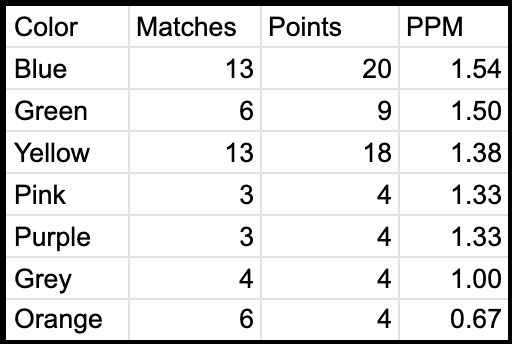
Even when I narrowed in on the upsets, my initial thesis didn’t really have legs. To count something as an upset, either the lower ranked team had to win OR there needed to be a FIFA ranking gap of 20 or more for a draw. I didn’t give any points for things like “they lost, but it wasn’t as bad as I expected.” Given that framework, there were seven upsets out of the 24 matches, and of those seven, three times were the keepers of the lower ranked team wearing yellow. The other four lower ranked were wearing grey, blue, pink, and purple.
Maybe, given that, it’s fair to say the yellow keeper was the most lucky, with no other color having a standout performance. But still, it represents less than half of the upsets.
By then numbers, Blue, Green, and Yellow are still the three luckiest keeper kit colors, however maybe main point takeaway here is actually just that we’re all in awe of Vozinha, that there have been a lot of images of him in his yellow keeper kit circulating the internet, and that thousands of hours of hard work and practice are actually what make a difference, not keeper kit color!
But, if I were picking a keeper kit for the next match Spain plays, I’d definitely give Yellow a try, just in case it helps!
Different Rules for Different Tax Brackets
Nothing new under the sun. Just like everywhere else in life, it seems, in this sport too we are seeing weird preferential treatment for certain players on and off the pitch.
I’ve already written about some of what the Iranian team has faced, forced to play their matches in a country actively bombing their home, not getting visas, sleeping in a different country than where their matches are, and so on. But the stories keep coming there, and for other teams too.
It will come as no surprise to anyone that the teams and fans facing a harder time with things like visas and access generally come from the global south, or countries that are majority non-white. Vozinha’s mother was not able to come to the match Cabo Verde played against Spain because she couldn’t afford the $15,000 bond Cabo Verdeans have to pay to visit the USA. House Minority Leader Hakeem Jeffries has since pulled some strings and she will be able to attend the next match against Uruguay on June 21.
And let’s face it, if Vozinha hadn’t played the match of his life, she would be coming to that match either. It’s only because he made such a splash that the story even got told. And this is just one example. There are 25 other Cabo Verde players, plus support staff. How many of their family members are not able to support them in person because they don’t have $15,000 to spare? And Cabo Verde is one of 50 countries whose citizens are required by the Trump administration to pay a bond of up to $15,000, because of allegations of high rates of overstaying their visas. Algeria, Ivory Coast, Senegal, and Tunisia are also on that list. The State Department says that the bond requirement will be waived for athletes and team members who are nationals of countries that are competing and demonstrate that they meet all requirements for the visa. Which I’m sure is totally true and also super easy to do.
Meanwhile, there are at least four players in this World Cup, with the recent addition of Hakimi, who have current or past court cases involving accusations of sexual assault. THere’s so much to say here, but I don’t even know where to start. Because how are there FOUR! That we know of!!
Meanwhile, on the pitch, there have been a few eyebrows raised around some of the star players. During the match between Argentina and Algeria, when the score was still 1-0 to Argentina, superstar Lionel Messi committed a clear red card offense that should have seen him sent off the pitch. Instead, there wasn’t even a VAR review, Messi stayed on the pitch, and went on to complete a hattrick to beat Algeria 3-0. What might have happened if he had been shown a red card, as he should have been? Not only would he have left his team to play the majority of the match down a player, but he would be suspended for Argentina’s next match against Austria. This could prove to be a monumental error, depending what happens next.
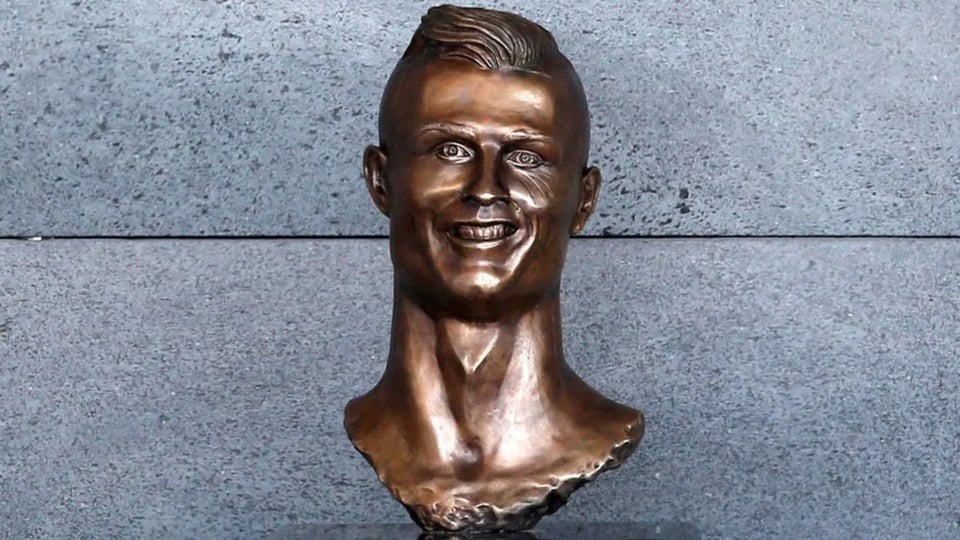
Speaking of suspensions, Ronaldo was supposed to be suspended for Portugal’s first match, played against DR Congo. But FIFA couldn’t have that, not the superstar, billionaire Ronaldo! So they changed the rules to allow Ronaldo to play. This, in the end, probably hurt Portugal more than it hurt DR Congo. The way the star played, Ronaldo could have been replaced by his horrifying bronze likeness, and the horrifying bronze likeness might have been more helpful to the other Portuguese players.
Everyone Hates the Hydration Breaks
After 24 matches of hydration breaks, it’s clear that pretty much everyone hates them. They were originally presented as 1 minute breaks for players to take on fluids and cooling towels. They’ve actually become 3 minute tactical timeouts where managers coach players and some coverage, like the Fox coverage in particular, completely cuts away from the match to show a bank of commercials. I haven’t been watching Fox, but I’ve heard there have been times where the commercials have even run over, cutting into live match action.
Beyond that, the breaks are clearly impacting the run of play. Each restart post-break feels like the beginning of the half, with all momentum lost. If you look at momentum maps for many matches, you can clearly see where the hydration break occurred.
If you aren’t a big watcher of the sport, you may not be familiar with the impact of momentum. Part of what makes this sport unique is that the clock doesn’t stop, and neither does the play. Sure there are stoppages here and there, but largely, the sport is about build up play, slowly chipping away at the opposing team, probing, passing, testing.
When the match comes to a complete stop, the players have to start over again, and sometimes the momentum swings in the other direction. More than once, teams have been in control before the hydration break, then coming out of the break, their opponent has taken over. All of this to say: it’s not just slowing down the sport, it’s literally changing it, fundamentally.
The commentary around it has been damning. People have started to refer to the matches as having quarters, not halves. Fans are loudly booing the start of each break. Pundits have pointed out that almost every rule change that’s been implemented by IFAB for this tournament was in service of speeding up the play, only for this rule to add a 3 minute stoppage in the middle of each half.
It was presented as a change for player wellbeing, however it’s happening in every match, regardless of temperature, including for matches played in indoor, air conditioned stadiums. I frankly won’t be surprised if and when a player occurs right after a break, due to the disruption of the rhythm. It’s clear to all that this change has nothing to do with player wellbeing, and everything to do with capitalism.
Now, Some Numbers!
Top Offensive Performances
Caveat: These numbers accidentally include the goals from Round 2 games for Groups A and B and I’m not going back to figure out who’s who.
Everyone talks about individuals, leaders for the Golden Boot. But what about clubs, and leagues? Real Madrid and Bayern Munich have 4 goals each. Arsenal, Inter Miami, Paris Saint-Germain, and Juventus have 3 goals apiece. The English Premier League has 16 goals, Germany’s Bundesliga has 12, France’s Ligue 1 has 7, and Spain’s La Liga has 6.
These numbers feel a little unfair, because these are also the most represented leagues at the tournament. It’s a completely different look when I do a calculation of goals per player, with the leading leagues being some of the least-represented leagues at the tournament, with Romania’s Liga I, Argentina’s Primera División, Slovenian PrvaLiga, and Russian Premier League in the lead. So we’ll wait a little longer before we present any laurels.
Top Offending Performances
What about yellow and red cards? In the first day of Round 2, we surpassed recent tournaments, and are well on pace to challenge the record of the 2006 World Cup in Germany, where 28 players were sent off across 64 matches.
Benfica has the most yellow cards, with 3. Brighton & Hove Albion, Manchester City, Memelodi Sundowns, Wolverhampton Wanderers, Orlando Pirates (South Africa, not Florida), Al-Ahli, Al-Rayyan, and Schalke 04 all have 2 yellow cards.
For red cards, Mamelodi Sundowns (South Africa), Sassuolo (Italy), Lokomotiv Moscow (Russia), Tondela (Portugal), Al-Wakrah (Qatar) and Cultural Leonesa (Spain) all have one each.
Some Cool Links
Before I go, I wanted to share two cool links I’ve seen.
As we discuss the hydration breaks, it feels worth looking at the actual numbers on temperatures for these matches, both real and relative. This tool lets you look at the details for each venue.
Tracking the Heat at the 2026 World Cup
Then there’s this visual storytelling of where players play at the club level versus their country team, and what we can take away from these numbers