
On Virtue and a Sledgehammer, AI, and the illusion of choice
The following contains discussions of suicide, misogyny, racism, eugenics, and euthanasia. It also contains full spoilers for Virtue and a Sledgehammer.
There is a transhumanist idea that technology will make people’s lives better. In every version of the Transhumanist Bill of Rights, it promises that all beings — sapient, sentient, artificial or otherwise — will have the right to "end involuntary suffering". These, alongside the thoughts and speculations of thinkers like Julian Huxley, Nick Bostrom, and Max More, have formed the backbone of the transhumanist philosophy. In essence, transhumanists advocate for the use of speculative and real technologies to create the posthuman, a being with such superior capabilities to us that it can no longer be categorized alongside the species. Seeking out this posthuman is what most most of these philosophers attempt to do.
I find something ominous in that "involuntary". It’s how transhumanism delineates itself from its uncomfortable connection to eugenics, but it is painfully vague. To a transhumanist, the difference between its “new” eugenics from the “old” is simple: its technologies will be universally accessible, benefit humanity, and always be optional. Diseases will be cured, the human body will be perfected and refined... but don’t worry, it’s good this time! People, not governments, get to decide what does and does not happen to them. Everyone will determine their own fates.
And yet.
The widespread introduction of generative AI models, such as ChatGPT and Claude, aren’t just passively changing how its users gather information; they are actively reshaping commerce, politics, the global climate, and art. These machines have offered to write people’s suicide notes. Their environmental footprint grows increasingly concerning every year. They have been used by political parties to create deepfakes for their campaigns. Despite their alleged neutrality, they are riddled with ontological assumptions and biases. Models like these embed these assumptions into their code — and, in turn, into the people using them. They change us, no state mandates needed. You don’t even have to use them to be surrounded by them. So, when every major corporation is introducing a new starry AI integration, storefronts are becoming overwhelmed by a slew of generated products, and when dozens of businesses argue that you’ll be abandoned without it, then, frankly, how voluntary is your subscription? Your entire town is using it. You entire town has been changed by it. How dare you not join your peers, and choose to live a worse life?

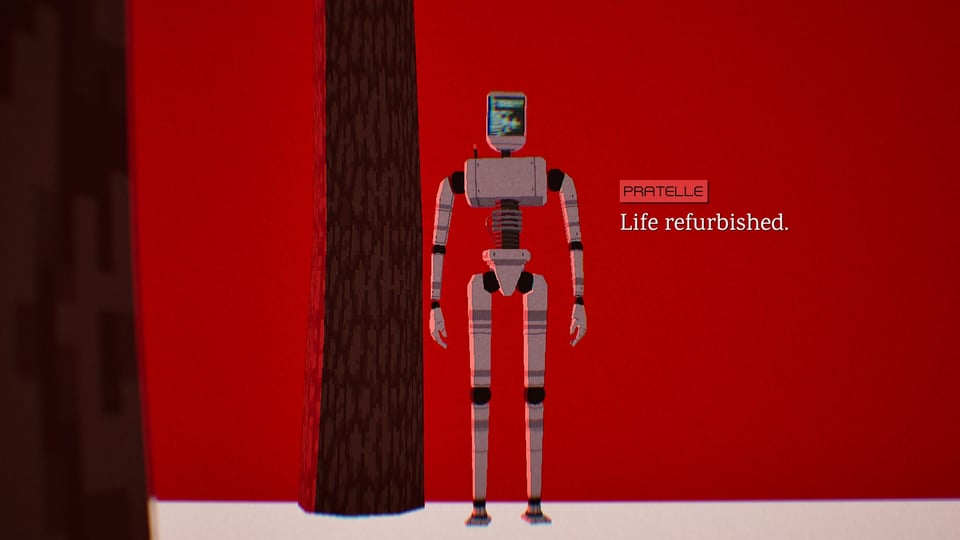
Deconstructeam and Selkie Harbor's Virtue and a Sledgehammer crafts this very town in an atmospheric narrative 3D walking simulator. The game places you in the perspective of Pratelle, and places in her hands the aforementioned virtuous sledgehammer. You have a simple mission: rip through your hometown, filled with new robotic versions of your neighbors, and tear everything down. These machines are the brainchild of Pratelle's older sister Nina, who she intends to find and destroy. It's an electrifying, emotional experience, with some extremely satisfying gameplay alongside it.
Your rampage is occasionally interrupted with short flashbacks to Pratelle’s childhood. One of the first of these to particularly affect me begins with a child Nina asking her sister to choke her until she passes out. “I need to understand how my brain works,” she begs. “I’m going crazy. I can’t control my thoughts. But there must be a trick to it.” Nina’s interest in understanding humans is contingent on her desire to fix a problem within herself. She doesn’t seek empathy; she wants a quick fix to make bad things go away.
And so, as an adult, she develops these “digital humans”: the result of blending extremely advanced tech with her transhumanist idealism until it congeals into these mimics of humanity. In their new form, these robots are incapable of growing beyond their initial simulated patterns — and it is growth that they so desperately need. While Pratelle smashes her way through town, they’ll hurl any number of racist, misogynistic, ableist, and otherwise uncomfortably violent insults at her. “I want to hear her scream”; “I’ve always hated aggressive women“; “The moment Merche brought an Arab into town, I knew it was gonna be trouble“. During a brief interlude in the story, Nina promises a digitization subject that they’ll be able to become their ideal selves in this new body. It’s a lie, but she doesn’t know it yet. She still believes that the body is the problem.
Later, while exploring an assembly line factory, Pratelle encounters a room full of malfunctioning robots. It seems that issues occur when digitizing the elderly, causing nearly everything they say to be incoherent. They are immortal in a body that no longer serves them. Worse, these machines were separated from one another by wooden fences, herded into corrals like cattle. Even these echoes are not free from the discrimination borne of human disgust.

Small moments like these reinforced what I entered Virtue and a Sledgehammer believing. I knew exactly what I was going to. I would smash this entire town to bits. I would end Nina's mission, and I would love it. As I played, I methodically flattened every building and machine in sight. It was extremely satisfying. Until it wasn't.
I encountered a particular machine a little over halfway through the game’s runtime, who was crouched quietly in a field of grass and flowers. They beg Pratelle to not kill them. When they were human, they had physical disabilities which affected their ability to walk. Now, with Nina’s digitization, their disability had been cured. They tell Pratelle that they are not their body; that “the electricity running through this machine is me.” I didn’t like how much I resonated with this machine. I reluctantly brought down my hammer on its head.
As time went on, and I spoke with more of these robots, I started to feel increasingly guilty. They continued to sound like me. Some even started to repeat the dialogue choices I had made in flashbacks — a pattern that reveals the machine’s inability to change, but which I again interpreted as reflections of myself. I began running from anything that approached. Upon confronting with the robot modeled after Pratelle's mother, I couldn't bring myself to destroy her. I had entered this story so ready for catharsis, for a rage room, and here I was mourning wire and code. How had my resolve been so easily shaken? Why did I convince myself that these patterns were me?

Ultimately, when I finally confronted Nina, I chose to destroy her. There is a part of me who feels guilty for that “ultimately”. This is a fictional world, and even here I struggled to hold the line. Still, I find some solace in my indecision. Each time I encountered a new machine, faced with the same ethical dilemmas, controls, and agency, I made different choices. I changed, even just over this short few hours. I did what the machines cannot. Back in our own reality, I am now certain that I will be able to hold the line. LLMs cannot feel my guilt. My guilt will make me better.
There was another choice I could have made, though. In the game’s other ending, players can choose to accept Nina. The two sisters embrace. Nina admits that Pratelle was right about the soul. There's something about humanity that her machine's patterns aren't able to quantify. She apologizes, over and over, yet as they talk, she quietly prepares Pratelle for digitization. When Pratelle realizes it, she protests, but Nina does not relent. After all, she has a moral obligation to bring her sister closer to perfection. Surrounded by machines, in Nina's stronghold, acceptance was never enough. Subscription was never voluntary.

Virtue and a Sledgehammer is an exercise in redirecting empathy. I am naturally inclined to personify lifeless things. I am interested in giving them my empathy. Pratelle, when she accepts destruction, doesn’t fall into this trap. She loves her sister, and channels that love to confront the consequences of what Nina has done. Forgiving Nina and the machines she has created will not save anyone; in fact, destroying them makes space for new life. I found this truth so difficult to accept in my early relationship with LLMs. Even as I believed the technology was disgusting, I reminded myself that other tech does makes things easier for me. Denying AI my empathy sometimes feels like denying me my life. But my empathy isn’t erased — just shifted, imbued into a sledgehammer. It fuels the determination I will wield to make space for a better world. It allows me to love this world more than I hate it. Transhumanist technology can change us, as it is designed to, but it cannot be allowed to prevent us from changing. For as long as I am alive, I must always be able to make radically different choices. Patterns must always be able to be broken.
