
Stories Spat Out
Lyndon J. Barrois, Sr.'s Gum Wrapper Sculptures of World Cup History
By Stella Horns
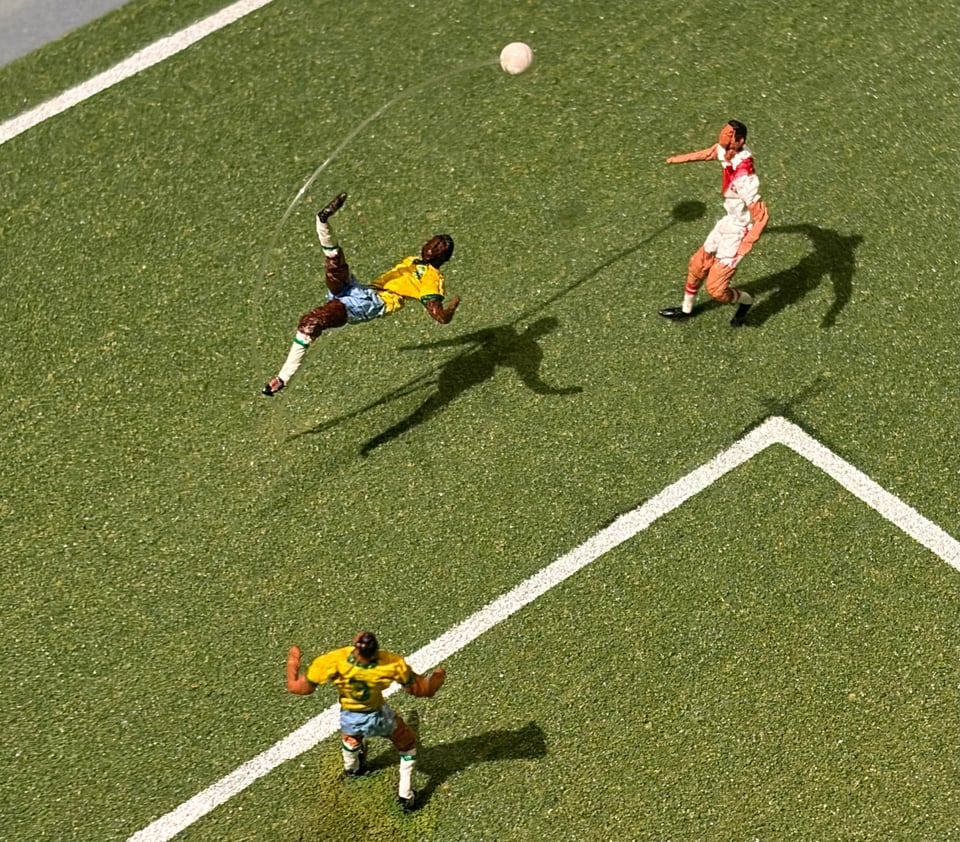
American goalie Hope Solo dives across the wide mouth of the goal to snatch the ball out of the air. Ahead of her, David Beckham’s free kick arcs over the heads of a huddled Romanian squad, while at the other end of the pitch, Pelé is frozen at the apex of his brilliant bicycle kick.
The dance we are watching is the Fútballet, a series of famous vignettes from throughout men’s and women’s FIFA World Cup history, brought to life as one-inch miniatures sculpted out of Wrigley’s gum wrappers and then animated in a stop-motion short film presented alongside a three-by-four-foot diorama. The static piece, originally created in 2018 for the Perez Art Museum Miami, centers the exhibition Fútbol is Life: Animated Sportraits by Lyndon J. Barrois, Sr. currently on view at the Los Angeles County Museum of Art (LACMA) as a nod to the ongoing tournament.
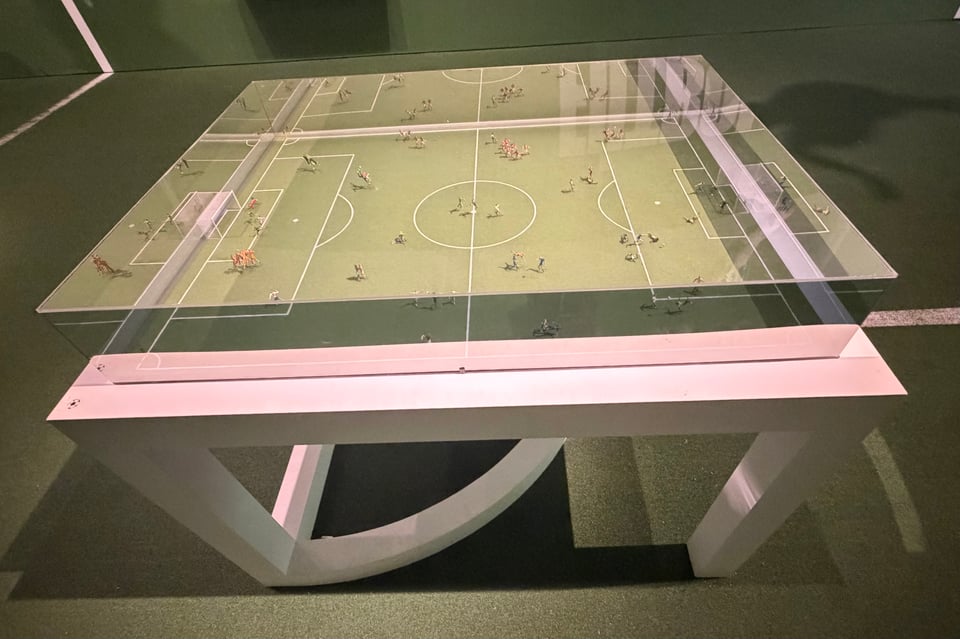
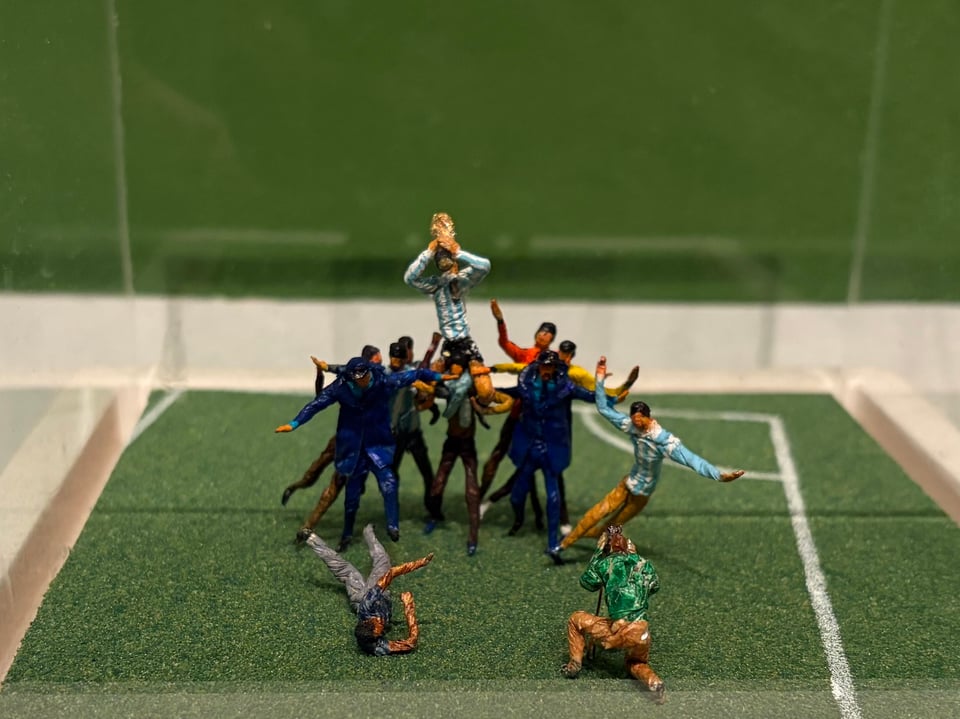
Barrois also created a series of new miniature vignettes for the show. Some depict equally iconic and memorable World Cup scenes, like the crushing 7-1 defeat on Brazilian home soil during the 2014 tournament, but others pull from more obscure history. The 1934 Italian and 1938 German teams line up to perform fascist salutes. Zaire plays Scotland in 1974 as the first African nation to play in the World Cup, though that team’s short-lived campaign would be emblematic of so many of the issues that plagued 20th century postcolonial states. Daniel Passarella hoists the trophy for Argentina in 1978, a moment of euphoria complicated by the nearby policemen shoving photographers to the ground, invoking the harsh military regime that ruled Argentina at the time.
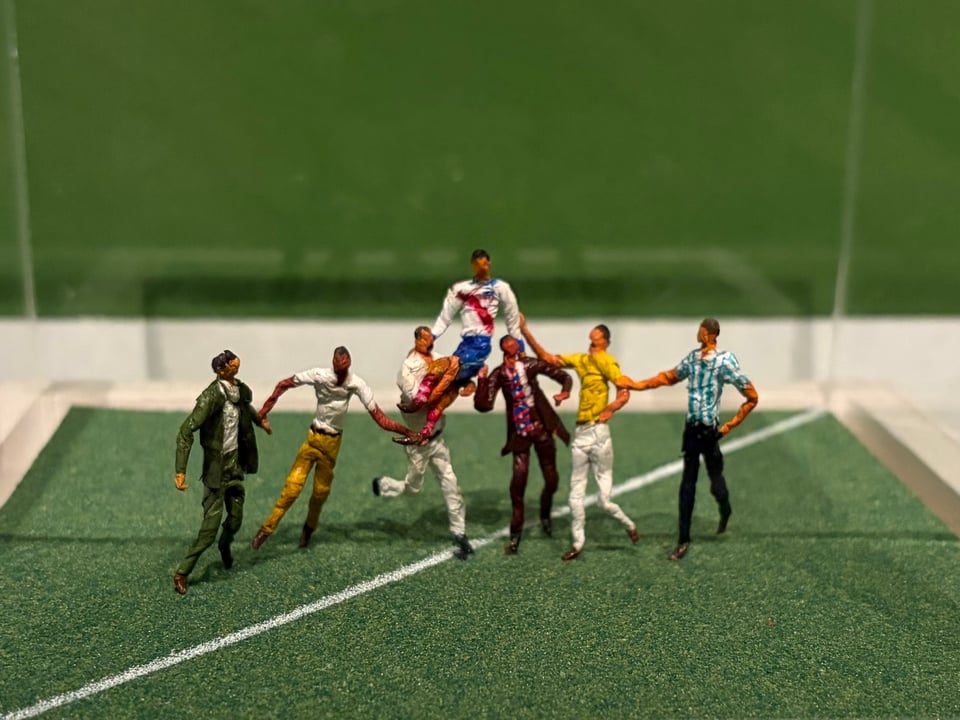
All throughout the timeline of Barrois’ World Cup vignettes, politics and protest intrude into the frame, or rather, onto the field. And they don’t always do it in ways that make you feel comfortable. In one vignette, Joe Gaetjens is carried off the pitch on his American teammates’ shoulders after scoring the only goal to win a 1950 game against England. But rather than letting you bask in that joy, the description beneath the diorama tells you that Gaetjens, born in Haiti, soon returned to his home country where he eventually disappeared – arrested by secret police due to his brother’s political activism.
Barrois chose to highlight moments like these deliberately. “Haitians have been vilified in this last election. And you look at the history of that, of Haiti itself as a country, and what Haitians have done for this country,” he told me, “I just had to glorify that guy, Joe Gaetjens, and his moment being hoisted, you know. I just had to.”
It would be easy to celebrate progress in sports without also shining the spotlight on the unseemly parts – the fascists, dictators, armed guards, and militant protestors – along the way. As time ticks forward from the 30s and 40s on toward the later 20th century, more countries from Asia and the global south are able to qualify for the tournament. In 1991, the FIFA Women’s World Cup was founded. The miniatures could simply appear in more colors and genders to celebrate their wins and mourn their losses.
But it is no accident of fate that the World Cup is now more inclusive and diverse than it was in the 1930s. People fought for that, just like they fought for many other rights and privileges throughout that century.
Besides sports, the subject of political protest is Barrois’ other main artistic interest. His 2020 Covid Chess Set satirized early pandemic era America, pitting a team of frontline workers and Black Lives Matter protestors against incumbent Republican politicians and anti-maskers. For a 2021 show at MASS MoCA with Glenn Kaino, Barrois depicted 17 moments from protest history, recreating Tiananmen Square and the beating of Rodney King with miniatures on floating asphalt rocks, carefully lit so that they’d cast life-sized shadows on the walls.
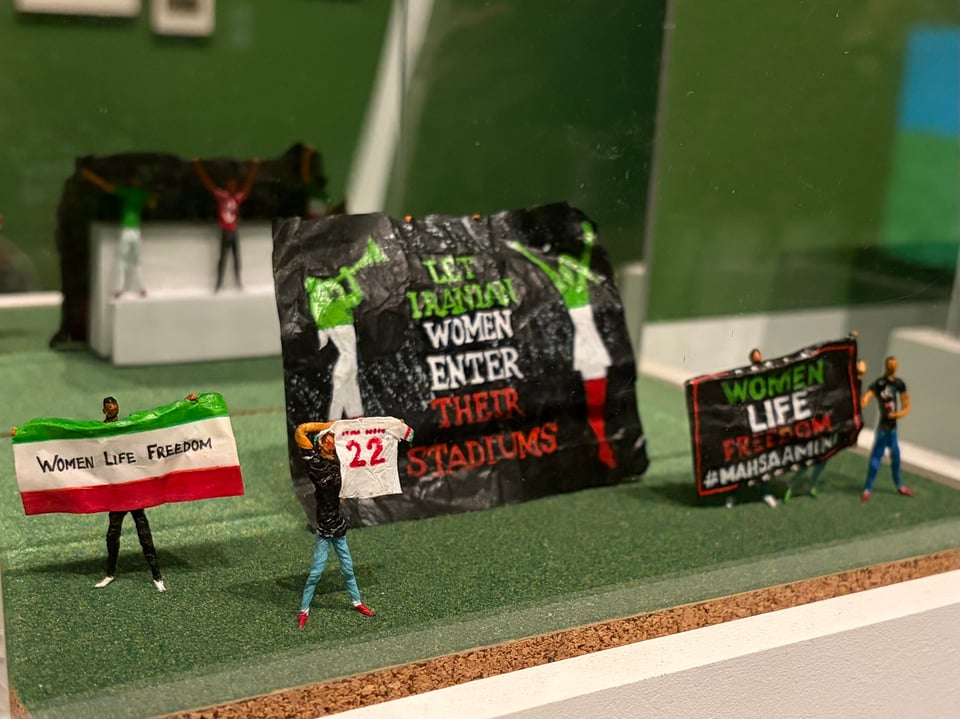
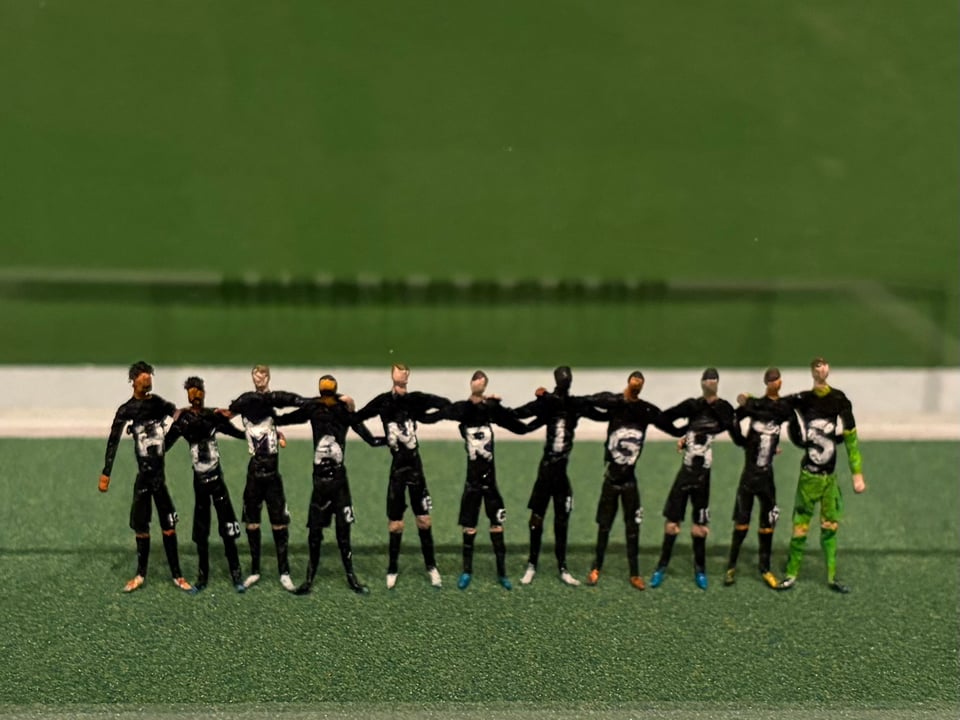
Protest scenes are also reflected in Barrois’ World Cup dioramas from the last decade or so. Protesters against inequality take the field in Brazil in 2013; a Pussy Riot activist is dragged off the pitch during the 2018 final in Russia; in Qatar in 2022, protestors stand for the rights of women, queer people, and Palestinians. And in a striking parallel to the 1938 vignette, the German men’s team stands lined up ahead of their 2022 World Cup qualifiers. But instead of aligning themselves with fascist power, this time their jerseys spell out “HUMAN RIGHTS,” making their stance clear amid the controversies swirling about thousands of reported migrant worker deaths in Qatar.
But is it enough? “I think we should take that further,” says Barrois, “If they [the athletes] said, you know what, fuck this stuff. We're just not going to play.” An athlete-led boycott has the potential for much a larger impact than brief single-event disruptions of external agitators. But Barrois also sees the other side of the coin. “They don't feel they have the leverage to do that. Because you work hard to play in these games. You work ungodly hard. So you don't want to sacrifice and miss that opportunity.”
It’s likely for that reason that most, if not all of the threatened or realized boycotts in the elite sporting world over the last decade have been about player treatment, like the recent media appearance boycotts at the French Open over prize money, the US national women’s ice hockey team’s averted 2017 IIFH World Championship boycott that finally got them paid outside of the 6-month Olympic window, and the Spanish and Jamaican national women’s soccer teams which both boycotted in response to mistreatment at the 2023 World Cup.
Elite athletes have such a short window during which they are at their peaks, so giving up even one year of that is a major sacrifice. Prestige events like the World Cup and the Olympics only come around every four years. Who knows what will happen. Maybe you’ll get that last big concussion next week, or blow your knee and never quite move the same again. Then you’ve not only lost your chance to make it to that big stage, but also likely your income, and the earning potential for the rest of your athletic career. So it’s understandable to want to maximize your money while you can. In those circumstances, it’s hard to stand up for your community, let alone other communities you may not even belong to. But that individualism is also what makes you, and everyone else, more easily exploitable. This is precisely why athlete unions are especially vulnerable to strikebreaking.
But there are also other approaches to institutionally-backed boycotts that don’t rely on athletes sitting out games. For example, the South African Council on Sports and South African Non-Racial Olympic Committee successfully lobbied the International Olympic Committee to ban South Africa from the 1964 Tokyo Olympics, kicking off the anti-apartheid sports boycott movement, which also saw the country kicked out of the World Cup from 1970-1990. The coordinated protest sought to cut off South Africa’s international sporting ties entirely in order to raise global awareness of the state’s segregationist practices, which were mirrored in its sports world, and exert pressure for change.
Similarly, Russian teams were banned from most international sporting events after the 2022 invasion of Ukraine, though some individual athletes have been allowed to return to competition. FIFA president Gianni Infantino favors Russian return to participation, arguing that the nation’s exclusion from sport “has achieved nothing.” Israel, notably, has not been banned from major international sporting events since its invasion of Gaza began in 2023.
Though no matches of the 2026 World Cup have yet been disrupted by protest (as of writing), protests have brewed outside and around games. Ahead of Mexico’s opening game in Mexico City, 18,000 protestors including teachers unions, federal judiciary workers, and transport workers mobilized in protest to call attention to the 134,460 missing persons in Mexico, according to Mexico’s National Registry. Most of the march was peaceful, but tensions eventually escalated and riot police fired tear gas as protestors knocked down guardrails outside the stadium. The protestors were not able to make their way inside or interrupt the opening ceremony, featuring a performance by Shakira, or the game, where Mexico beat South Africa 2-0.
And in Los Angeles, members of the Iranian diaspora protested around the team’s opener against New Zealand on June 15th, showing their disdain for Iran’s government by stomping on and ripping up Iran’s official flag and instead sneaking in and flying its pre-revolutionary lion-and-sun flag, which had been banned by FIFA.
Will anybody pick up the protest torch this year? “Who knows? The games just started. Maybe someone will,” says Barrois, who met with me on June 12th and planned to attend the USA vs. Paraguay match later that day. The 2026 FIFA World Cup will continue until July 19th.
As you step foot into the gallery that houses Fútbol is Life, tucked into a slim space on the right side of the Resnick Pavilion, you leave the sterile white expanse of the modern art museum and fall into a pocket dimensional football field that defies logic and distorts your sense of scale. The floor is covered with artificial turf, the walls painted to match. White lines sprayed onto the fake grass continue their paths up the walls into absurd continuities, meant to reference “soccer fields in schools or prisons, where fields were improvised in whatever spaces were available,” according to LACMA curator Britt Salvesen.
As you stare down at the tiny gum wrapper soccer players on their tiny fields, Lionel Messi and Marta Vieira de Silva, hang above your head. They are life-sized sculptures made, quite intuitively, from enormous special-ordered gum wrappers mounted on anatomical skeletons rigged in athletic poses.
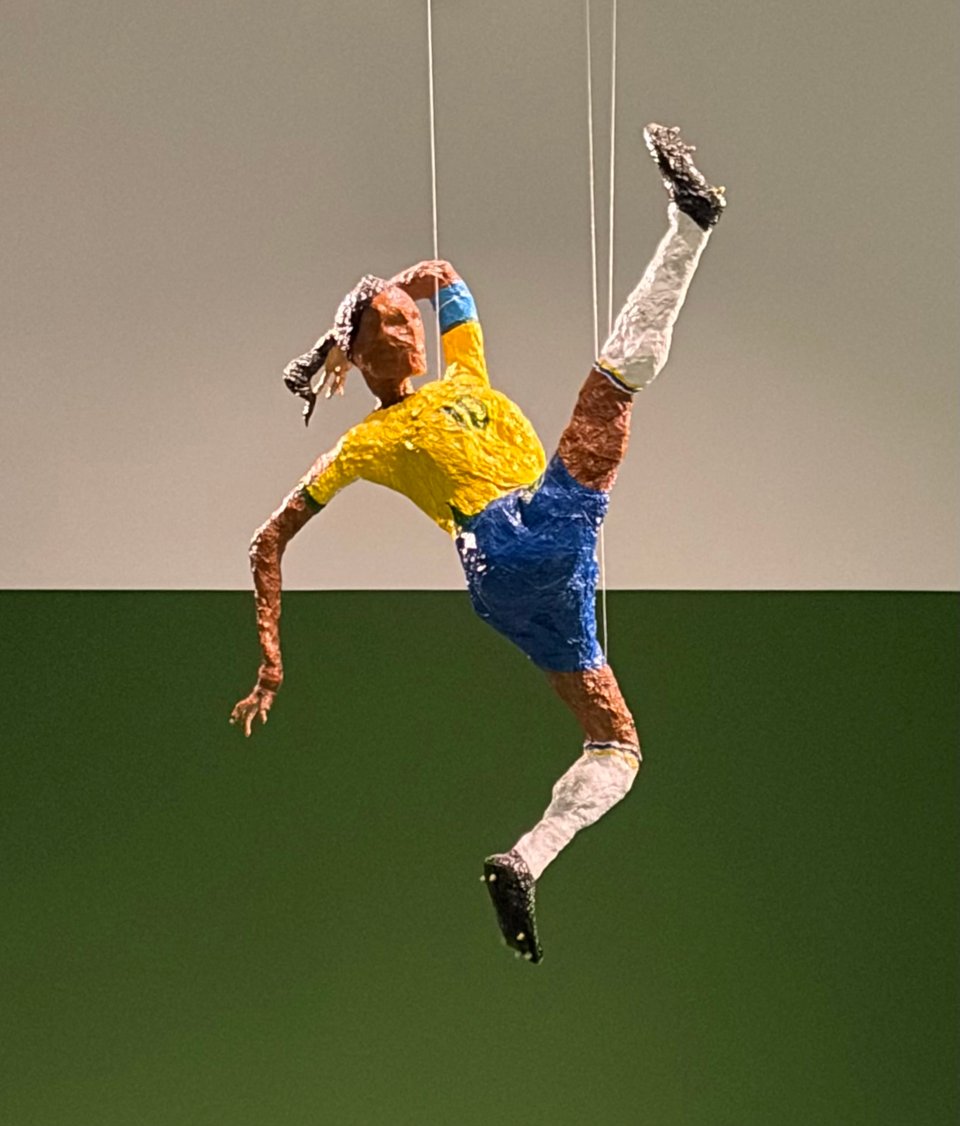
Barrois has been making his miniatures using the same gum wrapper technique since he was 10 years old and wanted drivers for his Hot Wheels cars. Already a connoisseur of crafting with discarded materials, Barrois soon fixated on the many Wrigley's Chewing Gum wrappers his mom left in her wake. They turned out to be his perfect sculpting medium: the foil side, forming the core, had enough structural integrity to maintain the figures’ poses, while the paper side, facing out, was a canvas to be decorated with markers and paint.
Soon, Barrois began sculpting boxers, making them fight, then whole miniature football teams from which he set up offensive and defensive lines. He closely watched the Wide World of Sports on TV and grew up as a misplaced Minnesota Vikings fan in New Orleans, so there were plenty of real-world inspirations to draw from for his miniature athletes, but back then he wasn’t trying to recreate anyone in particular. “At first they were fictional,” he says, “they were generic.”
Barrois thought of what he was doing as basically making his own toys, poseable action figures that “moved better than any other toy that was on the market.” It wasn’t until a friend suggested using them for his senior show at Xavier University that he realized he was making art.
That was around the time when he began making miniatures of real people, the process of which was “really much more exciting” because he “would really start to pay more attention to who these people were.” Instead of simply consuming sports media as he had his whole life, Barrois actively researched his subjects because he felt he owed it to them to get every detail right, to depict them faithfully: “That's when it really started to take on the consciousness of, I would say, sports literature.”
Barrois took the same rigorous approach to Fútbol is Life, spending seven months researching and sculpting the collection. He spent time reading about World Cup history, and even more time pouring over as much photography and video he could get his hands on, preferably in color.
The details Barrois scours the archival footage for aren’t just the colors and designs of uniforms, but also details like the fact that goalies in the 1930s wore little brown leather caps or how goals were shaped differently back then. They were covered in black netting, not the now standard white, and their back posts stood at different angles. “All that stuff's important,” Barrois insists, “I want to get the uniforms right, the shoes, the equipment, the goals, the ball, everything.”
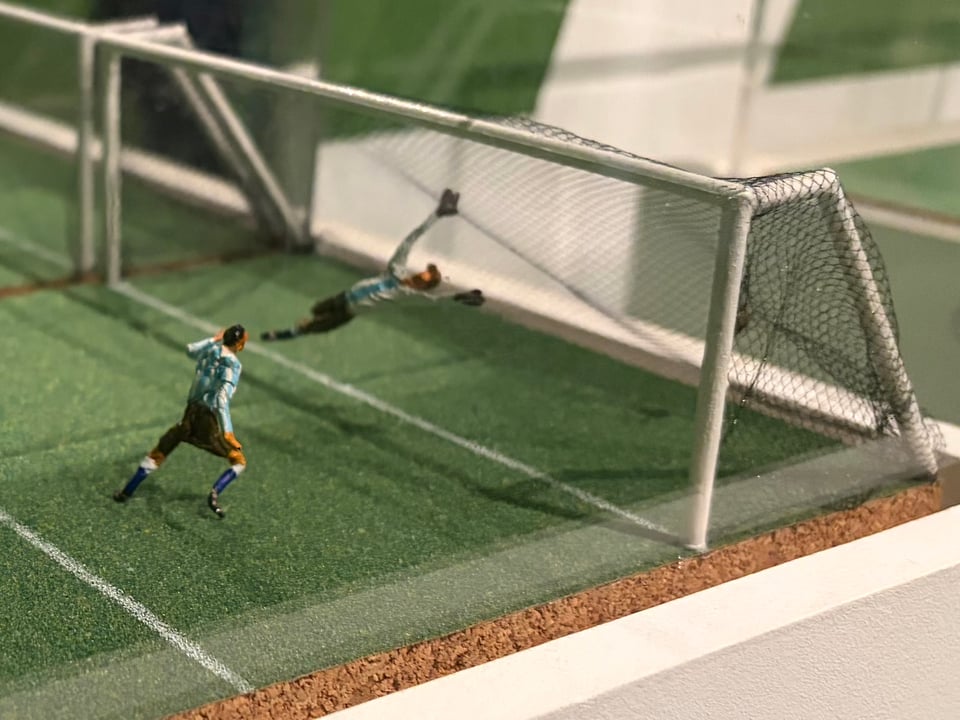
It’s this attention to detail and commitment to his subjects, along with the artistic practice, developed over decades – and of course the set dressing and all the trimmings that go along with a gallery show – that elevate the humble gum wrapper to the realm of fine art. After all, Barrois never expected all this success when he first started twisting trash into toys for entertainment.
Around the world millions of children take up the world’s most popular sport every day, for which all you need is a flat surface and something to kick. Some kids have balls, while others, like Pelé, Maradonna, Tevez, and Marta, at one point, use trash–stuffed socks, wadded plastic bags, crumpled newspapers. Their gum wrapper fantasies, given years of hard work and practice, immense talent, and a lot of luck, might also be just enough to take them all the way to the World Cup.