
Hearing from the pipeline industry, without knowing it
Plus: Insurance at the local scale, and an update on one state's fossil fuel divestment.
I scan through hundreds, if not thousands of local news stories about energy and climate change every year. I do so to follow trends across different states, think about new story ideas and share the best of what I find in this newsletter.
But I really paid attention when I saw Peter Barca, former Wisconsin state minority leader and state Secretary of Revenue, was invited on a local TV station to talk about electricity prices and data center projects, as part of his new role as Wisconsin chair of Natural Allies for a Clean Energy Future.
If this feels like deja vu to long-time newsletter readers, that’s because I reported on the funders and strategy behind Natural Allies — in a different set of states — in 2022.
The interview is the second time in two months I’ve noticed a local outlet fail to identify the pipeline company background of Natural Allies, even in passing, as the group makes a push in new states.
At the very top of the interview, the anchor asks Barca if Natural Allies is pushing “liberal agenda” on energy. Barca, a long time Democrat, demurs and says they don’t have any particular partisan bent; they talk to everybody. Eventually, he settles on “center-left”.
It’s certainly no giant jump to put a group that talks about “clean energy” into a left or Democratic bucket. Renewable- and climate-friendly Republicans, especially elected ones, are increasingly a rare breed.
 (Screenshot from the WISN interview)
But that’s part of why Natural Allies does what it does. The PR firm that helped create the group was clear from the start: Natural Allies is about tying natural gas to renewables in the mind of Democratic-leaning voters and others who like the idea of “clean” energy. (If you want to know more about why I scare quote “clean” when it comes to describing any kind of energy,read this earlier newsletter. )
The anchor asks him about data centers (there's a live bill in the Wisconsin legislature about it), but Barca says not all data centers are the same. Instead he pivots to talk about the need for “clean, affordable and reliable” energy in general.
Barca says even Republicans he talks to understand the need for “a mix of clean energy sources,” in the future, but doesn’t mention which sources those are, or what mix. When it comes to energy, these details really matter.
This position is not exactly a stranger to Democratic politics — in fact it was pretty much the median position before the Biden administration. So it’s not surprising that the people Natural Allies has tapped in places like Pennsylvania, New Jersey, Ohio, and now Virginia and Wisconsin, are well-known Democrats, many recently retired from public service.
But regardless of the actual policy beliefs of these former elected officials, Natural Allies is fundamentally a project of pipeline companies. They spend money on polls, TV and online advertising and state spokespersons in places where those pipeline companies are actively working on expansion projects.
Other than sounding generically positive about it, Natural Allies has very little to do with actually expanding or supporting renewable energy. In addition to gas companies, some pipefitting unions and minority business groups and have signed on, but the “allies” don’t include any of the solar or wind lobbying associations, geothermal or hydroelectricity companies, or even consumer electricity price watchdog groups. That would be quite a coalition.
When I first published my Natural Allies story in 2022, Marcellus Drilling News, an extremely pro-gas and oil online, labeled it “Antis Seek to Silence Pipe Industry Free Speech Ads to Minorities”.
I laughed a little, because what possibly could I have done to stop or silence a multi-million dollar marketing project? Arguably, nothing much has changed for Natural Allies. If anything, they’ve grown in the past three years. As a journalist, my first goal has always been more information: pointing out who is behind the advertisements you see on social media, who actually undertook the study behind that viral statistic, and who is asked to discuss various topics in interview and panels, regardless of topic.
So it’s dispiriting to see local TV stations, who I would have thought would have some experience with prior state-level influence campaigns, at least mention whose interests their guests are representing. It might have even been a better interview? Does Barca have strong feelings about particular projects in Wisconsin that could help lower electricity prices? What does he think about the Trump administration blocking nearly done wind projects while some new gas plants won’t come online for several years because we literally can’t build gas turbines fast enough?
Even when a story is otherwise well-done, readers do lose out when they don’t understand why a former elected official is suddenly so exercised about this one particular subject. This story about Virginia electricity prices and potential solutions for Virginia public radio is centered around an interview with former governor (and former DNC chair) Terry McAuliffe, in which McAuliffe pitches natural-gas as a “short-term” fix for rising power demand.
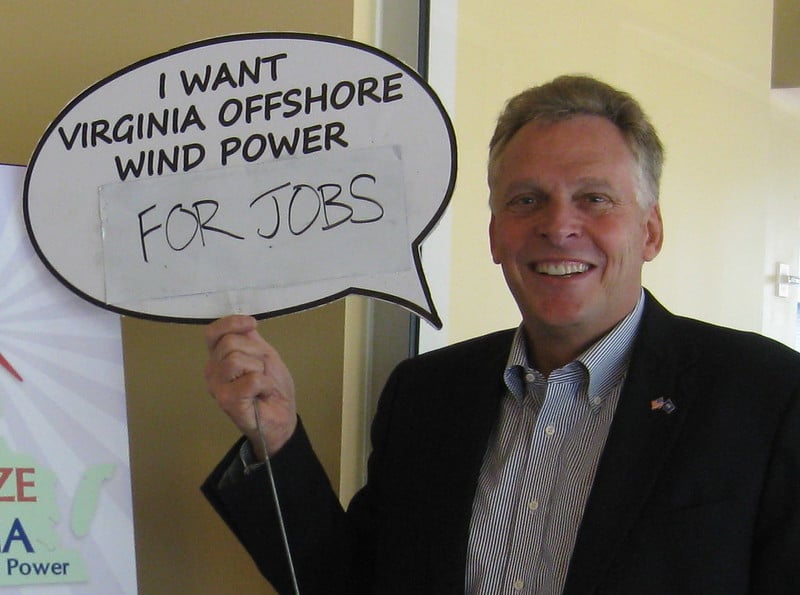
(Gov. McAuliffe in a different time (2011) at a wind power event. By Chesapeake Climate on Flickr )
I’ll let part of my correction email to its author speak for me here:
Thanks for covering power generation, electricity and costs in your most recent story for Virginia Public Radio. I have a small correction -- Natural Allies for a Clean Energy Future is not new, nor is it Gov. McAuliffe's group. I reported on the group and its wider strategy three years ago and I've seen very similar patterns to what they do since then.
Arguably it’s not even really Dem-led, even though they have lots of former Democratic leaders on their payroll. The group is primarily funded through and has all board members from gas pipeline companies, and they are active in several, mostly East coast states. One of the main funders of Natural Allies is pushing for an expansion project in Virginia right now.
Getting McAuliffe to be the voice of Natural Allies in Virginia is pretty standard practice for this group. They've engaged several high-profile Dems to talk up gas projects in their home states, write editorials, etc, but they've generally been open about being a "coalition" group with the backing of gas companies. If McAuliffe represented himself to you as the organizer or leader of the group, that's a stretch with many caveats, at best.
I know a correction can be annoying but thanks again for covering this. I spend a lot of time reading local coverage of energy policy and politics, and I know rising energy prices are a huge deal to residents in many states and I think you covered it well. Happy to chat more about Virginia in particular if you want to -- lots of interesting stuff going on there.
I got a response saying they’d “run it up the chain.” The story hasn’t been changed.
For what its worth, I don’t think either of these examples are “corporate media hiding the truth from you” moment. I think there are at least six PR people every one journalist in America, many of them offering interviewees available to talk to you about the topic you need to file on later today. I think the editorial staff that remains, in local papers and TV and radio, are beyond crunched for time to produce what’s been asked of them. And I think most journalists with any energy and energy politics expertise are increasingly only found in specialist media, behind a paywall that pays for their expertise and effort seeking out more detail.
I don’t know any particular good answer beyond me annoying an overworked reporter for a correction about topic I spent several months researching, but I do plan to keep mentioning it here. And more importantly, sharing when I do think local news has gotten it right.
Elsewhere
A new Q&A: I interviewed Carolyn Kousky, the founder of Insurance for Good about a Philly flood insurance project and the possible responses to our increasingly uninsurable future, for ImpactAlpha.
The site has investor-heavy audience and a hard paywall, but Kousky is excellent about talking about her work in a way in a practical, broad way. I thought her answer about investing in the things that would lower insurance losses was relevant for everyone, especially when we think about insurance and resilience on a local community level:
“Insurance is a market that prices risk, so if we invest in loss reduction and we lower the risk, shouldn’t we see lower insurance premiums? And then can’t we use that savings as a cash flow to pay for the investments? That is a lovely idea that faces so many challenges with implementation, but I think it’s still an important one.
One we’ve seen at the household level is a discount on your insurance premium if you harden your home, then pay for it through the savings and the loss reduction. For some measures, I think that actually could work really well. For example, fortifying your roof has been shown to provide dramatic reductions in losses from hurricanes.
The things you can do to your own home to reduce flood losses meaningfully enough for your insurance to reflect it, like elevating your home, are very expensive. Sometimes the best measures are at a community scale, but we don’t know how to capture that in tiny premium savings over thousands of residents with dozens of insurance companies. Some of those investments are very much public goods: stormwater infrastructure, stabilizing levees, doing prescribed burns to manage catastrophic wildfires. Insurance can’t be the sole solution for funding and financing all the loss reductions investments we need to be making, but one place where we think insurance could be doing a lot more is in the post-disaster context.”
An update: Three years ago I wrote about how Maine’s pension system was required to divest fossil fuels from their portfolio, and how doing so was more complicated than say, selling all your Exxon stock. A recent story from the Bangor Daily News explains why Maine didn’t hit its 2026 deadline to divest even as its total percentage of fossil fuel investments is down.
New to newsletters? I’ve recently been working with several established indie newsletters writers on growing their newsletters, but if you’re starting from square one (or don’t think of yourself as a writer, but are interested in using email for a specific project) you can get my low-cost guide, First Edition, here.
Reading
- This Bloomberg story has more detail about how Trump administration’s desire for more AI business is at direct odds with the White House’s direct attacks on solar and wind projects, given the physical constraints on other energy sources.
- Speaking of physical constraints, the coal plants the administration wants to keep going are, well, not in great shape. (NYTimes) Related: A round up of what “Trump’s EPA” did on fossil fuels in 2025 (Associated Press)
- “In Casco Bay’s cold, remote waters, electric workboats, and the aquaculture innovators who operate them, are putting marine electrification to the test.” (Daily Yonder)
- This feels like a spiritual successor to my Shuggie’s profile: How rising food costs are pushing restaurants to reuse food waste (Bloomberg)
- An example of a solar project at Superfund landfillI wrote about two years ago that has now come online (Canary Media)
- Ohio’s public utility regulator considers cutting price paid for solar produced by homeowners (Canary Media)
- What does this civil war fort have to do with climate change? Nothing, nothing at all, if you ask the Park Service right now. (NYTimes)
- Trump vetoes Florida Miccosukee flood protection, citing tribe’s opposition to ‘Alligator Alcatraz’ (Florida Phoenix)
- After a White Town Rejected a Data Center, Developers Targeted a Black Area (Capital B)
Listening
Some live Kishi Bashi for you
Thinking
On why YouTube clickbait titles, sometimes:
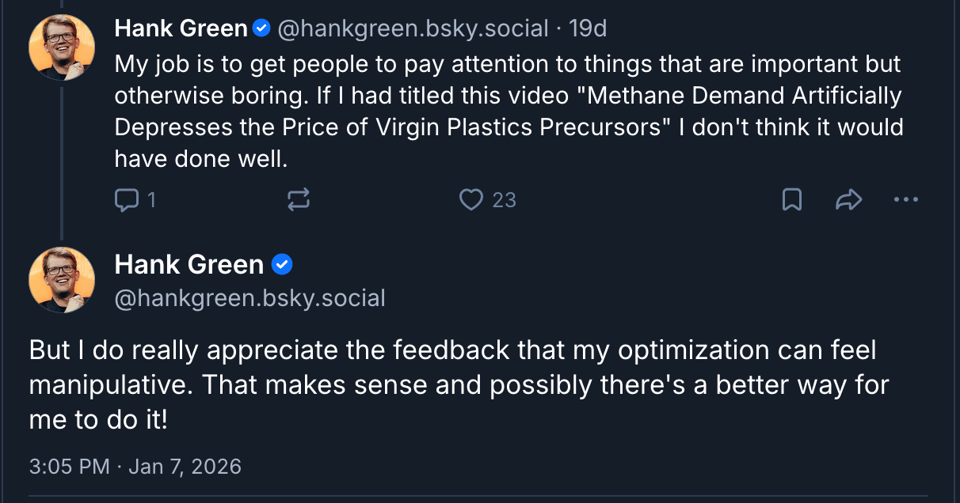
(currently the title is “There’s Actually A Reason You Can’t Recycle Plastic”, but its going through a few permutations, including “Your Stove Is the Reason You Can’t Recycle Plastic”. Classic A/B testing.)


Add a comment: