
A messy power plant story gets messier
A new development for one of WV's largest coal plants.
What compels a reporter to drive two hours each way to attend a bankruptcy hearing for a company most people have never heard of?
I found myself on I-95 last week, on my way to Wilmington, Delaware, because a company I spent months reporting on in 2024 was declaring bankruptcy.
I’ve done court reporting here in DC, but federal bankruptcy court had a very different flavor. I was the only person who wasn’t a lawyer or a party to the case in the courtroom. The court itself was inside an office building, with law firms on other floors. The entire security screening was stuffed tightly in the elevator bay (One security guard asked me to run my glasses through the x-ray machine because “Glasses can be video now”).
I was there because after nearly two years of relative quiet about what was happening with this company, the bankruptcy filing was the reporting equivalent of a fireworks show.
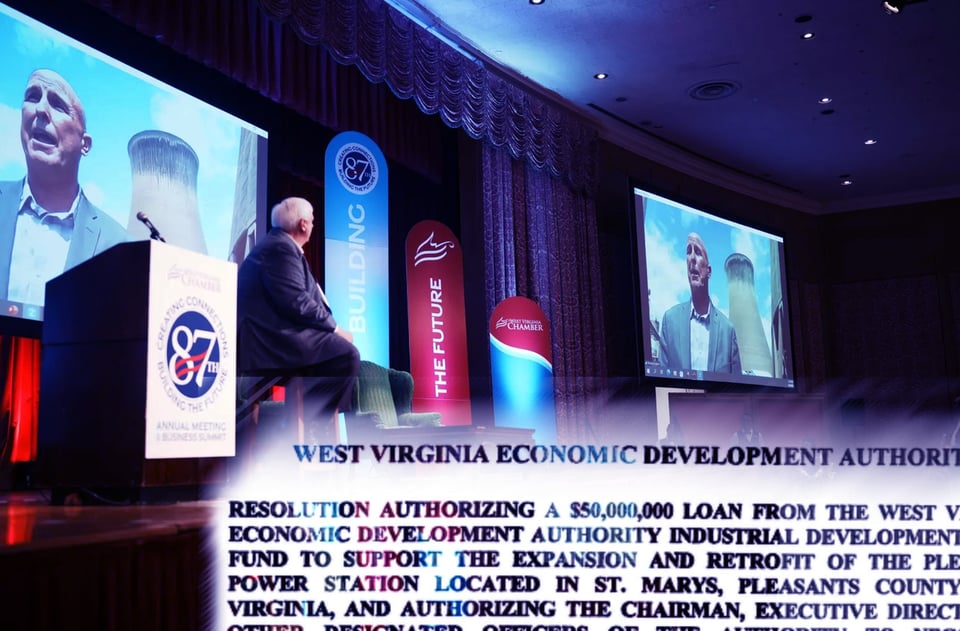
Simon Hodson and other leaders of the Omnis group of companies came to West Virginia several years ago, pitching the state on a revolutionary technology to turn coal into highly-valuable graphite and hydrogen, and burn hydrogen with zero emissions in a converted coal plant. But first, they had to buy Pleasants Power, a nearly five-decade old coal power generator on the banks of the Ohio River, which was about to be permanently shuttered.
My previous story delved into the lawsuits against Omnis and Hodson, a loan they received from West Virginia for the project and the high stakes for the local community around the plant.
Since that story, very little has publicly happened with the plant or Omnis. Energy data showed some power generation from Pleasants, on and off. There was a press release about a potential partnership with a company trying to pivot from cryptocurrency into AI data centers, but nothing seemed to come of it. And a major lawsuit against Omnis was recently put on hold because of health concerns of the plaintiff.
Motivational speaker Tony Robbins had lent Omnis money for the plant purchase and the project. But earlier this year, Robbins’ investment companies consider the loan past due, leading to an agreement where the power plant — and only the power plant — was placed under new management. I know this now because of bankruptcy documents filed by that new management last Sunday.
In those filings, new management alleged they had been forced to declare the bankruptcy last week because the original owners’ “gross misconduct” related to the plant while they continued to raise money for a technology that failed to materialize.
The new CEO, David Hindman, said the recently-ousted Omnis management had failed to fund the plant’s operations, didn’t pay vendors and only had enough coal on hand by late 2025 to operate the plant for a day. Previously management also attempted to develop a crypto-mining data center, despite the plant’s electrical capacity was already promised to the grid, he said, as well made questionable round-trip payments between related LLCs in order to unlock loan funds from the state of West Virginia.
I haven’t been able to assess the allegations fully. A lawyer for the previous management disputed them in court last week, but didn’t get into details in this particular hearing. There’s also a related fight in WV state court about who actually controls the power plant, after an attempt by Omnis to pay the Robbins’ companies loan.
But the new management is looking to sell, putting Pleasants Power, and the community around it, back where it was about three years ago. Is a coal plant more economically viable in 2026 than it was in 2023? Even given the Trump administration’s much more favorable treatment of coal and increasing electricity demand from data centers, that’s a open question.
What I’m reading this week
Speaking of West Virginia, parts of the state have recently been hit by deadly and devastating floods. Mountain State Spotlight explains the unaddressed flood prevention work the state has left undone since major flooding a decade ago.
The newest major player in EV charging? Walmart (Bloomberg, gift link)
The only state bucking a nationwide trend of slower rooftop solar installs? Florida (!?!)(Bloomberg, gift link)
“The program illustrates a subtler tactic in how the Trump administration is managing federal funds: not just terminating grants, as it did in droves last year, but quietly declining to give out new ones.” (NY Times)
A $100M Ohio energy fund lacks transparency — and excludes renewables (Canary Media)
Why is it so hard to predict wildfire smoke? How does wildfire smoke inhalation actually harm the body? (AP)
Michigan’s Supreme Court sends back the approval of a major oil pipeline crossing the Great Lakes back to regulators (Bridge Michigan)


Add a comment: