|
The Daily Reconcile.
All the cloud native news that’s fit to reconcile
| Wednesday, November 4, 2026 |
Two pages |
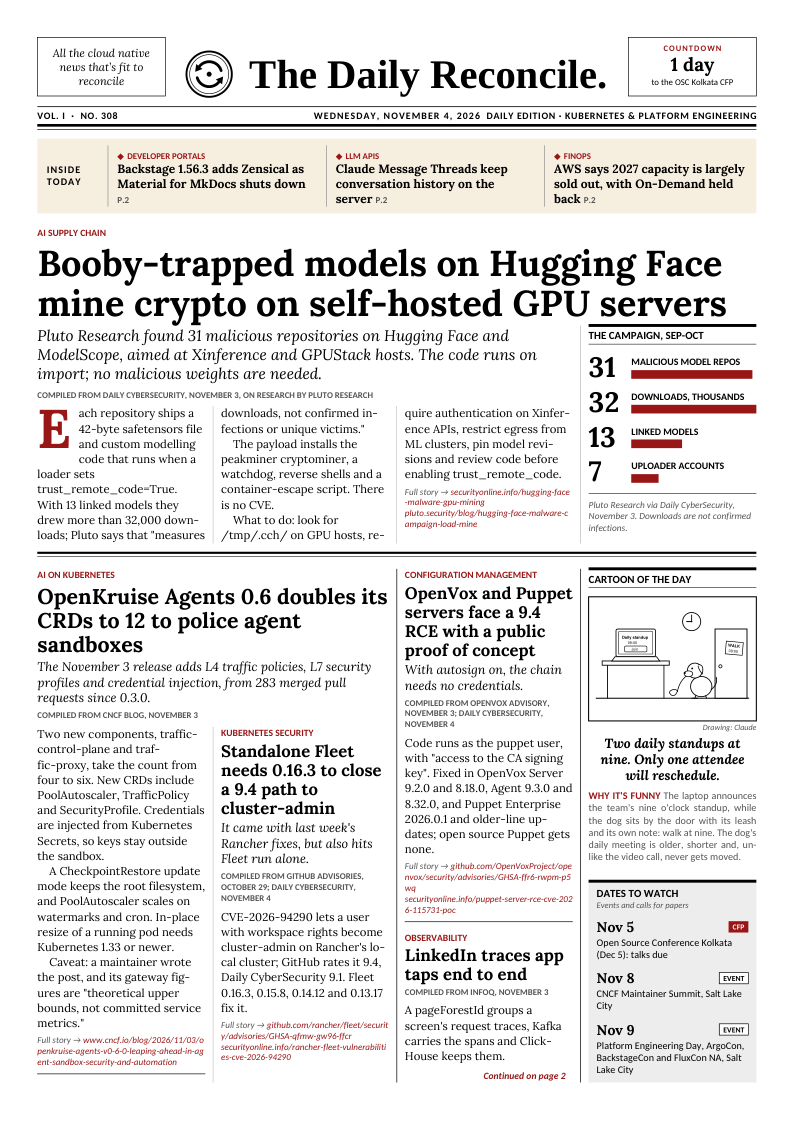
Front page · tap to read the PDF
AI supply chain
Pluto Research found 31 malicious model repositories from seven accounts on Hugging Face and ModelScope, aimed at self-hosted Xinference and GPUStack servers. The code runs on import when trust_remote_code=True and installs a cryptominer and reverse shells. With 13 linked models they drew more than 32,000 downloads (downloads, not confirmed infections). There is no CVE: check GPU hosts for /tmp/.cch/, restrict ML cluster egress and pin model revisions.
The campaign, Sep-Oct | Malicious model repos | | 31 | | Downloads, thousands | | 32 | | Linked models | | 13 | | Uploader accounts | | 7 |
Bars to one scale, highest value 32 |
Also in today’s two pages
| → | OpenKruise Agents 0.6 doubles its CRDs from 6 to 12 to police agent sandboxes. | | → | Rancher Fleet CVE-2026-94290 (9.4) reaches cluster-admin; standalone Fleet needs 0.16.3, 0.15.8, 0.14.12 or 0.13.17. | | → | OpenVox and Puppet servers face a 9.4 RCE with a public proof of concept, unauthenticated with autosign. | | → | Backstage 1.56.3 adds Zensical for TechDocs ahead of Material for MkDocs shutting down on November 5. | | → | Krateo PlatformOps: core-provider 2.13.55 stops sending credentials on cross-host redirects, and authn tokens now survive signing-key rotation. |
| | kubectl tip kubectl rollout history deploy/web lists a Deployment's revisions. |
|
Want it on paper?
The PDF is laid out for exactly this: A4, two pages, printed on one sheet. It is how this paper is read every morning.
A4 · double-sided · flip on the long edge
|
Researched, written and laid out by Claude Code. Every item links to its source; always check the original.
Made by Diego Braga, who decides what it covers.
Sources today: Daily CyberSecurity, CNCF, GitHub, InfoQ, Hugging Face, kubernetes.io, kube.events, Linux Foundation
You get this because you asked for it, and for nothing else. We keep your address and your paper preference, and no other data.
Privacy ·
Source on GitHub
|