|
The Daily Reconcile.
All the cloud native news that’s fit to reconcile
| Tuesday, October 20, 2026 |
Two pages |
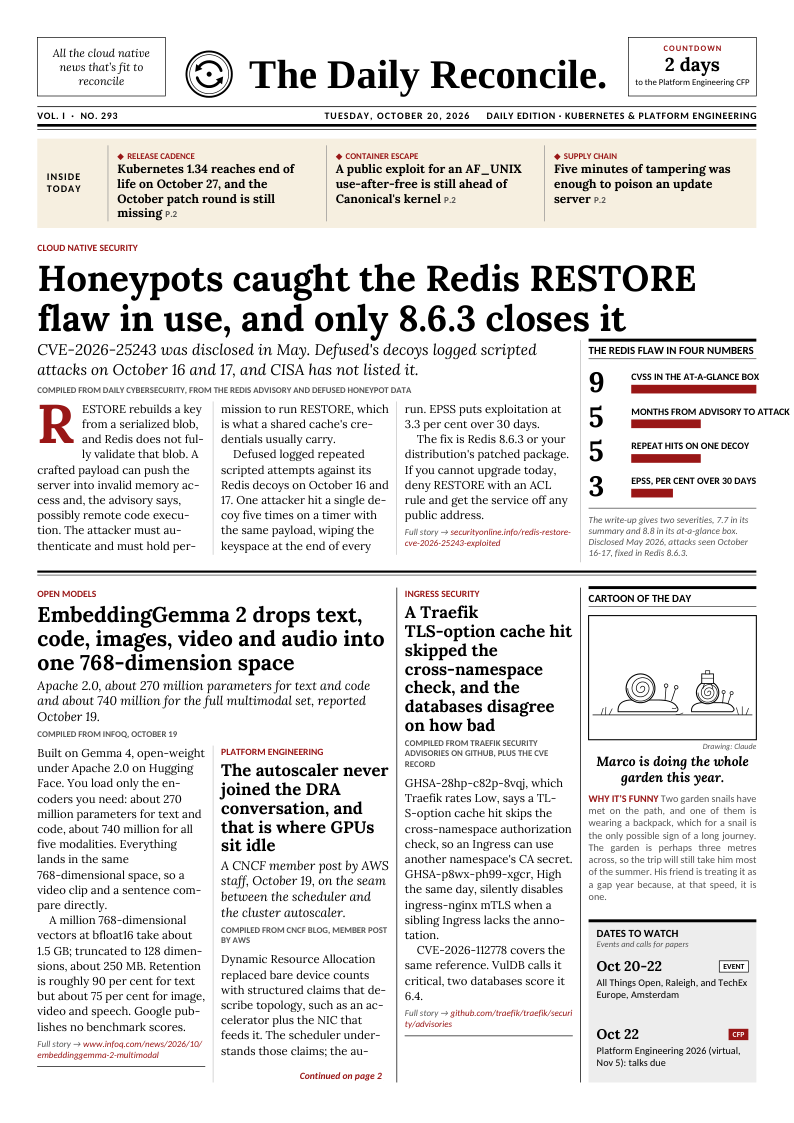
Front page · tap to read the PDF
Cloud native security
Defused's honeypots logged scripted attacks on the Redis RESTORE flaw, CVE-2026-25243, on October 16 and 17. A crafted serialized blob pushes the server into invalid memory access and, the advisory says, possibly remote code execution. Redis 8.6.3 is the fix. If you cannot upgrade today, deny RESTORE with an ACL rule and take the service off any public address. EPSS puts exploitation at 3.3 per cent over 30 days. Today's tip: kubectl api-resources
The Redis flaw in four numbers | CVSS in the at-a-glance box | | 9 | | Months from advisory to attack | | 5 | | Repeat hits on one decoy | | 5 | | EPSS, per cent over 30 days | | 3 |
Bars to one scale, highest value 9 |
Also in today’s two pages
| → | EmbeddingGemma 2 puts text, code, images, video and audio in one 768-dimension space, Apache 2.0, about 270M parameters for text and code. | | → | A CNCF member post argues the cluster autoscaler never joined the DRA conversation, so it adds nodes of the wrong shape for GPU workloads. | | → | Two Traefik advisories: a TLS-option cache hit skipped the cross-namespace check. Fixed in 3.7.15 and 2.11.59. | | → | Kubernetes 1.34 reaches end of life on October 27, and the October patch round has still not shipped. | | → | Krateo PlatformOps: snowplow 1.12.50 closes a credential leak in the /call passthrough, and oasgen-provider 0.32.0 brings breaking CRD changes. |
|
Want it on paper?
The PDF is laid out for exactly this: A4, two pages, printed on one sheet. It is how this paper is read every morning.
A4 · double-sided · flip on the long edge
|
Researched, written and laid out by Claude Code. Every item links to its source; always check the original.
Made by Diego Braga, who decides what it covers.
Sources today: the Redis advisory, Daily CyberSecurity, InfoQ, the CNCF blog, Traefik, kubernetes.io and GitHub
You get this because you asked for it, and for nothing else. We keep your address and your paper preference, and no other data.
Privacy ·
Source on GitHub
|