The Weekly Dive

Archives
Log in
Subscribe
October 10, 2026

Weekly Dive — Could Machine Learning Transform Deep-Sea Conservation?

The Weekly Dive

Weekly Dive — Friday, October 9, 2026

28 items from 23 outlets, led by “Could Machine Learning Transform Deep-Sea Conservation?”
Weekly Dive — The Lone Aquarist. Saltwater and reef news for the marine aquarist.
Friday, October 9, 2026 · 28 items · read on the web
 

Howdy, it's Isaac again.

Happy Friday, reefing family, and welcome back to my Weekly Dive.

This week
  • Could Machine Learning Transform Deep-Sea Conservation?
  • Spatial and temporal variability of Honduran benthic communities and reef functionality throughout the fourth global coral bleaching event
  • Agaricia spp. recruitment failure and subsequent recovery in the wake of mass bleaching and disease outbreak on reefs of St. Thomas, US Virgin Islands
  • In situ enhancement of coral larval settlement using acoustic enrichment, engineered habitats and living materials
  • Plus 24 more across husbandry & science, wild reefs, community
Let's dive into the news touching our hobby…
Community 3
Can a 1 kWh Power Station Keep a Reef Tank Alive During a Blackout? We Tested the Bluetti Elite 100 V2
Test of 1 kWh battery system's ability to sustain a reef tank through blackout, examining circulation, aeration and filtration runtime. Practical assessment of backup power sizing for system-critical periods.
Reefs.com · danireef · Oct 6 · reefs.com
2 Year Update with an MRC Filter Roller
A two-year field report on MRC filter-roller performance at a coral farm. Practical data on mechanical filtration will interest keepers choosing equipment.
15 min · Tidal Gardens · Oct 8 · youtube.com
Inside a Self-Built House with a 2,500L Custom Reef Tank & Paludarium! | Euro Reefing Roadtrip
Videotour of a custom 2,500-liter reef tank and paludarium built into owner-designed home in Bavaria, featuring anthias, gem tangs, leopard wrasses, and integrated filtration. Documentation of high-end European system design and husbandry practices.
15 min · SaltwaterAquarium.com · SaltwaterAquarium · Oct 6 · youtube.com
Husbandry & Science 8
Remobilized volcanogenic sediments boost photophysiological activity in three symbiotic reef-building coral species
Controlled experiment shows weathered volcanic sediment enhances photophysiology in three aquarium coral species. Demonstrates how mineral supplementation and environmental chemistry affect coral health and productivity.
Royal Society Open Science · Frank Förster et al. · Oct 7 · doi.org
The gut within: reframing the coral gastrovascular cavity as a discrete anaerobic microbial ecosystem
Research reframes coral gastrovascular cavity as anaerobic gut ecosystem with distinct microbial communities. New understanding of coral internal physiology and heterotrophy mechanisms fundamental to keeping corals alive.
Applied and Environmental Microbiology · Claudia Pogoreutz · Oct 5 · doi.org
The chromosomal genome sequence of the massive starlet coral, Siderastrea siderea (Ellis & Solander, 1768) (Scleractinia: Rhizangiidae)
Genome sequence published for Siderastrea siderea, a common aquarium coral. Genomic data enables deeper understanding of coral physiology, symbiosis, and stress response.
Wellcome Open Research · Richard F. Karp et al. · Oct 8 · doi.org
Transient Disturbance and Community Convergence of Coral-Associated Microbial Communities Under Acidification, Benzo[a]pyrene Pollution, and Combined Stress in Coral Acropora millepora
Research on how Acropora microbiomes respond to combined ocean acidification and organic pollution stress. Understanding coral holobiont stress responses directly informs what parameters matter most in captive systems.
Microorganisms · Qi Ming Zhao et al. · Oct 4 · doi.org
Seasonal variations in coral polyps and their skeletal microbiome in the marginal reef area of South China Sea
Seasonal patterns in coral skeletal microbiota from South China Sea marginal reef. Understanding coral holobiont biology informs what stressors and conditions matter in aquarium systems.
BMC Microbiology · Zhenjun Qin et al. · Oct 8 · doi.org
Preliminary in vitro antibacterial activity of Globularia trichosantha root extract and associated changes in tet(A) and floR transcript abundance in a single Vibrio anguillarum isolate
Plant extract shows antibacterial activity against Vibrio anguillarum, a trout pathogen. Results could inform disease management in marine farms raising aquaculture corals or ornamentals.
Frontiers in Marine Science — Journal · Teoman Özgür Sökmen · Oct 9 · frontiersin.org
🤝 Join over 4,400 citizen scientists in uploading photos and details of seahorse sightings to iSeahorse on…
iSeahorse crowdsources seahorse sighting data on iNaturalist to support research and protection efforts. Seahorses are kept in marine tanks and understanding their wild populations informs captive husbandry practices.
Project Seahorse — Bluesky · Oct 2 · bsky.app
UAV-based super-resolution instance segmentation enables ecological monitoring of sea cucumbers in shallow coral reef habitats
New AI framework uses super-resolution imaging to identify sea cucumbers in shallow reef UAV footage, addressing camouflage and blur challenges. Automated monitoring could scale ecological surveys, though application to tank-keeping remains distant.
Marine Pollution Bulletin · Fan Zhao et al. · Oct 7 · doi.org
Wild Reefs 16
Could Machine Learning Transform Deep-Sea Conservation?
The expedition explored the Nola seamount complex, where deep-sea corals and sponges torm vulnerable marine ecosystems that provide important habitat for a wide range of marine life.
YouTube.com · Oct 5 · youtu.be
Spatial and temporal variability of Honduran benthic communities and reef functionality throughout the fourth global coral bleaching event
Frontiers in Marine Science · Gianna Paden et al. · Oct 7 · doi.org
Agaricia spp. recruitment failure and subsequent recovery in the wake of mass bleaching and disease outbreak on reefs of St. Thomas, US Virgin Islands
Agaricia coral recruitment failed after 2019 bleaching and stony coral tissue loss disease in the USVI, with partial recovery by 2022. This directly measures reef resilience to the dual stressors reef keepers track in wild populations.
Frontiers in Marine Science — Journal · Marilyn E. Brandt · Oct 9 · frontiersin.org
In situ enhancement of coral larval settlement using acoustic enrichment, engineered habitats and living materials
Field trial combining acoustic cues, engineered habitat, and living materials to enhance coral larval settlement in Hawaiʻi. Demonstrates conservation restoration techniques relevant to understanding coral recruitment and settlement biology.
Communications Biology · Aaron A. Thode et al. · Oct 8 · doi.org
Deep learning–assisted coral morphology cover across 742 sites on the Great Barrier Reef (2022–2025): A Great Reef Census citizen science dataset
Citizen science combined with deep learning mapped coral cover across 742 Great Barrier Reef sites 2022–2025. Large-scale, validated dataset reveals reef health trends and demonstrates scalable monitoring technology.
Limnology and Oceanography Letters · Christopher L. Lawson et al. · Oct 5 · doi.org
The atoll gap: area, governance, and the under-recognition of a major coral reef system
Frontiers in Marine Science · Alex S. Wegmann et al. · Oct 6 · doi.org
Corals Reveal Atlantic Drivers of Red Sea Surface Variability Through Indian Ocean Inflow
Coral skeletal records reveal Atlantic influence on Red Sea temperature and salinity over 346 years. Long-term oceanographic patterns in reef regions inform understanding of natural variability underlying coral stress.
Geophysical Research Letters · Ian Plummer et al. · Oct 5 · doi.org
No effect of short‐term exposure to ocean acidification on individual‐level variation in behaviour and susceptibility to predation in a Great Barrier Reef damselfish
Study found no population-level behavioral change in damselfish from short-term acidification exposure, despite prior reports. Challenges assumptions about CO₂ sensitivity and individual variation in reef fish responses.
Journal of Animal Ecology · Dominique G. Roche et al. · Oct 8 · doi.org
High‐Resolution Satellite Imagery Reveals Landscape‐Scale Benthic Habitat Changes in a Turbid Coral Reef
Satellite analysis of a turbid southwestern Atlantic reef over 14 years reveals shifts in benthic habitat composition and spatial structure. Long-term habitat monitoring at scale reveals stress patterns that single-site surveys cannot detect.
Remote Sensing in Ecology and Conservation · Thais Andrade Galvão de Medeiros et al. · Oct 7 · doi.org
Spatial attention–driven hybrid Vision Transformers for automated classification of crown-of-thorns starfish in coral reef ecosystems
Deep learning system for automated crown-of-thorns starfish detection in reef surveys. Addresses a major reef pest through technology that could improve monitoring and management of wild reefs.
Frontiers in Marine Science · Yogasrinithi P. et al. · Oct 5 · doi.org
Reef fish assemblages on Acropora patches in the Colombian Caribbean: resistance to reef degradation
Fish assemblages on remaining Acropora patches in Colombian Caribbean show resilience despite 90% branching coral loss. Documents resistance mechanisms in degraded reefs and coral-fish interdependence.
PeerJ · Rocío García‐Urueña et al. · Oct 5 · doi.org
Projected intensification of summer upwelling along the Southeastern Coast of China
Coastal upwelling intensity along southeastern China is projected to increase through 2100 under climate scenarios. Upwelling drives nutrient cycling and regional ecosystem productivity affecting wild reef dynamics.
Frontiers in Marine Science — Journal · Fanglou Liao · Oct 9 · frontiersin.org
Through the Great Southern Reef Research Partnership, teams have surveyed priority regions across 5 states…
The Great Southern Reef Research Partnership surveyed and revisited monitoring sites across five Australian states. Long-term reef surveillance establishes the ecological baseline reef keepers watch in wild populations.
Great Southern Reef Foundation — Bluesky · Oct 8 · bsky.app
Effects of sea ice model characteristics on Arctic marine primary production
Research on how sea ice features affect Arctic phytoplankton and primary production under climate change. Models coral-reef productivity drivers in cold-water systems with shifting baselines.
Frontiers in Marine Science — Journal · Shuang Gao · Oct 8 · frontiersin.org
🌊 How is the incoming strong #ElNiño shaping up to impact California's coastline, kelp ecosystems and marine…
Scripps scientists discuss El Niño impact on California kelp and marine ecosystems. Kelp ecosystems are temperate, not tropical reef, but ENSO drives global reef bleaching cycles.
Scripps Institution of Oceanography — Bluesky · Oct 7 · bsky.app
Habitat-shifting predatory and herbivorous reef fishes exhibit spatial partitioning despite shared biophysical drivers of seascape use
Study of spatial partitioning in reef fish despite shared environmental drivers. Incremental work on wild reef fish behavior and habitat use.
Landscape Ecology · Isla N. Spence et al. · Oct 8 · doi.org
Resource
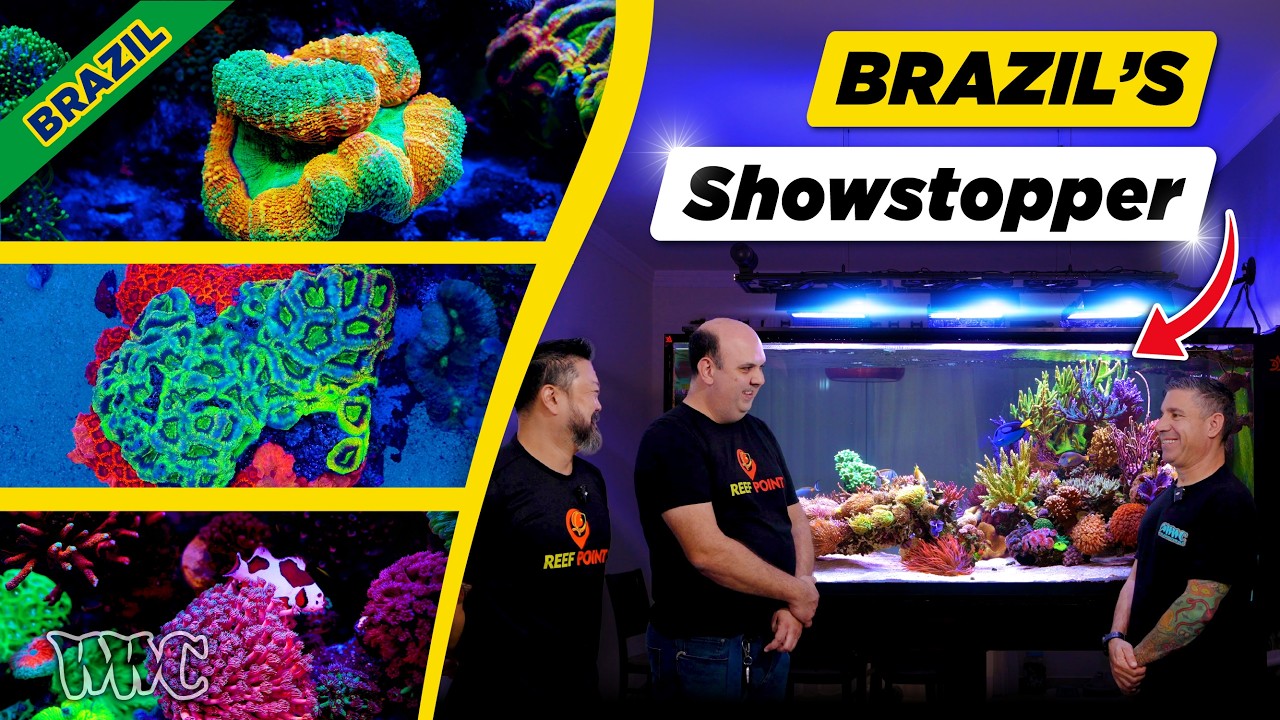
This 400-Gallon Reef Is One of Brazil’s Most Impressive | SPS, LPS & Aquascaping — World Wide Corals This 400-Gallon Reef Is One of Brazil’s Most Impressive | SPS, LPS & Aquascaping
Tour of an impressive 400-gallon Brazilian reef featuring SPS, LPS, and custom aquascaping. Shows mature system design, husbandry choices, and equipment setup worth learning from.
24 min · World Wide Corals · Oct 8 · youtube.com
 

Every item above links to its source. This week's reporting comes from Applied and Environmental Microbiology, BMC Microbiology, Communications Biology, Frontiers in Marine Science, Frontiers in Marine Science — Journal, Geophysical Research Letters, Great Southern Reef Foundation — Bluesky, Journal of Animal Ecology, Landscape Ecology, Limnology and Oceanography Letters, Marine Pollution Bulletin, Microorganisms, PeerJ, Project Seahorse — Bluesky, Reefs.com, Remote Sensing in Ecology and Conservation, Royal Society Open Science, SaltwaterAquarium.com, Scripps Institution of Oceanography — Bluesky, Tidal Gardens, Wellcome Open Research, World Wide Corals, YouTube.com. Headlines and links belong to them; go read the originals.

Back issues · About & sourcing policy · [email protected]

Weekly Dive is an automated digest from The Lone Aquarist that links to reporting it does not own. Edited by Isaac.

You just read issue #10 of The Weekly Dive. You can also browse the full archives of this newsletter.

← Newer Weekly Dive — Rapid coral bleaching recovery via symbiont transfer from healthy cor… Older → Weekly Dive — Climate-mediated population declines in the common Floridian coral, P…
Powered by Buttondown, the easiest way to start and grow your newsletter.