The hazards of enriched/fortified flour
The health problems caused by consumption of refined white flour can't be fixed with fortifications. Fortified flour is best avoided.
Hi Friends,
Last Saturday I went to a talk by a doctor who sees a lot of his patients’ problems go away on a ketogenic diet. This is an extreme form of the low carb diet, which results in the liver having to make ‘ketones’ from fat. People who adopt a ketogenic diet force their bodies to use fat-derived ketones instead of glucose to fuel their metabolic processes.
He’s not wrong. But I wonder how much of the benefits of low carb diets come from eliminating ‘enriched’ wheat flour from the diet.
The bread that was available in the early 1900s is totally different than the bread sold in modern supermarkets. Even if you’re not allergic to the higher levels of gluten in modern wheat, there are other serious problems with all the products sold with ‘enriched’ flour.
Americans who travel to Italy or Japan (where wheat flour is not fortified) commonly report that they ate basically the same types and quantities of food as they eat in the U.S., yet effortlessly lost weight. These travelers also report that their excess weight came back as soon as they returned to the United States.
I’m now convinced that the main problem with flour in the U.S. are two specific industrial vitamins used as “fortifications”.
Four years ago I sent an email out about whole wheat bread. This covered the history of the technology to make perfectly white flour, the appearance of deficiency diseases, and fortification as a response to the recognition of malnourishment resulting from the consumption of excessive amounts of white flour. This email quoted an excellent book which shared the origin of the roller mill in the late 1800’s.
Concern about iron fortification (mentioned in the previous email) was my main motivation for prioritizing the avoidance of ‘enriched flour’, starting maybe 15 years ago. But iron is not the only hazard caused by flour fortification.
The addition of Vitamin B-1 and Vitamin B-2 to flour is certainly basically innocuous, and highly beneficial to those who would otherwise develop beriberi (damage to the nervous system and the cardiovascular system caused by Vitamin B-1 deficiency) or ariboflavinosis (mouth and skin sores caused by Vitamin B-2 deficiency). No one with an already-adequate intake of Vitamins B-1 or B-2 is harmed by the small fortifications from the consumption of fortified flour.
Many people have found their chronic health problems are helped by Vitamin B-1 (thiamine) supplementation. Benfotiamine is a synthetic version of B-1 that may be more helpful than a natural B-1 supplement. This synthetic vitamin B-1 is fat soluble, and lasts longer in the body than natural water-soluble B-1 supplements (which is rapidly excreted in the urine).
My latest proposal: The simplest thing most people can do to improve their health is to avoid all sources of fortified flour.
The problem of the synthetic pro-vitamin folic acid — which was mandated to be added to enriched flour in 1998 — is commonly accepted by Science. The flour industry adds folic acid to bread and masa because a simple majority (more than half) of humans can convert this substance into a usable form of Vitamin B-9 (folate).
People who are poor methylators (#MTHFR) have trouble turning folic acid into Vitamin B-9. Poor methylators are on a spectrum from slightly-poor to very-poor, and make up 40-45% of all of humanity. For these people, unusable folic acid tends to get backed up in their bodies.
Folic acid is not the worst supplement. The addition of folic acid to the fortification of masa and enriched white flour (made from corn) might prevent a small number of cases of spina bifida every year (this is neural tube defects in newborns caused by folate deficiency in the earliest stages of pregnancy). By the time a woman realizes she’s pregnant it’s too late to take preventative measures.
Folate deficiency commonly results in “depression”, and is a known cause behind chronic alcoholism. The usual blood test for “folate” can’t tell the difference between folic acid and usable methylated folate.
My latest finding is about another problem from over-supplementation with certain B-vitamins. This was figured out and articulated by an anonymous person on the internet who connected specific adverse symptoms to his occasional consumption of fortified flour. I need to think about this a little bit more before I try to provide my own interpretation of his explanation.
But the practical implication to enhance your health are the same, regardless of the reasoning: avoid ‘enriched’ white flour.
Whole wheat flour is not enriched. There are a few flour brands that sell refined flour that is not enriched. Be very careful with Bob’s Red Mill flours: some are enriched, some are not. European cookies (at Trader Joe’s, World Market, and other U.S. retailers) are also usually not enriched.
Non-fortified flour brands include Farm2Flour, Jovial Foods (Einkorn), Sunrise Flour Mill, and War Eagle Mill.
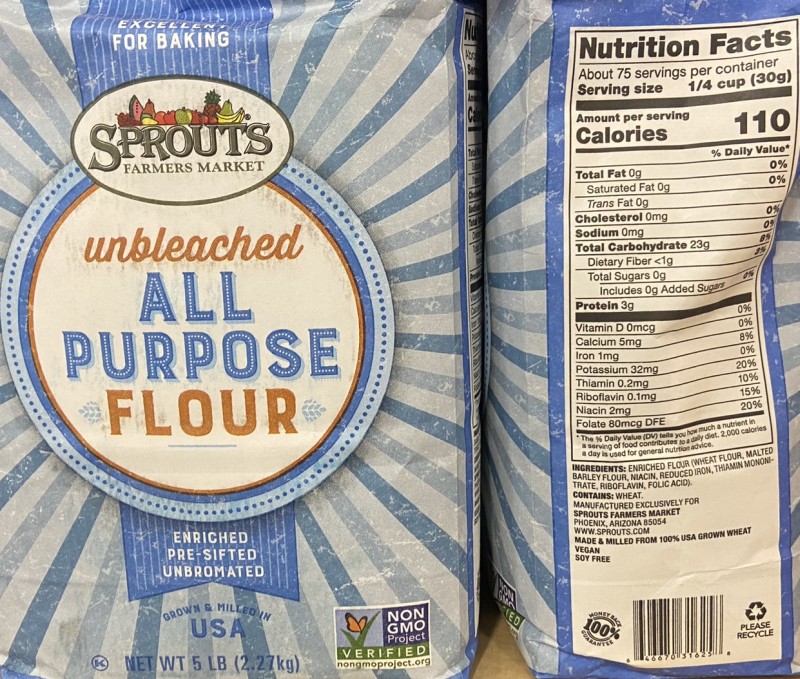
You can’t rely on stores that market themselves to health-conscious people for avoiding fortified flour. I’ve noticed that the lemon bars sold by “Whole Foods” use a crust made with enriched flour. This flour, sold at my local Sprouts “farmers” market, is fortified:
Many people take B-Complex supplements. These commonly have 100+ times the Recommended Daily Allowance of most of the B vitamins. While most of the excess B vitamins are lost in the urine, I think the synthetic b-complex supplements should generally be avoided.
People who think their low energy levels are caused by not getting enough of the b-vitamins in their diet might consider taking a whole-food-based B vitamin supplement.
Vegans and vegetarians do need a source of Vitamin B-12: supplementation of this specific vitamin is often helpful for these groups.
Again: Vitamin B-1, B-2 and B-12 are probably okay to consume. But "B-complex” is a landmine. You might notice benefit over the short term, but the benefits might not persist over a longer term.
Fortified flour is a stealth supplement given to most of the U.S. and Canadian population for their whole lives. While some of the classic diseases caused by white flour and corn consumption have been alleviated, the health consequences of refined wheat flour consumption just take on other forms.
Cayce’s recommendation of whole wheat bread used slow-rise yeast to help unlock the nutrients in the wheat kernel. Native Americans knew to unlock the nutrients in corn by boiling the kernels in an alkaline solution, to create masa (this processed corn is the type of corn used to make corn tortillas and tamales).
Just fortifying white flour is a health hack that does almost nothing to fix the problems of the mass consumption of refined white flour.
For your upcoming holiday gatherings, protect yourself from white flour by eating around the crusts on your pumpkin pie.
-James Knochel
P.S. I have a few barrels in stock, and a few more of my grounding coins and grounding pendants. I’m going to link to this email in an upcoming change.org petition to the Arizona Attorney General (about a friend who is certainly harmed by fortified flour), which should get a lot more exposure than the small number of people that this email is being sent out to.
Thanks for all of your support over the years!