#23: Iterations of the self - May in review
I read something a while ago that described the self as an emergent property, born of all the individual traits and quirks and likes and dislikes and conscious decisions you make on an hourly basis. The point of the post was that you can, at any time, reinvent yourself simply by swapping out some or all of your component parts. You are not beholden to who you’ve always been; there is nothing stopping you from building yourself a chrysalis and emerging anew.
The thesis of the post is nothing new. This is, after all, the same principle that underpins New Year’s resolutions and setting healthier habits and faking it until you make it.
But the poetic framing of the post got me thinking about what else the self might be. Here’s a nonexhaustive list:
- a sort of metaphysical ship of Theseus, in the vein of the author’s original conceptualization
- a graveyard of vestiges of everyone you’ve ever physically or figuratively brushed up against and consequently been physically or figuratively eroded by
- a matryoshka doll with infinite layers to peel away as they become unable to contain the enormity of what’s inside you
- a fossil record in medias res
- a garden eternally in bloom, which must be routinely weeded and watered and fertilized, and from which clippings and fruits can be harvested to share with others
- a garden eternally in bloom, which must be routinely weeded and watered and fertilized, grown entirely from the clippings and fruits you’ve been gifted from others
- that one phrase you’ve never spoken aloud because it’s the phrase you’ll use if you ever have to prove you’re stuck in a time loop; the one phrase no one but you could ever know


My obsession with physical correspondence and all its pursuant paraphernalia continues to lead me to new and delightful experiences. In recent weeks, I’ve fallen in love with Postcrossing, an international project dedicated to connecting strangers via the exchange of postcards. I’ve been accumulating postcards for years, as both cheap souvenirs and interesting pieces of art; Postcrossing has given me the perfect opportunity to use them up, while keeping my fountain pens from drying out in between the monthly letters I write to my friends. I sent my first postcard to Nelly in Germany, and a few weeks later, I received a postcard of my own from Geo in Moldova.
Sending so much mail has forced me to get really familiar with USPS postage rates, as well as the myriad stamp denominations that the USPS offers. Postcards are cheaper to mail domestically than envelopes, costing just $0.61 rather than the $0.78 for a 1-oz envelope, though both types of mail cost $1.70 to mail internationally. The USPS offers commemorative stamps in all 3 denominations, and plenty others besides—they’ve even got a variety of ultra-low-denomination stamps, in case you’ve ever wanted to pay for your postage exclusively in the stamp equivalent of pennies.
Earlier this year, the USPS announced it would be issuing a new triangular global stamp specifically to commemorate Postcrossing, with an issuance ceremony to be held in May during the 2026 World Stamps Expo in Boston.
Obviously I had to go.
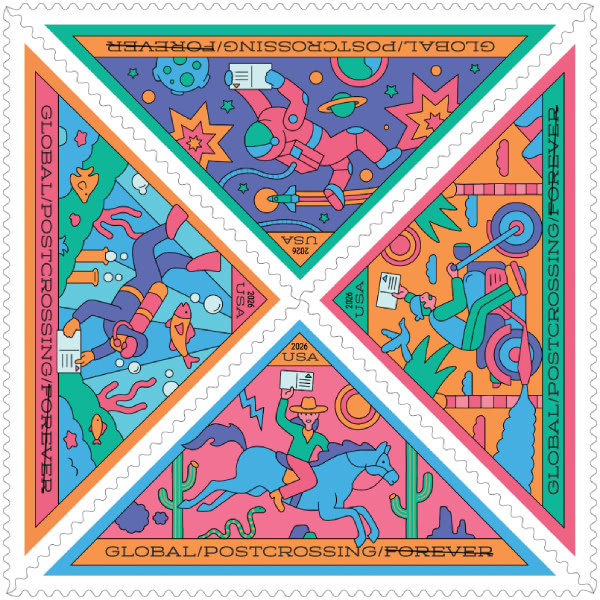
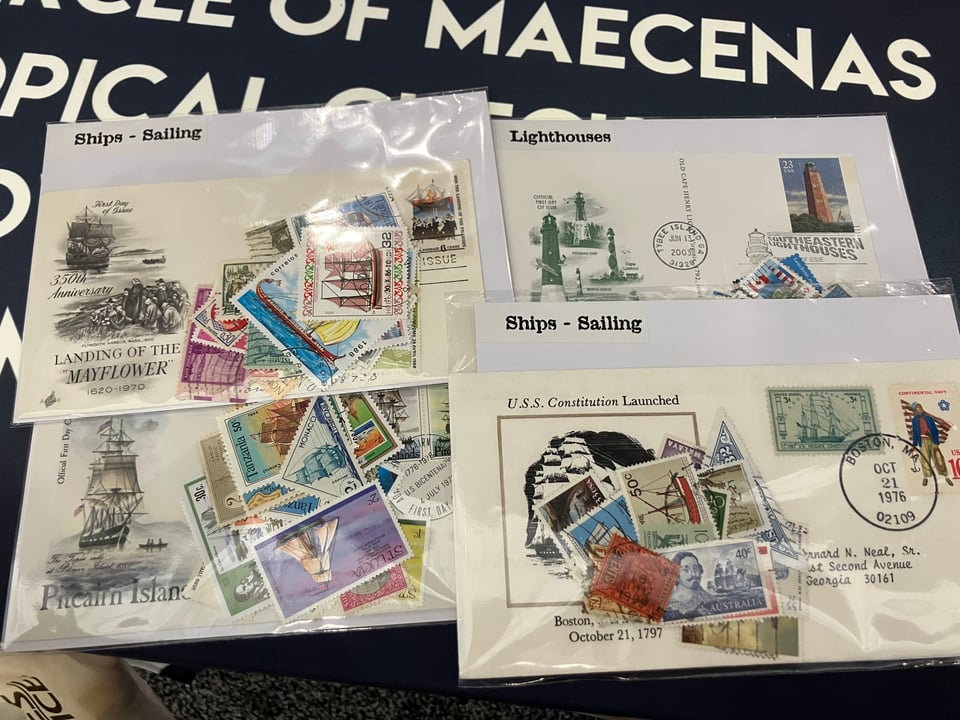
I didn’t expect much out of attending the World Stamps Expo except for a handful of Postcrossing stamps, a souvenir enamel pin, and maybe a neat story. Instead I got a front seat to a low-level disquiet that permeated the entire Expo: philately (the term for the collecting and studying of stamps) is struggling, if not outright failing, to recruit younger hobbyists.
I overheard multiple stamp dealers, heads of various philatelic associations, and even one of the USPS Stamp Art Directors speculating about the possible demise of the hobby. One Philatelic Association president said outright that he expected his association to die when he did, and he’d already marked for charity the association funds that had been sitting stagnant for years while membership steadily dwindled. Underlying these grim predictions was a general sense that philately had missed the boat for changing its outreach strategy, and if no one had figured out how to appeal to younger folk by now, likely no one ever would.
But then I watched younger folks turn out in droves for the Postcrossing stamp ceremony and subsequent Postcrossing meetup, bringing the average Expo attendee age down by at least 20 years. So clearly, it’s not that young people don’t care about stamps. I think we just care about stamps differently. Based on all of 72 hours of in situ observation, older philatelists seem to be more interested in collecting stamps to preserve them, whereas younger would-be philatelists are more interested in collecting stamps to use them. I myself am prime evidence of the latter. With the exception of one specific stamp that I’m seeking for the express purpose of framing behind archival glass,1 I acquire stamps with the intention of affixing them to either outgoing mail or my junk journal.
I don’t really have a neat and tidy conclusion here. Obviously my fledgling musings are not going to be the key to saving a hobby that has existed for centuries. I guess it’s just neat to be part of this long lineage, and to have watched it—and helped it—evolve in real time.
Buy the Postcrossing stamps from USPS

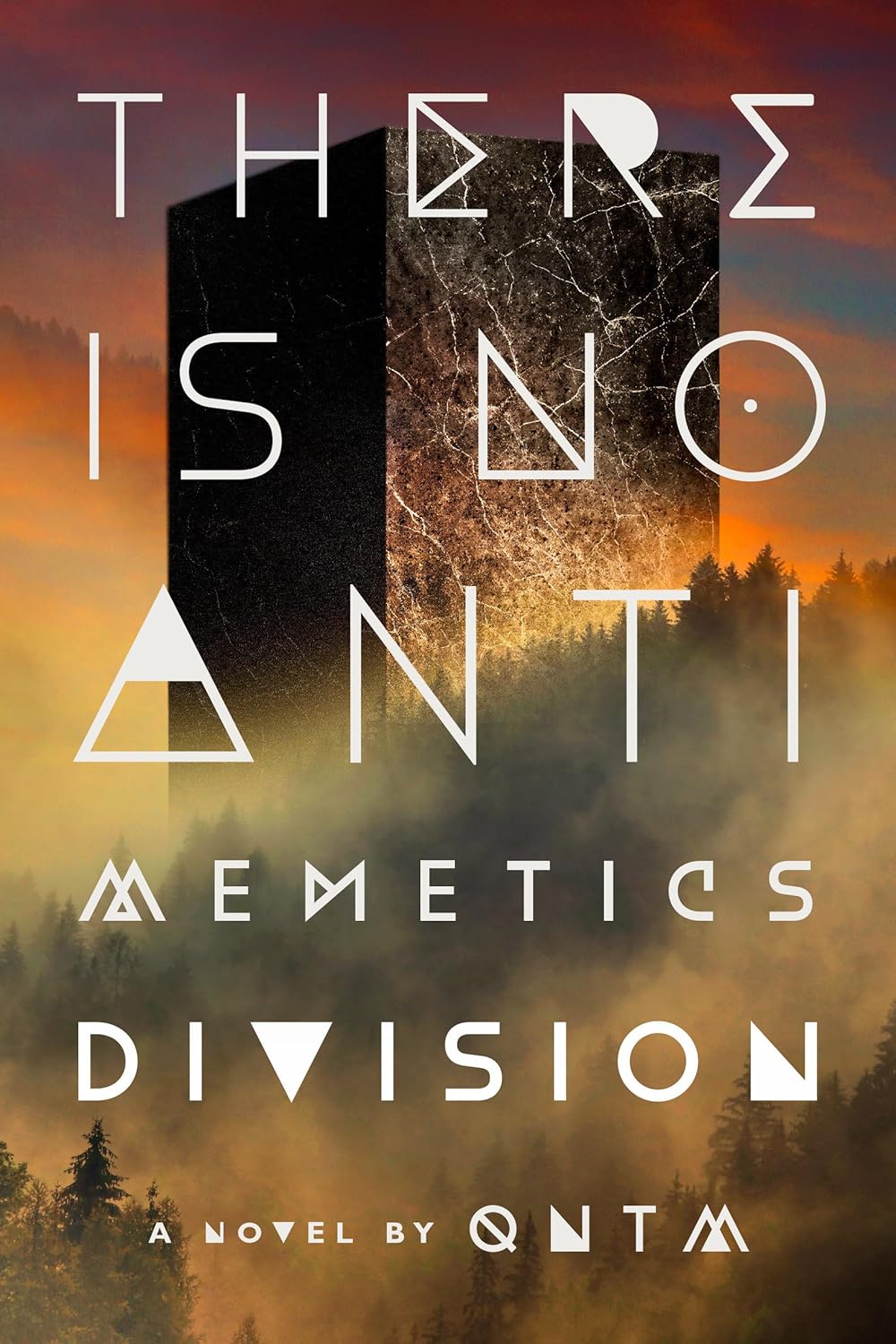
There Is No Antimemetics Division
by Sam Hughes (aka QNTM)
⭐⭐⭐⭐
We take a break from our regularly scheduled historical and fantasy romance programming to bring you a sci-fi recommendation.
Nowadays, when you hear the word “meme,” you probably think of viral jokes on the Internet and pictures layered with Impact font. But before it acquired that definition, a “meme” referred to any unit of cultural information that propagates through imitation. Internet memes are memes, but so is, say, the theory of gravity, which persists and propagates because people keep learning about it and then teaching it to others.
An antimeme, then, is a unit of information that resists being spread at all. TINAD takes this idea to the extreme, presenting antimemes that are capable of very literally eating your memories, or else are so dangerous that interacting with one requires you to destroy your own memory afterward. But the absence of something can still reveal something about its existence; the size of the meteor can be gleaned from the depth of its crater, or the mass of a black hole from the light it consumes.
This provides the premise for TINAD: an antimeme so life-threatening that simply knowing about it is fatal, yet so massive that excising it from your memory leaves a hole large enough to rederive its existence. How do you fight an enemy you can’t see—not “can’t” as in physically unable to, but “can’t” as in forbidden from? How do you formulate a battle strategy when the very act of doing so cements your defeat, because it means you know there’s an enemy to fight?
TINAD joins the ranks of Joe Haldemann’s The Forever War and Ted Chiang’s Story of Your Life as a story that poses a genuinely unique question, then doesn’t stop answering it until it’s blown far past the logical conclusion. Admittedly, it falters in its back half, where the psychological horror gives way to a banal sequence of cosmic horror that I found considerably less interesting to read. And I wasn’t entirely satisfied with the ending, which felt a little like it came out of nowhere. Still, I think these flaws are worth tolerating in order to experience the first half of the book, which compels, disquiets, and thrills in equal measure.

Gold
If you’ve known me for a while, I’ve likely gushed to you about The Amazing Devil, the folk rock band co-helmed by Joey Batey of Netflix Witcher fame. The Amazing Devil released their last album in 2021 to rapturous acclaim, then dropped off the face of the planet so Batey could focus on his filming obligations and on writing and promoting his book, and so that Madeleine Hyland, the other half of The Amazing Devil, could focus on raising a newborn.
They’re back, though! They did a live set at Hay-on-Wye at the end of May, where, in between their greatest hits, they quietly debuted a new song called “Gold.” Sung from the perspective of a new parent to their infant child, Gold is hitting me in all the tenderest parts of my heart.
Currently, Gold only exists in fan-recorded videos, but the fact that it exists at all has me cautiously excited that a new album is in the works. Maybe we’ll see that before another 5 years has passed.

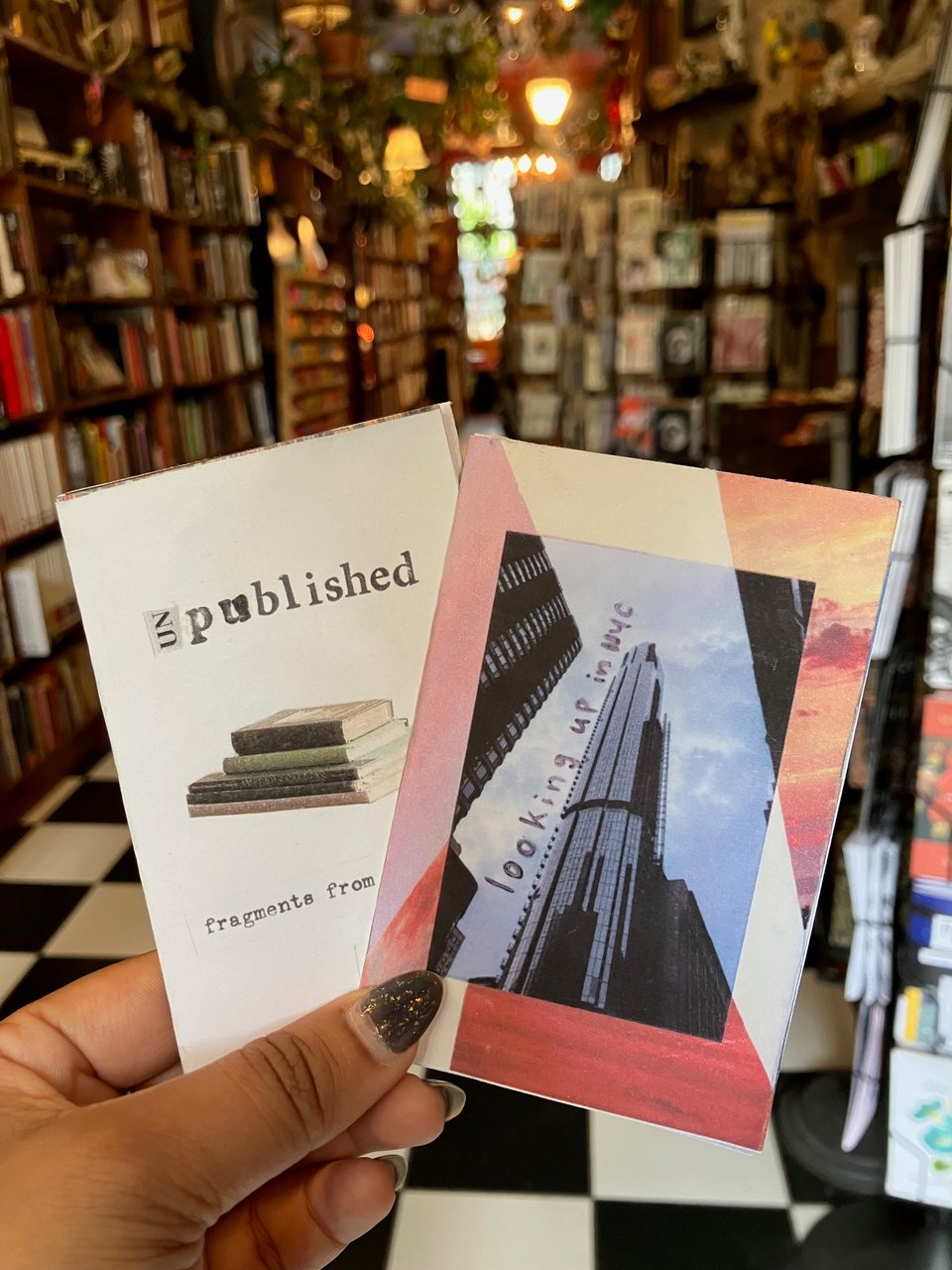
A brief zine update: zine 4 has hit the shelves! Find it now at a store near you!
…Provided you live in Brooklyn, anyway. My 2 latest zines can be found at Quimby’s on Metropolitan, while supplies last.
I haven’t gotten around to making zine 4 downloadable yet, but as always, let me know if you’d like a copy of it (or any of my zines) and I’ll pop one in the mail for you.

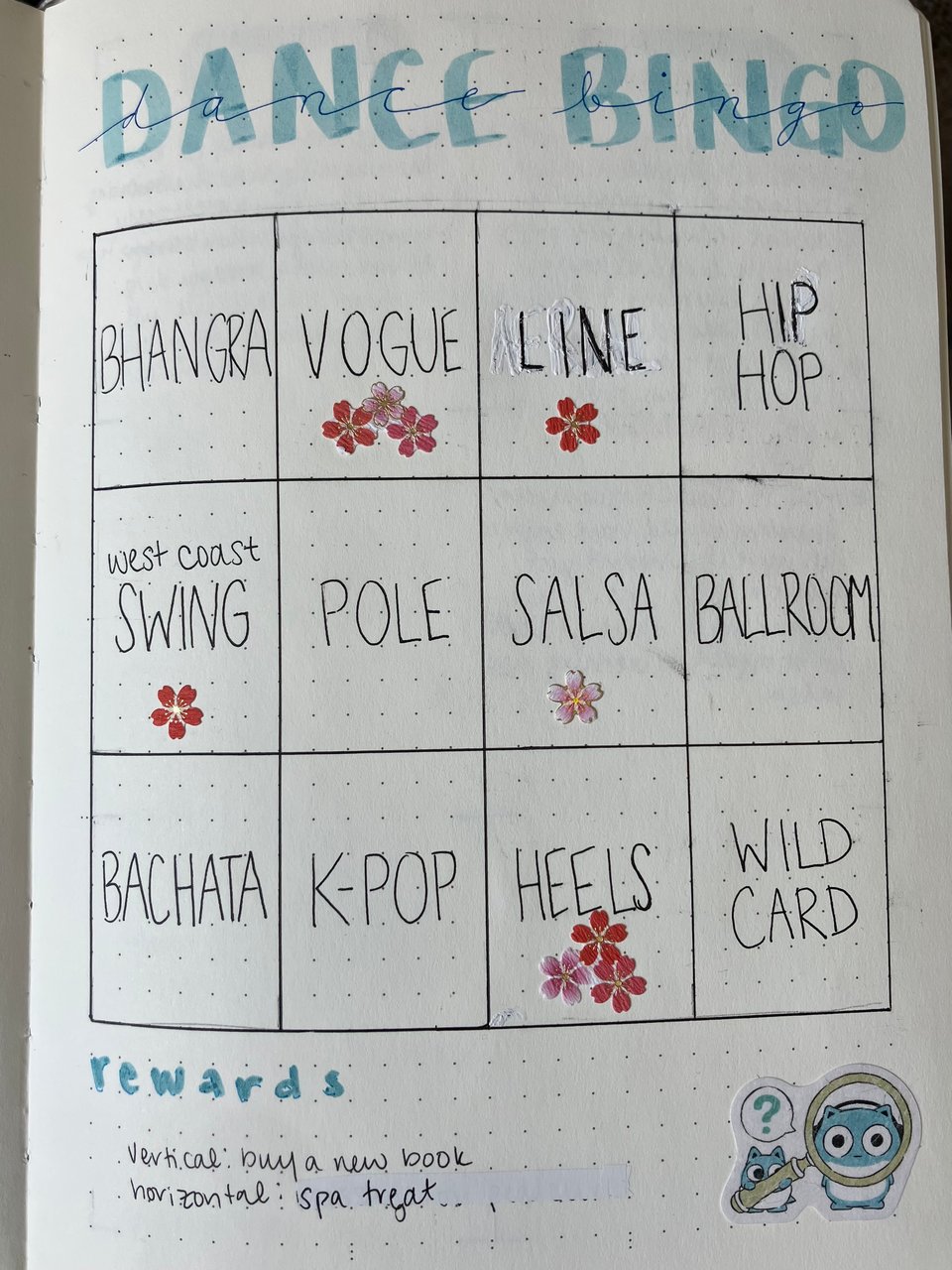
I’ve achieved my first Dance Bingo! I dipped my toes into partner dancing this month, with classes in West Coast Swing and salsa.
I’ll be honest, I walked into that first WCS class cocky. I was vaguely aware of the lead/follow dynamic, and I knew my femme presentation meant I’d be categorized as a follower. I didn’t truly understand what it meant to be a follower, though. At worst, I assumed, I’d have to reverse my steps in order to mirror my lead, but surely partner dance utilized all the same fundamental technical skills as solo dancing?
Needless to say, I was quickly humbled. Partner dancing is an entirely different beast from any of the dance styles I’m familiar with. As a solo dancer, and even as part of Indian social/partner dances like dandiya and garba, I’m used to being completely in control of my movements—used to carrying power and weight in every inch of my body in order to move smoothly through a sequence.
Being a follow requires you to abandon that mentality. You have to resist the urge to proactively direct your own body. Instead, that direction is provided entirely by your lead, and your focus shifts to reacting: making sure you end up where your lead expects you to be.
It took me an embarrassingly long time to relinquish my instinct to lead. At one point, I almost gave up and asked to be taught as a lead instead, just so I wouldn’t have to deal with this fundamental shift in my thinking. But I knew I’d regret backing down from this challenge, so I kept at it until it finally clicked. And I’m glad I did. There’s a different kind of exhilaration that comes from reading your partner correctly and shoring up the trust between you as a result. And I can’t deny, it’s beyond fun to be twirled around.
-
A Liberian stamp issued in 2005 featuring the painting “The Fighting Temeraire” by Joseph Turner, issued for the 200th anniversary of the Battle of Trafalgar, which I want solely because it depicts the namesake of Naomi Novik’s Temeraire book series. Alas, I did not find it at this expo; I’m planning to attend the next expo in Prague in 2028 to continue my search. ↩