#22: Birds, cats, and killing your darlings - April in review
(Resending this newsletter because I forgot to add a title to the initial email, like a complete fool.)
I’ve spent much of this month besieged by impostor syndrome, doubting my ability to write on a fundamental level. Never mind that I’ve been writing for nigh on 15 years; never mind that I’ve literally made a career (and several side hustles) on the back of my ability to communicate. From a tricky grant application to a brand messaging exercise at work to this very newsletter, every project I’ve worked on this month has confronted me with a blinking cursor and the fear that I’ll finally be exposed as a talentless hack whose reputation as a competent writer is a paper-thin veneer masking a mountain of lies.
Objectively, I can recognize that this is a nonsensical fear. Of course I can write; even beyond any inherent talent I might have, I’ve spent years honing my technical skills in order to be able to rely on them when my creative intuition deserts me. And I’ve received enough external validation and positive feedback to know I’m generally capable in this realm. So it’s strange to be suddenly fielding so many doubts, and so viscerally, too. It’s gotten me thinking about this chart I saw a few years ago:
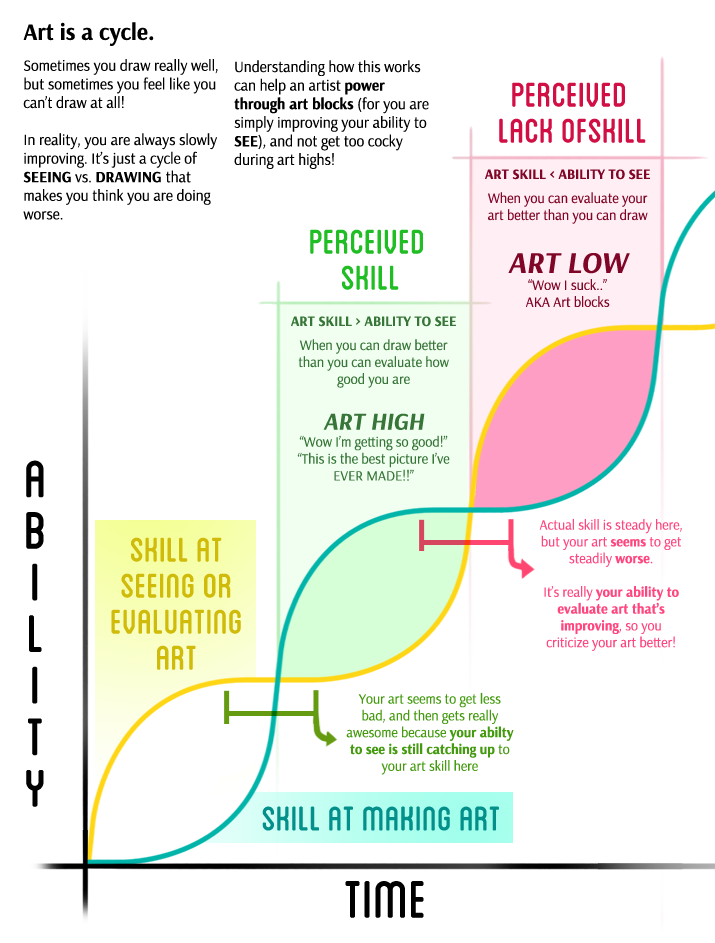
I’m trying to convince myself that my impostor syndrome is just an indicator that I’m in an art low, where my ability to see the flaws in my work outstrips my ability to address them. It would be nice to believe that I can expect to see a rush of improvement if I simply keep at it.
On the other hand, maybe I’m just telling myself an optimistic story to feel better. Maybe my impostor syndrome is actually a manifestation of a much deeper insecurity: a fear that I’ll disappoint the people relying on me. Or maybe I’m simply burned out on writing and ought to take a break. Who’s to say?
I don’t have any sage advice to offer here, or a tidy conclusion with a poignant quip that’ll prove I can write after all. I mostly offer these musings because they’re a genuine encapsulation of my experience of April, with the small hope that if you have ever felt impostor syndrome yourself, you might take comfort in knowing you are not alone.

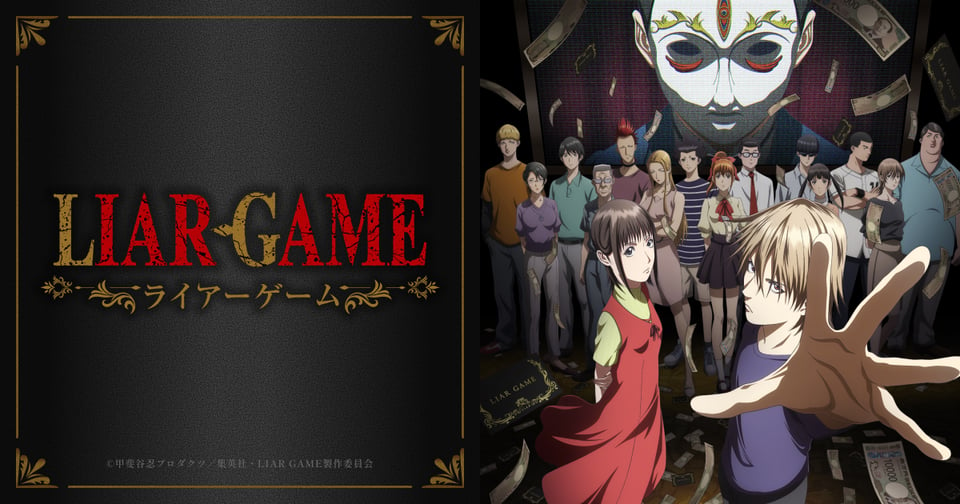
As soon as I discovered the internet, I became a regular on 2 online forums: a forum for riddles and brain teasers called BrainDen, and an offshoot called MafiaManiac where BrainDen regulars could play online mafia games.1 It’s not much of an overstatement to say these forums were the earliest crucibles in which I was forged. In addition to instilling a love for word puzzles within me, BrainDen gave me access to a tight-knit, deeply loving community where I was safe to be myself in all my weird, stumbling, tazer-obsessed teenage glory. I received life advice, love advice, an autograph from XKCD’s Randall Munroe, multiple years-long friendships (one of which has indirectly led to some of my closest friendships today), and a recommendation for a manga called Liar Game.
Liar Game is a psychological thriller that follows Nao, a naive and scrupulously honest college student, and Akiyama, a criminal psych grad who’s just finished a stint in prison for conning an MLM into bankruptcy, as they work their way through the titular Liar Game Tournament: a series of nominally simplistic games that hinge on deceiving your fellow players to win billions of yen. Akiyama plays the role of mastermind, using psychology and game theory to concoct winning strategies for each game, but it’s Nao’s guileless sincerity that actually allows Akiyama’s plans to succeed.
Liar Game was tailor-made to appeal to me. Akiyama is everything I love in a character—smart, ruthless, cocky, grudgingly kind underneath the facade. And the slow realization that the Liar Game might actually not be about lying is genuinely thrilling. It’s rewarding to watch Nao’s honesty interface with, and stymie, the mechanics of the Game, and to see her grow without being forced to abandon her core principles.
So you can imagine how excited I was to hear that Liar Game was finally being adapted into an anime, more than a decade after the completion of the manga. That it was being produced by Madhouse, the same studio that did Death Note and Perfect Blue, was just icing on the cake.
Alas, reality once more forsakes the dreamer. The anime is…bad. It’s a fairly faithful beat-by-beat adaptation of the manga, which ends up being to its detriment. The static nature of the manga translates to stilted animation, and the flaws of the manga’s early pacing are made painfully apparent by the anime’s decision to adapt strictly 2-3 chapters per episode, forcing viewers to absorb long expository monologues without any payoff. I’m starting to suspect this is a story better suited to the medium of print, where the game theory can shine without needing to be dressed up visually, and the players can stand around monologuing without their inactivity feeling so obviously stifling.
I’m hopeful that the anime will improve as we progress to the more exciting games in the Tournament, but at the moment, I can’t in good conscience recommend it to you. Instead, just read the manga, which admittedly has a slow start but hits its stride beautifully in volume 2.
Read on MangaTown (make sure you have an adblocker enabled)

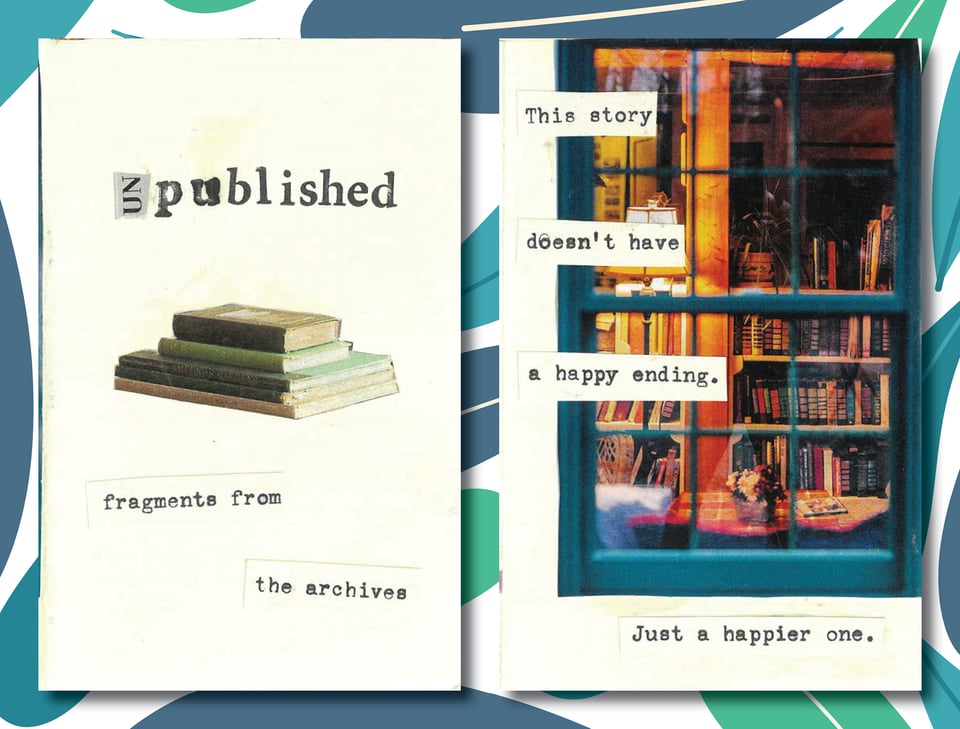
In an immediate about-face from my newsletter intro, my third zine is a love letter to my own writing.
I often liken my writing process to excavation. I sometimes have to write things a dozen times or more in order to figure out what, exactly, I’m trying to say, and how best to say it. This means a lot of what I write ends up on the cutting room floor—oftentimes as much as, if not more than, ends up in the final story.
But some of that byproduct is quite good in its own right, even if it doesn’t make the final cut due to pacing or flow. I’ve got some genuinely good lines languishing in dump docs2 and graveyards of struck out sentences; it’s a shame to think I might be the only person to ever read them.

Unpublished: fragments from the archives is an assemblage of deleted lines from various projects that I find compelling. Each line can be read in isolation, but I think a new piece of abstract microfiction emerges from their juxtaposition as well.
It was interesting to see some common ideas and themes emerge as I curated the excerpts for this zine—interesting and also quite humbling. I don’t think I would have known that I’m drawn to explorations of identity and grief before I assembled this zine. Much of my creative writing these days takes the form of fanfiction, and I usually don’t think of my fics as having themes at all. But of course they do. I wouldn’t be writing if I didn’t have something to say.
Download zine 3 (or email me if you’d like me to mail you a copy)

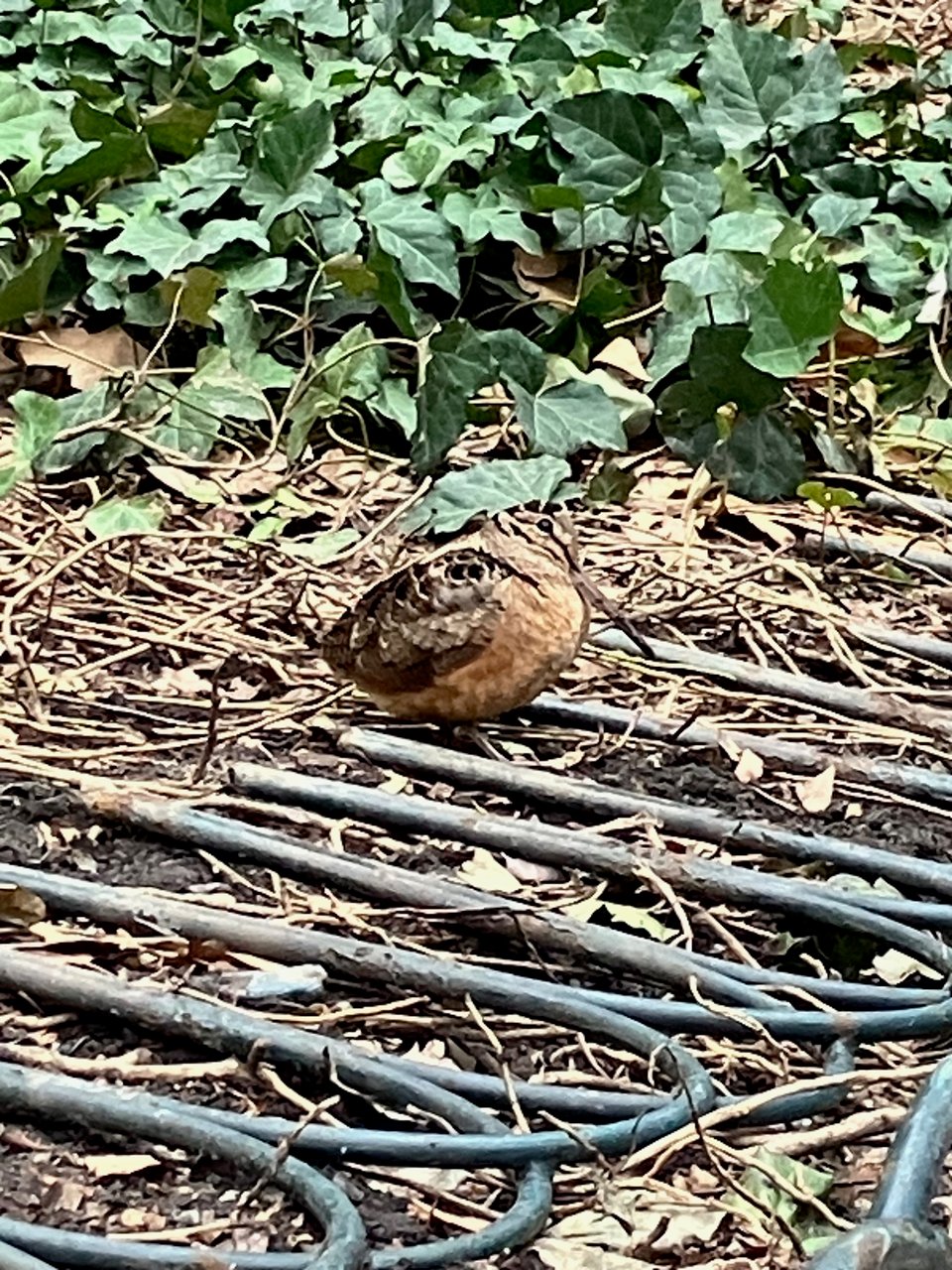
There were a few days where it seemed the whole country was abuzz with excitement over a single American woodcock that had been spotted in Bryant Park in New York City. I wasn’t sure what all the fuss was about, not being a birder myself, and had no intention to participate in it myself. But then my friend messaged me to say it would be a crying shame if I didn’t make the trivial 15-minute walk to meet the nation’s most beloved avian. So I pulled on a jacket, checked Reddit for the latest report on the bird’s location, and headed out.
It’s not the first time I’ve chased down a time-limited phenomenon at the bequest of an out-of-town friend. Last fall, I was goaded into trekking out to the Bronx to catch a whiff of the New York Botanical Garden’s corpse flower during one of its rare blooming periods. (The stink had faded considerably by the time I got there, which may have been for the best.) I’m quite grateful to have friends who will browbeat me into seeking out occurrences like this, as I’m not generally inclined to do so of my own volition. In a city where there are always a million things happening, it’s hard to know what’s worth the hype and what will just end up being a disappointment.
The woodcock was absolutely adorable. When I arrived, it was asleep in the mulch, but it soon woke up and started puttering about, completely unperturbed by the crowd of 30 or so people watching its antics. Every so often, someone walking by would pause and ask if there was a celebrity or something, and a member of the crowd would reply in reverent tones, “Kind of. It’s an American woodcock.” I myself stood there for decidedly longer than I’d expected to, caught up in the quiet excitement of the crowd and the tranquility of being part of something big—all because of one tiny little dancing fella.


You’re probably familiar with hidden object games, where you’re given a checklist of various things to find within a large, complex, sometimes interactive image. There’s a lesser known variant of this genre that I call “hidden cats” games, which follow the same premise, except every hidden object is a cat.
Not to brag, but I’m something of a hidden cats connoisseur. I’ve played every hidden cats franchise that exists on Steam, and what I’ve discovered is that not all hidden cats games are created equal. Despite the simplicity of the premise, making a good hidden cats game is not a simple endeavor.
First, the cats need to be integrated into the level. In other words, the cats shouldn’t just exist on a separate image layer on top of a pre-made landscape. It’s more fun to find hidden cats when they’re disguised as roof tiles or tucked into trees.
Second, the game needs to implement good game design, where players are led to develop intuitions that are consistently rewarded with the finding of cats. If a game has secret cats (cats that you reveal through interacting with the level, eg opening a door or upturning a bucket), there should some kind of consistent visual cue to indicate a secret cat is in the vicinity. If the game uses tricky methods to hide cats in plain sight (eg in roof or wall tiling), this method should be employed with regular frequency, both so the player doesn’t feel hoodwinked each time it’s deployed, and so the player continues to feel it worthwhile to check for this method because they know they’ll find a cat eventually.
These seem like simple and incredibly obvious considerations, but you’d be surprised how many hidden cats games stumble in one or both of these regards.3 For instance, “Find Matt’s Cats,” a recent entrant to the genre, completely fails to develop and reward player intuitions, and at one point also fails to hide any cats whatsoever in the level.
On the other hand, Melovity’s “Lots of Cats” duology is probably the best in the genre, with a perfect mix of cute, well-hidden, and secret cats. Devcats’ “Full of Cats” series is also a favorite of mine, as I’ve watched it grow from a simple hidden objects game to a full-on space opera without ever sacrificing good game design. Both series released new installments this month, and I’ve had an absolute blast finding the cats in them.
Buy Melovity’s games on Steam | Buy Devcats’ games on Steam
Both forums have since gone offline, due to the unexpected shutdowns of their hosting platforms. As far as I’m aware, no backup exists of either forum, though some history has been preserved through the extensive MafiaManiac wiki. I’ve got my own player profile on the wiki; let me know if you manage to find me!
(If any BD or MM users stumble upon this newsletter, via search alert or social media or just plain old SEO, give me a shout! I’d love to hear what everyone’s been up to in the intervening years.) ↩
Separate documents for each of my stories where I paste any cut content, so that I can return to previously excised writing if I decide that it has a place in my story after all. My dump docs often end up longer than my actual drafts. I am not a particularly efficient writer. ↩
Ironically, the “Hidden Cats” series by Nukearts Studio, which recently trademarked the words “hidden cats” and has been aggressively forcing other game devs to drop those words from their game titles, is itself quite mid. The cats aren’t integrated into the landscapes as well as cats in other games, and the base premise of the series just isn’t very fun to engage with. ↩