
July update
“Let me explain…there is too much. To sum up…”
Indigo to Wesley as Wesley revives after being mostly dead, while in the middle of storming Humperdink’s castle. The Princess Bride (1987)
It’s the second half of summer - the middle of my summer season is always the annual trip to Sawbill Lake in northern Minnesota, which happened last weekend - and I haven’t put anything out since April. Many things have happened: dances, Battleground, and a good deal of jamming besides. It’s been a lot of fun. Also, its just a lot - hence the above movie quote.
I’m just going to run down a selection of representative stories from the past few months. If you’re interested in hearing more about one thing or another, let me know.
Hanging out in B-flat…
…or, “I ain’t nothin’ but jambuster.”
There are a few tunes basically everyone knows, at least in my experience: Angeline the Baker, Soldier’s Joy, Arkansas Traveller, Mississippi Sawyer, and maybe Old Joe Clark or Seneca Square Dance. I don’t encounter these at jams all that often, I’m assuming because we’ve played them all enough already. Most people know Turkey in the Straw, but a lot of folks, myself included, don’t like to play it on account of it’s original title: Old Zip Coon. It once served as the theme music for a Minstrel show stock character of the same name. I’m not trying to erase the tune, mind, I just don’t much care to play Minstrel show tunes.
But which tunes should one learn for old-time jams in the Midwest? The short answer is: I don’t know. You’d think I would at this point, but the solution to this particular query has proven elusive. It reminds me a little of the tiger hunter who finds he is the one, in fact, being hunted: trying to find the right tunes is a fool’s errand and all you need do is let the tunes find you. Which is to say, if you go to jams and learn the tunes people play, you will know good tunes to play at jams. Keep calm and jam on, if you will.
Sounds good - so why am I doing something else entirely? I think probably because most of the time I spend playing fiddle is practicing on my own. I can easily spend 20 minutes bringing a handful of bars up to speed, and I enjoy mastering tricky left-hand runs. Tunes like Angus Campbell or the Ned Kendall/Constitution hornpipe medley in F I got from Charlie Walden are fun to play, but not the sort of thing you should bring to a jam. Angus Campbell I’m nearly as like to bomb as carry off, anyways.
In any event, after hearing a bunch of b-flat tunes at Lanesboro and then again at Battleground last summer, I decided I needed to learn some of them. I have nearly a dozen at this point, including Whitefish Rapids from Ruby John and Red Lion Hornpipe. There are a lot of really excellent b-flat hornpipes. Despite the less intuitive layout of the scale fingerings, it lends itself well to a variety of fiddle techniques. The open D and A strings being the third and seventh notes of the scale give b-flat melodies a rather different valence to that of more conventional key signatures - different patterns emerge among the tunes that give them a distinctive b-flat sound.
And what is that b-flat sound? I think they’re kind of like A tunes’ nerdy cousins - all the liveliness, but even notey-er. If A tunes were pasta, B-flat tunes would be risotto: just as tasty, but harder to make and not as popular. If D tunes were mountain bikes, B-flat tunes might be snowboards: same geography, similar thrills, divergent technique. If G tunes…well, you get the picture.
Battleground: Me and Phil Hold Down the Fort
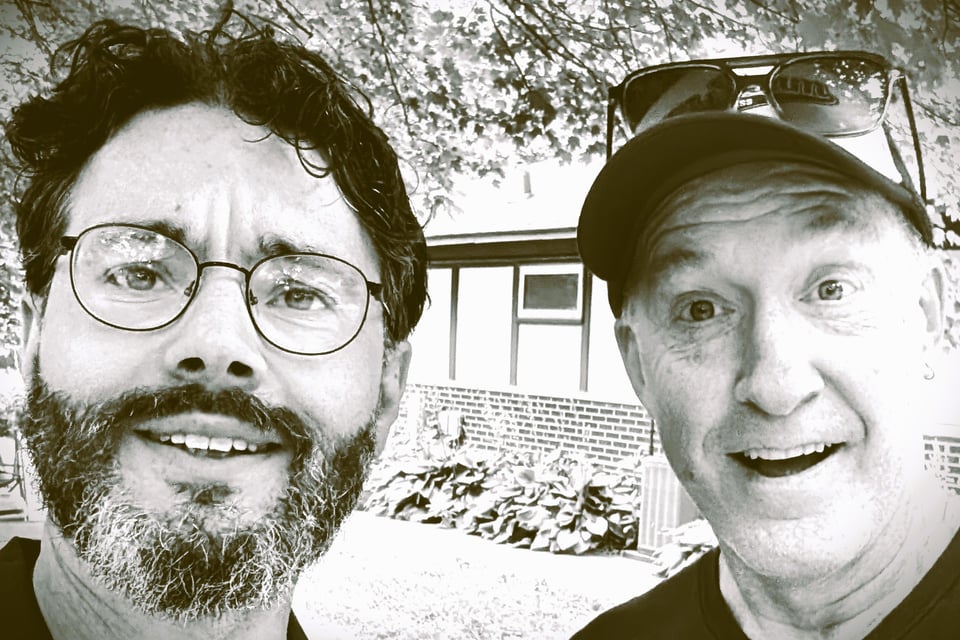
I got a haircut right before leaving for Battleground (the annual Indiana Fiddler’s Gathering, held in Battle Ground, Indiana, not far from where Izzy Stradlin grew up), which was maybe not the best move, as a lot of people didn’t quite recognize me at first (it’s been three years since I last cut my hair). This year was a notably uneven experience for me - there were some things that went well, and some that went less well.
The drive was a little rough: we (my partner and I and our two kiddos) left home a good deal later than I had hoped, and I drove down in a deep funk that lifted only in the last few miles before we arrived. Google Maps took us an unusually labyrinthine route through rainy cornfields, but we made it OK and got ourselves situated without too much trouble. The weather was mostly very pleasant: a little rain, but cool for summer, much nicer than the usual heat. That first night I jammed until 2 in the morning, bouncing between various groups, and catching some of the performances, too. At one point I got shut down when I started to play a tune that had already been played before I joined the circle - I was mortified, but hopefully I won’t make that mistake again.
One of the highlights of the festival was seeing Djangophonique, a jazz manouche combo out of Michigan. I was able to catch their act both Friday and Saturday night - I guess they ordinarily play with a singer and a clarinet, but they had the good sense to hire a violinist, Grant Flick, for the occasion. I checked out his jazz violin workshop on Saturday - which was alright, although not quite as helpful as AJ Srubas’ on bluegrass soloing, which hit the right balance between explaining and giving attendees something they could learn in a half-hour and take home with them. But Flick was more fun to listen to, at least for me - he really brought that fiery Grappelli style. One of their sets they closed with “Joseph Joseph,” an old jazz standard that the manouche guitarists seem to find really fun to play, and they managed carry it off with suitable panache.
I also spent a little time with some of Aaron’s friends from over by St. Louis, who all seem to have the same amiable vibe. We played some good G tunes - I remember calling Stump Tail Dog, a delightful little jam I got from Chirps - and at one point I was wracking my brains trying to recall a Dwight Lamb waltz that I encountered back in May. Some good fiddlers in that crew - and Blake, who plays guitar mostly, is also excellent. But then Laura, Ed, and Phil showed up and I went off with them. I jammed with those three probably more than anyone else that weekend.
Phil, of course, is my friend from Decatur, who helps run the monthly jam there. We frequently participate in a group chat with Jake, the other person running the Decatur jam, and Aaron, who I’ve played old-time with probably more than anyone else. Jake and Aaron had other stuff going on that weekend so they didn’t make it out to the Gathering, although they do normally. Hence, Phil and I were “holding down the fort” (whatever that means). Phil plays guitar mostly, having given up banjo a few years ago immediately following Battleground. Apparently he came home feeling uneasy about playing music, and Aaron, in a marathon phone conversation, helped Phil talk through his feelings and move over to guitar. I’ve only ever known Phil as a guitarist, but certainly it does suit him well. Late Saturday night he indulged me in a B-flat jam, after which we wandered around a little looking for jams to join, but by then the only circles still going were sort of “invitation only,” so to speak. Funny thing, though: the following morning I ran into a recent acquaintance, Barb, who I met at a house concert/jam in Miller Beach, and she said she had been listening to Phil and I jam B-flat tunes as she went to sleep, kind of playing along in her head, and that she’d enjoyed it.
Dance, Dance, Dance
It seems to me if you really want to get good at playing old-time music, you have to play dances. I played my first dance last summer in Urbana with Brenda’s Big Band, and was invited to join them once again last month. I met everyone the afternoon of the dance over where Brenda and her partner Drew are staying - Taylor, the banjo player, commented that they always have great appetizers, which is true, they’re just delightful people in that and other ways - and then we went over to the Channing-Murray community center to play. Its this wonderful old Unitarian church building that was converted at some point to general use for events and get togethers - they’ve got this old wooden floor that’s ideal for dancing, and good acoustics besides.
At one point we played “Molly Put the Kettle On,” a tune I, by all rights, really ought to know, between it being an established “chestnut” and my being married to a Molly, but somehow I never learned it, and it was just giving me a hard time that night, so after the first time through I switched over to playing “second fiddle,” outlining the chords with a simple shuffle rhythm. People must have had fun on that number, because a cheer went up afterwards, but it turned out I had a hot mic (the sound person was still working out the kinks) and had mostly drowned out Brenda’s (much better) fiddling. She was typically kind about it, suggesting the dancers care mostly about rhythm anyways.
Also last year, I played a dance up at Sawbill with my friend Jeff. This year the canoe outfitters (for whom my partner, Molly, Jeff, and his partner, Laura, who also happens to be a dance caller, all worked for 20 or so years ago) there were celebrating their 70th anniversary in business, and there were a whole lot of people around for the dance on that account. Jeff had brought a couple of his regular musical collaborators, Tom (fiddle) and Aaron (banjo), up from Duluth to play the dance, and we of course got jam a while, too. Tom taught me a neat G tune, Chattanooga, which is both obscure and not too hard to play (i.e., the perfect jam tune). Aaron, somewhat like my Aaron, is as fun to talk to as he is to play with - he grew up in South America, and took up old-time in part as a way of connecting with the US after he moved here as an adult. He’s very curious about the music, and we talked at length about how to find new tunes. I told him about delving into Ryan’s Mammoth Collection (aka Cole’s 1000 Fiddle Tunes) and writing out selections in my notebook to learn. The scene up in Duluth is maybe a little more limited than central Illinois, and Jeff, Tom, and Aaron all play bluegrass as well as old-time, hence there’s not the same impetus to expanded the tune repertory. They still have a decent list of tunes they can play, including plenty I don’t know, but I guess adding to it isn’t easy. Tom told me at one point he planned to learn several of the tunes he heard me play during our jams.
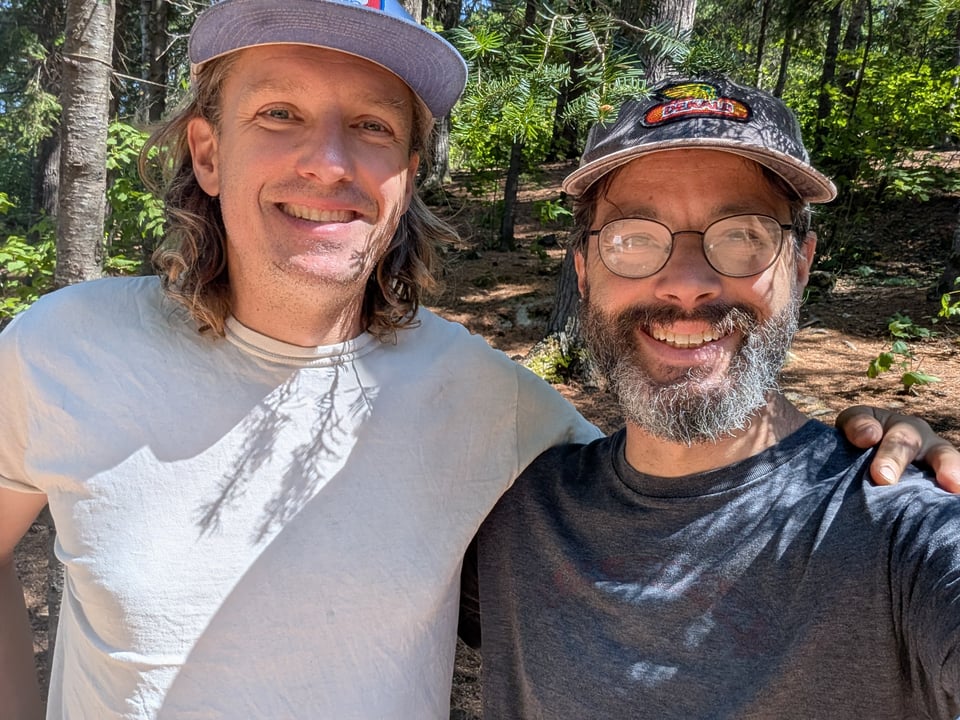
The dance itself was a joy - Tom lead off most of the time, but we shared the duty of driving the band pretty evenly. The mosquitos were on us that night - we were in a huge shed (normally used for storing canoes) and the doors were wide open. I recall at one point feeling distinctly a mosquito skewering my neck like a tiny, bug-eyed rapier and just thinking “don’t stop! don’t drop the rhythm!” Other times I was the one swatting them off my face. We went for about three hours, with plenty of breaks between dances, but exhausting our catalog of mutually known tunes by the end. It was a real all ages event - we did a few kid specific dances early on - with Laura’s dad Terence - who is, let us say, of a certain age - calling for the first half. He’s been calling dances professionally for decades and has an uncommon enthusiasm for it. After Laura took over the calling, he sat in on guitar, trading off with Jeff, who would switch off on bass with our friend Adam. A real team effort. There was pizza from a wood-fired backyard stone oven afterwards.
It’s a funny thing, jamming with Jeff. Two years ago I came up north with a mandolin and a burgeoning interest in fiddle tunes. Last year I showed up with a fiddle and enough tunes to carry us through a dance on my own. Now I’ve got half a dozen dances under my belt and a grip of semi-obscure Missouri bangers besides. Kind of a wild progression. But he’s great fun to play with - doesn’t so much play distinct bass lines like the Missouri players do, but keeps a propulsive strumming rhythm, and comes up with good chord progressions that bring a little bit of a dramatic sensibility to a tune. Hearing someone play the same thing but differently is really one of the neat parts of old-time.
I’m hoping to put on a couple of dances this fall in Ottawa, but the details aren’t yet clear. There’s research to do before any kind of plan emerges. Although thinking about it has opened up the possibility to me of playing more often in (or near) Ottawa, which would be nice.
Busted Fiddle
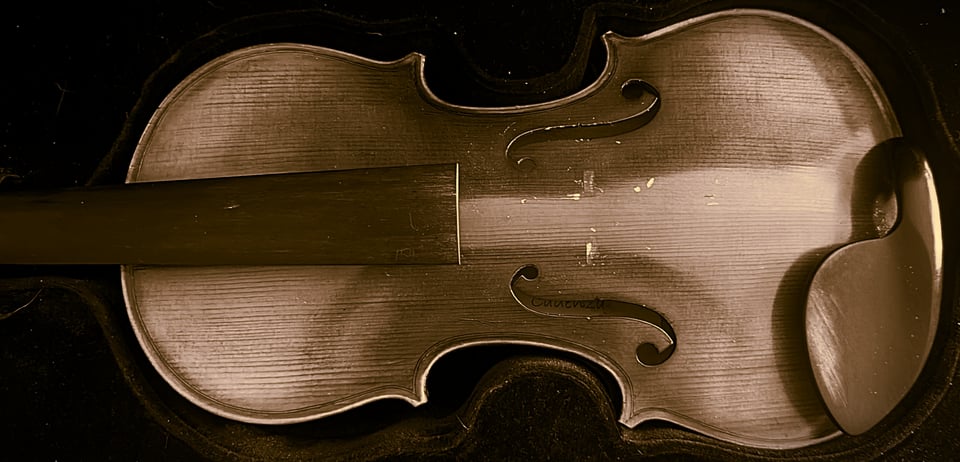
I’m leaving out a lot here: there was the Fiddle Weekend at Urbana’s Center for the Arts, a house concert with Christian Bugge and Bruce Reid in Miller Beach, I played the Star Spangled Banner alongside my 4 year-old (on cello) for a minor league baseball game, and my buddy Nick and I jammed under a park shelter by the Fox River one rainy afternoon. And more. But the only thing I really think I must write about here is what happened right at the end of Battleground: my fiddle broke.
The winding on my A string started coming apart on Saturday afternoon, so I bought a couple of spares off an old guitarist. The following day, I noticed my bridge seemed to be leaning over, so I attempted to nudge it back into place, but it collapsed instead. Fortunately there was a luthier on-hand at there at the Gathering, so I took it over to him. The sound post had also fallen over, but he managed to put that and the bridge back up in ten or fifteen minutes. He handed me the fiddle, I put it in the case, turned back to him with payment, and hear a dramatic “sproing!” When I looked down at my case, I saw that the tailpiece had broken at the point where the strings feed into the fine tuners.
The luthier told me he’d never seen that happen - and I kind of had to remind myself not to take it as a sign to give up fiddle - but I managed to get it over to Austin’s Violin Shop for repairs before the week was out. They were the third of three recommended luthiers I contacted - it turns out summer is the busy season for string instrument repairs - but they very graciously offered me a loaner while my own is in the shop. When I go to pick my fiddle up I will be sure to have a discussion of how to avoid this sort of thing in the future - I purchased the instrument new a year ago, and seems strange it would break so soon.
From here to September
Its always been a little bothersome to me that months don’t really line up evenly with the seasons - September weather feels summerish to me, but the first weekend is Labor Day, the unofficial end of summer - by then I’m fully into the business of the Fall semester. In any event, I have a few things yet in store between now and then.
One is the Illinois State Fair Fiddle Contest on August 15th in Springfield, for which I’ll need to play a hoedown and a waltz. I am genuinely torn over what I should play for the hoedown - on the one hand, a B-flat hornpipe - something real note-y like Highland or Blue Water, perhaps - seems like the obvious choice, but then again I could go with something a little more traditional, like Cincinnati Hornpipe, which is in D, but has that “tear it up and get down” kind of energy, or maybe Jinrishika, with all kinds of jaunty rhythm in the B section. In any event, I’ve pretty much decided to go with a Dwight Lamb waltz that I learned back in May - I bought a whole book of his tunes that night, and have been really enjoying them. I’m finally learning the polkas I never knew I needed.
And then, after Labor Day, there will be the Fiddle Frolic, the annual workshop weekend that started me down this old-time path in the first place. There will be numerous people I’m looking forward to seeing and jamming with there, and I suppose it might occasion a more formal reflection on what I’ve learned thus far as a fiddle player. Although at this point I’m willing to settle for any kind of regular writing routine, reflective or otherwise - so long as its something worth reading.
Add a comment: