
In the Firelands
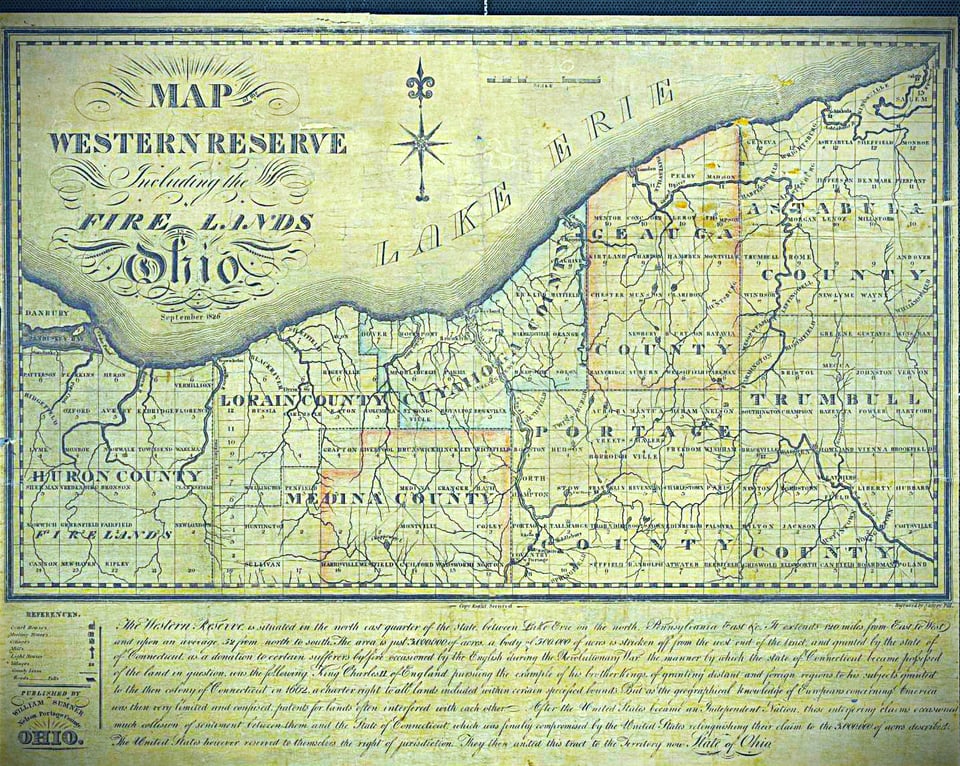
This week I’m on a family vacation in Northern Ohio, not far from where I grew up. There’s a framed copy of the above map on the wall of the rental property - the term “Western Reserve” is familiar to me, but I’m not sure I’d heard it called the “Firelands” before. Being so close to Lake Erie, its kind of on the damp side here, ecologically speaking, and I got to wondering why anyone would call it the Firelands. Something like New York’s “Burned Over District,” perhaps? Turns out its a reference to the many Connecticut homes lost to fires during the Revolutionary War. Folks were offered the prospect of settling the territory as restitution for damages incurred during wartime, although eventually the state sold off its claim to a group of investors and used the money to fund public education.
Among other things, I’ve heard a lot of trains this week, as our rental property is situated right next to a freight line. A couple dozen or so come rumbling by, horn blaring, in a given 24-hour period, often travelling at a considerable clip. I suppose that in the 19th century the noise made by railways was analogous to that of streets and highways nowadays, but the sound of a train is quite different, especially with the chug of coal-powered steam engines. There are, of course, tunes inspired by trains, Orange Blossom Special being perhaps the most well known (although I suppose that’s a song, since it’s got words, but the fiddle part is what everyone remembers it for). Are there tunes inspired by cars? It feels like there ought to be a tune called “Cadillac” or “Tin Lizzy” (maybe not “F-150”).
Being fully off work this week, I’ve been playing my newly repaired fiddle a good deal - Austin’s Violin Shop in Sugar Grove did an admirable job of putting it back together. Besides putting a new bridge and tailpiece on, they also re-haired my old viola bow. The bow I’ve been using comes from a violin I borrowed from a friend some years ago - the violin itself has a partially collapsed fingerboard, and is basically unplayable, but the bow is perfectly good. It had been sitting in its case, out of the way in my living room when I switched it out with the cheap fiberglass bow I’d been using. A good bow makes a big difference.
My new-old viola bow is surprisingly heavy. I had originally thought it would become my regular bow, but I’ve been alternating between them. At the moment, I probably prefer the lighter bow, but that could change. Sometimes its nice having more weight on the string - the tone is a little more intense, and it can be a little easier to control. On the other hand, the lighter bow feels more agile and has better economy of motion. It seems likely I’ll just use both for the time being, but the variability in feel tells me there’s more to finding a good bow than I previously thought.
In the meantime, I’m still perplexed by my exploded tailpiece. Several people - including one of the folks at Austin’s - have told me they’ve never heard of a tailpiece breaking like that. And I definitely wonder what caused the break, because I want to avoid this kind of thing in the future. As far as I can tell, the tailpiece that broke is an ordinary Wittner, manufactured from some kind of composite plastic designed to resist heat and humidity. There’s a good deal of tension on violin strings, but if something was going to break, it seems like it would be the wooden bridge before the material-designed-for-space-ships tailpiece.
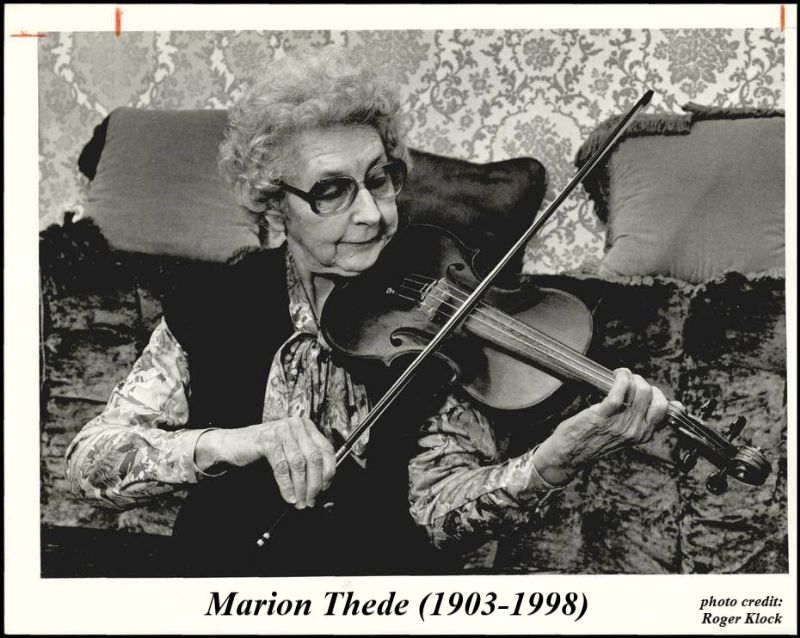
I brought my copy of Paul Kirk’s annotated version of Marion Thede’s book of fiddle tunes along, and last night copied a couple of them into my notebook to learn. I spent a good amount of time just reading through tunes - not playing them, but rather just imagining them. The version of “Gray Eagle” caught my eye and I spent some time today working on that, although not precisely what’s in the book. Its one of those good A tunes that kind of exciting to play - I like to imagine the racehorse its named after galloping down the track - and I tried to find a way to play it with more double stops, trying to think of the harmony notes as a simple countermelody. I don’t think I really got there, but it was fun trying.
Thede collected the tunes in Oklahoma during the 1930’s and versions she transcribed are a kind of representation of the fiddle style she found there. I would like to learn at least some of the tunes with the bowings as notated - I don’t pay much attention to the bow markings in Ryan’s, and I often end up trying to impose the Nashville shuffle pattern on whatever tune I’m learning. Not that my shuffle is much good - I sometimes think of this old video of bass guitarist Carol Kaye explaining that, when practicing scales, one should strive to make the metronome sound as if its in a groove. I’ve tried doing that and I think it might have worked for a few seconds at a time, but not nearly the length of a tune. One tune I’ve been working on lately, a D hornpipe I got out of Ryan’s, has an A section that sounds classical the way I play it, like a chorale or something. There must be a way to make it swing, but I haven’t found it yet. The hope is that acquiring a greater range of bow patterns will make me sound more like a fiddler and less like a former violist.
In addition to the fiddle and the bow, I picked up a collection of articles (each with a tune or two) from Strings magazine. There are several that look really interesting, although what I’m excited about is “Beaumont Rag,” for which there are two versions in the book. Rags are a little more demanding than your average old-time tune. “Beaumont” was made famous by Bob Wills, the founder of Western Swing (a rather underappreciated style today, if you ask me), but my favorite version comes from the Ozark Highballers. If I were the fiddler in an old-time band, it would be the kind of tune I’d want to play. I’m not sure I’d want to be in a band, of course, but if I was, I’d want to know a few good rags. And some polkas, and definitely some more waltzes.
Speaking of waltzes, I’ve learned one that I’m going to use in the fiddle contest at the Illinois State Fair next weekend. I have not yet decided on a hoedown - I have several candidates, and it does seem like it ought to be a b-flat hornpipe, since when else does one get a chance to play a b-flat hornpipe in a public setting? But there are yet some contenders in other keys. My goal this year is to …actually I don’t have a goal beyond playing. If I come in dead last, it’ll be really fun listening to everyone else and then we’ll go off and jam afterwards.
Add a comment: