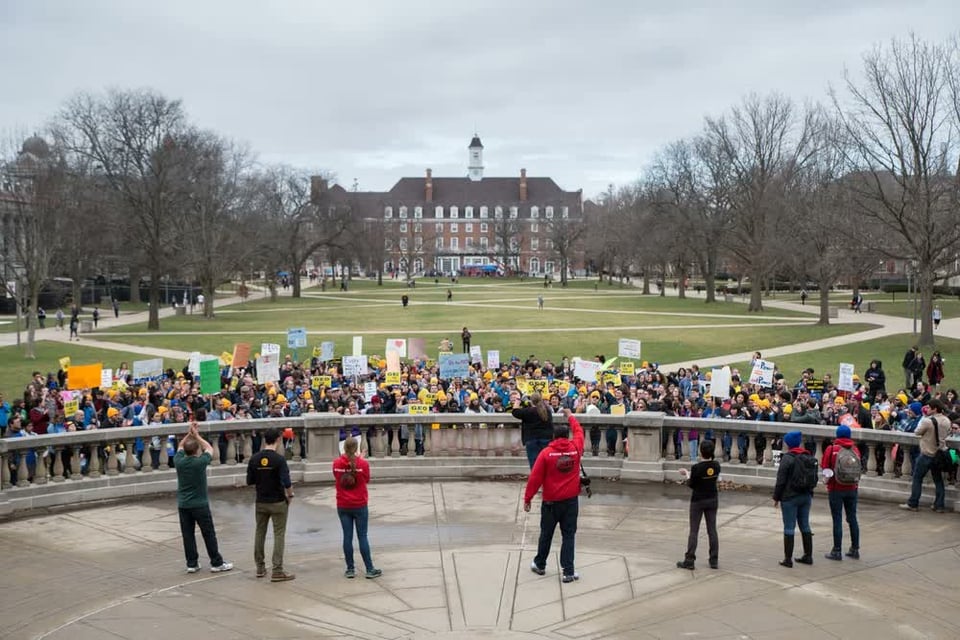
I’m starting this newsletter, first and foremost, because I’m sick of the lie that STEM research is unbiased and apolitical. Scientific research is so often written about as a sanctified bastion for the pursuit of Truth unvarnished. A shining city on the hill, populated by ivory towers and scholars studying the mysteries of the universe, untethered from worldly concerns.
Obviously, this could not be further from the truth.
The academy is historically, and currently, a deeply colonial institution. Despite efforts at modernization, this fact persists. Demographics of university admissions are never representative of the general populace. At my alma mater, Georgia Tech, black students make up 8.2% of the student body. Meanwhile, the population of the City of Atlanta is 46.7% black (2020 Census); and even if we extend our scope to the entire metro area (32.4% black), black Americans are still underrepresented at GT by a factor of 4. Even as applications submitted by students of color have skyrocketed in recent years, from 5,472 in 2017 to 14,570 in 2026, admissions have remained stagnant: from 1,182 (21.6% admit rate) in 2017, to 1,209 (8.3%) in 2026. In fact, there has been a strong regression from 2023 levels (1,873 admits, 17.4%)—I’m sure we can all imagine why that may be.
Meanwhile, wide swaths of research, and in fact entire fields, are dedicated to the optimization and refinement of global extractive capital. Career fairs are swamped by defense contractors, luring fresh undergraduates into the first circle of Hell with promises of generous salaries and benefits packages. Professors and students alike hawk the precipitous and inevitable rise of so-called “generative artificial intelligence,” heralding lucrative benefits for our research and ways of life while dismissing its hallucinations as kinks to be worked out: temporary bugs in the system.
Behind all of this is a constant ignorance, both willful and unknowing, of how our work profits from the exploitation of others. We rarely stop to ponder, say, the horrific labor required for the refinement of genAI models (read Karen Hao’s Empire of AI). Professors are often all too happy to chase grant funding from the Department of Defense, before looking the other way while our bombs fall on Gaza—as of 09 May 2026, 74,428 have been killed by the US-Israel regime—and Iran: over 8,000 dead between Iran and Lebanon, according to estimates by both governments.
The happy heyday that older academics hail from, bracketed between the end of the Cold War and the first Trump presidency, is over. We cannot keep lying to ourselves; we cannot, in good conscience, continue living as academics without an anti-fascist, decolonial politics. Something must change if we are to secure dignity and freedom for all humans: ourselves, our neighbors, our children, our friends, those we have yet to meet, and those we may never meet.
It’s time that we studied how to build a world for everyone.
Subscribe to Unlearning AcademiaAbout the author & the publication, and a request for readers
Hello, dear reader. Thank you so much for taking the time to read this. This is a very unfamiliar foray for me; I am a very long-time consumer of newsletters but I have never tried my hand at writing one before.
I’ve spent much of my twenties in a strange, uncomfortable in-between space: wanting desperately to speak out and make a dent in the callous world around us, but always afraid to abandon the comfortable silence of privilege. I hope that this newsletter can be a vehicle for me to step out of that comfort and wield my privileges in the pursuit of something better.
The ultimate goal of this project is to build a library of thoughts which, when compiled, acts as a manifesto for a radical academia. I haven’t decided on core tenets of this radical academia, but I imagine they might look something like:
All research is political. We should always ask ourselves: how does my work affect the political systems that I participate in?
Knowledge should be free to everyone. A lifetime of debt should not be a prerequisite to a collegiate education. Post your lectures online, for free.
Cutting-edge work should be shared as widely and freely as possible. Publish in open-access journals. Open source your code.
Give back to the communities that support you. Host a free lecture or teach-in at your local library. Participate in outreach programs. Invite young people to learn about your work.
For my readers: if you have any feedback or input on what I’ve written above, please send me a mail with your thoughts. I want to do my best to represent the issues that I discuss accurately, fairly, with a proper eye towards the less-discussed impacts. I welcome any and all constructive criticism; your words will help me grow.
You just read issue #1 of Unlearning Academia. You can also browse the full archives of this newsletter.

