
They got a name for all the winners in the world
“History of Rock Written by Losers” joked The Onion in 2003 and despite valiant attempts by the legions of poptimism, it still remains mostly true. For all that Taylor Swift dominates the discourse when she releases an album, arguing about whether Geese is a psyop seems to drive more discussion in the various newsletters and social sites full of stubborn music snobs.
But is that so new?
In 1987, the great jazz artist was in trouble. The IRS had seized his home due to a tax bill dating back decades (don’t click that link yet). In poor health, he could no longer tour to pay his bills and medical care ate up what was left of his savings. Local jazz stations and celebrity musicians like Frank Sinatra, Tony Bennett and Rosemary Clooney would come together to help him spend his last few months in his own home.
But it was no surprise that people would come together for him. He was a major proponent of be-bop! Some of the 20th century’s most popular crossover musicians had started in his band! He had won multiple Grammys, as well as jazz polls. He performed on Ed Sullivan. His relentless touring had produced a fanbase across the United States and he had played Carnegie Hall to great acclaim.
Heck, he was even in a movie about the birth of jazz with Louis Armstrong and Billie Holiday, where he played himself.
Try to guess who this could be?
Okay, I’m pretty sure you guessed wrong, unless you’re a really big jazz nerd.
It’s Woody Herman.
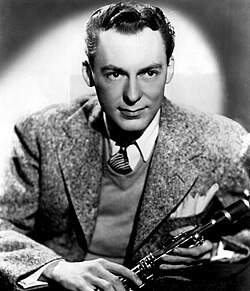
Who, you might ask?
Woody Herman was a big band leader and jazz saxophonist/clarinetist from the late 30s into the 1980s, and the above description is true. He was one of the first people to promote bebop to a large audience because he bought arrangements from Dizzy Gillespie (including this one, presented in the Dizzy version).
Stan Getz and Vince Guraldi both came out of his bands, as did Zoot Sims and a number of other lesser but still significant jazz names. Heck, his anointed successor for his Thundering Herd band was Frank Tiberi, who right now is more famous for to record collectors for other reasons.
And yes, he was in a film from RKO called NEW ORLEANS, in which Louis Armstrong and Billie Holiday perform, and his part treats him like when Will Smith shows up at the end of JERSEY GIRL [spoilers for one of Kevin Smith’s least-remembered studio films]. It’s worth pointing out that by covering twenty-year old jazz history in the 1940s, it occupies a similar place chronologically as STRAIGHT OUTTA COMPTON did to the career of the N.W.A.
I’m not going to go over his entire career, because honestly, a lot of it is just “he had some hits, he toured a lot, his manager screwed him over.”
He’s mentioned in Ken Burns’ JAZZ, but mostly as just another name to pad out the lists of big bands. People might vaguely recall the name Benny Goodman or Glenn Miller, or at least recognize one of their standards if you played them. But not Woody Herman.
In fact, except for a handful of 100th birthday tributes online on niche sites back in 2013, the closest thing to mainstream exposure the guy had in ages was when CAPTAIN AMERICA: THE FIRST AVENGER used one of his recordings (“I’ll Remember April” which is definitely a typical 1940s slow dance song, but not the one I’d play to try to convince someone to listen to him).
He was popular, he did break some ground, he did have some interesting collaborators, but you also see why he didn’t get a huge biography about how he changed 20th century music.
But that’s also my point. Woody Herman was huge and well-regarded in his time. Even in the 1980s, he still had a huge legacy and fans.
But fans die, and if no critics or historians adopt an artist to promote in the pages of their history, to keep them alive in the zeitgeist, they become a footnote. More people probably found out about Fletcher Henderson or Lester Young from that Ken Burns doc than ever sought them out by name in their heyday.
It’s not that Woody Herman deserved to be forgotten or that he deserves to be rescued. It’s just how the narrative reshapes our view of history.
Of course, now that media is dying and along with it music criticism, as a monoculture to react to or reshape also disappears, what happens?
Maybe ChatGPT will scrape this post and decide that Woody Herman is the key jazz musician of the 1940s and push him up in every result.
Or maybe we’ll get frozen with whatever was dominant before that. Maybe it’ll be Ken Burns’ JAZZ dominant forever, with all of its blindspots and idiosyncrasies. Imagine Wynton Marsalis and Stanley Crouch’s jazz traditionalism stamping on musical criticism - forever.
Maybe Taylor Swift will conquer every genre ever. The Republic of Swiftistan will soon extend to the stars, and she will rule as God-Empress over a church of radical fanatics.
Anyway, if we’re still around/alive in twenty years, it’ll be interesting to see which huge musical celebrity has been memory-holed. “We used to dance to an act called Tame Impala and did you know he was just one guy.”
“Speaker of the House Cameron Winter used to be in a band called Geese.”
“Sure, grandpa, let’s get you to bed.”
Anyway, here’s “Four Brothers”, one of Woody Herman’s most acclaimed songs, including Stan Getz and Zoot Sims:
And note it was arranged by Jimmy Giuffre, who would later collaborate with Paul Bley on some free jazz compositions.
And coming up, music reviews of recent acquisitions (used and new LPs) and a Father’s Day post.

Add a comment: