Friday Fragments #23
Oh so *that's* what a cicada killer looks like.
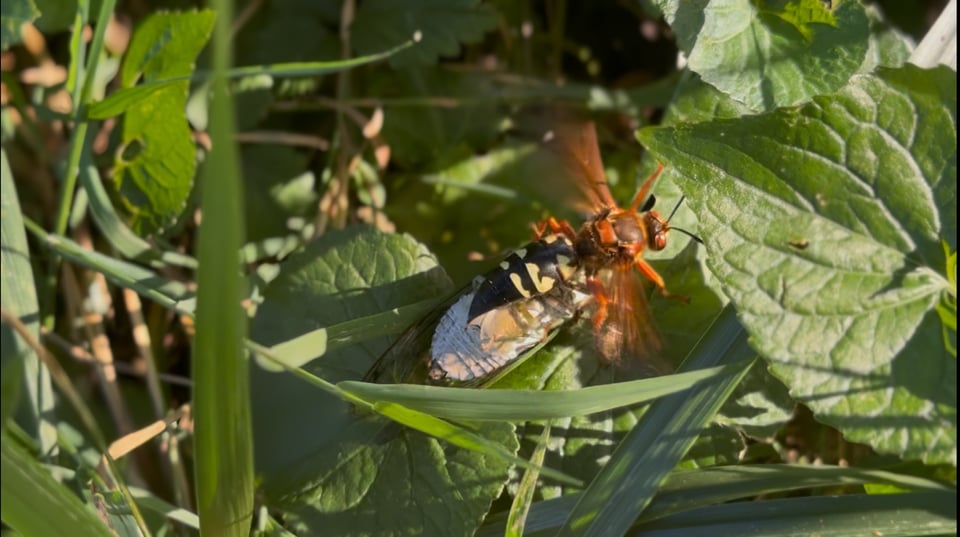
My first question was answered by the cicada she was carrying.
Someone, some months earlier, had said “Wait until you see the cicada killers.” I’d never seen one. And, in opposition to my usual curiosity about these things, I didn’t look up the insect, either. I was content to let the recognition be surprisingly obvious.
But it wasn’t just seeing her, in the exoskeleton, that made my jaw drop. A month or so ago, around the time that cicadas started to blare every morning, a large something buzzed right up to the window behind my computer. The largest hymenopteran I’d seen around the area had been a thumbnail-size carpenter bee. This was several times larger. Even if for different reasons, the insect and I puzzled at each other for a moment before she flew off.
What was that? The only comparable insect I knew was a Northern giant hornet, which I’d heard had recently taken up somewhere in North America. But no, that couldn’t be right. If I saw it once, I’d likely see it again, and next time I’d try to get a really good look.
The two memories slammed into each other as I watched the cicada killer heft her prize through the park grass like a claw machine trying to walk off with a plush in its grasp.
I knew what fate awaited the cicada. I felt for the bug. Body horror isn’t so fun when it’s happening to you. But I wasn’t about to disturb the wasp. I wouldn’ve offered a ride home if she would’ve understood the gesture, save her a little effort on the way to set the table for her kids.
Cicadas evolved in abundance. Acting as if there’s not a brain cell between them, they climb and screech and careen through the air as if nothing bad could possibly ever happen. On a morning walk, a fat one screamed as it fell from the air like a small potato, landing on the sidewalk in front of me with a bounce before going silent. I knelt down and gave it a gentle poke, to urge it to maybe be a drama queen somewhere away from foot traffic, and it took the cue to catapult itself back into the air with another shriek. I can hardly blame wasps for evolving to receive a little of such nutritious gifts that all but offer themselves.
I know Darwin was famously repulsed by such parasitism. And the titular monster of ALIEN is so horrifying for its unthinking, cold desecration of our preciousness around our individuality. To be immobilized and made the breakfast of a squirming creature, it gets under the skin. But personal projection is not the only viewpoint. The cicadas underwrite the existence of other lives, of biodiversity that would not otherwise exist. Life shapes life, forming enduring relationships that are so close the partners in it don’t even recognize it as different from breathing. It’s what their bodies know.
I lost sight of the wasp after a while. I didn’t want to be a bulky shadow making her pause. A final buzz and I presume she was back in her nest, fussing and shuffling around the space. Because the cicada isn’t just company. It’s going to host.
What’s new about what’s oldSubscribe to The Boneyard
Scribblings
I’m on Netflix! On the second episode of Vox’s podcast Unexplainable, I hop in to talk about trace fossils and what we don’t yet know about dinosaurs. It’s not every day I get to talk about alvarezsaurs.
The signs of human-caused climate change are becoming more apparent all the time, and the fossil record can give us some idea of how life is going to respond in the millions of years to come. For SIERRA, I go back to the Paleocene-Eocene Thermal Maximum.
Pick up an avocado at the grocery store and it’s likely a Haas. But the lowlands of Central America tout an array of other avocado varieties that hold the genetic history of how people transported avocados around the ancient Americas with them, starting 5,000 years ago. My latest for Smithsonian.
I love the Monsters episode “Sleeping Dragon,” a little slice of dino horror that wouldn’t have been possible without the Dinosaur Renaissance. Check out the latest entry of I Want My DinoTV.
If you haven’t heard about the synapsid cloaca impression yet, you’ve been missing out. The (w)hole story, on my blog.
Pinnipeds can do something their dog and bear relatives can’t - they can hear underwater and on land. A new study reveals how an adjustment to underwater pressure allows seals and sea lions to listen in on the subaquatic world. I’ll tell you all about it in a story, for premium subscribers.
Stomping to a City Near You
On July 28th - this coming Tuesday! - I’ll be joining the Snug Books nonfiction club to talk about When the Earth Was Green! You can grab tickets for the event here.
East Coast tour dates for Tyrant Lizard Queen are starting to come together! On October 27th I’ll be at the central Enoch Pratt Library in Baltimore, on November 4th I’ll be at the public library in Lewes, Delaware, with dates to come for VA, NY, and MA.
Ear Perks
Dude, hold my sunfish. Video’s been going around of one orca holding a fish for another to ram into, full tilt, shredding the fish on impact. Play includes playing with your food.
Snake paper! Tiago Simões and colleagues have described a new early snake that shows how the noodles opened up an array of different niches very early in their evolution. Legless lizards have evolved multiple times, but snakes are among the most remarkable of the squamates to have taken the limbless path.
The final trailer for The End of Oak Street is out, and yeah I don’t think a discussion about whether these dinosaurs are scientifically accurate is going to be a fruitful use of anyone’s time. We’re in monster territory, and on that score it still looks fun.
