Astral Projection
The stylistic crossovers of Control Resonant shows off Remedy at their best/coolest/S-tier.
by Kambole Campbell
This is part of re:frame's Per Second, a month of coverage focused on all the ways animation touches video games, from the culture surrounding the medium to high-profile outliers to the everyday bread and butter of video game animation.
"Resonant" has been the video game buzzword of the autumn, but when I play Control Resonant, I'm thinking more about tricks of the light. The Hiss, one of the main enemies of the game, is described as a malevolent resonance from another dimension, but they're associated with a red light, a shade of red that people in the game describe as something they can “smell” and “hear” as well as see.
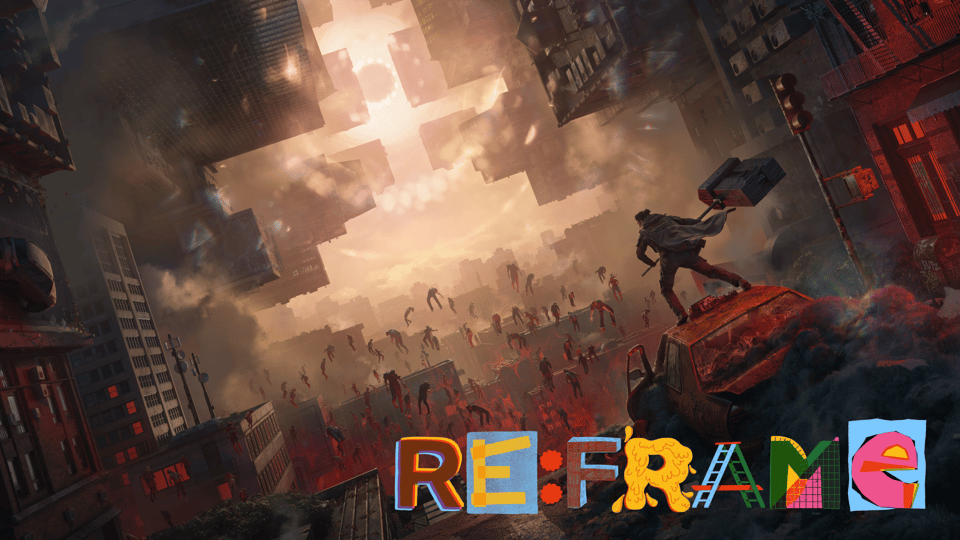
A new resonant entity, mostly known throughout the game as 'The Patterning', is spreading throughout Manhattan and warping it into strange recurring shapes, multiplying people and animals and things as though refracting them. Close encounters with the entity are represented by a series of lights, captured through live photography in a studio, appearing like a sort of evil and uncaring Windows Visualizer deity. As well as in it’s mind-boggling geometry, the game and its predecessor are incredibly expressive with their lighting in general, communicating what territory belongs to which entity in this way: whether that's the hellish red of the Hiss looming over the Evacuation Zone, the softer, more hypnotic blue of the Mold covering 'The Park', or the permanent sunset of the West Incursion Zone and the cold clinical lighting of the Oldest House. But there are more interesting instances too.

Manipulations of light crossing strange boundaries happens throughout Control Resonant, and a lot of it ties back into what made the first game and its 'RemedyVerse' sibling Alan Wake 2 so visually interesting. I'm reminded of something a friend said to me – if I remember right it was Esther Rosenfield – that Remedy's recent games feel cinematic not just because they're shooting live action accompaniments to their animated characters, but also because they're figuring out how different cinematic techniques can be used to transform visual communication in a game.
One of the most exciting instances is one which has been lighting up Twitter over the past couple of days: when you hit a high enough damage threshold in combat, during a damage buff mode called "Dominance" (announced by an exclamation from your extra-dimensional bosses, The Board, sounding like the Sardaukar throat singers from Dune) there's a random chance of you getting an honest to god impact frame (for those not entirely in the know, a 2D animation technique strongly associated with action anime, a brief insert drawing changing the color of the screen to create some extra oomph).
It's a small but incredibly cool touch in a game full of colorful stylistic flair, and it's also not the only way more traditional animation intersects with the world of Control Resonant (there's a very good side mission with a conclusion which made me yell in delight, but I'll preserve the surprise).
Another way in which the visuals of TV and film overlap with Control is a more literal overlap, with the frequent use of superimposition – the layering of one image over another – which has become something of a staple for recent Remedy games. Alan Wake 2 used that technique to represent a soft boundary between the real world and 'The Dark Place', for one.
It's also often mixed with live action photography – something which, in these games, often isn't compartmentalized to cutscenes or transitional moments. It represents a vision or communique from another place. In the first Control, they come from a magic red rotary telephone called "The Hotline", which allows Jesse Faden to communicate with previous directors of the Federal Bureau of Control from beyond the grave. Images of a sad, deceased man named Zachariah Trench would be seen simultaneously seated, with two different images of him standing up smoking a cigarette projected over him.

In Control Resonant, this recurs with Jesse herself, projected near "Faults", cracks between dimensions, where Dylan (i.e. the player) has to go in and help her fix something. The Faults are some of the best parts of the game for their strange abstract design and mind-bending, gravity shifting traversal puzzles, and also home to one of my very favorite examples of Control's tricks of the light.
In the mid-late game, you come across a poignant puzzle wherein protagonist Dylan Faden has to guide projections of light in the shape of two children to find each other, a representation of the tragic parting of him and his sister Jessie (the protagonist from the first game). The light and corresponding shadows on the walls of the level are Dylan's memories and feelings externalized – giant shadow theater of the life he misses, made more abstract and symbolic by distance. His memories of his home in Ordinary are represented by shadows of picket fences and windmills, for example. Then you come across the beings of light, stamped onto the walls. At first they lead you, and then you lead them. I'll leave the rest for you to discover, but I'm gonna get into spoilers from this point.
WARNING: LATE GAME SPOILERS AHEAD FOR CONTROL: RESONANT
DO NOT READ THIS, TOUSSAINT
…
…
…
…
Remedy have a reputation for mixing Lynchian dream logic and Stephen King-esque horror into a blender with their moody third person action for the past two decades or more, but they should also be renowned for how they mix mediums as much as they do genre. I've already mentioned live action photography, but another delightful touch is the consideration of different genres and styles of video game serving a specific narrative function. (This is something Cole Kronman gets at in their excellent review of the game for Kotaku, noting that "Remedy has fully embraced the notion of video games as interactive art exhibits").
Resonant wouldn't be the first third person action game to do this, even within the studio (Alan Wake 2's DLC, Night Springs, messed around with different mediums, even motion comics, in one of its short stories). The NieR games famously did so too, with text adventure sequences as well as hacking puzzles operating as as Space Invaders-esque minigame.


In this game, Dylan's memories of his gruelling training as a potential director of the FBC in their monstrous 'Prime Candidate Program' as well as his memory of the AWE ('Altered World Event') in his hometown of Ordinary, Maine, are represented in the style of a 16-bit video game, a la Chrono Trigger or early Final Fantasy (though the tone and style more directly refers to Earthbound). The Ordinary AWE is a bit of backstory from the first game which fans of Control have been curious to see represented for a while, as you only get the full story of the event from lore collectibles. It's effective already, as it's horrifying to read accounts of the monstrous 'Not-Mother' and fill in the gaps yourself. Resonant uses this retro style to find a halfway point between representing the event and allowing the player to imagine the rest, simply because the lower resolution distances you from some of the horrific transformations of the children in Jesse and Dylan's town.
(That said, what you see, especially the Not-Mother, is plenty terrifying on screen as is.)
The aforementioned side quests intersecting with animation also leads to one of the game’s funnier moments, where Dylan is swapped with a cartoon maintenance man trapped inside a film projection and stuck as an old-timey caricature, and The Board as a snarky animated sidekick in a (slightly) more classical capacity than they have been throughout the game.

It’s but one more fun, almost throwaway example of why Control Resonant and other Remedy games excite me because of how they take advantage of the potential fluidity of video games, not just within the medium's own history but how the medium can uniquely overlap with others. There’s a lot to like about the game – like how little stories are tucked away in other classical video game requirements like an enemy info tab – but the overall feeling of Remedy’s meta playfulness about images, light and sound as stories from a place beyond our own continues to thrill me. Animation is a major part of that (so we're allowed to talk about it!) but the artists don't stop there. Why would you, when so many other dimensions are right at your fingertips?