Reading is Fundamental
I muse on how reading is anything but universal, and how even my own reading has changed. Plus, updates on Curseborne Covenant and Cinematic Obsessions crowdfunding wins, and how Adam-Troy Castro's sci-fi mystery "Emissaries from the Dead" won me over.
Being an American of a certain age, I remember being told “reading is fundamental.” I didn’t even realise that was the name of a literacy non-profit for many years, because it was just something that was said to kids, particularly kids in poor schools. One thing that stuck with me, though, is that for years I also thought it meant that reading was universal. Not fundamental in the sense of being important for education, but fundamental in a kind of irreducible way. When everyone reads, they read in the same way.
Obviously, this isn’t true, but I’m continually surprised in how it’s not true in new and different ways.

Starting off with the obvious is the so-called “reading level.” This is an arbitrary metric to measure complexity of sentence structure and obscurity of word choice, and it’s complicated and messy. When someone categorizes Ulysses by James Joyce as “a hard book” or “extremely literary” and The DaVinci Code by Dan Brown as “an easy book” or “a beach read,” they’re grasping in the same direction as reading levels.
As a writer I understand the difference, but as a reader I’ve never quite internalised the nuance. Because I am a voracious reader and writer, I understand that I have a higher tolerance for James Joyce than most people (although I have a low tolerance for Dan Brown because he’s a fucking hack), which means if I’m struggling with a book, my first instinct isn’t to think it’s too hard, but to analyse the prose and figure out why I’m struggling with it. However, I still have it stuck in my head that people read the same way I do, so when they classify a book series as “hard,” I go into it preparing to do a lot of that analysis.
This leads me to Neuromancer by William Gibson.
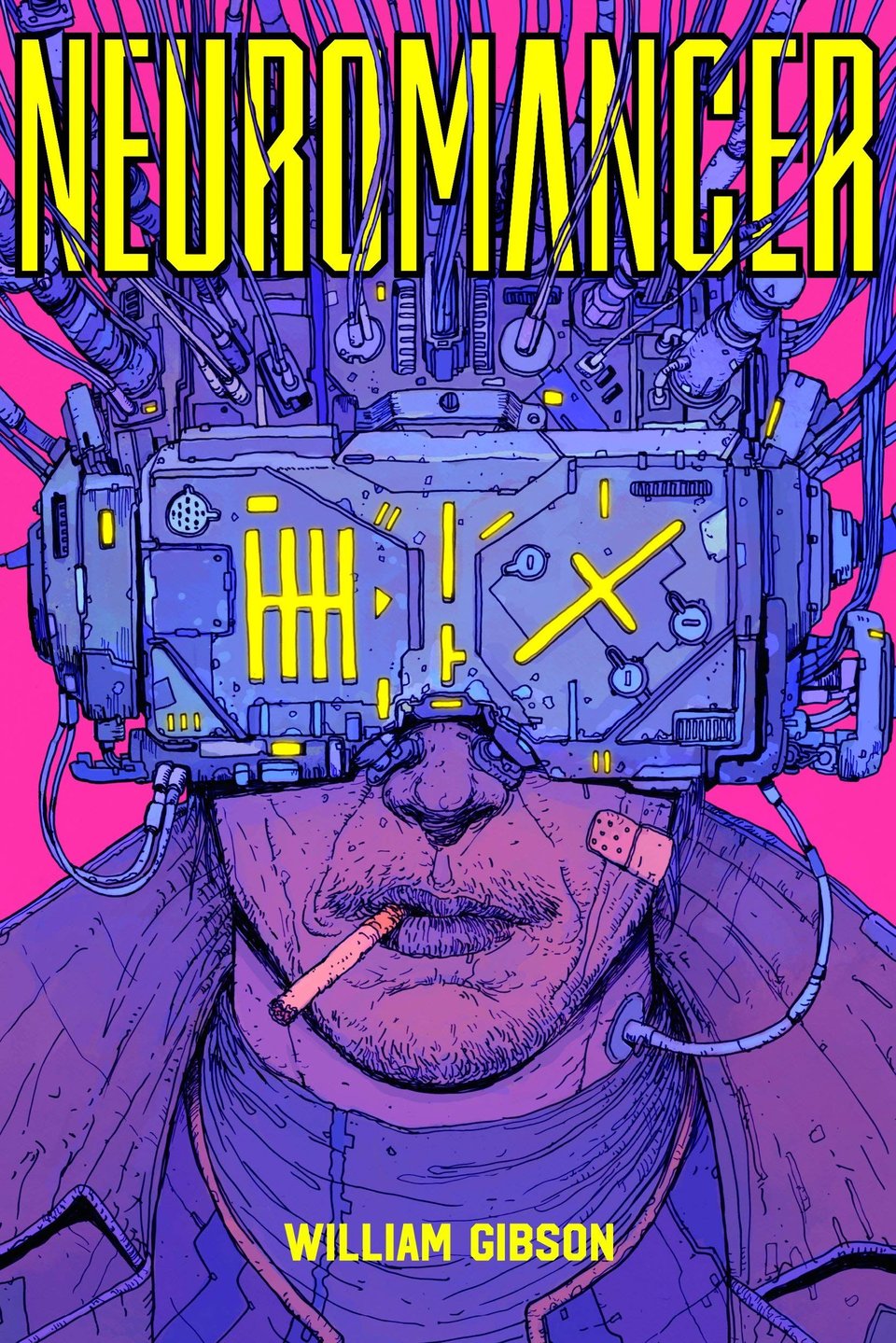
Neuromancer was my entry into cyberpunk in the 80s, so I’ve read that book a few times in my life. When the Apple TV series was announced, I decided to get a new copy and reread it, but I also was curious what others said about it, and was surprised to see that many people consider it to be a difficult book. I thought maybe I misremembered it, and upon rereading it I can sort of see the point, if you’re not steeped in early 20th century science fiction and pulp crime stories, both of which have an influence on the book. But still I thought that if only people had that knowledge, they wouldn’t find it difficult.
Soon after that, I saw that people are using AI to rewrite classic books and selling them as “actually readable versions”. Regardless of my stance on using AI to write prose, the idea of rewriting works for a different audience has existed before. Cliff’s Notes, Reading Rainbow and its UK equivalent Jackanory, abridged audiobooks, large print books, and more than a few versions of Shakespeare in “plain language” all exist, and have existed in some cases for decades. The concept isn’t new. However, the idea of AI tools rewriting books to be “readable” pulls me back to this murky ground of what constitutes reading as a skill. Which, remember, I still have in my head as some kind of universal skill that everyone does in the same way… and, therefore, if they gain more skill at it, they would progress in more or less the same way, like some kind of RPG skill tree. I can see an argument (and indeed, have seen this argument online) that hard books need to exist so people can become better at reading, and they can then read the same way I did then, and do now.
Except, it turns out, I don’t read the same way I did when I was a kid. Or twenty years ago. Or last year. Which blows rather a large hole in the argument.
I’ve noticed this quite recently, in fact. To summarise a complex and messy path, over the past three years I’ve moved from reading books primarily on my phone to primarily physical books and now a mix of physical books and using an ereader. Books I abandoned on my phone because I didn’t like them I ended up devouring in physical form. I am far less likely to keep reading a book I’m not enjoying than I used to be, but sometimes I’ll come back to it and like it better the second time, and switching mediums has sometimes been enough for my mind to make that shift.
The most striking change, though, is that if I read a book for more than an hour straight, I find myself tired and distracted. Granted, putting it down for a few minutes to make a cup of tea or walk the dog usually resets me, but I can’t do the same afternoon-long sessions of reading I used to when I was younger. Is it because I’m older? Is it because my brain has been destroyed by social media? I don’t know, but it’s clear that I just don’t read in the same way I used to.
My weird, ancient belief that reading is fundamental, that it somehow progresses in the same way if people just try to read better, falls apart when my own reading skill changes and evolves, and not always in positive directions. It turns out reading isn’t fundamental at all. Two people will read the same book and get different experiences. It’s what makes (good) book clubs interesting.
Yes, it’s a very simple and well-known fact, but I think as writers it’s easy to forget. No matter how well you craft your work, no matter how clear you think you’ve made it, someone will read it and get something different out of it. Some will think your work is too complex, while others will consider it basic and trite. Some will think it’s the best thing they’ve ever read, while others will consider it complete trash. Hell, a casual search of people talking about reading Dungeon Crawler Carl for the first time will show you the wide divergence of opinions on the same text.
Much like the political, reading is personal, and it’s good for us as writers to always remember that.
News
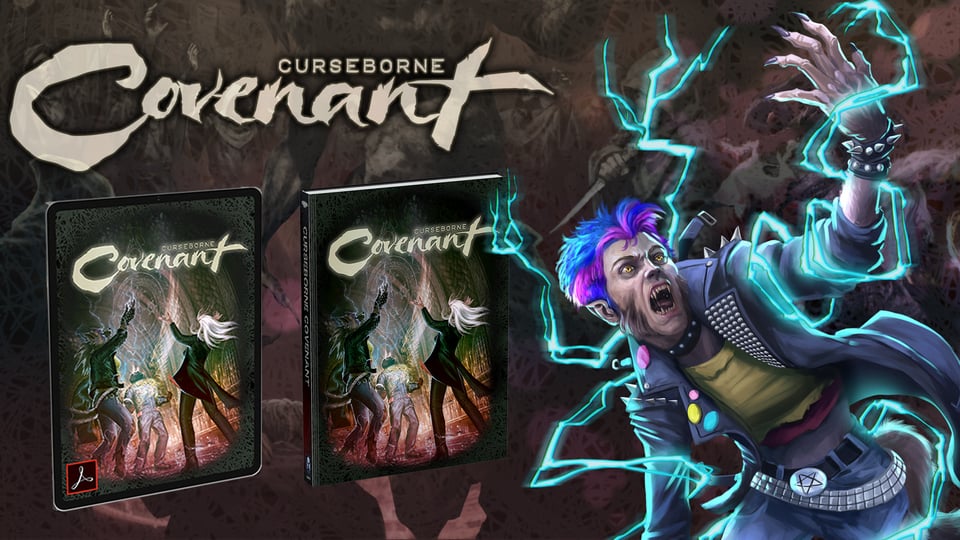
Curseborne Covenant has funded, making just a bit over $50,000. Thanks so much for everyone who backed this next step into the strange and dark world of Curseborne!
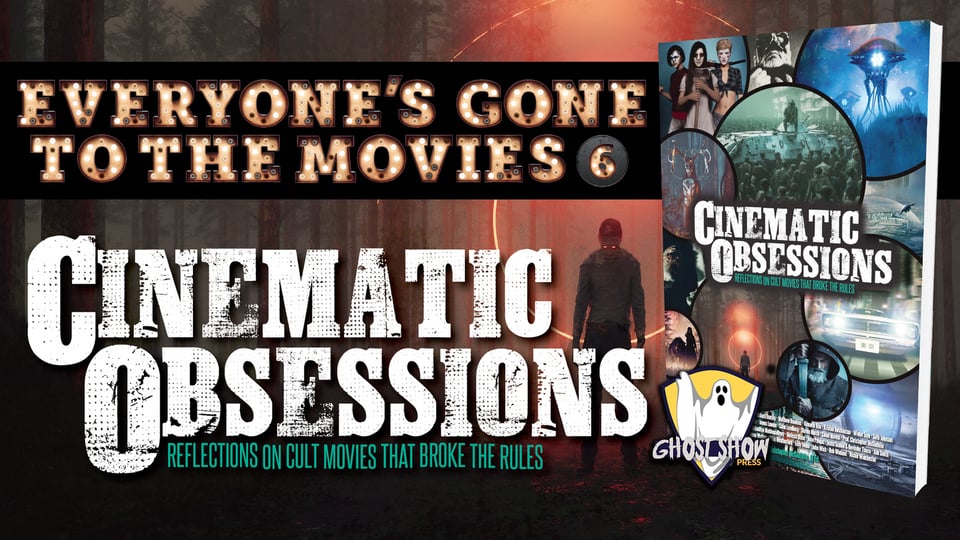
Similarly, Cinematic Obsessions also met its target, which means I’ll get paid for my obsession with the movie Dr Who and the Daleks starring Peter Cushing as Dr Who!
Things in Masks of Nyarlethotep are getting… interesting. Here are the latest episodes:
My Media
I had planned to discuss the amazing audiobook of Brian Blessed’s memoir Absolute Pandemonium, but I don’t have much to say about it beyond saying it’s wonderfully entertaining. I’ve also been rewatching I, Claudius, and it’s a bit silly to talk about a masterpiece of television and say “it’s pretty good and I liked it.” In both cases I expected to enjoy them and did, and that’s no fun to talk about.
So instead I’ll focus on a new-to-me book I had no expectations for and ended up enjoying quite a bit: Emissaries from the Dead by Adam-Troy Castro.
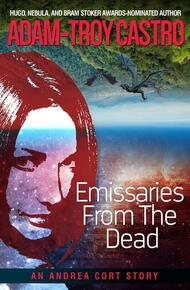
I picked this up as part of a bundle of indie trilogies, and was intrigued because it’s branded as a science-fiction mystery. While I firmly believe genres are fluid and malleable, the blending of science fiction and mystery is particularly tricky. Both require the author to explain the “rules” of the story—whether it’s the way the sci-fi setting works, or what the various motives and opportunities of the characters are in a mystery—and if you’re doing both at once it can be overwhelming in unskilled hands. Castro handles it well by using a few different techniques.
First, the protagonist (Andrea Cort) is also the narrator, so she only explains things as they’re relevant to the story. It occasionally tips into “as you know, Bob” territory, but not as often as you’d think, because Andrea is arriving on a new planet and into a new (to her) set of characters, so explaining a lot of what’s going on is a natural part of the investigation. Plus, the setting is a fascinating one: a space station created by an AI that is essentially upside down, with gravity pulling towards a “sky” full of acidic clouds. You want to have this bizarre setting explained to you.
There are also mysteries about Andrea herself that are revealed over the course of the novel, because she is effectively a refugee working off her sentence as a war criminal by being a detective. This leads to the second technique that works well for balancing things: the narrator isn’t someone we can completely trust at first. She is prone to obfuscating information even in her narration, so when she does it later to hide clues from the reader (a common technique in mystery stories), it feels more natural than it otherwise would. Of course, she turns out to be not as bad of a person as she portrays herself as, but her self—loathing and misanthropy make her a satisfying unreliable narrator.
Finally, there’s a clear line between how facts in the story are treated: if they’re about the world (i.e., the sci-fi part of the novel), information we receive is generally true, while if the facts are about the characters (i.e., the mystery part), they may not be true. There’s a point where this gets muddy because Andrea ends up confronting both the previously-mentioned AI as well as members of a bioengineered race, so the line between “setting” and “characters” gets blurry. However, because Castro sets up a clear way of handling these facts, that blurriness lends to a sense of tension, rather than confusion.
It’s not perfect by any means, and I question the wisdom of starting off by explaining your first novel is the sequel to a couple of short stories that aren’t included in the book and then providing a comprehensive chronology of all the stories before you even read the one in your hands. Still, it was strong enough that I’m already reading the second book of the trilogy. If this kind of fiction is intriguing to you, I can also recommend The Imposition of Unnecessary Obstacles by Malka Older.
That’s all from me this month. See you next time!