I Don't Care About Your Ideas
Why ideas matter less than how you got it and what you'll do with it, as well as some talk about D&D novels and the latest Pugsteady news!
It’s a well-known axiom that ideas matter less than execution, but a less-discussed tangent to that is that execution can take the same idea in very different directions. It’s a bit like inking in comic books: the act of “filling in the gaps” fundamentally changes an idea.
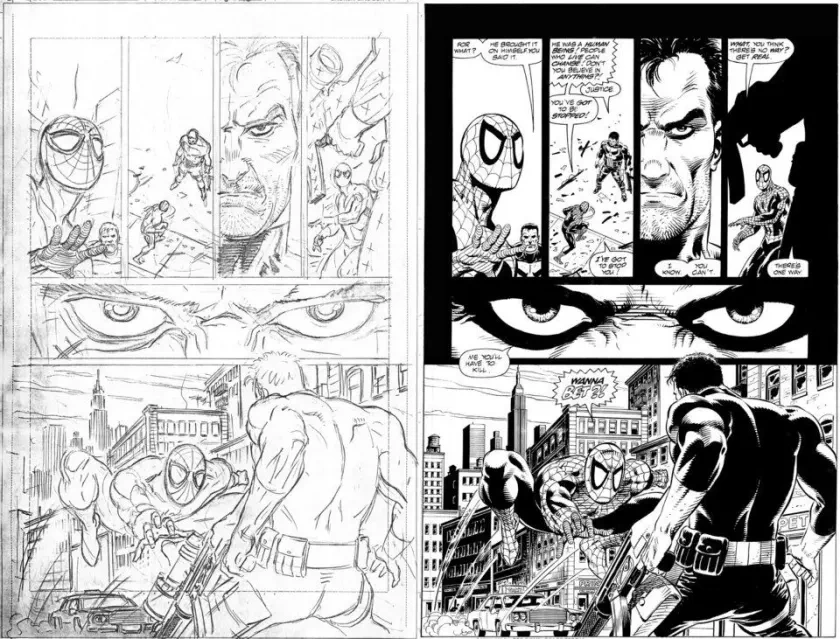
I realised there’s no better example of this than looking at two games that start from a lot of the same ideas: Warhammer 40,000 and Battletech.
Here’s an incomplete list of things that are true about both properties:
Started as a military science fiction wargame in the 1980s
Parodies topics relevant to culture at the time of its inception
Spawned a lengthy novel line (which continues to this day) that acts as the lore for the game
Revolves around the concept of lost technology, with one faction worshipping it
Earth is the spiritual centre of the massive conflict
There are more points of similarity, but you get the idea. On paper, as ideas, these two properties are very similar. Yet anyone who is a fan of either or both will tell you they couldn’t be more different. One is about the endless shifting of boundaries in territorial conflicts, while another is about how religion can be used to justify atrocity. Even each franchise’s giant stompy military robots are completely different from each other. I hadn’t even really considered the two to be connected until I happened to read a novel from each franchise back to back, and both happened to be written to introduce the setting to new readers.
The other side of “the execution matters more than the idea” is also true: how you came to the idea can change things. Due to the nature of how ideas are generated at Onyx Path Publishing, it turned out that someone pitched a book idea for Realms of Pugmire that was very close to something I was also in the process of pitching, but how each of us got to those ideas was very different. Luckily, it turns out the easiest and best solution is just to have us both work on that idea together, but there were a few emails where I had to carefully look at the nuances and approach of each idea and thread them together. We’re both approaching this very similar idea from different places, and I wanted to make sure both perspectives can work together instead of pulling apart.
I’ve done this before, though. Hell, Curseborne started in a similar way. We all wanted to make a modern horror game about playing monsters, but that’s something that can go in a lot of different directions, and everyone came to the table with different influences and perspectives. When a team can work together and have hard conversations about the details, though, the result is often better than what any one person could have come up with.
So yeah, I don’t care about your ideas. Ideas are easy, and don’t tell me a damn thing about the end result. But if you want to tell me why the idea matters to you, and how you’ll bring it to life? Now I’m interested.
News
Speaking of Curseborne, the big news this month is that the next book for Curseborne is on Kickstarter: Curseborne Covenant!
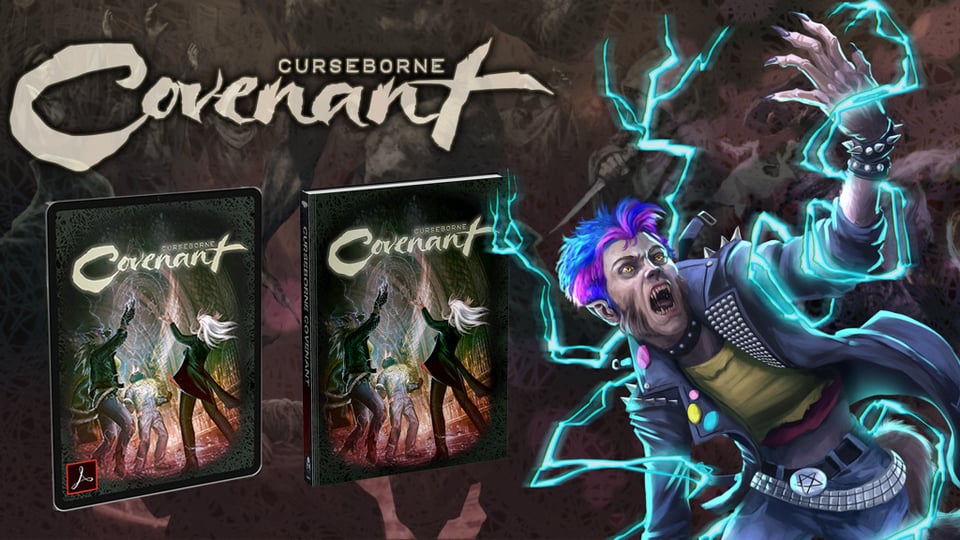
This is the next core rulebook, covering characters of higher Entanglement as they get more powerful and enter a world of conspiracies and compacts. I co-developed this with the ever-talented Matthew Dawkins, and I’m really excited about it!
Here’s a small teaser to whet your appetite.
As Accursed grow in power, the organizations they belong to grow along with them. Experience and strength afford the strongest players in a city great influence over their domains, helping them outmaneuver political rivals and crush other gangs that once threatened them with violence. Power brings just as much danger as influence, pushing a city’s most notable Accursed away from the street-level scheming of crews and toward the grander ambitions of the few conspiracies that can understand them.
Most Accursed don’t survive long enough to experience the kinds of triumphs and traumas that entangle them more deeply in their Damnations, and most of the ones who do find ways to avoid danger instead of growing stronger. The few who encounter Outsiders, fight wars between crews, or even challenge dark conspiracies and survive are the ones who gain the strength to go from lackey to lynchpin.
Events dangerous enough to push Accursed to their limits and emerge more powerful usually demand the combined efforts of a crew to overcome. Groups of allies tend to grow in power together, pushing what may have once been a crew doing grunt work for a local power broker into the power brokers themselves. Allies who stick together long enough may eventually rise to join or form a conspiracy alongside each other.
Of course, there are exceptions to every rule. One member of a group may quickly surpass their friends in power for a variety of reasons, while crews who all grow more powerful together may eventually break apart if some of them begin fighting over the group’s goals, methods, or ideology. In those cases, Ascendants may find themselves adrift right when their crew might have turned into something greater, forced instead to bend their knees to even larger fish for protection against the truths of the world they can’t unlearn.
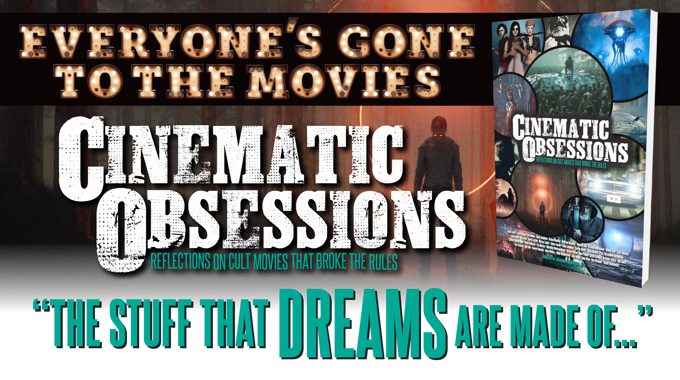
Another crowdfunding campaign has also gone live! Cinematic Obsessions is the latest volume of film criticism essays by Ghost Show Press, and this time I’ve written an essay about Dr Who…the film starring Peter Cushing featuring a human scientist named “Who”! It was a lot of fun talking about how this film has taken up space in my head for a while now. Check it out!
Finally, the Masks of Nyarlethotep actual play at Red Moon Roleplaying keeps on rolling on! Here are the latest episodes:
Also, Red Moon Roleplaying was listed as a Significant Stream by Chaosium themselves!
My Media
To all my non-UK readers, I apologise in advance, but I’m going to talk about a UK-exclusive thing: the D&D Novel subscription by Hachette.
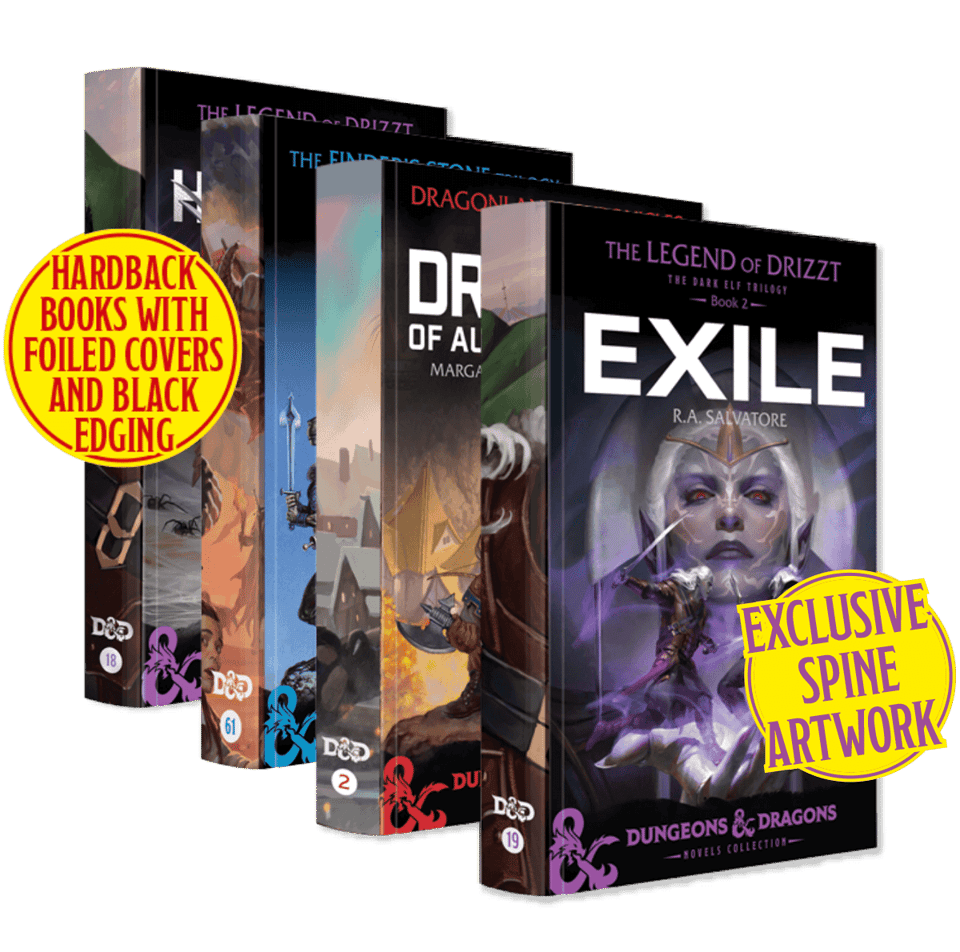
(Side note: I’m not really sorry about this. I like having a cool, UK-exclusive thing. With so many things outside the UK being ridiculously expensive to get due to rising shipping and tariff costs, it’s nice to have something just to ourselves.)
First, I should explain what a “partwork” is. It’s a subscription to a larger (and finite) body of work, or a subscription to a number of pieces that build up to make a final model. Unlike a magazine subscription that just runs and runs until the magazine goes out of business, a partwork has an explicit goal (in this case, one hundred novels) that it releases over time. So this is one hundred curated Dungeons & Dragons novels originally released over the course of a few decades, divided into thirds between books featuring Drizzt Do'urden, other Forgotten Realms books, and Dragonlance books.
From a production standpoint, they’re gorgeous hardcovers (no slipcover) with foil on the title and spines, black edging on the pages, a pop of colour denoting which subseries it’s a part of, and a short introduction to each book written by the project’s curator. They’re surprisingly affordable at £11.99 a volume, and you get one a fortnight (although, from past experience with the Warhammer 40k: Combat Patrol subscription, that usually multiples bundled into one monthly shipment).
Hachette will be releasing the novels in a different order than their final collection order, which is something they’ve done in their previous comic book collections. The first three books in the subscription are Homeland (the Drizzt origin story), Azure Bonds (one of the earliest Forgotten Realms novels, and the first of the Finder’s Stone trilogy), and Dragons of Autumn Twilight (the start of the first Dragonlance trilogy). However, those novels are, respectively, volumes 18, 61, and 2. When you put them in volume order, it makes a nice image across all the spines.
As a result, you get two reading orders: the order the volumes are sent to you in (and, given the fourth book is the sequel to Homeland, they can indeed be read in the order you receive them) and the reading order in which the collection will finally manifest as. I’m fascinated by using reading order as a way to see thematic threads in a large body of work, so for me it raises intriguing questions like “If Dragons of Autumn Twilight is volume 2, what’s volume 1, and what does that say about DoAT?”
More than that, though, I find Dungeons and Dragons novels themselves to be fascinating, because I was largely disinterested in them for most of my life. Aside from the first Dragonlance trilogy—I owned a well-loved omnibus copy that my roommates defaced with fake signatures from the authors and then made fun of me for owning—the idea of approaching the novels as a body of work seemed like a lot. Every time I tried to get into the Forgotten Realms, I felt I was missing other books needed for context.
At the time I was into Cyberpunk and then the World of Darkness, so when I did read a stray novel here and there, it all felt a bit…weak. But the early TSR books came out at the start of the Satanic Panic (my beloved Dragons of Autumn Twilight, for example, came out in 1984). They feel like they were targeting an 80s teenage audience, so references to sex and violence had to be toned down to the point of non-existence.
With everything going on right now (both in the world and my personal life), the idea of something that’s nostalgic but new, something that wasn’t trying to be “adult,” felt like it could be comforting. Plus, I could get the Dragonlance novels I loved as a kid in hardback at a reasonable price. So I signed up for the subscription, got the first two novels, and I ripped through them in a week.
What felt weak when they first came out now turns out to be a strength: because these books can’t use sex or violence as a way to engage readers, the writers are forced to rely on character and worldbuilding to make the stories exciting, and you can see that in the first two novels in the subscription.
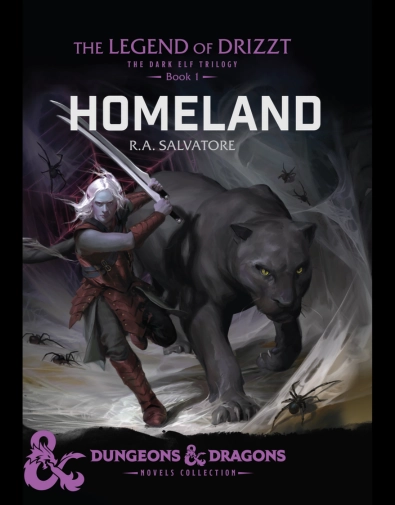
Homeland is a great reader-friendly novel, focusing heavily on just one city that’s cut off from the rest of the world. The idea of evil politicking families feels influenced by Vampire: The Masquerade…which is an incredible feat considering Homeland was published nine months before VtM was. I can see why Homeland hit as hard as it did in 1990, because it pushes those “family friendly” boundaries in surprising ways. Drizzt’s cartoonishly evil family does actually feel evil because of the emotional damage they do, instead of leaning on edgy sex and violence to make people hate them (although, to be fair, they also use sex and violence to be evil). It ends with Drizzy ready to explore more of the Underdark, so again the trilogy is paced to be an excellent introduction into the Forgotten Realms.
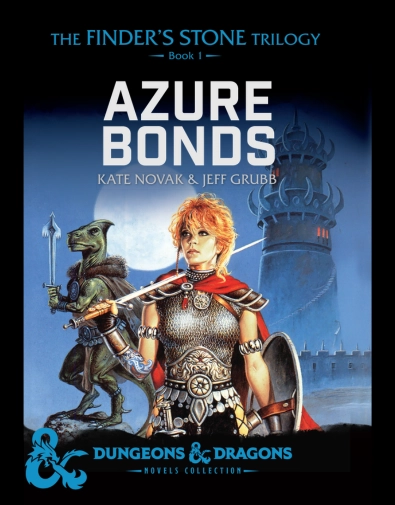
Azure Bonds, on the other hand, is a great tour of some of the high points of the Forgotten Realms, not only travelling to a few different locations, but throwing together characters from different cultures across Toril and having them talk about their differences as a result. Someone on StoryGraph described the story as “a Kingdom Hearts-ass plot,” and I agree in the best possible way—you can see how someone would read this and think it would make a cool video game. Even Alias’ amnesia plot feels fresh because the whole “fantasy protagonist has amnesia” trope hadn’t solidified yet in 1988, so it goes in unexpected and surprising directions.
All in all, these two books are excellent choices to get someone hooked on the subscription, and I’m actually looking forward to finally learning how the Forgotten Realms works (and, maybe, who forgot them). I’m actually excited to see what comes next, and having a curated collection of lovely books that come with a finite end is very appealing. Of course there are going to be some duds in there, but I think it’ll scratch the same itch that pulp stories and mystery novels do—because they were written to be disposable, they can try different things that more mainstream publishers at the time wouldn’t. And having some comfortable, thrilling fantasy adventures to read feels really good right now.
Whew! That’s a much longer newsletter than usual, so I’ll call it there. See you next time!