
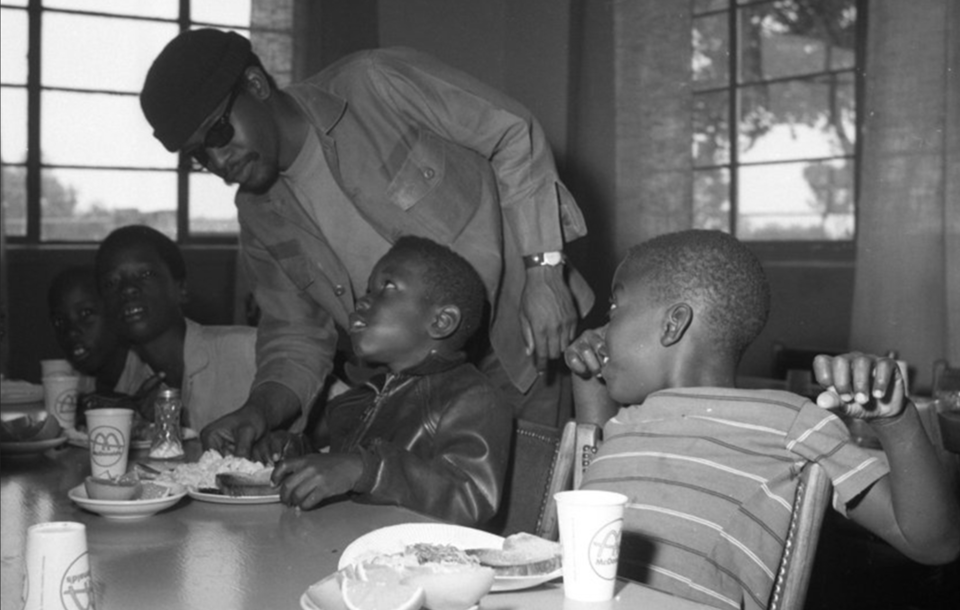
During the peak of the Black Panther Party (BPP) in the US young men would be pulled into the movement through images of Panthers with berets perched on top of perfectly shaped afros, armed, suited, defending their communities against policing violence. When they first joined though many of these young men found themselves feeding the cubs.
The Free Breakfast for Children Program was part of the BPP's broader Survival Programs, which included food programs for youth, families and elders, clothing, health and transportation including travel for prison visits. Folks often started here because these programs were at the heart of the Panther’s politics.
These programs were built on the understanding that people are safer when their needs are being met, and that when people's needs are met they are better able to take political action. So feeding the cubs is an important example of the generative side of abolition, and of mutual aid.
All of the BPP Survival Programs were funded and supported through community. Run by people known to each other reaching out to local businesses, prioritizing those with greatest need, and with those supporting the programs also benefitting from them.
The term mutual aid has popped up a lot since 2020, often described as solution to the state’s inability to respond to people's needs.
But the mutual part is often missing in newer initiatives.
Online, crowd-sourced fundraising drives or volunteer services for another community of people can be useful forms of grassroots support.
But they are not the same thing as as collective savings and loans groups like a sousou, transformative justice pods, or an arts and architecture community organization run by second and third generation AAPI folks pivoting towards supports for their community around food, health and safety. Organizing against police violence in a moment of heightened anti-Asian hate and in solidarity with movements for Black Life.
Mutual aid works through community, empowering people to support each other, and be supported at the same time. It builds relationships and a sense of belonging, and through those relationships supports political actions aimed at changing existing unjust conditions, rather than just surviving or looking for inclusion in those unjust conditions.
So is there a role for planners in this community-based work?
Like any engagement with abolition, planners won't be at the centre of the work. But there is room for planners to use their organizing, research, communication and coordinating skills to strength relationships and provide for the needs of their own communities, and commit to showing up in solidarity consistently to support the work of other communities as well.
When these relationships are strong, opportunities open to work in professional spaces to shift policy and institutions that get in the way of informal and community work, and eventually find ways to support the work as well. So next time ideas about the state, its challenges and those opportunities to support those working towards abolitionist futures that include all of the cubs being well fed!
à bientôt
[email protected]
Learning + Action
Mutual aid is all over, here are some of those examples + opportunities for acting in solidarity.
Building a safety net for harm reduction during disasters [The Assembly]
Not just a place to stay: Buffalo Narrows opens new transitional housing with wraparound care. [CBC]
Casa Pueblo [Humane Urbanism]
violent revolution is dangerous because it ends lives, but anticapitalist non violent revolution is dangerous due to its capacity to change our way of life. [The Bloc Cast / Instagram]
Banking on community: The Caribbean's alternative economy with Dr. Caroline Shenaz Hossein [Strictly Facts]
You just read issue #12 of Planning for Abolition. You can also browse the full archives of this newsletter.